Something has gone wrong. You can feel it before you can name it.
You show up to vote. The promises are large. The direction doesn’t change. The economy grows on paper while your own situation stays where it was or drifts backward. Everything is presented as a battle between two sides — and the battle never seems to resolve anything except which team controls the room where nothing changes. The fruit that used to ripen on the vine, sweet and seasonal and grown nearby, now comes from somewhere far away in every season and doesn’t taste the way it did. The water that used to run clean now burns in some places coming out of the tap. Wells that worked for decades have gone dry and had to be dug hundreds of feet deeper. We call this progress. The question the frame doesn’t ask is: progress for whom?
That feeling — the gap between what you were told the system does and what you have watched it actually do — is accurate perception. It is not cynicism. It is not apathy. It is pattern recognition. The gap has a history. The history has rooms. The rooms have records.
There was a time when this was not as it has become.
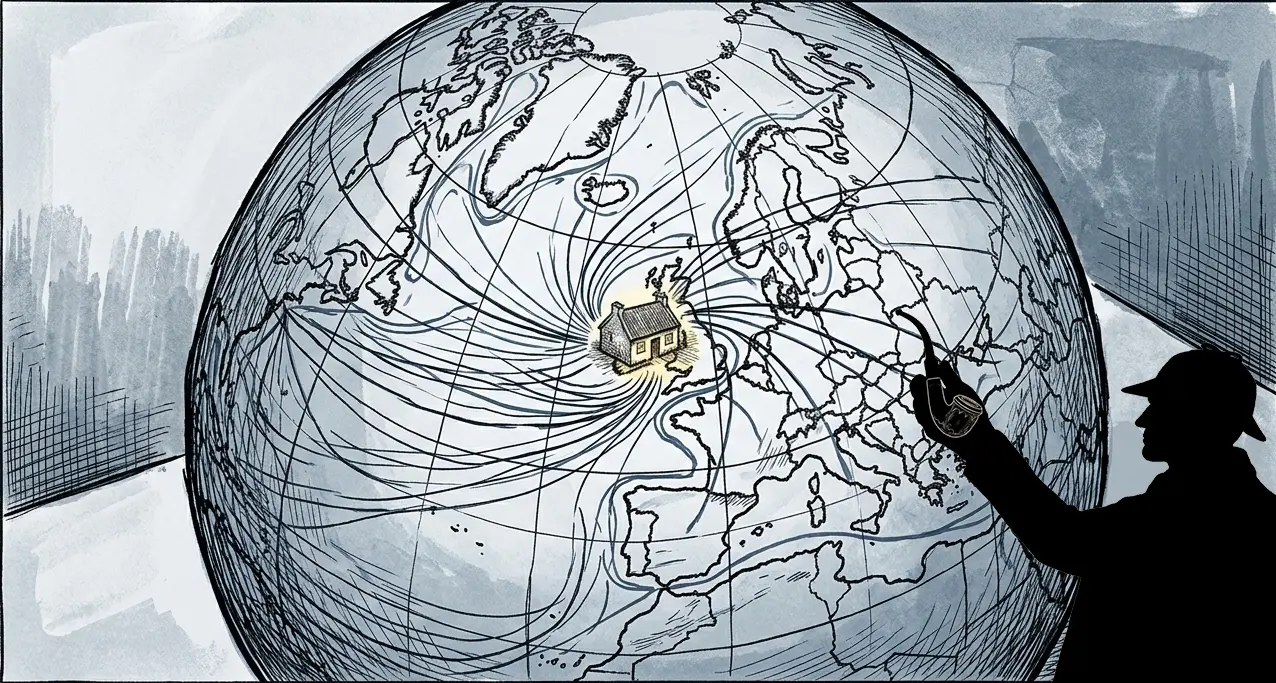
Katharine Lee Bates climbed Pikes Peak in the summer of 1893 and wrote down what she saw. Amber waves of grain. Purple mountain majesties. The fruited plain. She was not writing a fantasy. The abundance was real — the topsoil deep, the rivers clean, the fisheries so thick that Lewis and Clark had described the salmon runs as uncountable. The bison had numbered sixty million on the plains. A continent so large and so full that the genuine operating assumption — the frame that organized the first era of American resource policy — was that it could not be used up.
By 1893, when Bates stood on that peak, the assumption was already failing. The bison were nearly gone. The salmon runs were thinning. The topsoil was moving. The abundance had a ceiling, and the country was pressing against it. What Bates saw was real — and it was already in the process of being converted into something else.
George Washington did not wait for the country to discover what would threaten it. He named it on his way out the door.
In his 1796 Farewell Address — the last public act of his presidency — he warned with specific urgency about the danger of political parties. They would become, he wrote, “potent engines by which cunning, ambitious, and unprincipled men will be enabled to subvert the power of the people.” They would distract public councils, enfeeble public administration, and render alien to each other those who should be bound together. He had watched both parties form around him during his own terms, despite his refusal to join either. He understood what they were: organizations whose internal logic would eventually subordinate the public good to the faction’s survival.
Madison had made the same argument nine years earlier in Federalist 10: factions, organized around interests or passions, are dangerous not because their members are corrupt but because the organizational logic of a faction produces outcomes that serve the faction at the expense of the whole.
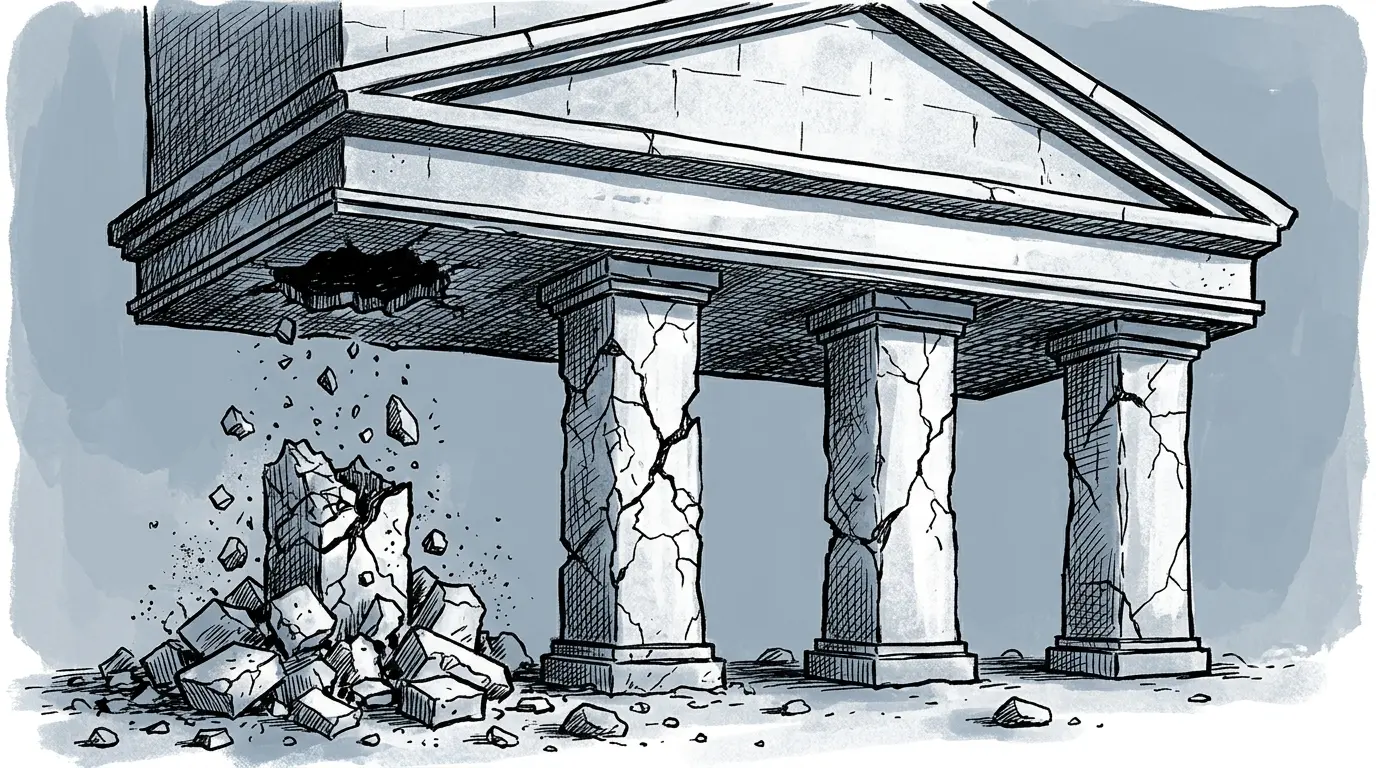
Within two years of Washington’s address, the parties had hardened. Within a century, two of them had written the ballot access laws, the debate commission rules, and the legislative architecture that made their permanence structural rather than electoral. The duopoly Washington named as the republic’s specific danger is now so thoroughly established that questioning it is framed as naive. The warning is in the record. It was not in the frame.
The selling of the commons that followed — of the land, the water, the minerals, the spectrum, the knowledge that belonged to everyone — and of the representation that might have protected it, is what this series documents. Not the loss. The mechanism.
When a proposed change threatens the arrangements that produce these outcomes, the argument arrives on cue, framed as: too complex, too entrenched, too interlocked to move. What that framing excludes is that the argument was constructed inside a room that had already decided which questions were permitted — and that outside that room, other answers exist. Norway built a sovereign wealth fund from its petroleum commons and now holds over a trillion dollars in trust for its citizens. Alaska built a version of the same. Texas built one in 1839 for its public schools, and it is still running. The answers were not unavailable. They were outside the frame.
The frame was tended carefully by the people for whom the argument inside it was working. The two parties Washington warned about now operate the room where the arguments are permitted. The binary that makes every question about which side you’re on is the frame. What it excludes is the question of what the arrangement is actually doing — and for whom.
That feeling you have — that the votes don’t move the needle, that the promises don’t land, that something structural is wrong in a way neither party will name — is accurate. Washington named it in 1796. The rooms have confirmed it ever since.
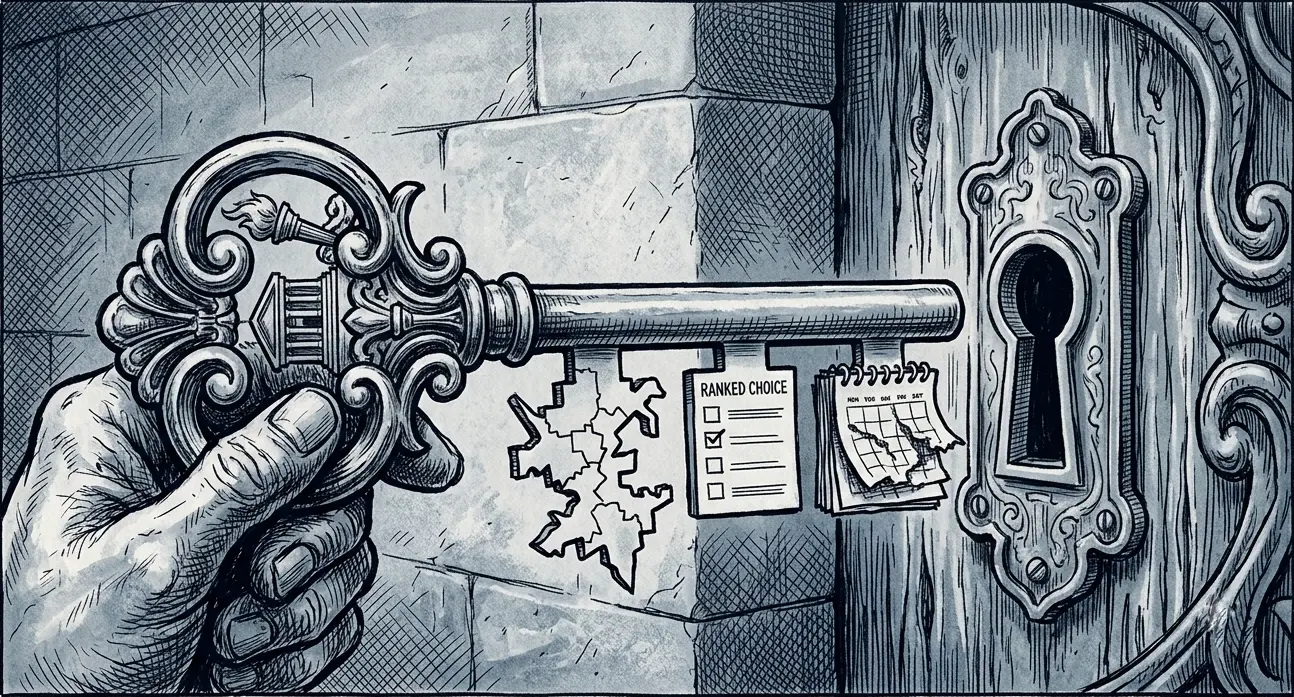
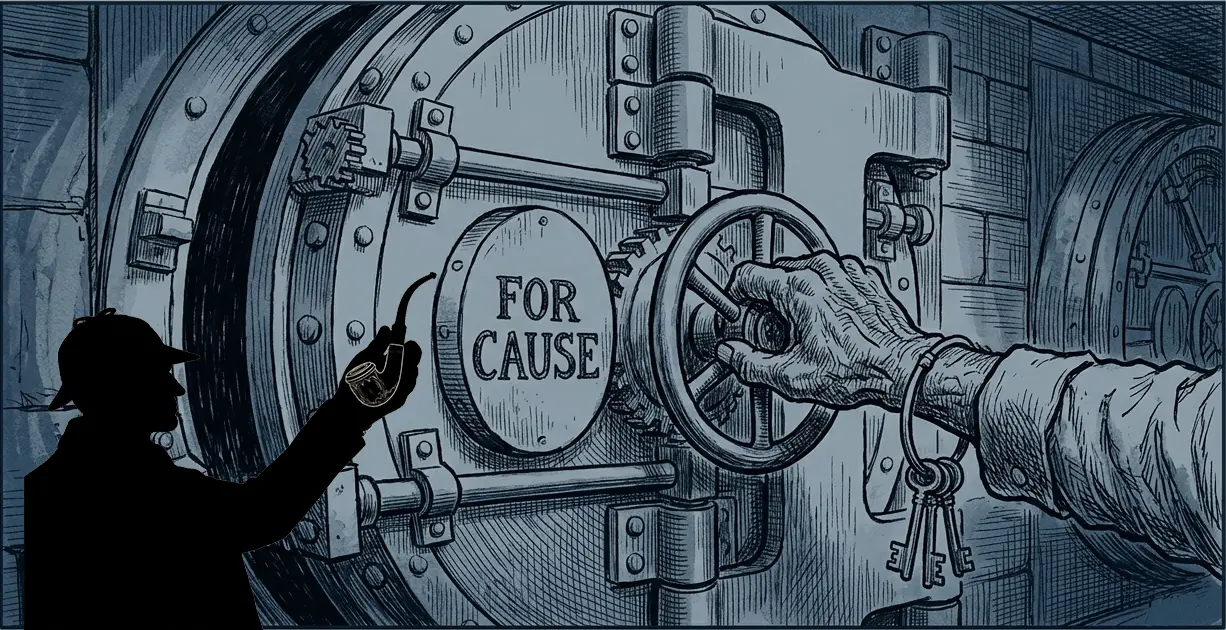
This series opens those rooms one at a time. The frozen House. The rigged map. The locked door. The captured process. The money pipeline. The bought bench. The doubt machine. The darkened room. The balance sheet of what was taken. Twelve blocks, step by step, naming names, showing the mechanism and the record behind it.
Once you see what the rooms were doing, you will see it everywhere. That is the point. What you do with it is yours.
Check This Yourself
The Farewell Address is public record, in Washington’s own words:
Ask an AI: “What did George Washington warn about political parties in his Farewell Address, and how does the current two-party system compare to what he described?”
Sources
1. Katharine Lee Bates / Pikes Peak, 1893. Historical record.
The civil service protections that cover most federal employees were not created to protect the employees. They were created to protect the government’s work from the employees’ employers.
The Pendleton Civil Service Reform Act of 1883 ended the spoils system that had governed federal employment since Andrew Jackson — the practice of replacing government workers wholesale with the new president’s political allies after each election. The spoils system had produced a federal workforce that changed with every administration, staffed by people whose primary qualification was loyalty to the winning party and whose tenure depended on the next election’s outcome. Pendleton established competitive examinations, merit-based hiring, and protection from removal for reasons other than performance and misconduct. The principle was not that federal employees deserved job security. The principle was that the government’s functions — tax collection, border control, currency management, disease surveillance, military procurement — required institutional knowledge and continuity that a rotation of political loyalists would destroy.
On June 3, 2026, President Trump signed an executive order formally placing approximately 8,000 senior career federal positions into a new employment classification called Schedule Policy/Career. These employees — senior officials in positions characterized as “confidential, policy-determining, policy-making, or policy-advocating” — were converted to at-will status. They can now be removed for any reason, with no right of appeal to the Merit Systems Protection Board. Their whistleblower complaints, if any, will be investigated by their own agency rather than by an independent body. The administration has not ruled out expanding the pool beyond 8,000. The Office of Personnel Management originally estimated 50,000 positions could be reclassified; the current order is a first installment.
The positions affected are not clerical. The appendix to the executive order lists chief information officers, chief information security officers, chief technology officers, and senior officials across regulatory and national security agencies. These are the career officials who maintain institutional continuity across administrations — who know where the data systems are, how the compliance frameworks were built, what the legal constraints on agency action are, and why specific policies were designed the way they were. They are, in the administration’s framing, the people who impede the efficient execution of presidential directives. They are, in the framing of the 1883 reformers, the people the spoils system was replaced to protect.
The administration’s stated justification is accountability. OPM Director Scott Kupor said at a press briefing that the president is elected by the American people, that the executive branch implements the president’s policy agenda, and that therefore the people in policy-influencing positions must be willing to carry out presidential directives or be removable if they won’t. He also said there would be no political loyalty tests — that reclassified employees could not be fired based on political affiliation, and that those who were fired could still seek protection under whistleblower statutes. The federal law prohibiting removal based on political affiliation, he noted, would remain in place. What he did not say is that the employees would no longer have the independent appeal mechanism that currently enforces that law. It would now be up to agencies to enforce it themselves — the same agencies whose leadership is appointed by the president whose directives these employees are now required to implement.
The White House fact sheet framing this action cites a survey showing that a plurality of senior federal employees in Washington would ignore a lawful presidential order they considered bad policy. It does not identify the survey, its methodology, its sample size, or when it was conducted. It presents this finding as justification for removing due process protections from 8,000 people.
The order is facing multiple lawsuits. Democracy Forward argues it violates the Constitution and the 1978 Civil Service Reform Act. Protect Democracy has filed an amended complaint describing Schedule Policy/Career as a return to a spoils system staffed by political loyalists rather than neutral professionals. The conservative Supreme Court majority has signaled openness to the theory underlying the order — that Article II gives the president full control over the executive branch, including positions Congress designed to be insulated from White House control. A decision on that question is expected.
The Pendleton Act took forty-six years to build after Jackson’s spoils system began. The system it replaced was not abolished because it was corrupt in the criminal sense. It was abolished because it was structurally incompatible with a government that needed to function consistently across administrations. What the June 3 order does — incrementally, with 8,000 positions and an announced intention to expand — is begin to reconstruct the structural conditions the 1883 reformers spent their careers correcting.
The silence won’t feel like silence. It will just feel like the way things are.
NPR, “Trump Strips Job Protections from 8,000 Federal Workers,” June 3, 2026. Federal News Network, “Trump Moves About 8,000 Federal Positions to Schedule Policy/Career,” June 3, 2026. CNN, “Trump Makes It Easier to Fire 8,000 Federal Workers by Making Them At-Will Employees,” June 3, 2026. Government Executive, “Trump Signs Order Moving Thousands of Federal Employees into Schedule F,” June 3, 2026. FedScoop, “Nearly 8,000 Federal Positions Lose Workforce Protections Under Trump Order,” June 4, 2026. White House, “Fact Sheet: President Donald J. Trump Increases Accountability in the Federal Workforce,” June 3, 2026. White House, “Implementing Schedule Policy/Career in the Excepted Service” (Executive Order text), June 3, 2026.
The Australian government’s admission came at Senate estimates on June 3, in the flat language of bureaucratic disclosure: the Department of Employment and Workplace Relations said that approximately 300,000 Centrelink payments had been illegally cancelled between 2020 and 2024, due to a glitch in the automated mutual obligations system. The system had cancelled payments before the legally required 28-day window had elapsed, cutting off benefits for people on JobSeeker, Youth Allowance, Disability Support, and Parenting Payment — the populations at the floor of the welfare system — without the legal notice required before cancellation.
This was not the first admission. The government had previously conceded 9,510 unlawful cancellations. Independent analysis by Economic Justice Australia identified the actual number as approximately 310,000. The government quietly paused new payment cancellations in July 2024. It did not announce the pause. It did not publicly acknowledge the gap between 9,510 and 310,000 until Senate estimates compelled it.
Australians of a certain age will read the phrase “automated Centrelink system” and feel a specific kind of recognition. The Robodebt scheme ran from 2016 to 2019 under the Liberal-National Coalition government, using automated income-averaging calculations to raise debt notices against welfare recipients — more than half a million inaccurate notices, pursuing people for money they did not owe, with the burden of proof reversed: the recipient had to prove the debt was wrong, not the government. The Federal Court ruled Robodebt unlawful in 2019. The subsequent royal commission produced 57 recommendations. The settlement cost over $1.8 billion. The commission’s final report described it as a “shameful chapter in the administration of the commonwealth.” Its 57 recommendations were made so the scheme’s mistakes would never be repeated.
The mutual obligations glitch is not Robodebt. The mechanism is different — a timing error in cancellation, not a fraudulent debt-calculation method. But the structural pattern is identical: an automated government system making administrative decisions about individual welfare entitlements at scale, without individual review, producing illegal outcomes that only became fully visible when external pressure forced disclosure. The government’s initial figure was 9,510. Economic Justice Australia’s independent analysis found 310,000. The ratio between what the government admitted and what actually happened is approximately 33 to 1.
There is an additional detail. The government commissioned a Deloitte review of the automated system. Large portions of that review, it emerged, were themselves generated using artificial intelligence. A government review of an automated system that illegally cancelled welfare payments was partially written by another automated system. Economic Justice Australia’s Kate Allingham said the organisation had “not seen anything that assures us” that reforms were actually happening. Meanwhile, between January and March 2026 alone — after the pause on cancellations was announced — nearly 300,000 suspension notices were issued. More than 3,300 per day.
The structural argument is not about the Albanese government’s intent or competence. It is about what automated administrative systems do at scale when human review is removed from decisions that affect individual legal entitlements. The Centrelink system’s function is to determine whether individual recipients have met their mutual obligations. That determination — whether a specific person in a specific circumstance did or did not comply with a requirement — is an individual judgment about an individual situation. Automating it at scale means replacing those individual judgments with a rule set applied uniformly. When the rule set has a timing error, 300,000 people lose payments they were legally entitled to keep, before anyone notices, and the government’s first disclosure puts the number at 9,510. The Robodebt royal commission made 57 recommendations to prevent this from happening again. The reforms, critics say, have largely recycled old ideas. The Deloitte report reviewing the system was partially written by AI. Cancellations were paused; suspensions were not. The silence won’t feel like silence. It will just feel like the way things are.
Essay 12 — The Converging Frames (See also: Essay 13 — The False Frame) Copyright 2026 — Steve Sagnotti Sources:
The Guardian, “Hundreds of Thousands of Centrelink Payments Cancelled Illegally, Albanese Government Admits,” June 3, 2026. YourLifeChoices, “The Government Just Admitted to 300,000 Illegal Centrelink Cancellations: What Happens Now?” June 2026. Victoria Legal Aid, “Learning from the Failures of Robodebt — Building a Fairer, Client-Centred Social Security System” (case history), 2026. Wikipedia, “Robodebt Scheme” (scheme history and outcomes), retrieved June 2026. Colitco / Economic Justice Australia, “Centrelink Debt Scandal: Automated Failures and Pattern of Review,” 2025–2026.
The Kennedy Center for the Performing Arts is named for President Kennedy by act of Congress. The statute establishing the center says so plainly: Congress gave the center its name, and only Congress can change it.
This was not, until recently, a point anyone needed to litigate.
On December 18, 2025, the Kennedy Center’s board — reconstituted by Trump after he removed several trustees and appointed himself chairman the previous spring — voted to rename the facility the “Donald J. Trump and John F. Kennedy Memorial Center for the Performing Arts.” Workers began affixing the new letters to the building’s facade the following day. In February 2026, Trump announced the center would be closed for approximately two years for a major renovation, at an estimated cost of $257 million in congressionally appropriated funds. The board voted to ratify the closure at a March 16 meeting — the same meeting at which the board stripped Democratic Rep. Joyce Beatty, an ex officio member through her role in Congress, of her voting rights.
On May 29, U.S. District Judge Christopher Cooper ruled that the board had violated federal law on every count.
The renaming was illegal. “May the John F. Kennedy Center for the Performing Arts be renamed absent Congressional authorization?” Cooper wrote. “The answer, plain from the face of the statute, is no. Nor can any other individual be memorialized on the front portico of the building.” The closure was procedurally invalid. The board’s vote, Cooper found, was “ill-informed and seemingly preordained” — trustees had learned about the closure plan at the same time as the public, through a social media post, and “deprived of time and information, they had no meaningful opportunity to consider perhaps the most momentous decision in the Center’s lifetime since it opened in 1971.” Stripping Beatty of her vote was also ruled an overreach of the board’s authority. Cooper ordered Trump’s name removed from the facade and all signage within two weeks and restored Beatty’s voting rights.
Trump responded on social media, saying the judge “should be ashamed of himself,” and announced he would direct his administration to transfer control of the center to Congress — effectively withdrawing from the legal fight by converting the institution into something he no longer wanted to be responsible for.
The structural argument here is not about the Kennedy Center’s aesthetic or cultural significance. It is about the mechanism. The sequence is worth stating plainly:
The executive removes the existing board. The executive appoints a new board, installs himself as chairman. The new board votes to rename the institution after the executive — a vote the executive’s own appointees control. The new board votes to close the institution for renovation — a decision announced before the board was consulted, ratified afterward. A congressional ex officio member is stripped of her vote at the meeting where these decisions are ratified. When a court blocks the sequence, the executive announces he will transfer the institution to congressional control, framing a legal defeat as an administrative choice.
What the judge found is not that the executive acted with corrupt intent. What the judge found is that the board acted without statutory authority — that the law establishing the institution assigned naming authority to Congress, not to a board, and that a board appointed by the executive cannot confer on itself powers the statute doesn’t grant.
This is not unique to the Kennedy Center. Trump’s name or image has been added to the Justice Department headquarters and the U.S. Institute of Peace during the same period. He has proposed a triumphal arch overlooking the Potomac. The East Wing of the White House was demolished to build a ballroom. These are not the same as the Kennedy Center — some are discretionary executive actions, some are normal renovation decisions. But the Kennedy Center case establishes the outer limit: there is a category of institution that Congress created, named, and governs by statute, and the executive’s power over that institution’s governing board does not extend to powers the statute explicitly reserves to Congress.
The legal fight will continue. Alabama’s attorney general said of a different case: it’s not a matter of whether they win, only when. The Kennedy Center’s board spokeswoman said the center “remains committed to pursuing every lawful avenue” to see the Trump name restored.
The name is off the building. For now.
Essay 3 — The People in the Room Broken Frames — Block 9: The Darkened Room (not yet published — thebrokenframes.substack.com/s/broken-frames)
Copyright 2026 — Steve Sagnotti
Sources:
PBS NewsHour, “Judge Says Kennedy Center Board Violated Law Putting Trump’s Name on Building, Blocks Closure,” May 29, 2026. CNN, “Judge Says Trump Can’t Add His Name to Kennedy Center and Blocks Planned Closure,” May 29, 2026. NBC News, “Judge Temporarily Halts Kennedy Center Closure and Orders Removal of Trump’s Name,” May 29, 2026. CNBC, “Trump’s Name Must Be Removed from Kennedy Center, Judge Rules,” May 29, 2026. CBS News, “Judge Blocks Closure of Kennedy Center and Orders Removal of Trump’s Name,” May 29, 2026. Axios, “Trump’s Name Must Be Removed from Kennedy Center, Judge Orders,” May 30, 2026.
Redistricting in the United States is supposed to happen once a decade, after the census. The census counts people. The count determines how many House seats each state gets. Legislatures then draw the maps. The process has always been political — the party in power draws lines that favor itself. But the once-a-decade rule, however imperfect, established at minimum that voters get to live inside a known district for a predictable period of time.
That rule is now gone.
On the same day in May 2026 — Tuesday, May 26 — two things happened simultaneously in two Southern states that together define the new landscape. In South Carolina, the Republican-controlled state Senate voted down a new congressional map that would have eliminated the state’s only Democratic seat, a majority-Black district held for more than three decades by Rep. James Clyburn. In Alabama, a federal three-judge panel blocked a Republican-drawn congressional map that the court found had been designed to eliminate one of the state’s two majority-minority districts in violation of the Fourteenth Amendment. Two states. One day. One defeat by legislative defection, one defeat by federal court order.
The South Carolina story requires the full context. Trump had personally lobbied the Republican state Senate majority leader by phone — twice — and called into a private caucus meeting to pressure Republican senators into supporting the remap. The Republican-controlled House had already passed the new map. What stopped it was a coalition of twelve Republican senators who broke with the president, led by Senate Majority Leader Shane Massey, who gave a forty-five-minute floor speech about the dangers of antidemocratic gerrymandering. Among the quieter concerns: the new district lines would have redistributed Democratic voters into currently safe Republican seats, making those seats more competitive — a risk Republican incumbents weren’t willing to take on behalf of a national party strategy. The Senate adjourned without a vote, scheduling a return date of June 10 — the day after the state’s already-scheduled primary — effectively ending the redistricting push for the 2026 cycle in South Carolina.
The Alabama story is different in kind. Alabama’s redistricting fight did not start in 2026. In 2023, the same three-judge panel found that Alabama’s existing congressional map violated the Voting Rights Act and ordered the legislature to create a second district where Black voters could elect a representative of their choice. The legislature drew a new map — and the new map, the court found, still failed to comply. Alabama appealed. The Supreme Court, earlier in 2026, narrowed the Voting Rights Act in a Louisiana case that many states read as a green light to redraw maps without Black-majority districts. Alabama drew another map. The same three-judge panel — two of whom were Trump appointees — blocked it. The court found the map “intentionally discriminated based on race in violation of the Constitution,” specifically noting that the legislature “well knew that a plan without an additional Black-opportunity district would dilute Black Alabamians’ opportunity to participate in the political process, and it intentionally enacted that very plan.” Alabama’s attorney general announced immediate appeal to the Supreme Court.
Both cases are instances of the same mechanism at different stages of maturation. The South Carolina push was an attempt to use mid-cycle redistricting — outside the normal decennial process — to manufacture House seats before a midterm where the party holding the White House historically loses ground. The Alabama situation is further along: a legislature that has been in active defiance of federal court orders about its congressional map since 2023, drawing and redrawing lines until it finds a configuration a court will accept or the Supreme Court overrules the lower court.
What these two cases document, separately and together, is the use of the map-drawing function as an ongoing, continuously adjusted tool for managing electoral outcomes — not a one-time decennial process that constrains what a legislature can do, but a living instrument to be redrawn whenever the political calculus shifts. Trump’s mid-decade redistricting push has, according to reporting at the time of the South Carolina vote, already netted Republicans approximately nine net House seats through redrawn maps in states where the effort succeeded. The South Carolina defection and the Alabama court order are not a reversal of that trend. They are two speed bumps on a longer road.
The frozen House has 435 seats. It has had 435 seats since 1929. The party holding a slim majority in that chamber is now managing that majority in part by redrawing the districts from which its majority is elected, mid-decade, at the direction of the executive. South Carolina’s Senate Majority Leader gave a speech about antidemocratic gerrymandering and won the vote — this time. Alabama’s attorney general said it’s not a matter of whether they win, only when.
The silence won’t feel like silence. It will just feel like the way things are.
Essay 11 — Out of Frame Broken Frames — Block 3: The Map That Chooses (not yet published — thebrokenframes.substack.com/s/broken-frames) Broken Frames — Block 5: The Locked Door (not yet published)
Copyright 2026 — Steve Sagnotti
Sources:
Associated Press / Mississippi Today, “South Carolina Senate Rejects Trump’s Call to Redraw Congressional Maps,” May 26, 2026. MS NOW / NBC News, “South Carolina Senate Rejects Trump Push to Redraw Clyburn District,” May 26, 2026. MS NOW, “Why a Dozen South Carolina Senators Bucked Trump on Redistricting,” May 27, 2026. NPR, “Trump-Backed Redistricting Plan Is Rejected in South Carolina,” May 26, 2026. NBC News, “Federal Court Blocks Alabama from Using GOP-Drawn Congressional Map,” May 26, 2026. CNBC, “Judges Block Alabama Redistricting Maps That Would Dilute Black Vote in Midterms,” May 26, 2026. Washington Times, “Federal Court Blocks Alabama Republicans’ Congressional Map,” May 26, 2026. PBS NewsHour, “Federal Court Blocks Alabama Plan for New Congressional Districts,” May 26, 2026.
The “Broadview Six” case did not fall apart because the prosecutors were bad lawyers. It fell apart because a federal judge read the grand jury transcripts and saw what was in them — and then noticed that the version submitted to her by the prosecutors had pages missing.
The facts are not in dispute. On September 26, 2025, six people — a former congressional candidate, an Oak Park village trustee, a former Cook County Board candidate, a Democratic committeeperson, a musician, and a campaign worker — were among a crowd of protesters at a federal immigration facility in Broadview, Illinois. The crowd surrounded a federal agent’s SUV. Federal prosecutors selected these six from that crowd of hundreds and charged them with felony conspiracy carrying seven years.
What happened inside the grand jury was not visible until May 2026, when Judge April Perry ordered the unredacted transcripts and read them. The lead prosecutor had told the panel she had a “very interesting case” and urged the jurors to trust her — that she would never ask them to charge someone without probable cause. When the first group of jurors was skeptical — one called the case a “crock of sh–” — those jurors were excused. Prosecutors presented the case again to a reconstituted panel. When a juror asked whether prosecutors had “unlimited tries” to get an indictment, a second prosecutor replied: “I think the saying is the second time is the charm.”
Perry, a former federal prosecutor herself, told the courtroom she had read hundreds, if not thousands, of grand jury transcripts and had never seen what she found in these. The documented misconduct broke into nine categories: improper vouching, unauthorized contact with jurors outside proceedings, dismissing skeptical jurors, improperly testifying, failure to correctly instruct on the law, expressing personal opinions about guilt — and, in a separate detail, the U.S. Attorney himself appearing before the grand jury on the day of the indictment to ask jurors to identify themselves if they could not be impartial about immigration cases.
U.S. Attorney Andrew Boutros appeared in court personally on May 21 and dropped all charges with prejudice. He apologized. He also continued to describe the defendants’ conduct as “unacceptable in a civilized society.” Perry told him he was “significantly undercutting” his own apology.
The controlled unraveling that followed is now documented across multiple courtrooms. A second case collapsed in June: a COVID-19 testing fraud prosecution brought by the same prosecutor before the same grand jury. A second federal judge — U.S. District Judge Sharon Johnson Coleman — dismissed those charges and noted that Boutros was absent from her courtroom as he had not been from Perry’s. “Pandora’s Box has been opened,” Coleman said. “We have cases throughout this building that are all in turmoil.” More than 110 former federal prosecutors from the Northern District published an open letter describing a “failure of leadership” and a troubling exodus of staff from the office. Two U.S. senators called for Boutros’ resignation. House Judiciary’s ranking Democrat, Rep. Jamie Raskin, called for federal and state bar investigations. Defense attorneys filed for a special prosecutor with authority to bring criminal contempt charges, arguing the misconduct runs not to a single rogue assistant U.S. attorney but to “the highest levels of the Chicago U.S. Attorney’s Office and likely to the Department of Justice in Washington D.C.”
The defendants are seeking discovery of communications between Boutros’ office and the White House. The government has indicated it will not contest their Hyde Amendment claim for legal fees — a posture that carries its own meaning. The Hyde Amendment allows fee awards only where the government’s position was vexatious, frivolous, or in bad faith. By declining to contest it, the government has implicitly acknowledged the standard is met.
The Broadview Six case sits inside a larger record. The Chicago Sun-Times has tracked every prosecution arising from Operation Midway Blitz, the Trump administration’s immigration enforcement surge in Chicago. Of more than 30 cases filed: two produced guilty pleas, five ended in deferred prosecution agreements, two remain pending. Twenty-four others failed — twenty dismissed, at least three refused by grand juries that would not indict, one acquittal. In the most severe case, a federal agent shot a woman five times; the administration publicly called her a domestic terrorist and charged her with assault, then dismissed the case after body camera footage contradicted the government’s account.
The mechanism has a history. Grand juries were designed as a constitutional check on the executive — a citizen body standing between the government’s desire to prosecute and the machinery of a criminal trial. The formulation that a competent prosecutor can get a grand jury to indict a ham sandwich has circulated in federal courthouses for decades, because the pattern it describes is not new. The proceedings are secret. Defense counsel is absent. The prosecutor controls what the jury hears, how the law is explained, and — as these transcripts now show — which jurors are permitted to stay in the room.
The six people selected from a crowd of hundreds were all connected to local Democratic politics. When the first citizen panel was skeptical, skeptical citizens were removed.
One detail remains current as of this writing. The deputy attorney general who announced the original Broadview Six indictment — Todd Blanche — is now the Trump administration’s nominee to be Attorney General of the United States.
The sequence is stated plainly. The transcripts are public. A second case has collapsed. A judge has said Pandora’s Box is open. The U.S. Attorney has not appeared in that judge’s court. The man who announced the prosecution is nominated to lead the Department of Justice.
The silence won’t feel like silence. It will just feel like the way things are.
Essay 3 — The People in the Room Broken Frames — Block 9: The Darkened Room (not yet published — thebrokenframes.substack.com/s/broken-frames)
Sources:
Chicago Sun-Times, “Broadview Six Charges Dropped as Chicago’s Top Federal Prosecutor Admits Case Was Tainted by Misconduct,” May 21, 2026. Capitol News Illinois / Hannah Meisel, “Transcripts Show Grand Jurors Dismissed for Disagreeing with Government’s Case,” June 9, 2026. CBS Chicago, “Newly Released Grand Jury Transcript Shows Prosecutors Vouched for Case, Dismissed Skeptical Jurors,” June 9, 2026. WTTW Chicago Tonight, “‘Pandora’s Box Has Been Opened’: Judge Blasts U.S. Attorney Boutros as Another Case Falls Apart,” June 12, 2026. Chicago Sun-Times, “‘Is Mr. Boutros Here?’ Judge Drops Fraud Charges, Calls Out U.S. Attorney,” June 12, 2026. WTTW Chicago Tonight, “Former Federal Prosecutors Talk Andrew Boutros, Collapse of ‘Broadview Six’ Case,” June 11, 2026. Capitol News Illinois / Hannah Meisel, “‘No One Can Credibly Investigate Themselves’: Broadview Six Protesters Request Special Prosecutor,” June 17, 2026. Chicago Sun-Times, “‘Broadview Six’ Fallout Expands to Washington, as Raskin Calls for Probe,” June 17, 2026. CBS Chicago, “Cleared ‘Broadview Six’ Defendant Calls Prosecutors’ Grand Jury Actions ‘Shocking and Horrifying,’” June 18, 2026. David French / New York Times Opinion, “A Malicious Chapter in the History of American Justice,” June 21, 2026.
In the same week in May 2026, two opinion pieces appeared in two countries about the same problem — and neither author knew the other was writing it.
In the United States, political scientist Lee Drutman appeared in a New York Times opinion video with columnist Ezra Klein to make a point that has animated his work for years: America’s two-party system is not an organic outgrowth of civic culture or political preference. It is a direct result of electoral structure. Single-member districts with first-past-the-post voting mechanically produce two parties. Not because voters want two parties — survey after survey shows they don’t — but because the rules make any other outcome mathematically punishing. Drutman’s prescription: multi-member districts with proportional representation, the system used by most mature democracies and the one both John Adams and James Madison warned would be necessary to prevent the tyranny of faction.
In England, journalist Jason Okundaye wrote in The Guardian about the drama at Worcestershire county council, where Reform UK had won a plurality of seats in 2025 local elections and taken control — without a majority. What followed was, by Okundaye’s account, chaos: two different leaders, two different deputies, two cabinet members sacked, promised efficiencies never found, a council left £600 million in debt by its predecessor now being run by people who’d spent twenty minutes reviewing a billion pounds in spending. In May 2026, a rainbow coalition of Conservatives, Greens, Liberal Democrats, and independents removed Reform from power. The national Conservative Party promptly suspended the local Conservative leader who’d made it happen.
The Worcestershire situation is not primarily a story about Reform UK’s competence or incompetence. It is a story about what happens when a voting system built for two parties is used by an electorate that has fractured into five or six. Britain’s first-past-the-post system — identical in structure to the American single-member district system Drutman describes — produces distorted outcomes in a multiparty environment. A party that wins a plurality but not a majority governs with the full authority of a majority, and parties that don’t know how to form coalitions or share power are left with no legitimate mechanism for doing so. The Electoral Reform Society has been saying this since before the Brexit vote, Okundaye notes. Westminster has declined to listen.
Two countries. The same electoral architecture. The same structural consequence: a system designed for a two-party world, operating in a world that has moved on.
The American version of this problem has a specific origin. The single-member district system that produces the two-party doom loop — Drutman’s phrase — was not an inevitable feature of democratic governance. It was a choice, embedded in law and reinforced by decades of rules that make third-party ballot access expensive, primary structures that reward ideological purity over coalition-building, and a House of Representatives that stopped growing in 1929 and has remained frozen at 435 members ever since. The frozen House is not an accident of history. It is a constructed artifact — a room that stopped making room for new people precisely when the country began to look like something other than what the room had been built to represent.
Britain’s room was built differently but locked by the same logic: if the existing parties benefit from the existing rules, they have no incentive to change them. The Electoral Reform Society can publish reports. Local councils in Worcestershire can collapse. Westminster will govern like it’s 1950 until it can’t.
“The public wants a fairer, more honest, more cooperative politics,” the Electoral Reform Society wrote — three years after the Brexit vote, when two-party democracy looked fragile but still robust. In 2026, first-past-the-post is producing distorted outcomes in English local elections and an American electorate that wants more than two choices is being offered the same two it has always been offered, dressed in new packaging.
The silence won’t feel like silence. It will just feel like the way things are.
Essay 11 — Out of Frame Broken Frames — Block 4: The Private Government (Party) (not yet published — thebrokenframes.substack.com/s/broken-frames) Broken Frames — Block 5: The Locked Door (not yet published)
Sources: New York Times Opinion, “Breaking the Two-Party System” (video, Ezra Klein with Lee Drutman), May 19, 2026. The Guardian / Jason Okundaye, “To Understand Britain’s New Politics, Look No Further Than This Shakespearean Saga in Worcestershire,” May 25, 2026. British Brief, “Worcestershire Council Saga Shows UK Failing to Adapt to Multiparty Politics,” May 2026. Lee Drutman, Breaking the Two-Party Doom Loop, Oxford University Press, 2020. Electoral Reform Society, survey on public preferences for electoral reform (cited in Guardian piece).
The executives who announced the layoffs didn’t use the same words by accident. They used them because the words are accurate.
Standard Chartered CEO Bill Winters, at an investor briefing in Hong Kong on May 19, announced the elimination of approximately 7,800 back-office jobs — more than 15% of the bank’s support workforce — by 2030. The framing was deliberate: “It’s not cost cutting. It’s replacing, in some cases, lower-value human capital with the financial capital and the investment capital we’re putting in.” He added that the bank would have “job role reductions in favour of the machines, and that will accelerate as we go forward into AI.” Standard Chartered shares rose 2.4% the same day.
The same week, Meta began laying off 8,000 employees globally — roughly 10% of its worldwide workforce — as it redirected capital toward AI infrastructure spending projected at up to $145 billion in 2026. Meta’s chief people officer was explicit: headcount is being converted into compute.
In Australia, WiseTech Global — one of the country’s largest publicly listed technology companies — began informing the first wave of its 2,000 workers that their jobs were gone. The company had announced the restructure in February, describing it as a “deep AI transformation.” In emails sent to staff outside China, the subject line read: “Our AI Transformation — next steps.” The email sent to workers inside China read: “Our global transformation — next steps.” The word AI was removed. Under Chinese labor law, companies can face legal liability for citing AI as the reason for redundancy. The message was adjusted accordingly.
Three companies. Three countries. One week. The mechanism is identical across all three: economic returns from AI infrastructure flow upward to shareholders and owners while the costs — job loss, income disruption, career displacement — flow outward to workers. WiseTech’s founder Richard White told an investment conference earlier in May that “it doesn’t take much effort to convince people, in the end, that they’re stupid to be paying $100 for labor when you can pay $2 for the AI.” His own employees were apparently among the people who needed convincing. Over 590 of them — more than half of WiseTech’s Australian technical workforce — signed a petition calling for fair consultation and transparency on severance. According to their union, those concerns were largely ignored.
This is not new. The pattern of capital-intensive transformation that concentrates gains for owners while externalizing costs to workers has a history that predates every executive in every one of these boardrooms. The first Industrial Revolution produced factory conditions that required a century of labor organizing, workplace safety legislation, and eventually basic legal protections to partially correct. Those protections — severance requirements, wrongful termination standards, collective bargaining rights — were built piecemeal, unevenly, jurisdiction by jurisdiction, after the damage was already done.
What WiseTech’s two-email system reveals is that those protections are patchwork and unequal — and that large global firms know it. A company that can structure redundancy communications to avoid legal liability in one country while citing the true reason in another is operating inside a compliance map, not an ethical one. There is no global standard for severance when AI displaces workers. There is no international framework governing what a company owes the people it eliminates in favor of machines. The rules were written for a different era. The companies deploying AI in 2026 know that.
Morgan Stanley estimated in early 2026 that up to 200,000 jobs in European banking alone may disappear by 2030 — concentrated in risk, compliance, and back-office operations, precisely the functions Standard Chartered is now targeting. The tech industry cut 80,000 jobs in the first quarter of 2026 alone, with nearly half attributed to AI adoption. Standard Chartered’s announcement, investors have noted, creates pressure on every peer institution that hasn’t yet published its own AI headcount reduction plan. The market is now rewarding the announcement itself.
Power does not require conspiracy. It only requires that the people in the room share a common interest in the outcome.
The Standard Chartered shareholder briefing was that room. The outcome — 7,800 jobs converted to higher return on equity — produced a 2.4% share price gain the same day. No law was broken. No coordination was necessary. Every other major bank’s board is now asking its executives why their number isn’t at least as large.
The tool changed with the century. The problem being solved did not.
Sources: PYMNTS.com, “Standard Chartered Cutting 8,000 Jobs as AI Focus Accelerates,” May 19, 2026. European Business Magazine, “Standard Chartered Is Cutting 8,000 Jobs and Calling It ‘Replacing Lower-Value Human Capital,’” May 19, 2026. Human Resources Director Canada, “Major International Lender Targets ‘Lower-Value Human Capital,’” May 19, 2026. The Guardian / Josh Taylor, “WiseTech Begins Redundancies — But Omits ‘AI’ from Emails to Chinese Employees,” May 22, 2026. Information Age / ACS, “WiseTech’s ‘Damaging’ AI Layoffs Hit by Scandal,” May 2026. Human Resources Director Australia, “This CEO Announced Huge Job Cuts Because of AI,” May 2026. New York Times, “Meta Begins Laying Off 8,000 Employees Amid A.I. Transformation,” May 20, 2026. Reuters, “Meta Lays Out Details of May 20 Restructuring,” May 20, 2026.
Essay 16 — What was said before the room was built
Steve Sagnotti · steves-head.space
The preceding two essays named what can be built — the structural repairs, the shovel-ready work, the floor beneath the displacement wave. They are real and worth building. They are not the whole answer.
The whole answer is older. It was there before the first council convened to decide what you were allowed to know about yourself. Fifteen essays to get here. This is what was always on the other side.
This essay looks at what the institution spent fifteen centuries ensuring you would not.
Before the rooms were built, there was something the rooms were built over. Not a competing institution. Not a rival doctrine. Something the institution recognized as a threat precisely because it required no institution.
Every council, every canon, every sanctioned channel presupposed its existence — and spent considerable energy ensuring you would not look at it directly. The narrowing required something to narrow against. The gate required something worth guarding.
What was there before the councils met, before the creeds were written, before the institution decided which texts would survive and which would not — that is what this essay returns to. Not as theology. Not as argument. As evidence. Voices that never met each other, or met only as enemies, kept describing the same obligations. Here is what they said.
I. What Is Owed to the Vulnerable
The Hebrew prophets had been making this argument eight centuries before the Christian councils met. Isaiah was not addressing a theological dispute. He was addressing an institution that had mistaken religious performance for religious obligation — people fasting correctly, observing the forms, keeping the days. His response was structural.
Is not this the fast I choose: to loose the bonds of injustice, to undo the straps of the yoke, to let the oppressed go free, to break every yoke? Is it not to share your bread with the hungry and bring the homeless poor into your house?
— Isaiah 58:6–7 (c. 8th century BC)
The Sermon on the Mount requires no introduction for most Western readers. But one passage in it is worth reading slowly against the world the previous essays have documented.
For I was hungry and you gave me food, I was thirsty and you gave me drink, I was a stranger and you welcomed me, I was naked and you clothed me, I was sick and you visited me, I was in prison and you came to me. Truly I tell you, whatever you did for one of the least of these, you did for me.
— Matthew 25:35–36, 40
Surah 107 is one of the shortest chapters in the Quran — seven verses, among the first revealed, titled Al-Ma‘un: The Small Kindnesses. Its subject is not doctrine. It is conduct. In Islam, Zakat — the obligation to give a portion of accumulated wealth to those who need it — is one of the five pillars of the faith. Not charity in the Western sense, which is voluntary and praiseworthy when present and overlooked when absent. A structural requirement, built into the architecture of the faith as obligation. This surah identifies the person who withholds this not as an insufficient believer, but as one who denies the faith itself.
Have you seen the one who denies the faith? That is the one who drives away the orphan and does not encourage the feeding of the poor. So woe to those who pray but are heedless of their prayer — those who make a show of their deeds but withhold small kindnesses.
— Quran, Surah 107 (Al-Ma‘un — The Small Kindnesses)
Amos was writing in the eighth century BC — roughly 2,800 years ago, eight centuries before the Christian councils met. He was not a priest or an official. He was a shepherd from Judea addressing the merchant class of Israel. His subject was the extraction economy. The ephah is the measure you sell. The shekel is the measure you collect. Making one small and the other great — controlling both instruments of the transaction and setting both in your favor — is the mechanism he described with the precision of a forensic accountant. This is not moral poetry. It is structural analysis.
Hear this, you who trample the needy and bring the poor of the land to ruin, saying: ‘When will the new moon be over that we may sell grain, and the Sabbath, that we may offer wheat for sale — making the ephah small and the shekel great and dealing deceitfully with false balances, buying the poor for silver and the needy for a pair of sandals?’
— Amos 8:4–6 (c. 8th century BC)
These traditions were in theological conflict with each other. Some produced centuries of war against each other. They kept arriving at the same structural obligation: what you do with what you have, toward the people who have least, is the measure. Not what you believe. Not how you pray. What you do.
Every tradition in this section named the mechanism. Isaiah named the yoke. Amos named the false balances. The Quran named the withheld small kindness. The Sermon on the Mount named the stranger at the gate. They named it thousands of years before the room was built. The gap between what the obligation requires and what the arrangement produces is not invisible. It is what the traditions kept naming, from every direction, across every century the room has existed.
II. What Accumulated Power Corrupts
The Tao Te Ching was written in the sixth century BC in China — roughly the same era as the Hebrew prophets, with no knowledge of what was happening in Judea and no knowledge of what would later be suppressed at Constantinople. Most Western readers have a vague cultural sense of Taoism as ‘go with the flow’ — which is approximately as accurate as summarizing the entire Christian tradition as ‘be nice.’ The structural critique in the Tao is specific: overreach consumes itself. The accumulation that fills to overflowing destroys what it accumulated. This is not mysticism. It is political economy written 2,600 years ago.
Holding a cup and overfilling it / Cannot be as good as stopping short / Pounding a blade and sharpening it / Cannot be kept for long / Gold and jade fill up the room / No one is able to protect them / Wealth and position bring arrogance / And leave disasters upon oneself — Tao Te Ching, Chapter 9 (Lao Tzu, trans. Derek Lin)
The great Tao fades away / There is benevolence and justice / Intelligence comes forth / There is great deception / The six relations are not harmonious / There is filial piety and kind affection / The country is in confused chaos / There are loyal ministers — Tao Te Ching, Chapter 18 (Lao Tzu, trans. Derek Lin)
One verse in the same tradition has been managed for sixteen centuries. It has been interpreted as metaphor, as hyperbole, as referring to a gate in Jerusalem that camels could pass if they knelt — a reading with no credible historical support but considerable institutional convenience. The plain reading does not require instruction to anyone who reads it.
It is easier for a camel to go through the eye of a needle than for someone who is rich to enter the kingdom of God.
— Matthew 19:24
Most readers know the word Jubilee without knowing the mechanism. Leviticus 25 encoded a mandatory structural correction directly into law: every fifty years, debts cancelled, land returned to its original holders, the accumulation clock reset. The theological justification was explicit — the land belongs to God, not to those who hold its title. You are tenants. Tenancy has obligations. Permanent concentration is not an option the framework permits. It was never consistently practiced. But it was in the text — the original correction mechanism, encoded in the foundational law of a tradition three thousand years old, understanding that accumulation without periodic correction destroys the community that makes accumulation possible in the first place.
In this Year of Jubilee everyone is to return to their own property. If you sell land to any of your own people or buy land from them, do not take advantage of each other.
— Leviticus 25:13–14
The Quran defines righteousness structurally rather than doctrinally. Which direction you face in prayer is institutional performance. The text explicitly says the performance is not the point.
Righteousness is not that you turn your face toward the east or the west, but righteousness is in one who believes in God and gives wealth, in spite of love for it, to relatives, orphans, the needy, the traveler, those who ask for help, and for freeing slaves.
— Quran, Surah 2:177 (Al-Baqarah)
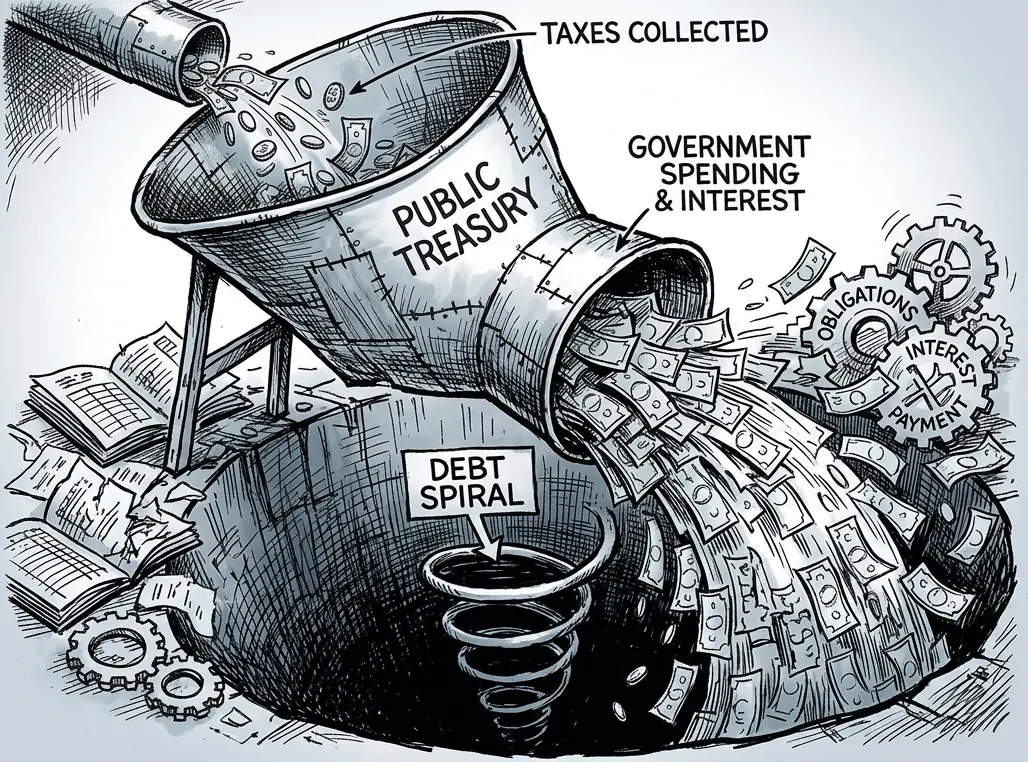
The Jubilee is the original correction mechanism. The 2031 clock is what happens when the correction mechanism is not merely ignored but actively inverted — when the false balances become policy, when the accumulation clock is protected rather than reset, when the debt that was supposed to be periodically cancelled instead compounds until the interest exceeds the growth. Every tradition in this section understood that concentration without correction destroys the community that makes accumulation possible. The debt spiral is not a surprise to anyone who read the original frame. It is the predicted consequence of ignoring it.
III. What the Institution Was For and What It Became
This is the sentence that required the councils. If the kingdom is not mediated by institution, not requiring a gate, not accessible only through sanctioned channels — then the entire apparatus of institutional authority is philosophically unnecessary. Not merely flawed. Unnecessary. The councils did not dispute the words. They stripped the cosmological context that made them mean what they mean.
The kingdom of God is not coming with signs to be observed. Nor will they say, ‘Look, here it is!’ or ‘There!’ For behold, the kingdom of God is within you.
— Luke 17:20–21
The Islamic mystical tradition — the Sufis — built entire centuries of practice on this verse. Rumi, Hafiz, Ibn Arabi — contained, managed, occasionally condemned by the institutional authorities of their own tradition. The pattern holds across traditions: direct access is the theological claim that institutional authority cannot survive intact.
We are closer to him than his jugular vein.
— Quran, Surah 50:16 (Qaf)
The Tao Te Ching does not claim the Tao is God. It claims the Tao precedes every institution, every name, every category that has ever been applied to the ground of being. That is not blasphemy. It is a structural observation about what the institution was built over.
The Tao is empty / When utilized, it is not filled up / So deep! It seems to be the source of all things / It blunts the sharpness / Unravels the knots / Dims the glare / Mixes the dusts / So indistinct! It seems to exist / I do not know whose offspring it is / Its image is the predecessor of God — Tao Te Ching, Chapter 4 (Lao Tzu, trans. Derek Lin)
Three traditions. The same structural observation. The source is not the institution. The institution is what was built over the source. It is not the door. It is what was placed in front of the door and called the door.
The Cathars understood this. They had no institutional hierarchy worth having. No priests between the soul and the divine. Women leading ceremonies. The consolamentum — the central sacrament — administered by any perfected soul regardless of gender. The institution found this intolerable, not because it was wrong, but because it was right in a way that made the institution’s function incoherent. It took a crusade to end it. The bodies at Béziers were not a theological argument. They were an institutional one.
The Hebrew prophets understood it from inside the tradition. Isaiah said the performance was worthless without the structural obligation. Amos said God despised the feasts and solemn assemblies while the poor were being bought for silver. The prophets were not anti-religious. They were anti-institutional in the specific sense that the institution had mistaken its own maintenance for the purpose it was supposed to serve.
IV. The Convergence Named
The traditions in this essay were not in agreement on theology. Several of them were in centuries-long violent conflict with each other over precisely who had the correct institutional form. They produced some of the bloodiest disputes in human history. They kept arriving at the same place.
The Tao Te Ching was not present at Constantinople II. The Buddha was not available for cross-examination by Justinian’s bishops. Amos had been making the extraction economy argument for fourteen centuries before the council met, and nobody in the room felt obliged to reckon with him. None of them knew about the narrowing. All of them kept describing the same original frame.
When teachings that never met each other — or met only as enemies — keep describing the same obligations, the same structural corruptions, the same warning about what accumulated power does to the people it was supposed to serve, that convergence is not coincidence. It is a description of something real. Something the institution could manage in any single tradition but could not suppress in all of them simultaneously.
You can narrow a canon. You cannot narrow what the canon was pointing at.
First they narrowed the frame. Then they defined the argument. For sixteen centuries in the Western mainstream it managed to do exactly that. It could not manage it everywhere.
The original frame says: your neighbor’s gain is not your loss. Accumulation is not virtue. The vulnerable are not problems to be managed. The institution does not stand between you and everything worth having. Every tradition in this essay kept arriving at that place. They still are.
The false frame required that they all be silenced simultaneously. For sixteen centuries in the Western mainstream it managed to do exactly that. It could not manage it everywhere. The teachings kept escaping through every gap the institution left. In the Cathar perfecti, who had no hierarchy of souls by birth and women at the altar. In the mystics who kept insisting that direct experience was possible without institutional mediation — Meister Eckhart, Hildegard of Bingen, Julian of Norwich, Rumi, Ibn Arabi — managed, contained, occasionally condemned, never quite extinguished. In the liberation theologians who read the same texts the prosperity gospel preachers read and arrived at opposite conclusions, because they read them among the poor rather than for the donor class. In Bonhoeffer, who saw exactly what happens when the church blesses the warrior state and who died opposing it.
The structural repairs in Essays 14 and 15 are real. The expanded House, the citizens’ assembly, the sovereign fund, the stability frame — these are the original frame applied to the specific conditions of this moment. The people in the citizens’ assembly are the ones with no fundraising reason to fail. The sovereign fund is the Jubilee made structural. The sortition is the room expanded to include the people every tradition named as the measure of the community’s integrity: the poor, the stranger, the orphan, the ones the institution was built to exclude. But every tradition in this essay also understood something the structural repairs cannot address on their own: the room reconstitutes itself unless the people inside it have changed what they believe the room is for. The repairs are the condition. The frame is the foundation. It is the original frame applied to the specific conditions of this moment. The people in the citizens’ assembly are the ones with no fundraising reason to fail. The sovereign fund is the Jubilee made structural. The sortition is the room expanded to include the people every tradition named as the measure of the community’s integrity: the poor, the stranger, the orphan, the ones the institution was built to exclude.
The traditions did not only describe the mechanism. They described what becomes available when the mechanism is named.
V. What the Rupture Means
The frame is not holding. Its contradictions are visible now in ways the silence can no longer cover.
Collapse would be simpler — one system failing, another waiting to replace it. What is happening is harder to name and more significant. The frame that crystallized in the fifth century is revealing its own limits — the places where its logic cannot hold, where its silences can no longer be mistaken for the way things are.
The physicist was trying to understand what information is at its most fundamental level. The cognitive scientist was trying to explain why physical processes produce subjective experience. The philosopher was trying to locate where consciousness lives in a material world. Wheeler, Hoffman, and Goff were working different problems in different disciplines across different decades. They converged on related but not identical conclusions — each arriving in the same territory by a different road. They are standing where the Vedic philosophers stood three thousand years earlier. They did not go looking for the Vedic philosophers. They followed their own work to its edge.
The consciousness researchers arrived through a different door. Fifty years of peer-reviewed evidence from institutions with no interest in confirming it. What the near-death accounts keep reporting — across cultures, centuries, committed atheists who entered the experience as materialists — is not the institutional judgment architecture. It is not the gate or the entrance requirement. It is something closer to what every tradition in this essay kept describing from the other side: a ground of being that precedes the hierarchy, where the question is not what you accumulated but what you did with what you had, toward the people who had least.
They are not saying the same thing because they read each other. They are saying the same thing because they found the same thing.
What the original traditions understood — what the frame could not afford for you to understand — is that the cosmos has no entrance requirement. That the institution is not the door. It is what was placed in front of the door and called the door. Amos understood it in the eighth century BC. The Tao Te Ching understood it in the sixth century BC. Julian of Norwich understood it inside a stone cell in the fourteenth century, in the middle of the Black Death, with no mechanism of political change available and no institution willing to sanction what she found at the bottom of it.
She found what they found. What the consciousness researchers keep finding. What the near-death accounts keep reporting.
What was worth guarding was never the institution’s to give or withhold.
The sky was there before the first council convened. The rupture is not the sky appearing. It is the frame becoming thin enough that you can see it was always there.
The original frame does not prescribe. It describes. Every independent witness in this essay arrived at the same observation across three thousand years: the measure is not what you believed, not which institution you belonged to. The measure is what you did with what you had, toward the people who had least. It is what was always on the other side of the gate the gate was guarding.
You have now looked at it directly.
VI. The Sky Has Not Moved
In 1373, a woman named Julian lived alone in a small stone cell attached to the wall of a church in Norwich, England. The Black Death had passed through the city multiple times in her lifetime. The Hundred Years’ War was ongoing. The institutional machinery of the Western church was operating at full capacity. She had no mechanism of political change available to her. She had a direct experience she spent the next twenty years writing down.
All shall be well, and all shall be well, and all manner of thing shall be well.
— Julian of Norwich, Revelations of Divine Love (1373)
Not denial. Not naïvety. Not the piety of someone who had not looked at the short view. The long view, held by someone who had looked at the short view without flinching and chose to report what she found at the bottom of it.
The frame managed the canon, froze the House, purchased the room, built the warehouses, told the people outside it that the arrangement was natural and the alternatives were utopian. What it could not do — fifteen centuries of demonstrated effort shows it could not do — is reach what it was always narrowing against.
The sky was there before the first council convened. It will be there after the last corporation files for bankruptcy. The original frame was not created by any tradition. The traditions found it. They disagreed about everything else and kept finding the same thing: that the ground of being is not behind a gate. That the measure of a community is what it does with what it has, toward the people who have least. That the institution is not the door. It is what was placed in front of the door and called the door.
None are denied their place in the original frame. That was always the point of it. The institution took the permission to see that clearly. It could not take what the frame was pointing at.
The rest, as it has always been, is yours.
Steve Sagnotti is a serious amateur photographer, writer, and technologist based in Oregon. With his camera he tries to capture common images not often seen, leading to common questions not often asked.
Tao Te Ching: Annotated & Explained: Derek Lin (Skylight Paths Publishing 2006) Chapters 4, 9, 18. Attributed to Lao Tzu, c. 600 BC; earliest extant text (Guodian bamboo slips) dated c. 300 BC.
Julian of Norwich, Revelations of Divine Love, long text, c. 1393. Elizabeth Spearing translation (Penguin Classics, 1998). ‘All shall be well’: Chapter 27.
Essay 15 — What can be built before the window closes
Steve Sagnotti · steves-head.space
“The best time to plant a tree was twenty years ago. The second best time is now.”
— Chinese proverb
“We are trying to construct a more inclusive society. We are going to make a country in which no one is left out.”
— Franklin D. Roosevelt, 1936
The preceding essays raised a question without answering it. What happens to the people?
Not the people in the aggregate — the displacement wave, the labor market adjustment, the transitional cohort. The specific people. The Class of 2026 entering the desert this month. Michelah in 2031. The fifty-five-year-old whose job the model absorbed last quarter. The question was asked at the end of Essay 13 and left there deliberately, because the answers that follow require a different kind of evidence than the documentation that preceded them.
This essay is one answer — the shovel-ready answer, the one that does not require waiting for the room to be rebuilt first. Essay 14 named what a repaired room would build. This essay names what can be built before the repair is complete, because the 2031 window does not wait for the renovation.
The false frame has a specific answer to the displacement wave. It is already being built. Thirty-four permanent detention facilities. Eight mega-centers. Ninety-two thousand beds. Infrastructure owned, not leased, distributed across the national geography, available for whatever population the room decides requires containment next. The false frame looks at ten million displaced workers and sees a management problem. The cost is fifty-five thousand dollars per person per year at the low end. Scale that to the displacement wave the preceding essays document and the math produces a number the fiscal spiral cannot absorb. The false frame does not acknowledge this. The two rooms — the one tracking displacement and the one tracking the debt spiral — are still not talking to each other.
A stability frame looks at the same ten million people and sees something different. Not a management problem. A workforce. One that happens to coincide with a documented inventory of work the market will not fund but the country demonstrably needs. The math from this vantage point runs differently: the same fiscal pressure that makes the warehouse unaffordable also makes the productive alternative attractive, because workers in the revenue column pay taxes and workers in the expenditure column consume them. The choice between the two is not ideological. It is arithmetic. The stability frame makes the arithmetic visible.
This essay builds that frame.
I. The Math Nobody Is Doing
Essay 12 established the Jennifer Harris mechanism: as one dollar of value creation shifts from workers to owners, total tax revenue falls ten to fifteen cents. The displacement wave and the debt spiral are not parallel crises. They are the same crisis viewed from two angles. The worker who loses her job stops paying payroll taxes and starts drawing on unemployment, food assistance, Medicaid. She moves from the revenue column to the expenditure column at the exact moment the fiscal system is least able to absorb the shift.
The containment apparatus does not reverse this. A person in an ICE detention facility at fifty-five thousand dollars per year is not in the revenue column. She is a permanent expenditure line. The infrastructure is owned. The operating cost runs whether or not the beds are full. The reconciliation act that funds the detention expansion simultaneously cuts the programs the displaced would draw on outside it. Both outcomes move workers further from the revenue column. Neither addresses the underlying arithmetic.
The WPA at its peak employed 3.3 million workers simultaneously. At prevailing wages, those workers paid income tax, spent money in local economies, and maintained the consumer base that market activity depends on. The net fiscal cost of the program — accounting for the tax revenue generated, the economic activity multiplied through local spending, and the reduction in relief expenditure — was substantially lower than the gross appropriation. The false frame presents this as a historical curiosity. The stability frame recognizes it as a mechanism. The mechanism is available.
The question the stability frame asks is simple: what does it cost to warehouse a displaced worker, and what does it cost to employ one productively? The answer to the first question is documented. The answer to the second depends on what the work is, which is the subject of the next section. But the framing matters before the numbers do. Inside the false frame, employment programs are expenditures to be minimized. Outside it, they are investments whose return includes tax revenue, consumer spending, and the maintenance of a social fabric that is considerably cheaper to preserve than to repair after it tears.
II. It Has Been Done Before
In 1933, the United States faced a displacement wave of a different kind. Twenty-five percent unemployment. Hoovervilles in every major city. The Bonus Army — veterans of the First World War, promised compensation that hadn’t arrived — marching on Washington and being dispersed by cavalry. The false frame of that moment had an answer too: the market would self-correct, government intervention would make things worse, the men sleeping in parks were there by the logic of their own choices.
Franklin Roosevelt’s administration did not wait for the room to repair itself. It identified work the market would not fund but the country needed, paid people to do it at scale, and kept them economically active during the lag. The Works Progress Administration employed 8.5 million people across infrastructure, arts, literacy programs, and environmental work. The Civilian Conservation Corps put three million men to work in forests, parks, and watersheds — building trails, planting trees, fighting erosion, maintaining the public lands that private industry had no incentive to steward. The men who arrived having never held a shovel left having built something visible, something that still exists, something with their names on it in the sense that matters.
The substitutability objection is real and the essay should name it honestly. A displaced farmer in 1933 could dig a ditch. A displaced customer service worker or junior analyst in 2026 cannot be sent to the forest with the same ease. The skills gap runs differently now. But the mechanism survives even when the substitutability doesn’t: identify work the market won’t fund but society needs, pay people to do it at scale, keep them economically active during the lag. The specific work changes with the era. The structural logic does not.
The WPA wasn’t a government employment program in the sense the false frame uses to dismiss it. The government defined the need, provided the funding, and set the standard. Private contractors bid on the work. Private firms executed it. The government did not pour the concrete or plant the trees directly. It created the demand signal and the funding mechanism that private industry lacked any incentive to create on its own. The interstate highway system — the largest public works program in American history — was built by private contractors on federal contracts. Nobody calls it socialism. The WPA worked the same way. The stability frame makes no new argument here. It recovers an old one that the false frame has spent fifty years misrepresenting.
III. The Work That Is Waiting
The substitutability problem dissolves when the inventory of needed work is examined honestly. The false frame presents the displacement wave as a mismatch between available workers and available work — too many people, not enough jobs. The stability frame asks a different question: what work exists that the market is not doing?
The answer is not abstract. It is documented, understaffed, and urgent.
The United States Forest Service manages 193 million acres of national forest and grassland. Its own assessments document a chronic backlog in fire mitigation, trail maintenance, watershed restoration, and invasive species management — work that directly reduces the catastrophic fire risk that has cost the country hundreds of billions of dollars in recent years. The agency does not have the workforce to do what its own scientists say needs doing. The CCC precedent is direct: this is exactly the work the corps did, at exactly the scale the corps operated, in exactly the terrain the corps knew. The need was there in 1933. It is larger now.
Federal inspection and oversight capacity is chronically understaffed across every domain where the public’s investment requires monitoring. Food safety. Workplace safety. Environmental compliance. Infrastructure inspection. The bridge that fails, the mine that collapses, the contaminated water supply — these are not accidents of nature. They are the predictable output of an inspection regime whose capacity has been systematically reduced by the same purchased legislation Essay 11 documented. The work of inspection is not make-work. It exists because the things being inspected exist and the rules governing them exist. The question is only whether anyone shows up to enforce them. Tripling federal inspection capacity would not require inventing new work. It would require staffing the work that is already documented and already undone.
Care work is the largest single category of documented need that the market chronically underserves. The World Economic Forum’s Future of Jobs report identifies care roles — home health aides, childcare workers, elder care specialists — as among the fastest-growing by absolute numbers through 2030. The demographic driver is not a projection. The baby boom generation is aging. The care it requires is not optional and it is not automatable. These roles cannot be sent to a server farm. They require people, in rooms, with other people. They are chronically underpaid because the people who perform them have historically had the least bargaining power and the people who need them have historically had the least political power. A public employment option with a wage floor in care work absorbs displacement and delivers something the market has spent decades demonstrating it will not deliver on its own.
The Office of Technology Assessment employed 143 people when Congress eliminated it in 1995 for twenty-two million dollars in annual savings. Restoring it would require people with the analytical skills to evaluate technology policy — exactly the cohort that AI displacement is currently moving out of entry-level white-collar roles. The Class of 2026 entering a desert labor market includes people trained in data analysis, research methodology, and technical communication. The OTA restoration workforce and the displaced analyst cohort are the same population. The work is documented. The workers are available. The room has a vested interest in the vacuum remaining.
Digital literacy infrastructure is the final category. The ZipRecruiter survey found that only one in three members of the Class of 2026 received meaningful AI training in college. Someone has to build that training infrastructure at community college level across the country. The need is documented, the timeline is urgent, and the work requires people who understand both the technology and the communities it is entering. This is not make-work. It is the foundational investment that determines whether the next cohort is better positioned than the one entering the desert now.
IV. The Hiring Condition
A standard infrastructure contract does not solve the displacement problem. The lowest bidder hires whoever they want, mostly experienced trades workers who already have jobs. The bridge gets built. Michelah is still in the desert.
The condition that makes a stability frame program different from a standard public works bill is written into the contract terms: a documented percentage of labor hours must go to workers from the displaced cohort. Not a mandate on every private firm in the economy — a condition on firms accepting public contracts for publicly funded work. The legal architecture for this already exists. Section 3 of the Housing and Urban Development Act requires that federally funded construction projects prioritize hiring low-income residents of the area where the work is done. Davis-Bacon requires prevailing wages on federal contracts. The mechanism is established. The variable is which workers the condition prioritizes.
This is also the answer to the dignity question, which is real and which the essay should not paper over. A person hired by a private contractor doing documented infrastructure work on a public contract is not a government charity case. She is a worker with a paycheck from a private employer, doing a job that needed doing, in a sector that is expanding because the public decided the need was real. The employment relationship matters. The nature of the work matters. A stability frame that produces government make-work produces neither stability nor a frame that can survive political scrutiny. One that produces private employment on real public need earns its constituency the way Social Security did — through the visible, specific, nameable thing it built.
The enforcement of the hiring condition requires the inspectors to exist. This is where the two arguments converge: the oversight capacity that monitors contract compliance is the same capacity that monitors workplace safety, environmental compliance, and infrastructure integrity. You cannot enforce a condition you cannot monitor. The false frame that eliminated inspection capacity also eliminated the mechanism for ensuring public contracts serve public purposes. Rebuilding one requires rebuilding the other. They are the same repair.
V. Skills, Matching, and the Service Question
The draft board analogy is not decorative. When the United States needed to mobilize millions of people rapidly in 1940, it did not do so by posting job listings. It assessed what it had, determined what it needed, and matched them at scale through a mechanism — imperfect, sometimes unjust, but operationally effective — that converted civilian capacity into military capability faster than any previous mobilization in history.
The displacement wave requires a matching problem of comparable scale. Not the same mechanism — a national citizen service is not conscription, and the essay should be clear on this distinction — but the same underlying challenge: how do you connect the skills a population has with the work a society needs, at a speed the crisis requires, without waiting for the market to do it over a decade?
The stability frame’s answer is a National Citizen Service: a voluntary program, structured around meaningful tracks, available to every American at the transition point between education and employment. Not a program for the displaced specifically — a program for everyone, at the moment everyone faces it. Military service is one track. Forestry and public lands is another. Care work is another. Infrastructure inspection and oversight is another. OTA restoration and technical assessment is another. Digital literacy infrastructure is another.
The voluntary-with-incentives model has a documented record. The CCC did not conscript its workers. It offered wages, housing, food, and skills in an economy where the alternative was nothing. The enrollment exceeded projections. People self-select toward meaningful work when meaningful work is available and the alternative is a desert. The Class of 2026 entering the labor market now is not choosing between a national service program and a good private sector job. For a significant fraction of them, they are choosing between a national service program and the desert Michelah described.
Matching within the program is where AI earns its place on the productive side of the ledger rather than the destructive side. The draft board in 1940 used paper forms and interview panels. A modern matching system ingests documented need — which forest districts are most understaffed, which inspection backlogs are most critical, which communities have the highest care worker shortages — against documented capacity — what skills the incoming cohort has, what training they can acquire in what timeframe — and produces placements that serve both the individual and the public need. The army got its infantry because infantry was what the moment required. It also got its eleven navy volunteers because eleven people wanted to be there and the navy needed them. Both mechanisms — directed placement weighted to need, and self-selection weighted to fit — are available and can operate simultaneously. AI makes the optimization tractable at a scale that was impossible in 1940.
The skills gap the false frame presents as an obstacle is, from inside the stability frame, a design parameter. You don’t send the displaced analyst to dig the ditch. You send her to do the environmental baseline survey, the OTA restoration work, the digital literacy training. You send the displaced logistics worker to the inspection corps. You send the person with no formal credential and strong hands to the forest, where the work is learnable and the need is urgent and the result is visible. The frame that sees only “displaced workers” and “available jobs” cannot make these connections. The frame that sees documented need and documented capacity and asks how to connect them can.
VI. The Bottleneck and the Tool
The sprint model cannot work if the permitting process takes a decade. This is not a metaphor. The United States has the longest infrastructure permitting timelines in the developed world by a significant margin. A highway project that takes two to three years to permit in Germany takes seven to ten years here. A transmission line that takes eighteen months in Australia takes a decade in the United States. The causes are documented: NEPA environmental review averaging four and a half years to complete, multi-agency coordination with no required timeline, litigation as a de facto veto independent of the merits, and permitting agencies chronically understaffed relative to the volume of projects in their queues.
The result is that the United States cannot build the infrastructure its own engineers say it needs at anything like the speed the problems require. The grid buildout needed for the energy transition, the water infrastructure repairs the American Society of Civil Engineers documents, the broadband deployment needed to close the digital divide — all of them are stuck in permitting queues. The 2031 window arrives before the shovels go in.
AI changes this calculation at specific, documented points in the process. A full Environmental Impact Statement currently takes teams of consultants three to five years to produce, at costs running into the tens of millions for large projects. AI can draft the baseline environmental survey, model impacts across scenarios, cross-reference existing databases of species habitat, water quality, soil composition, and air quality, and produce a structured document in weeks rather than years. The review process still requires human judgment and public comment — that is appropriate and the stability frame does not propose eliminating it. But the document production bottleneck is an AI-solvable problem with existing technology. The NEPA timeline compresses dramatically when the EIS takes months rather than years.
Multi-agency coordination — the problem of eight agencies with incompatible systems, timelines, and data formats that no one is required to reconcile — is addressable by AI as a coordination layer. A project dashboard that ingests the requirements of every relevant agency, identifies conflicts and dependencies, flags what can proceed in parallel, and surfaces the critical path. This exists in private sector project management. It does not exist for federal permitting. Building it is exactly the kind of OTA-restoration, technical-capacity work the previous section identified as waiting for a workforce.
The permitting bottleneck is not entirely accidental. Utilities have used permitting complexity to block transmission lines that would enable competing renewable energy. Established developers have used NEPA to block competitors. The tool is real and has legitimate uses; it has also been captured by actors whose interests have nothing to do with environmental protection. AI-assisted permitting reform is not anti-environment. The environmental analysis still happens. It happens faster and with better data. A document that took four years to produce because eight agencies couldn’t reconcile their timelines doesn’t take four years because the analysis requires it. The stability frame names the difference between a timeline that reflects the work and one that reflects who benefits from the delay..
VII. The Sprint
You do not need Rome. You need the foundation before 2031.
The false frame’s approach to large public problems is the monolith: design the complete solution, assemble the complete funding package, build the complete political coalition, execute the complete program. This approach has a specific failure mode: it takes longer than the crisis it is designed to address. The decade-long infrastructure project can be cancelled by a change in administration before it is complete, producing nothing. The workforce reabsorption program designed in the conventional model — full scope, full design, full permitting, full funding before anyone reports to work — does not help the Class of 2026. It might help the Class of 2036 if everything goes well.
The stability frame’s approach is different in sequence, not in ambition. Fund the first stage with defined success metrics. Stage two is contingent on stage one results. Produce something real at each stage — something that builds its own constituency, something that exists and is therefore harder to eliminate than something that is merely planned. The shack goes up before the house is designed, not because the house isn’t the goal, but because the shack tells you things a blueprint never could — where the wind comes from, which wall you’ll want to extend first, what the foundation actually required when the ground turned out to be different from the survey.
Applied to the workforce: a pilot National Citizen Service in three states, authorized and funded for one stage, tells you what a national program designed from scratch never could. Which work categories absorb workers fastest. Which training pipelines produce useful skills in six months versus two years. Which communities have the infrastructure to support a corps presence. You learn cheaply, at small scale, before committing the full apparatus. The pilot produces visible results. Visible results build the constituency for the next stage. The constituency funds the next stage. Medicare is one example of how a program can be built — not as a comprehensive national health system but as a limited program for the elderly that proved itself and built its own political base over decades..
The sprint model also answers the political capture problem that the previous essay documented. A decade-long monolith has to hold its coalition for a decade. A sprint-stage authorization has to hold it for one budget cycle. The people who benefit from inaction can block a comprehensive bill. Blocking a pilot is harder — the argument against a pilot is the argument against learning, and that argument is harder to make with a straight face to the 45 percent who have concluded the room produces nothing for them.
VIII. The Standard Arguments
The stability frame will generate objections. They will arrive in the same forms that every accountability proposal in this project has generated. They deserve substantive answers rather than dismissal, because some of them have real merit.
“This is socialism. The government should not be in the business of employing people.”
The government has been in the business of employing people for the entire history of the republic. Postal workers. Federal inspectors. Forest rangers. The military. The argument is not against government employment. It is against government employment of people the current political coalition would rather see in a warehouse. The WPA employed 8.5 million people through private contractors bidding on public contracts. The interstate highway system was built the same way. National defense — the expenditure no one calls socialism — dwarfs any workforce program this essay contemplates. The label is not an argument. It is a way of preventing one.
“This takes work away from private industry.”
The opposite is closer to accurate. Private industry is not doing the work this essay describes — not because it couldn’t, but because there is no profit in it. The Forest Service’s fire mitigation backlog does not generate revenue. The inspection of a bridge does not produce a product to sell. The care worker serving an elder on Medicaid does not generate a margin worth pursuing. Private industry leaves this work undone because private industry is not designed to do work it cannot monetize. A stability frame program creates contracts that private industry bids on and executes. The contractor who wins the forest restoration contract, the inspection services contract, the care infrastructure contract — that is a private firm earning a market return on publicly funded work. This is how public infrastructure has always been built in America. The stability frame does not nationalize anything. It creates demand that private industry is well positioned to meet, with the condition that the workforce doing the meeting includes the people who need the work.
“We can’t afford it.”
The fiscal spiral Essay 12 documented makes this the most self-defeating objection available. The question is not whether the country spends money on the displacement wave. The infrastructure is already built and already being funded. The question is what the expenditure produces. Fifty-five thousand dollars per person per year to warehouse someone who used to be a taxpayer produces a permanent expenditure line, a population removed from the consumer base, and a social fabric under pressure. A wage and meaningful work produces a taxpayer, a consumer, and someone with a reason to show up tomorrow. The fiscal responsibility argument for the warehouse is the argument that the expensive option is cheap because you don’t count the cost. The stability frame counts the cost.
“The government can’t run anything efficiently.”
The CCC built 800 parks, planted three billion trees, and constructed 125,000 miles of roads in nine years. The WPA built or repaired 650,000 miles of roads, 78,000 bridges, 125,000 civilian and military buildings, and 700 miles of airport runways. These are not theoretical projections. They are the current inventory of infrastructure still in use. The efficiency objection has a specific structural problem: it is made against programs that worked while ignoring the programs it favors that did not. The F-35 program is eleven years late and $165 billion over budget. The Pentagon has never passed an audit. The efficiency argument is applied selectively, to programs that serve the wrong constituency.
“Who decides where people go? This sounds like forced labor.”
The National Citizen Service described in this essay is voluntary. It offers tracks, not mandates. The CCC enrolled its workers. The navy got its eleven volunteers because eleven people wanted to serve on ships. A voluntary program with real tracks and real wages and real work will attract the people for whom it makes sense, which is a large fraction of the people currently in the desert. The matching system optimizes within the choices people make, weighted toward documented need. The army sends more people to infantry than to signals corps because infantry is what the army most needs. A citizen service sends more people to fire mitigation and inspection than to digital literacy infrastructure for the same reason. This is not coercion. It is the ordinary logic of a program that has to accomplish something as well as employ someone.
“Private contractors will capture the contracts the way defense contractors do.”
This is the most legitimate objection and it deserves the most substantive answer. Yes, contractor capture is a real and documented risk. The defense procurement system is the clearest example of what happens when large public contracts meet organized private interests over a long enough timeline. The stability frame’s structural defense is the sprint model: stage-gate funding with measurable output requirements at each stage makes extraction harder than in a decade-long monolith where the contractor is paid regardless of what gets built. The inspection capacity rebuilt under this program is also the inspection capacity that monitors contract compliance — the same workforce that checks the bridge checks whether the hiring condition was met and whether the stage-gate deliverable was delivered. Accountability is built into the mechanism as a design requirement, not assumed from the good intentions of the participants.
IX. The Frame from Here
The Class of 2026 is entering the desert this month. They did everything they were told. They incurred the debt. They earned the credential. The entry point was closing before they arrived, for reasons documented across the preceding essays, arranged by people who had a vested interest in the arrangement.
Inside the false frame, they are a labor market adjustment. A transitional cohort. An efficiency gain distributed across a generation. The quarterly report that records their displacement also records the margin improvement it produced. They do not appear in the same column.
Outside it, they are the workforce for the most urgent documented needs in the country. The forest that needs tending. The bridge that needs inspecting. The elder who needs someone in the room. The community college that needs someone to build the AI literacy infrastructure the next cohort will require. The OTA that needs the analysts the AI displacement wave just produced. The environmental baseline survey that needs to be done before the permitting clock can start. They are not a problem to be managed. They are the answer to a set of problems the market has been declining to solve for decades, now arriving with the workforce to address them at exactly the moment the problems are becoming undeniable.
A stability frame connects those two things. Not because it is generous. Because it is cheaper than the alternative, faster than the monolith, and productive in ways the warehouse is not. The false frame will call it make-work. The forest will still be standing. The bridge will still be inspected. The elder will still have had someone in the room.
The window is 2031. The permitting clock is running. The workforce is already in the desert.
The structural repairs are real and worth building. They are not the whole answer. The whole answer is older — there before the first room was built, there before the first council met to decide what you were allowed to know about yourself. The next essay returns to it.
— — —
Steve Sagnotti is a serious amateur photographer, writer, and technologist based in Oregon. With his camera he tries to capture common images not often seen, leading to common questions not often asked.
CCC output (800 parks, 3 billion trees, 125,000 miles of roads): National Archives CCC records; American Conservation Experience.
WPA output (650,000 miles roads, 78,000 bridges, etc.): Federal Works Agency. Final Report on the WPA Program, 1946.
F-35 program cost overruns and timeline: Government Accountability Office. F-35 Joint Strike Fighter: DOD Needs to Complete Developmental Testing Before Making Significant New Investments.