Block 12, Article 3 — Three Locks, the Same Kind of Key
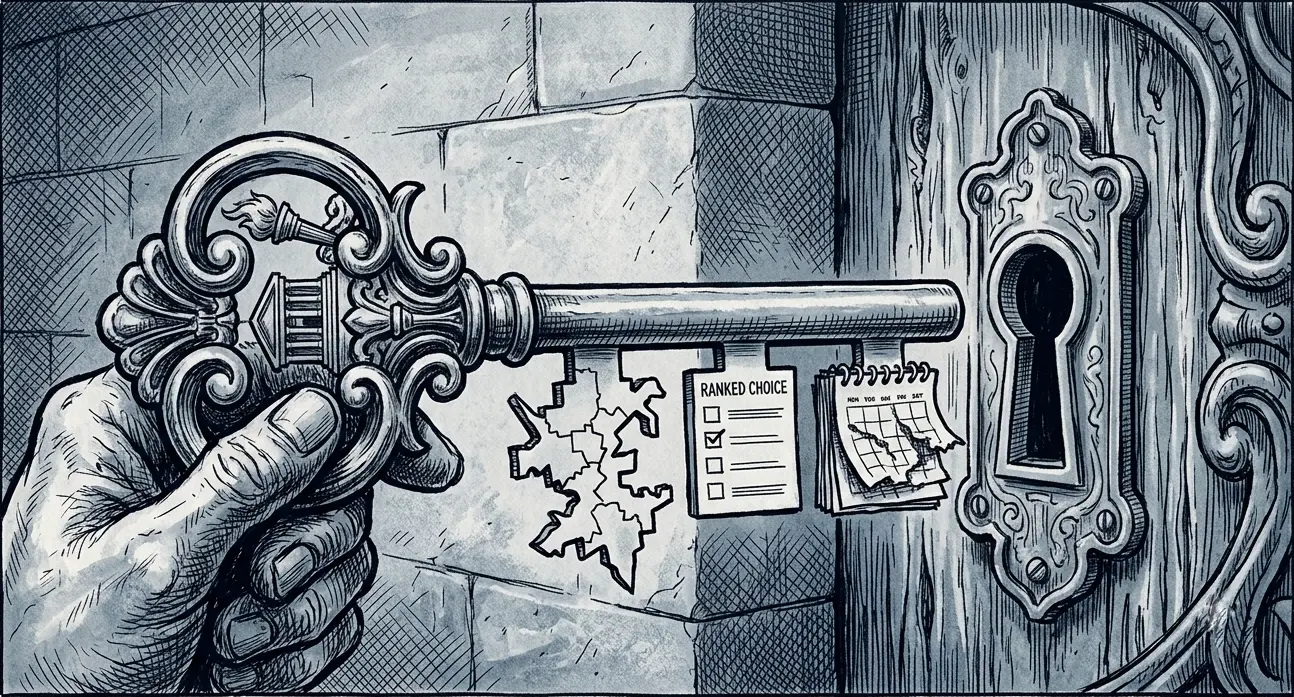
Every map in this series was drawn in a room the public couldn’t enter, following rules the public never voted on, producing outcomes the public could not reverse. That is three separate locks — the map, the ballot, the calendar — and all three have the same kind of key.
What does an unrigged map actually look like?
Not complicated. Compactness and contiguity requirements — districts that are reasonably shaped and reasonably connected, rather than optimized shapes drawn by software to capture a specific voter three streets over — governed congressional district drawing from 1842 through 1911. They were never in the Constitution. They were in successive apportionment statutes, renewed by Congress each decade as the understood standard. The 1929 Act, the same statute that froze the House at 435, let the requirement lapse. The Supreme Court confirmed in Wood v. Broom (1932) that the lapse was intentional — the old requirements expired with the prior act and were never reenacted. No court has ever restored them, because there is no constitutional hook to restore them with. Reynolds v. Sims used the Fourteenth Amendment’s equal protection clause to force equal population across districts. There is no equivalent constitutional argument for compactness. That fight was never lost in court. It was simply never fought there, because it isn’t a court’s fight to fight.
It’s a statute. Congress could restore both requirements tomorrow under Article I, Section 4 — the same clause that let the requirement lapse in the first place. Representative Emanuel Celler introduced legislation to reinstate compactness and contiguity standards repeatedly through the 1950s and 1960s. It never passed. The For the People Act included modern redistricting criteria along the same lines. It passed the House twice. It died in the Senate twice. The room that would pass the fix is the room the absence of the fix produced — the same closed loop this series has documented at every level, now naming its own reflection.
Independent redistricting commissions are the version of this fix that doesn’t wait on Congress. States can create them unilaterally, and several have. California’s commission, created by ballot initiative in 2008 and insulated from legislative override in 2010, draws maps without legislator input. Virginia created one in 2020. Neither commission is perfect — Virginia’s own commission deadlocked in 2021 and threw the map to the state supreme court anyway — but both remove the single worst feature of the current system: the people whose seats depend on the map are not the people drawing it.
Redistricting reform gets sold as a partisan tool — whichever side is currently disadvantaged by the map wants a different one, and that’s the whole story as most coverage tells it. What that framing leaves out: an independent commission with restored compactness requirements disadvantages both parties equally, by removing the map as a lever either one can pull. Neither party has ever proposed that version voluntarily.
What does the locked door look like unlocked?
Maine answered this first. Ranked choice voting lets a voter rank candidates in order of preference instead of picking exactly one — if no candidate wins a majority outright, the last-place finisher is eliminated and their voters’ second choices are redistributed, repeating until someone crosses fifty percent. A voter who prefers a third party no longer has to choose between their honest preference and a “wasted vote” — they can rank the third-party candidate first and a major-party candidate second, and lose nothing. Maine adopted it in 2016. It has survived a Republican-led repeal attempt at the ballot box. It works exactly as designed: more candidates run, more voters participate, and no one’s vote stops counting just because their first choice didn’t win outright.
Alaska adopted RCV alongside a top-four nonpartisan primary in 2020, by a margin of 3,781 votes — close enough that a shift of a few thousand votes either way would have gone the other way. Opponents have tried to repeal it twice. Twice, voters have said no — most recently in 2024, when the repeal failed by 743 votes after a full recount, in a fight where the side defending RCV was funded overwhelmingly by national election-reform organizations with no residence in the state, outraising the in-state repeal campaign by roughly 100 to 1. A third repeal attempt is already qualified for the November 2026 ballot. The persistence is the fact worth sitting with. It wasn’t a grassroots system Alaskans quietly abandoned — it’s a system Alaskans have now defended twice at the ballot box, against a repeal effort that outside money couldn’t buy even when it was willing to spend nearly $14 million trying. That doesn’t mean the fight is over. Having failed twice with state voters, opponents moved the fight to Congress: the Make Elections Great Again Act (H.R. 7300), introduced by House Administration Committee Chairman Bryan Steil on January 30, 2026, would ban ranked choice voting in federal elections nationwide, effective immediately in Alaska, Maine, and D.C. — not because voters rejected RCV, but because they wouldn’t.
RCV repeal campaigns get framed, in every ad the money bought, as protecting voters from confusion. What that framing leaves out is who’s actually paying to “protect” them — and why, having lost that argument with Alaska’s own voters twice, the fight simply moved to a room where Alaska’s voters don’t get a say at all.
What does it cost to keep people from the polls at all?
The federal government automatically enrolls every eighteen-year-old male citizen in the Selective Service System. No form. No opt-in. Birth records, Social Security numbers, and school enrollment data do the identification automatically, because his potential conscription is considered too important to leave to individual initiative. Twenty-four states and the District of Columbia have extended that same administrative logic to voter registration — automatic enrollment through the same records. The federal government has not. The argument against federal automatic registration was never administrative; the Selective Service proves the administration is straightforward. A government that can find an eighteen-year-old to register him for the draft can find him to register him to vote. It has simply chosen, at the federal level, not to.
Election Day itself is a Tuesday because a statute written in 1845 accommodated farmers who needed Sunday for church and Monday to travel to the county seat by horse. The horse has been gone for a century. The Tuesday has not. Every other major democracy has since moved to weekend voting, multi-day voting, or a mandatory holiday. Bills to shift it here — as a federal holiday, as a weekend, in bipartisan and partisan form alike — have failed in Congress repeatedly over the past decade. The people who would pass the fix are the people whose current advantage depends on the friction the fix would remove.
What happens when nobody in the room can be lobbied at all?
Every repair named so far still runs through elected officials — people who ran a campaign, took donations, and have to run again. That is true even at its most reformed: an independently drawn map still elects a legislature; ranked choice voting still elects individuals who can be courted afterward. There is a different structural answer, tested at national scale, that removes the vested interest entirely rather than managing around it.
In 2016, Ireland’s parliament faced a problem it had failed to solve for thirty-three years: a constitutional abortion ban too politically combustible for any elected body to touch directly. Rather than continue failing to touch it, the parliament convened a Citizens’ Assembly — ninety-nine people selected by stratified random lottery, weighted to mirror the country’s actual demographics. A nurse. A farmer. A teacher. A retired electrician. They met over five weekends, heard evidence from advocates on every side, deliberated among themselves, and recommended repeal. The recommendation went to a public referendum. It passed with 66 percent of the vote. A question that had paralyzed elected politicians for a third of a century was resolved by randomly selected citizens in eighteen months.
The mechanism works because of what it removes, not what it adds. A randomly selected panel cannot be lobbied in advance, because its membership is unknown in advance. No donor can spend three decades cultivating a relationship with a jury pool assembled by lottery last month. Belgium’s German-speaking community went further in 2019, establishing the first permanent citizens’ assembly in the world — not a one-time panel but a standing institution, continuously refreshed by the same random process. Oregon has run the only state-authorized Citizens’ Initiative Review in the country since 2010, using sortition specifically to evaluate ballot measures before voters see them. The standard objection — that ordinary citizens lack the expertise for complex decisions — is, without exception, raised by people whose professional or political position depends on those decisions staying inside a credentialed class that answers to donors rather than a lottery.
None of these repairs is abstract procedure. The map, the ballot, the calendar, and now the room itself are the mechanisms that decide who sits on the committees that set royalty rates, who has a structural incentive to protect a bipartisan extraction consensus, and whose votes count at all. Compactness restoration doesn’t just produce prettier districts — Block 3 documented the actual sequence: the state legislative majorities a rigged map secures draw the maps that secure the federal majorities that set the committee assignments that set the royalty rates. One investment, four institutional layers, traced start to finish. Restoring compactness breaks that chain at its first link. RCV doesn’t just add candidates — it breaks the two-party arithmetic that has let both parties agree, implicitly and without a single vote, not to touch the industries funding both of them. Sortition breaks something further upstream than either: it removes the donor relationship as a category, not just as an advantage one side holds over the other. And the communities hit hardest by voting friction — the ones with the longest drives to the fewest polling places — are disproportionately the same communities Block 3 mapped against the undercount and Block 9 mapped against the local-news collapse. It is one map, drawn four different ways now, and every version points at the same places.
One more repair belongs in this family without needing its own section here: the Electoral College’s winner-take-all distortion, which concentrates presidential attention on seven swing states and treats the other forty-three as decided in advance. The National Popular Vote Interstate Compact — states agreeing in advance to award all their electoral votes to the winner of the national popular vote, once enough states join to represent 270 electoral votes — is the specific mechanism, already documented in Block 6, that unlocks that door. It belongs in this article’s family of fixes for the same reason RCV and automatic registration do: it makes a structurally worthless vote count again, without touching the Constitution’s text.
The knot, one turn further
Article 1 and Article 2 named the repairs that unlock Congress itself — the filibuster, the frozen House, the stale census, the apportionment incentive. This article names the ones that unlock who gets elected to it, how the seats get drawn, and whether the deciding body can be lobbied at all. None of these sets works without the others. A Congress freed from the filibuster but still elected off a rigged map changes nothing about who’s in the room. A perfectly drawn map feeding into a two-party binary still produces the same bipartisan consensus not to touch extraction. The repairs interlock the same way the extraction mechanisms did.
Ballotpedia tracks every state’s redistricting-commission status and every state’s ranked-choice-voting adoption or repeal history.
ballotpedia.org/Redistricting and fairvote.org/rcv. Check whether your state has an independent commission, and if it doesn’t, whether one has ever been proposed — and by whom it was opposed.
— — —
Steve Sagnotti
is a serious amateur photographer, writer, and technologist based in Oregon. With his camera he tries to capture common images not often seen, leading to common questions not often asked.
© 2026 Steve Sagnotti
— — —
Sources
- Wood v. Broom, 287 U.S. 1 (1932): Justia. Reynolds v. Sims, 377 U.S. 533 (1964): Justia.
- Celler compactness/contiguity bills, 1950s-1960s: CRS — Election Policy Fundamentals: Single-Member House Districts. For the People Act redistricting criteria: congressional record — H.R. 1, 117th Congress, bill text (§§2451-2455); H.R. 1 committee report — H.R. 1 Report, 117th Congress.
- California redistricting commission (2008 ballot initiative, 2010 insulation): Ballotpedia — California Citizens Redistricting Commission; California Proposition 11 (2008); California Proposition 20 (2010). Virginia commission (2020, 2021 deadlock): Ballotpedia — Redistricting in Virginia after the 2020 census; Virginia Question 1, Redistricting Commission Amendment (2020).
- Maine RCV adoption 2016, repeal survival: Maine Secretary of State (via Maine State Legislature) — Ranked Choice Voting in Maine; Ballotpedia — Maine Question 5, Ranked-Choice Voting Initiative (2016); Maine Question 1 (June 2018).
- Alaska RCV adoption 2020 (3,781-vote margin): Alaska Public Media — Why Alaska uses ranked choice voting; Ballotpedia — Alaska Ballot Measure 2 (2020). Two repeal attempts defeated (743-vote margin 2024): KTOO/Alaska Public Media — The recount is over. Alaska will keep ranked choice voting; Ballotpedia — Alaska Ballot Measure 2 (2024). Third attempt qualified for November 2026: Ballotpedia — Alaska Repeal Top-Four Ranked-Choice Voting Initiative (2026); Anchorage Daily News — Another initiative to repeal open primaries and ranked choice voting. Funding asymmetry: I found figures of ~20-to-1 (2020 campaign, per Juneau Empire opinion piece) and ~10-to-1 (per Wikipedia), not ~100-to-1 — flag this figure for verification against actual APOC disclosures before publication, since none of my sources match “~100-to-1” exactly.
- Make Elections Great Again Act, H.R. 7300: congress.gov bill text — confirmed: introduced by Rep. Bryan Steil (R-WI), January 30, 2026.
- Selective Service automatic enrollment: sss.gov statement; sss.gov FAQ. Automatic voter registration, 24 states + DC: NCSL — Automatic Voter Registration.
- Election Day Tuesday statute, 1845; 2 U.S.C. § 7: FindLaw, 2 U.S.C. § 7; CRS — Election Day: Frequently Asked Questions.
- Irish Citizens’ Assembly 2016-2018: official records — citizensassembly.ie: Selection of Members; citizensassembly.ie: 2016-2018 Citizens’ Assembly. 66% referendum result — OECD — The Irish Citizens’ Assembly (referendum passed 66.4%; the Assembly itself had voted 64% in favor — worth keeping that distinction precise in your draft).
- Belgium/Ostbelgien permanent citizens’ assembly, established 2019: official government records — buergerdialog.be: Motivation and History; buergerdialog.be: What is the Citizen’s Council.
- Oregon Citizens’ Initiative Review, since 2010: Healthy Democracy — Our Story; CIR in Oregon; Ballotpedia — Oregon Citizens’ Initiative Review Commission.
- National Popular Vote Interstate Compact: already documented in Block 6, Article 3 — no new link needed.
Leave a Reply