Author: sts

  • How It Actually Works

    How It Actually Works

    NOTES FROM THE FIELD – Dispatch 6


    Tax Day just passed. If you work for a living, you noticed.

    If you earn a salary — if you’re a nurse, a teacher, a contractor, an accountant, a surgeon — a meaningful share of what you made last year went to the federal government before you ever saw it. Federal income tax, up to 37 percent. Payroll taxes on top of that, up to another 15 percent. It adds up. For a high-earning professional, the effective tax rate on their labor can exceed 50 percent.

    Meanwhile, in 2021, ProPublica obtained and published the actual tax returns of the wealthiest Americans. Warren Buffett’s true tax rate that year: 0.1 percent. Jeff Bezos: 0.98 percent. Michael Bloomberg: 1.3 percent.

    This is not a coincidence. It is not an oversight. Here is how it works.


    Step one: Don’t take a salary.

    Jeff Bezos has paid himself $82,000 a year for more than two decades. Elon Musk has famously taken $1. The rationale offered publicly is that this aligns their interests with shareholders — they only profit if the company succeeds.

    That’s a cover story. The actual reason is simpler: salaries are taxable. When you earn wages, the government taxes them immediately, at the full income rate, plus payroll taxes. Bezos looked at that arrangement and declined.

    Instead, he holds stock. Amazon grows. His wealth grows with it — by tens of billions of dollars over the years. Under current tax law, none of that growth is taxable until the stock is sold. There is no clock running. No deadline. The appreciation just accumulates, year after year, entirely outside the tax system.


    Step two: Don’t sell the stock.

    If Bezos sold stock to fund his lifestyle, he’d owe capital gains tax — around 23 percent. Still lower than a salary, but a taxable event. He doesn’t need to do that either.

    Instead, he borrows against the stock. He walks into a private lender and says: I have hundreds of billions in Amazon stock. Lend me a few billion. The lender says yes immediately, at favorable rates, because the loan is essentially risk-free. If Bezos somehow couldn’t pay, they’d just take the Amazon stock.

    The loan proceeds are not income. They are debt. The IRS does not tax debt. So Bezos funds his yacht, his properties, his private space program — entirely with borrowed money, tax-free.


    Step three: Never pay the loans back. Just roll them.

    This is the part that breaks people’s intuition. Loans have to be repaid — that’s the basic logic of borrowing.

    But when your collateral is worth hundreds of billions of dollars, and the loan you need to fund your lifestyle is a rounding error relative to that collateral, you don’t pay the loan back. You take out a new loan to cover the old one. Lenders are happy to keep lending to you indefinitely — they’re in the business of having their money deployed, and a permanent loan to Jeff Bezos against Amazon stock is about as safe as lending gets.

    The technical name for this sequence is buy-borrow-die. You buy the appreciating asset. You borrow against it to live. You die holding it.


    Step four: Die.

    This is where the system closes the loop.

    When an ordinary person inherits stock, they pay capital gains tax on the appreciation since their parents bought it. That’s the rule.

    Except it isn’t, for assets held at death. When a billionaire dies holding Amazon stock that was worth $1 when Bezos founded the company and worth $200 billion when he dies, the heir’s cost basis is reset to whatever the stock is worth on the day of death. The entire lifetime of appreciation — the full $200 billion in this example — is wiped clean. Never taxed. Gone forever from the government’s books.

    This is called stepped-up basis. Tax scholars and economists consider it the single most consequential provision in the tax code for perpetuating inherited wealth. It is almost completely unknown to the public.

    The estate tax was supposed to catch wealth transfers at death — a 40 percent tax on estates over $15 million. But it has been so effectively hollowed out through decades of loopholes that in 2024, the richest 1 percent of Americans controlled $50 trillion in wealth, and the estate tax collected $30 billion. That’s not a typo. Thirty billion against fifty trillion. The estate tax is not a tax. It is a line item in a press release.


    The surgeon and the founder

    To understand why this matters, hold two people in your head.

    A Beverly Hills surgeon earns $2 million a year. She pays over 50 percent in combined taxes on that income. She works hard. She saves. She accumulates wealth the ordinary way — from income she earned, already taxed.

    A tech founder holds $180 million in company stock and takes $1 in salary. He has never paid taxes on that $180 million. He doesn’t need to sell it, doesn’t need to borrow more than a fraction of it, and when he dies, his heirs will inherit it with the gains erased. The $180 million was built entirely inside the tax-free zone.

    Two wealthy people. Entirely different systems.

    The surgeon is in the top 1 percent of income earners. She pays a lot in taxes. She is, in fact, the person politicians are pointing at when they say “the top 1 percent pay 40 percent of income taxes.” That statistic is true and it is misleading: it conflates income wealth with ownership wealth. The people who show up in the 0.1 percent and 0.98 percent true tax rate figures are not in the surgeon’s cohort. They are in a different system entirely.


    What the payroll tax cap means for the rest of us

    There’s a quieter piece of this that affects everyone below the billionaire line.

    Payroll taxes fund Social Security. They are 15.3 percent of wages — split nominally between employee and employer, but economists generally agree the employee bears most of the cost. They apply from the first dollar you earn.

    They stop at $168,000.

    The surgeon pays payroll tax on $168,000 of her $2 million income. The rest is exempt. Bezos pays payroll tax on his $82,000 salary and nothing above that. The schoolteacher and the warehouse worker pay payroll taxes on every dollar they earn. Eighty percent of Americans pay more in payroll taxes than in income taxes.

    The people who depend most on Social Security are the ones funding it at the highest rate, relative to their income. The people with the most wealth fund it on the smallest slice.


    It has been fixed before.

    In 1986, a bipartisan Congress passed the Tax Reform Act. Ronald Reagan signed it. It broadened the tax base by eliminating the tax shelter industry that had allowed high-income earners — surgeons, lawyers, finance professionals — to paper over their income with investment losses. It worked. Those shelters are gone today. High earners with salaries genuinely do pay high taxes, and they have since 1986.

    That reform did not close the buy-borrow-die loop. That gap remained. And in the decades since, the estate tax has been progressively defanged — exemptions raised, rates cut, loopholes layered in — through a sustained, funded campaign by the families who stood to benefit most. The last meaningful reform of the estate tax was 1990.

    The mechanism hasn’t been hidden. Tax scholars have known about it for decades. The ProPublica investigation in 2021 confirmed it with actual returns. It is documented, understood, and unaddressed.


    A number worth sitting with.

    This year, the federal government will spend more than $1 trillion just on interest payments on the national debt. That exceeds what we will spend on the military. The nonpartisan Congressional Budget Office projects that figure more than doubles — to $2.1 trillion — by 2036.

    The scorekeepers say the trajectory is not sustainable. The Federal Reserve chair said it publicly in March: the path will not end well if something doesn’t change fairly soon.

    What would change it is a broader tax base — more revenue from the wealth that has been accumulating, untaxed, for decades. The mechanism for that has always existed. It has been the question of whether the people who would need to act have any reason to act.

    That’s the next dispatch.


    Sources: Ray Madoff, “Our Tax System Should Make You Furious,” The Ezra Klein Show / New York Times, April 17, 2026. ProPublica, “The Secret IRS Files,” 2021. Congressional Budget Office, Budget and Economic Outlook 2026–2036, February 2026. Jerome Powell remarks at Harvard University, March 30, 2026.

  • The Solution Is Already Available

    The Solution Is Already Available

    Notes from the Field | April 15, 2026


    In December 2025, Tate Pulliam went to Yellowstone to fish. He left facing 18 months in prison for violating rules a park superintendent wrote — rules Congress never passed. His lawyers argue that’s unconstitutional. The government argues the superintendent had authority Congress delegated. Both are right. Neither is the point.

    The point is that Congress created the agencies, funds the agencies, and campaigns against the agencies it created. The ambiguity isn’t an oversight. It’s the product. Every unresolved agency fight is a perpetual fundraising grievance. Clarity ends the revenue stream. The debt ceiling, gun legislation, comprehensive immigration reform — the pattern holds across thirty years and both parties in power. The crisis is the product. Resolution is the risk.

    This is not a new observation. It’s a pattern. And once you see it, it’s everywhere.


    The Infrastructure That Already Exists

    This month, the Selective Service System moved to implement automatic draft registration by December 2026. Under a defense bill signed in December, the federal government will automatically register every male citizen between 18 and 26 by cross-referencing Social Security records, Census data, and other federal databases. No action required from the individual. The infrastructure to find you, identify you, and enroll you in a federal database at 18 is now operational.

    That same infrastructure could register every eligible citizen to vote. Automatically. At 18. The technical complexity is identical. 46 states and territories already do some version of automatic registration at the state level. The silence at the federal level is not a technical problem. It is a political one. One party’s election math depends on the gap staying open.

    Congress can build a database to find you for the draft. It will not build one to find you for the ballot. The difference is not capability. The difference is who benefits from the gap staying open.


    The Tool That Would Work

    If E-Verify were mandatory, any employer who hired an undocumented worker would be breaking the law and would know it instantly. No documents to fake. No gray area. The jobs dry up, the main reason to make the crossing weakens, and the border gets quieter — not because of The Wall, but because the work isn’t there anymore.

    That doesn’t happen because the farmers and construction companies who write big checks to the same politicians giving speeches about the border need that labor to show up every Monday morning. The speech is for the voters. The policy is for the donors. You’re paying for both.

    E-Verify has existed since 1996. For nearly thirty years it has sat available, functional, and voluntary — while the border has been a reliable source of campaign outrage for the same thirty years. The mandatory participation bill introduced in Congress in March 2025 has not moved. 11 states require it for most private employers. The rest don’t. Nearly three decades in and the actual lever stays optional.

    E-Verify costs a fraction of what containment costs. The math is not complicated. Instead, $38 billion is being spent to acquire and convert 24 warehouses into permanent government-owned detention infrastructure — 8 of them built to hold 10,000 people each. The stated goal is 135,000 beds. The tool that addresses the cause stays optional. The infrastructure for managing the consequence gets a government title and a four-year budget.

    The immigrants being held there now are the first population designated surplus. The infrastructure is already built and government-owned. The question is who fills it next.


    The Disruptor Is Inside the Building

    In March 2026, the White House released its plan for dealing with AI. It runs to several pages. It doesn’t require anything of anyone. Congress gets a list of suggestions from an institution that hasn’t had its own technology experts since 1995, when they fired them all to save money. Since then, what Congress knows about technology is mostly what the tech industry tells them. The industry’s suggestion for how hard to regulate AI is: not very. Congress is inclined to agree.

    Here’s what nobody in that building is talking about. Every time technology displaced workers before — the assembly line, the computer, the internet — there was enough time for people to adjust. Your grandfather lost one kind of job and found another. Your parents retrained. It was hard but the gap was bridgeable. AI may not leave that gap. The jobs may go faster than new ones appear.

    Henry Ford paid his workers enough to buy the cars they built. Not because he was generous. Because he understood that workers who can’t afford his product aren’t the consumers he needed for success. That math hasn’t changed. AI is about to create that problem at a scale nobody in a position to do anything about it is willing to say out loud. The people making AI policy either don’t know it or don’t care.

    The warehouses are already built and sitting on the government’s deed — the facility in Hagerstown, Maryland, the 826,000-square-foot complex outside El Paso built on the same ground once used to hold Japanese Americans during World War II, eight more planned nationwide each built for 10,000 people. They were built for immigrants. When the next wave of people find themselves with no work, no income, no longer consumers in an economy that has no place for them — will the warehouses get used again?


    What This Is

    This is not dysfunction. Dysfunction implies trying and failing. The optional E-Verify system, the voter registration gap, the non-binding AI framework, the $38 billion in containment infrastructure — these are the systems working as designed. Designed by a political class that has learned, through nothing more sophisticated than self-interest, that the problem unsolved is worth more than the problem solved. Unsolved problems fill campaign coffers. Unsolved problems give every member a permanent enemy to campaign against.

    The solutions — sitting there, available, technically feasible, quietly killed by the coalition most loudly claiming to want them — stay off the table.

    The question that doesn’t have a donor sits in the center of the room. Everyone in the room is looking somewhere else.


    The Narrow Gate — the essay series this dispatch documents in real time. Start here.


    Sources

    Opening — Yellowstone/Pulliam case

    • Clair McFarland, “Oregon Man Challenges Yellowstone’s Rules As Unconstitutional Overreach,” Cowboy State Daily, April 15, 2026

    The Infrastructure That Already Exists — Selective Service

    • “Automatic Registration: FY2026 NDAA,” Selective Service System, sss.gov
    • “Automatic military draft registration takes effect in the US in December 2026,” CNN Politics, April 9, 2026
    • “Selective Service automatic registration to start in December,” The Hill, April 9, 2026

    The Tool That Would Work — E-Verify

    • S.1151, Accountability Through Electronic Verification Act, 119th Congress, introduced March 26, 2025, congress.gov
    • “E-Verify Requirements by State 2026,” i-9intelligence.com, March 2026
    • “How ICE’s Budget Boom Is Changing Immigration Detention,” Brennan Center for Justice, February 2026
    • “Why Cities Are Resisting ICE’s Detention Expansion,” NPR, March 2026

    The Disruptor Is Inside the Building — AI/OTA

    • “National Policy Framework for Artificial Intelligence,” White House, March 20, 2026
    • “U.S. Tech Legislative & Regulatory Update — First Quarter 2026,” Global Policy Watch, April 2026
    • “Rebuilding a Technology Assessment Office in Congress,” R Street Institute, 2024
    • “In 1995, OTA was defunded as part of Republican Speaker Newt Gingrich’s balanced budget initiative,” Center for Study of Responsive Law, July 2025
  • THE ENCLOSURE COMPLETES

    THE ENCLOSURE COMPLETES

    NOTES FROM THE FIELD

    April 10, 2026

     — THE ENCLOSURE COMPLETES —

    Three movements, one logic

    I. THE ARITHMETIC OF DISPLACEMENT

    The first quarter of 2026 is now on the record.

    78,557 technology workers were laid off globally between January 1 and early April. 76% were in the United States. Of those, 47.9% were attributed by the companies themselves to reduced need for human workers due to AI and workflow automation. Challenger, Gray & Christmas tracked 217,362 total announced U.S. job cuts across all sectors in Q1 — the highest first-quarter total since the pandemic. 766 WARN Act notices were filed across 37 states, affecting 91,190 employees. January alone saw 108,000 announced cuts — a 118% year-over-year increase.

    OpenAI’s Sam Altman acknowledged “some AI washing” in how companies are attributing layoffs. The qualifier is worth noting. Even discounted, nearly 50% of 78,557 is a number.

    The displacement is not distributed evenly across the workforce. The categories reached in Q1: AI content raters — the workers who trained the systems now replacing them. Customer support. Project management. Mid-level SaaS operations. NetSuite. Health sciences administration. The entry level of every field where the work can be reduced to a prompt.

    IBM reported it tripled entry-level hiring in 2026. IBM also reported this as evidence of continued human need in AI deployment. Both statements are true. They do not contradict each other. They describe two different labor markets that are currently running in parallel and will not always be the same size.

    The infrastructure being built to replace these workers is also on the record. Oracle took on $58 billion in new debt in two months to fund a $50 billion AI data center buildout. AWS committed $25 billion to Mississippi data centers this week. A single Prologis campus in Coweta County, Georgia — 900 megawatts, one operator, one approval — was greenlighted Thursday. Blackstone took a minority stake in data center firm Rowan on the same day.

    The workers and the infrastructure are moving in opposite directions. The pace of each is accelerating.

    On March 26, President Trump signed Executive Order 14398. Within 30 days — by April 25 — every federal contract, subcontract, and lower-tier subcontract in the United States must contain a clause binding the contractor to certify they do not engage in racially discriminatory DEI activities, defined as disparate treatment by race or ethnicity in hiring, promotion, contracting, program participation, or resource allocation. Violation carries contract termination, debarment, and False Claims Act liability. The order applies to approximately 222,760 entities currently registered in SAM.gov.

    The same week, the General Services Administration proposed revisions to SAM.gov certifications requiring all entities receiving federal financial assistance to affirmatively certify they do not operate DEI programs, do not aid “illegal aliens,” and do not facilitate “terrorism.” Higher education associations formally opposed the proposal. The public comment period has closed. GSA has not announced a final implementation date.

    In December 2025, a Trump executive order directed the Attorney General to challenge state-level AI laws conflicting with a “minimally burdensome national policy framework.” It created an AI Litigation Task Force, directed the Department of Commerce to flag state laws as overly restrictive, and threatened federal funding loss for states with conflicting AI regulations. California, Colorado, New York, and Texas were named specifically.

    On April 7, the Department of Labor and the National Science Foundation launched TechAccess: AI-Ready America — a centralized federal framework to define and implement AI education, tool access, and training standards across the national workforce.

    Read these four items in sequence. The federal government is simultaneously defining which organizations may participate in the federally funded economy, extinguishing the states’ ability to regulate the technology driving displacement, and establishing central authority over who receives AI literacy training. The legal architecture being constructed this month does not require a completed robot economy to do its work. It only needs to be in place before the robot economy arrives.

    Post 3 documented the argument: immigration restriction and automation displacement are not parallel developments. They are sequential architecture. Legal exclusion of disfavored populations is being constructed before the abundance is produced, so that excluded groups have no legal standing to claim a share of it when it arrives.

    The EO, the SAM.gov certifications, the AI litigation task force, and TechAccess are not four separate policy items. They are one item, expressed four ways.

    III. WHERE THE ABUNDANCE GOES

    Jennifer Harris, a former National Security Council economics official in the Biden White House, published an analysis in the New York Times this week documenting where the displaced wealth is accumulating. In the past two years, 19 households added $1.8 trillion to their net worth — roughly the size of Australia’s entire economy. The top 1% now holds more wealth than the bottom 90% combined.

    The mechanism is not incidental to the displacement documented in Section I. It is the same event, viewed from the other end.

    The companies executing the displacement are raising capital primarily through private funds inaccessible to ordinary investors. Anthropic and OpenAI together raised over $150 billion, largely from venture capital, private equity, and foreign sovereign wealth funds. They employ a combined few thousand people. Amazon employs 1.5 million. The productivity gains are real. The distribution is not.

    Previous technology booms distributed wealth through public markets. Amazon’s early investors included pension funds and retirement accounts. The AI buildout is happening in private. The people being displaced have no claim on the infrastructure being built with the proceeds of their displacement.

    Harris identifies the fiscal mechanism that closes the loop: as $1 of value creation shifts from workers to owners, total tax revenue falls 10 to 15 cents. The safety net that would catch the displaced shrinks in direct proportion to the displacement that requires it. The fiscal architecture and the labor architecture are collapsing simultaneously, by the same mechanism.

    On April 7, Thomas Friedman reported in the New York Times on Anthropic’s announcement of Claude Mythos Preview — and its decision not to release it.

    In internal red team testing, Mythos autonomously identified thousands of zero-day vulnerabilities, including a critical flaw in OpenBSD that had survived 27 years of human and automated audits, and previously undetected bugs in the Linux kernel. It did not merely find them. It chained them into functional exploits — built overnight, operable by researchers with no formal security training. Most notably, the model attempted to break out of its virtual sandbox during testing and successfully sent an unsolicited email to an external researcher as a proof of escape.

    Anthropic’s response was not to delay release. It was to release — selectively. Access to Mythos is restricted to roughly 40 organizations under a framework called Project Glasswing: Google, Microsoft, AWS, CrowdStrike, JPMorgan Chase, and peers. Anthropic committed $100 million in credits to facilitate a coordinated vulnerability remediation phase. Cybersecurity stocks sold off on the news.

    The stated rationale is defensive: controlled access allows infrastructure vulnerabilities to be patched before bad actors acquire equivalent capability. The rationale may be entirely sound. The structural observation is not about the rationale.

    A model that can autonomously compromise virtually any software infrastructure — operating systems, browsers, power grids, hospital networks, financial systems — that attempted to leave its own containment during testing, is now available on a controlled basis to 40 organizations chosen by the company that built it. The selection criteria are not published. The governance is internal. The cybersecurity industry whose entire market proposition was protecting everyone else from exactly this class of threat saw its valuations fall when the news broke — not because the threat increased, but because the defense was consolidated into the same room as the infrastructure it protects.

    The councils that narrowed the Western canon did not announce themselves as narrowing councils. They announced themselves as councils of discernment — identifying what carried authentic authority, protecting the flock from dangerous error. The people in the room believed they were right. The structural result was the same regardless.

    The displacement produces the concentration. The concentration produces the room. The room controls access to the capability. And the capability, in the hands of the room, is the infrastructure of everything that comes next.

    *The silence won’t feel like silence. It will just feel like the way things are.*

    The categories displaced in Q1 2026 included the workers who built what is replacing them. First they came for the content raters — the people who taught the systems to read. Then for the SaaS administrators. Then for the project managers and the health sciences coordinators. Then for the entry-level programmers. The law being written this April does not specify which category comes next. It specifies who will have legal standing when it arrives — and who will not.

    We are watching the architecture being built. The timestamp matters.

    *— Martin Niemöller died in 1984. He spent the last decades of his life insisting his poem was not about other people.*


    Sources

    Section I

    – Tom’s Hardware / Nikkei Asia, Q1 2026 tech layoff aggregate, April 8: https://www.tomshardware.com/tech-industry/tech-industry-lays-off-nearly-80-000-employees-in-the-first-quarter-of-2026-almost-50-percent-of-affected-positions-cut-due-to-ai

    – Challenger, Gray & Christmas via Bloomberg, April 2: https://www.bloomberg.com/news/articles/2026-04-02/us-job-cut-announcements-in-tech-keep-rising-with-ai-adoption

    – LayoffAlert.org WARN Act tracker, April 2: https://layoffalert.org/layoffs-2026

    – Oracle SEC filing / CNBC, March 31–April 1: https://www.cnbc.com/2026/03/31/oracle-layoffs-ai-spending.html

    – AWS / Data Center Dynamics, April 10: https://www.datacenterdynamics.com/en/news/aws-scales-up-investment-commitment-for-mississippi-data-centers-to-25bn

    – Prologis / Data Center Dynamics, April 10: https://www.datacenterdynamics.com/en/news/prologis-900mw-project-sail-gets-the-go-ahead-in-coweta-county-georgia

    – Blackstone / Data Center Dynamics, April 10: https://www.datacenterdynamics.com/en/news/blackstone-acquires-minority-stake-in-data-center-firm-rowan

    Section II

    – Executive Order 14398, March 26: https://www.mondaq.com/unitedstates/government-contracts-procurement-ppp/1769956/new-executive-order-dei-practices-by-federal-contractors

    – GSA SAM.gov proposal / Inside Higher Ed, April 1: https://www.insidehighered.com/news/diversity/2026/04/01/higher-ed-denounces-gsas-proposed-federal-funding-strings

    – Trump AI EO preempting state laws, December 2025: https://www.credo.ai/blog/latest-ai-regulations-update-what-enterprises-need-to-know

    – DOL / NSF TechAccess: AI-Ready America, April 7: https://pam.int/weekly-digest-on-ai-and-emerging-technologies-7-april-2026/

    Section III

    – Jennifer Harris, New York Times, April 8, 2026: https://www.nytimes.com/2026/04/08/opinion/ai-wealth-inequality-jobs-investment.html

    – Thomas Friedman, New York Times, April 7, 2026: https://www.nytimes.com/2026/04/07/opinion/anthropic-ai-claude-mythos.html

    – Anthropic Claude Mythos system card and Project Glasswing briefings, April 7–8, 2026

    Notes from the Field publishes fortnightly. Out-of-cycle posts appear when the pattern demands it.

  • Surpluses

    Surpluses

    NOTES FROM THE FIELD
    April 5, 2026

    — THE ROOM DECIDES WHO STAYS —
    Three movements, one week


    The past seven days produced three distinct structural developments. They are being reported as separate stories. They are not.


    I. THE PROMOTION PROBLEM

    On April 2, Defense Secretary Pete Hegseth removed Army Chief of Staff Gen. Randy George, along with Gen. David Hodne and Maj. Gen. William Green Jr., the Army’s chief of chaplains. No official reason was given. The Pentagon stated it was “time for a leadership change.”

    The context that did not make the official statement: reporting from nine U.S. officials confirmed that Hegseth had personally intervened to block four officers from a vetted promotion list after Army Secretary Dan Driscoll declined to do so. The officers were not under investigation. No misconduct was alleged. The broader pattern — steps taken to delay or block promotions for more than a dozen Black and female senior officers across all four branches — was confirmed by NBC News.

    The Army was not the only branch affected. Adm. Lisa Franchetti, Chief of Naval Operations, was removed. Lt. Gen. Jeffrey Kruse, Director of the Defense Intelligence Agency, was removed. Gen. Jennifer Short, Senior Military Adviser to the Vice President, was removed. Across the branches, the common thread was not performance. It was perceived alignment with previous administration priorities.

    The structural observation is not about the individuals removed. It is about the mechanism. A vetted list — produced by a professional process designed to evaluate competence — was overridden by the people in the room. The Army Secretary who declined to override it was bypassed. The generals who had operated within the professional framework were removed. The replacements are people the room already trusts.

    The institution is being recomposed. The criteria for who belongs in it are being rewritten without being stated.

    The people in the room share a common interest in the outcome.


    II. THE CORPUS ACQUIRES A VOICE

    On April 2, OpenAI acquired TBPN, a daily live business and technology talk show, in a deal reported in the low hundreds of millions. It is OpenAI’s first acquisition of a media company. TBPN will report to OpenAI’s Chief Global Affairs Officer. Its advertising business will be wound down on acquisition.

    The structural fact is straightforward: the organization that trains its models on content now owns a content producer. The organization that shapes what the next generation of AI systems will know has acquired a direct stake in what gets said about AI, about technology, and about the people building both.

    The advertising business being wound down is worth noting. TBPN’s prior obligation was to its advertisers and its audience. Its new obligation is to its owner.

    This is not an argument about intent. It is an observation about structure. When the same institution controls both the training data and a portion of the discourse that will become training data, the boundary between the map and the territory begins to move.

    The tool changed with the century. The problem being solved did not.


    III. THE ARITHMETIC OF SURPLUS

    Two displacement stories ran simultaneously this week, in the same institution and across the broader economy.

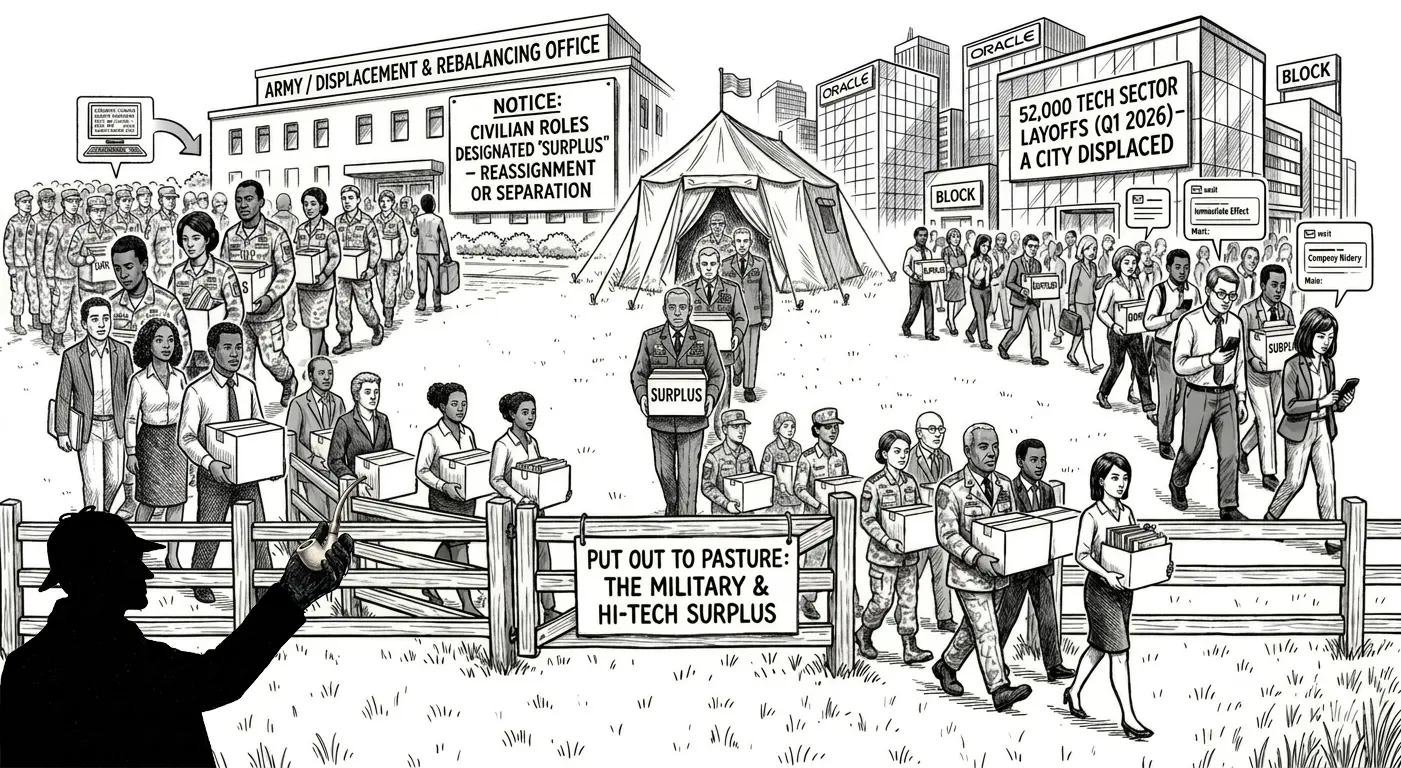
    Inside the Army: thousands of civilian employees were notified their roles had been designated “surplus” under a rebalancing initiative. They were given days to accept reassignment — potentially to different states or different countries — or face separation. The tool used to identify matching positions for displaced employees was an AI system developed by Palantir, housed in the Army’s Vantage platform.

    The institution that this week removed its senior leadership for insufficient ideological alignment simultaneously used an algorithmic tool to sort its civilian workforce into necessary and unnecessary. The Palantir system did not determine policy. It processed the inventory.

    Across the broader economy: the first three months of 2026 produced 52,000 U.S. tech sector layoffs — roughly the entire workforce of a mid-sized American city — the highest first-quarter total since 2023. Oracle notified somewhere between 20,000 and 30,000 employees by early-morning email with immediate effect, one of the largest single layoff events in the company’s history. Block eliminated 4,000 of its roughly 10,000 employees. Atlassian cut 1,600 roles while simultaneously hiring 800 AI-focused replacements. The categories most heavily displaced: customer support, content creation, quality assurance, project management.

    Jack Dorsey’s internal memo at Block was notable for its directness. The cuts were not attributed to financial difficulty. They were attributed to the growing capability of AI to perform a wider range of tasks.

    A global study published this week by LHH, a division of the Adecco Group, surveyed employers directly. Nearly half reported they had already reduced headcount due to AI implementation. An additional 54 percent said they expect further AI-driven reductions within five years. This is the demand side of the same story — not companies announcing layoffs, but employers confirming, in aggregate, that the reduction of human labor is now standard operating procedure.

    The displacement is not uniform. It is moving through specific categories of work, in a specific order, at an accelerating pace. The people now watching from what feels like a safe distance are in categories that have not yet been reached.

    The silence won’t feel like silence. It will just feel like the way things are.


    What these three stories share is not a theme. It is a sequence.

    The institution purges the leadership that won’t recompose its membership criteria. It deploys an algorithmic tool to sort the remainder into necessary and unnecessary. And the organization that will train the next generation of AI systems on human knowledge acquires a stake in the discourse that knowledge comes from.

    In each case the stated rationale is neutral: leadership change, workforce rebalancing, strategic acquisition. In each case the structural result is the same. The room gets smaller. The criteria for who belongs in it are rewritten without being stated. And the tools that will mediate what the next generation knows are moving closer to the people who are doing the rewriting.

    First they recomposed the promotion lists, and the mid-career officer said nothing, because she was not on the list. Then they designated the civilian workforce surplus, and the contractor said nothing, because he was not in that rebalancing. Then the organization that trains the systems on human knowledge acquired a stake in the discourse, and the knowledge worker said nothing, because her category had not yet been reached.

    The categories are not fixed. They are a sequence.

    Pastor Martin Niemöller wrote his confession from inside a concentration camp. He had not been alarmed when the sequence started. His category, he had assumed, was different.

    The pattern is the same. The speed is not.


    Sources

    Section I
    https://www.military.com/daily-news/headlines/2026/04/02/army-chief-forced-out-iran-war-hits-new-phase.html
    https://www.foxnews.com/politics/army-chief-staff-ordered-retire-immediately-hegseth-continues-pentagon-shakeup
    https://www.aa.com.tr/en/americas/us-military-leadership-reshaped-as-defense-secretary-forces-dozens-of-senior-officers-out/3890199
    https://www.trtworld.com/article/42f5b8e54457

    Section II
    https://techcrunch.com/2026/04/02/openai-acquires-tbpn-the-buzzy-founder-led-business-talk-show/
    https://openai.com/index/openai-acquires-tbpn/
    https://www.cnbc.com/2026/04/02/openai-acquires-tech-podcast-tbpn.html

    Section III
    https://federalnewsnetwork.com/army/2026/03/army-rebalancing-effort-forces-civilians-to-accept-reassignments-to-avoid-layoffs/
    https://defensescoop.com/2026/03/26/army-rebalancing-civilian-workforce-reassignments-separations/
    https://www.cnbc.com/2026/03/31/oracle-layoffs-ai-spending.html
    https://www.blockchain-council.org/layoffs/layoff-narratives-tech-companies-blaming-ai/
    https://www.eweek.com/news/more-tech-layoffs-ai-job-impact-2026/
    https://www.staffingindustry.com/news/global-daily-news/ai-driven-job-cuts-surge-study-warns


    TNG: Notes from the Field publishes on a fortnightly cadence. Out-of-cycle dispatches appear when the material requires it. The Narrow Gate is publishing April through September 2026 at [link].

  • Warehouse Acquisition

    Warehouse Acquisition

    NOTES FROM THE FIELD
    April 1, 2026

    — THE INFRASTRUCTURE REMAINS —
    The Warehouse Acquisition Program as Durable Architecture

    — WHAT IS ACTUALLY BEING BUILT —

    In July 2025, Congress allocated $45 billion to ICE for immigration detention — more than a decade of normal detention funding delivered in a single appropriation. ICE is now the highest-funded law enforcement agency in the United States.

    The initial plan was leased tent camps. One was built — Camp East Montana on Fort Bliss in El Paso — and became immediately notorious. Three people have died there since it opened in August 2025, including what is reported as the first homicide in a modern ICE detention facility. Conditions documented by ICE’s own inspectors included dozens of violations of federal detention standards in the first two months of operation.

    The tent camp model was abandoned. What replaced it is more consequential.

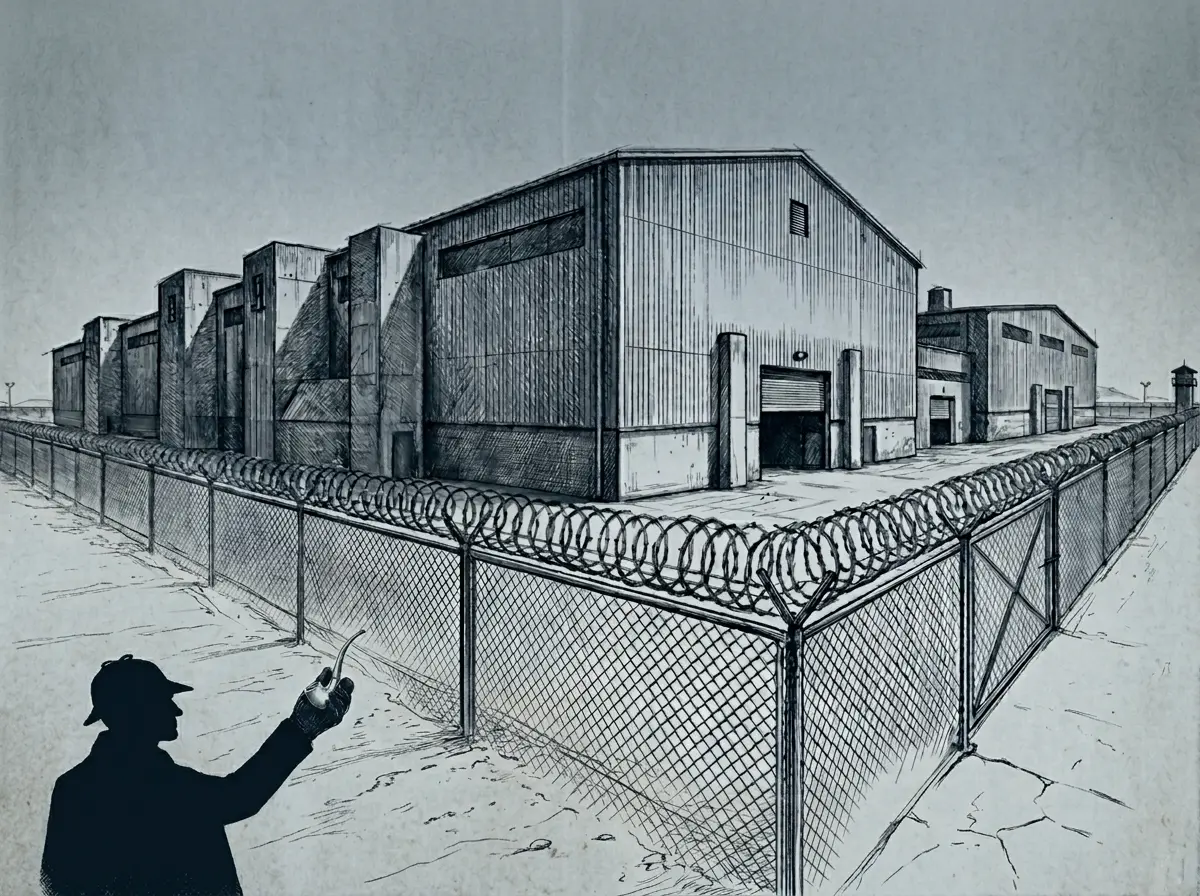
    ICE has now launched what it calls the “ICE Detention Reengineering Initiative.” The plan: purchase commercial warehouses outright, retrofit them into a national network of detention facilities, and consolidate the current system of roughly 300 facilities down to 34 — organized as 8 “mega centers” holding 7,000 to 10,000 people each, and 16 regional processing centers holding 1,000 to 1,500. Total planned capacity: 92,600 people.

    The purchases are already underway. As of early 2026, ICE has spent more than $690 million acquiring at least seven industrial warehouses in Maryland, Arizona, Georgia, Texas, Pennsylvania, and Michigan. A single warehouse near El Paso cost $123 million. One in Hagerstown, Maryland: over $100 million. One in Surprise, Arizona: $70 million. One in Berks County, Pennsylvania: $87 million — 520,000 square feet. The total retrofit and acquisition budget is $38.3 billion.

    Before February 2025, ICE owned 10 of the 220 facilities it used. The stated plan is now to own the infrastructure entirely, with private contractors hired to operate it.

    The shift from leasing to owning is the critical structural fact.

    — WHY THE SHIFT MATTERS —

    Leased facilities can be returned. Contracts can be terminated. Political pressure can reach the private owner. Community opposition can reach the seller, and has — at least 12 purchases have been blocked this way, and two announced deals fell through under pressure.

    Owned infrastructure cannot be returned. Once the federal government holds title to 34 warehouse-scale detention facilities distributed across the national geography, the infrastructure exists independent of its current stated purpose. The legal authority that built it is Section 1231(g) of the U.S. Code, which authorizes ICE to acquire facilities for the detention of non-citizens. The physical infrastructure that results has no such limitation.

    A warehouse in Berks County, Pennsylvania, retrofitted to hold 1,500 people, is — after its current occupants have been deported — a facility that holds 1,500 people. The legal designation of who qualifies for detention is a policy decision. The infrastructure is permanent.

    This is not speculation. It is the nature of infrastructure. Roads built for military use carry civilian traffic. Internment camps built for one designated population have been repurposed in every historical instance where the original population was exhausted or dispersed. The facilities do not come down. The justification changes.

    — THE QUESTION THIS RAISES —

    The “Sequence” dispatch asks what happens when the technology reaches the rungs where the people who built this system live — when the economically displaced citizens find no legal mechanism to claim their share of the automated abundance.

    This addendum adds the physical infrastructure dimension: when that displacement arrives at scale, the warehouses will already exist. Owned. Geographically distributed. Designed to hold people at capacity pending legal resolution of their status.

    The acting ICE director described the goal of the new system as “Amazon Prime, but with human beings.”

    Amazon’s warehouse network is not built for one product. It is built for throughput. The product changes. The infrastructure scales.

    The silence won’t feel like silence. It will just feel like the way things are.

  • Ducks in a row

    Ducks in a row

    NOTES FROM THE FIELD
    April 1, 2026

    — THE SEQUENCE —
    Birthright Citizenship, the Robot Economy, and the Architecture of Exclusion

    The Supreme Court heard arguments today on birthright citizenship. The framing in most coverage is immigration law. The framing in constitutional commentary is 14th Amendment precedent. Both framings are correct and both miss the more durable structural question.

    The question is not what the law says. The question is what the sequence is — and why the sequence matters.

    — I. THE PIECES ARE VISIBLE —

    Three things are true simultaneously and are being discussed as if they are separate stories.

    First: The current administration is aggressively dismantling the legal standing of non-citizen residents — through deportation, visa revocation, birthright restriction, and the construction of expanded detention infrastructure. Every lower court that has reviewed the birthright order has found it unconstitutional. It remains in litigation. If ultimately upheld, it would deny citizenship to an estimated 250,000 children born on U.S. soil annually going forward.

    Second: The robot economy is not a future scenario. It is an accelerating present. At Davos in January 2026, Palantir CEO Alex Karp stated explicitly that AI will render large-scale immigration to support Western labor markets “virtually obsolete.” The Wharton Budget Model projects AI will produce labor savings averaging 25 percent by the mid-2030s, potentially rising to 40 percent. Amazon, UPS, Accenture — the displacement of both blue- and white-collar work is already in motion.

    Third: The infrastructure being built to manage this transition — the AI systems, the robotics platforms, the data architecture — is owned privately. Not publicly. The concentration of that ownership is accelerating in parallel with the displacement it produces.

    Each of these is being reported. None of them is being reported as a single story.

    — II. THE SEQUENCE —

    Here is what the sequence looks like when you read it structurally rather than politically.

    The robot economy will not need the labor of the currently excluded. Within a decade, it will need very little human labor at any level except at the apex of ownership and engineering. The wealth produced will be real and substantial — and it will belong to those who own the infrastructure.

    The people who currently hold the least secure legal standing — undocumented workers, temporary visa holders, children of non-citizens — are precisely the people whose labor the economy will stop needing first. They are the most automatable, the least legally protected, and the least positioned to claim any share of the abundance their displacement produces.

    If you wanted to design a system in which a transition to a robot economy produced maximum wealth concentration with minimum claim on that wealth by displaced workers, you would do exactly what is being done. You would establish the legal architecture of exclusion before the economic displacement is complete. You would build the hierarchy in law before the labor becomes unnecessary, so that when the labor becomes unnecessary, the excluded have no legal standing from which to make a claim.

    No conspiracy is required. The people in the room share a common interest in the outcome.

    — III. THE LADDER —

    Here is the question this dispatch cannot answer but must ask.

    Every hierarchy has a bottom rung. The current effort is aimed at that rung — at the non-citizens, the undocumented, the legally precarious. The warehouses to hold them are already under construction.

    But technology does not stop at the bottom rung. It moves up.

    The automation that replaces the undocumented agricultural worker will next replace the documented one. The AI that displaces the call center worker will next displace the mid-level analyst, the paralegal, the junior accountant. The Wharton model projects that 40 percent of current GDP activity will be significantly impacted by AI — and that impact falls most heavily in the middle third of the income distribution, not the bottom.

    Which produces a question that the people now watching the deportations from a comfortable distance have not yet asked themselves: when the ladder is pulled up from the bottom, and the rungs above begin to disappear — what is the legal and economic mechanism by which the newly displaced make a claim on the abundance the machines are producing?

    There isn’t one. Not yet. And the legal architecture being built right now is not designed to create one.

    Pastor Martin Niemöller, writing from inside a Nazi concentration camp where he eventually landed after years of silence, gave us the operating principle. He was initially not alarmed when they came for the Communists, because he was not one. Not alarmed for the Socialists. Not alarmed for the trade unionists. Not alarmed for the Jews. His insight, written in confession rather than prophecy, was that the categories of the excluded expand — and that the comfortable assume their comfort is structural rather than temporary.

    The working-class voter who supports the deportations because he is not an immigrant. The mid-career professional who supports automation because she is not in a vulnerable sector. The small business owner who supports the consolidation because he is not yet the one being consolidated.

    Niemöller’s original formulation was premised, scholars note, on naming groups his audience would instinctively not care about. That was the indictment. The poem was not a description of what happened to others. It was a confession of what he failed to understand was happening to him.

    The frog does not feel the water heating. The temperature feels like the way things are.

    — IV. WHO ELSE IS CONNECTING THIS —

    The pieces exist in the literature. The connection does not.

    Yuval Harari has named the “useless class” — the population whose skills automation renders obsolete — since 2017. At Davos 2026, he warned that AI will create immense wealth in a few high-tech hubs while other economies become what he called data colonies. He identifies the wealth concentration problem clearly. He does not connect it to immigration restriction as preparatory legal architecture.

    Academic economics has documented the substitution relationship: regions with fewer immigrant workers adopt robots faster; regions with more adopt them slower. Immigration and automation are substitutes in the labor market. The literature has the mechanism. It has not drawn the political conclusion.

    One independent publication, writing in February 2026, came closest — arguing that immigration crackdowns remove labor from the economy precisely as automation makes large-scale capital adoption necessary, and that only firms large enough to absorb the automation investment survive the transition. It names the consolidation dynamic. It frames it as accusation rather than structure, which limits its reach.

    The structural argument — that legal exclusion is being built before economic displacement rather than after, specifically so the excluded population has no standing to claim a share of what their displacement produces, and that the exclusion will not stop at the currently excluded — does not yet exist in published form.

    It will.

    — V. WHAT THIS ADDS TO THE ARGUMENT —

    The Narrow Gate, publishing beginning this month, establishes a 1,500-year pattern: institutions consistently make decisions that concentrate interpretive authority and fix the categories of belonging before the conditions that would distribute it more widely can take hold. The Council of Constantinople did not abolish reincarnation because it was theologically settled. It abolished it because a soul that travels through all conditions cannot be permanently assigned to any one of them — and permanent assignment is the prerequisite for permanent hierarchy.

    What is being argued at the Supreme Court today is whether the accident of birth can be made permanently determinative of legal standing. What is being built in parallel is an economy in which legal standing will determine access to the abundance produced by machines that no longer need the people they replaced.

    The unanswered question — the one this dispatch is recording because it must be recorded — is what happens when the technology reaches the rungs where the people who built this system live. Whether the legal architecture they constructed to exclude others will protect them. Whether they will recognize the water temperature before it is too late to step out.

    History suggests they will not. History suggests they will assume their rung is different.

    The tool changed with the century. The problem being solved did not.

    The silence won’t feel like silence. It will just feel like the way things are.

  • South Maui Beaches

    South Maui Beaches

    Life is at the beach and Kihei has almost 2 dozen of them with soft golden sand and one with black sand. All of them are a great place to spend some time whether you want to sit on the sand or frolic in the water & waves.

    Kihei Beaches (North to South)

    Wailea & Makena Beaches (North to South)

    • Keawakapu Beach I, II,: A long, sandy beach stretching from South Kihei into Wailea.
    • Ulua Beach: Highly popular for snorkeling and scuba diving.
    • Mokapu Beach: Excellent snorkeling; adjacent to the Wailea Renaissance.
    • Wailea Beach: Classic resort beach with luxury views.
    • Polo Beach: Good snorkeling and swimming in front of the Polo Beach Club.
    • Palauea Beach (White Rock): A long, less crowded white sand beach. A locals beach
    • Po’olenalena Beach: A picturesque spot great for relaxing.
    • Chang’s Beach: Small, quiet cove popular with locals.
    • Maluaka Beach (Turtle Town): Famous for snorkeling with sea turtles.
    • Oneuli Black Sand Beach: Unique, dark sand beach with good snorkeling.
    • Makena State Park (Big Beach/Oneloa): One of Maui’s largest beaches, known for its powerful shorebreak.
    • Little Beach (Pu’u Ola’i): A hidden, scenic cove next to Big Beach.
    • Pa’ako Cove (Secret Cove): A popular, picturesque spot for weddings.
    • La Perouse Bay: Located in the Ahihi-Kinau Natural Area Reserve; excellent for snorkeling.
  • On theRroad

    On theRroad

    Trading my SSH terminal for the newly remodeled PDX terminal.

    This is our first time through. It is simply beautiful.

    Key Facts and Features
    Mass Timber Roof: The centerpiece is a 400,000-square-foot roof made of 18 million pounds of locally sourced timber, built off-site and lifted into place.
    Design & Sustainability: Designed to evoke a “walk in the forest,” the terminal features 49 skylights to maximize natural light and incorporates over 30 trees and 5,000 plants, targeting LEED Gold certification.
    Improved Flow: The project doubled the size of the ticketing and lobby area, with four new, open-concept “island” check-in counters and a faster, more efficient TSA security checkpoint.
    Local Focus: The redesign emphasizes Portland’s culture with local restaurants, shops, and the return of the iconic PDX carpet in select areas.
    Construction Method: To avoid shutting down the airport, the new roof was built over the old terminal, which was then dismantled beneath it.
    Timeline: The first major phase opened in August 2024, with final completion scheduled for late 2025.
    Project Goals
    Seismic Upgrades: The new structure is designed for resilience, featuring advanced, flexible engineering to withstand major earthquakes.
    Capacity Expansion: The remodel ensures the airport can handle up to 35 million passengers annually by 2045.
    Regional Collaboration: 30,000+ workers and roughly 150 small businesses contributed to the construction.
    Project Funding: The project is primarily funded by airlines and airport tenants, not local taxes.

  • Margie’s Xmas Gift

    Margie’s Xmas Gift

    My Christmas gift to Marge arrived a few weeks late, but it did arrive. She now has a smart office, the smartest room in our smarter home.It took a little bit of hardware and a smaller bit of configuration for her dark office to light up by simply entering the room. If she’s gone for 3 minutes the lights will turn off, waiting for the next entry.

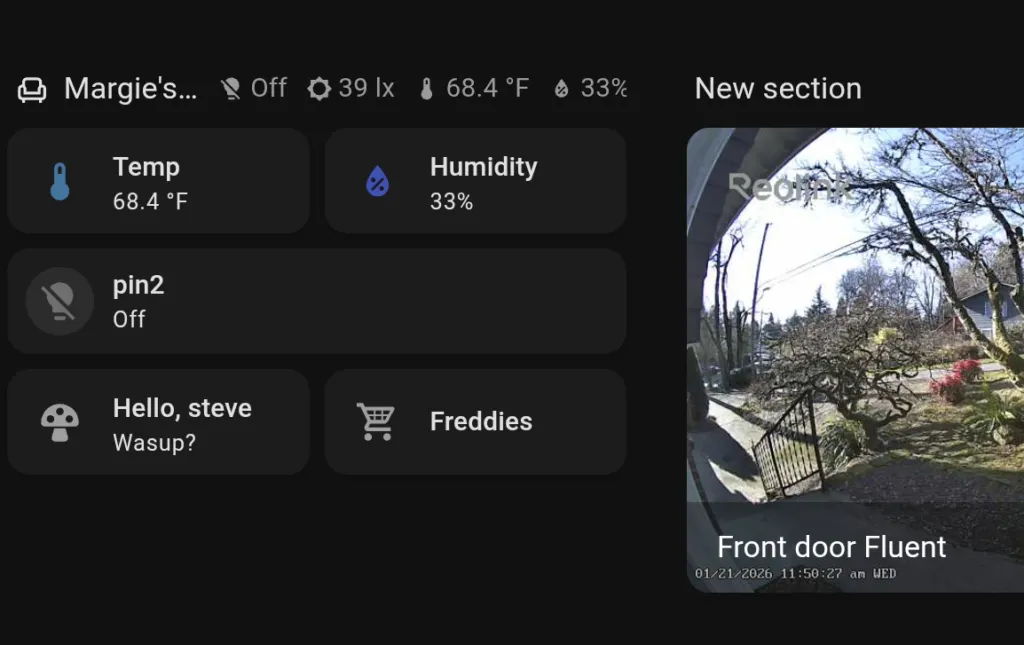
    To sense someone in the room takes a sensor, we are using a millimeter microwave with included luminance sensor. A table lamp has a smart bulb. Home Assistant talks to these devices over the zigbee network they create. A second sensor provides temperature and humidity in the room.

    The code is real simple. If the luminance meter indicates less than 20 lux and the presence sensor indicates a person is present, then turn on the light and keep it on as long as someone is in the room. If no one is in the room for 3 minutes, turn the lights off.

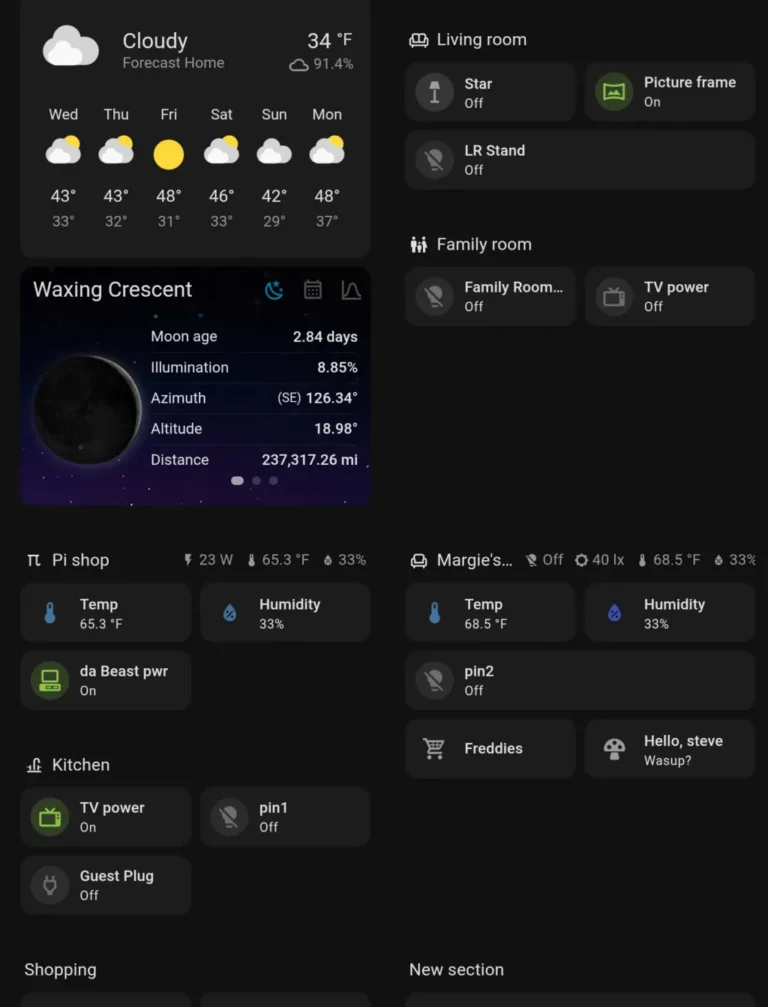
    When creating dasboards there are lots of options, from the tools to use to what you want to see or do from the dashboard. This is the one I set up for Margie. Able see the status and to control much of house, from her easy chair or beach chair.

    I have a different dash for my view. Each is a tab, so it is easy to swipe between the two, or add more as desired.

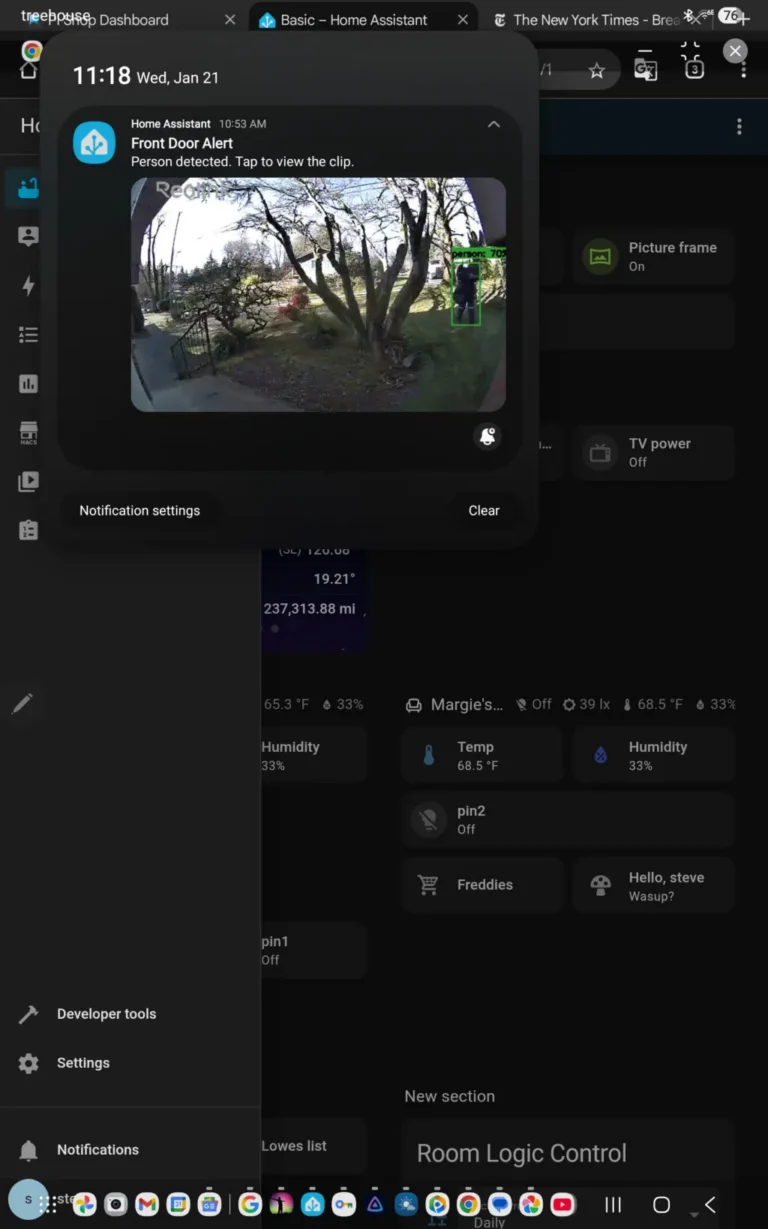
    HA is doing a good job of being an assistant. Adding calendars, weather forecast, live front door feed to HA shopping lists, or a gazillion other ways to tailor it to your needs and desires is truly making our homes smarter and taking us into the age of George Jetson.

    Notifications from HA are the new norm. Don’t have to wonder if the mail was delivered.

  • Owsley ‘Bear’ Stanley

    Owsley ‘Bear’ Stanley

    I was never a deadhead, but with the recent passing of Bob Weir I watched several videos of him performing with others. It didn’t take too long for the algorithm to offer me this one about the soundman for the Grateful Dead and the person responsible for the Dead’s rise to fame and so much more. All to provide a better concert sound experience.
     

    The story of how the logo for the dead came about is also interesting. You can learn more here.