Block 11, Article 2 — The Bill Has a Due Date. It Was Published in February.
The bill has a due date. It was published in February.
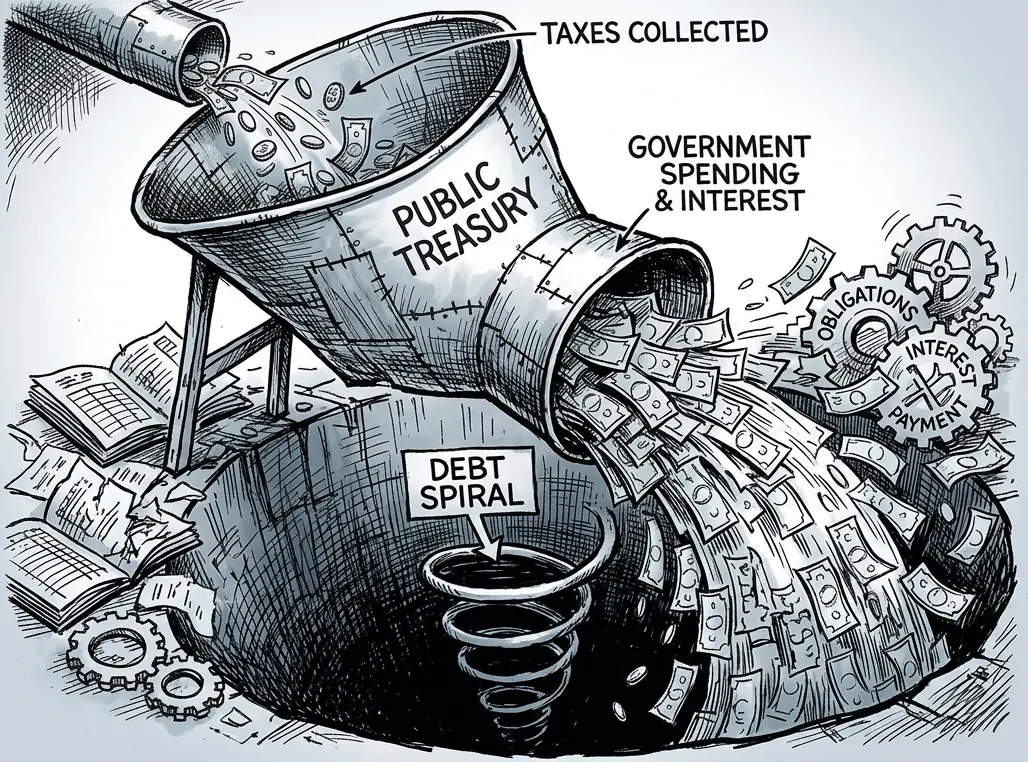
The Congressional Budget Office released its Budget and Economic Outlook on February 11, 2026. It is not a partisan document. It is a federal agency’s actuarial reading of the nation’s books. What it showed: federal interest payments in fiscal year 2026 will reach $1 trillion — exceeding defense spending and becoming the fastest-growing line item in the entire federal budget. By fiscal year 2031, the interest rate on the national debt is projected to exceed the economy’s growth rate. When that happens, the debt becomes self-compounding. It grows faster than the capacity to service it. The Committee for a Responsible Federal Budget named the condition directly: a debt spiral.
On March 30, 2026, Jerome Powell — the chairman of the Federal Reserve, not an opposition politician, not an advocacy group — walked into a Harvard economics class and told the students that the country’s fiscal path will not end well if we don’t do something fairly soon. The man running the nation’s central bank said that out loud, at a university, to students who will be paying the bill for decades. The remark was covered briefly and then the news cycle moved on.
The bill arrives in 2031. It is on a known schedule. The CBO already published it.
How a bathtub empties.
The debt did not accumulate randomly. It has a mechanism, and the mechanism runs in two directions simultaneously: spending went up while revenue was deliberately reduced.
Start with the revenue side. The Tax Cuts and Jobs Act of 2017 was scored by the CBO at $1.3 trillion over ten years. The reconciliation act signed July 4, 2025 added $4.7 trillion to projected deficits for 2026 through 2035. At the moment that bill was adding $4.7 trillion to the debt, it also cut coal royalty rates on public lands from 12.5 percent to 7 percent and rolled oil and gas royalty rates back to 12.5 percent — the rate set in the Mineral Leasing Act of 1920. The hardrock mineral royalty rate, for gold now worth $3,200 an ounce, remains zero — set in 1872. Carried interest, which allows private equity managers to treat compensation as capital gains, has been identified as a closure target by administrations of both parties for two decades. It remains. The room protecting extraction income from full taxation is the same room running up the debt and pointing at the debt to justify cutting everything else.
Now the spending side. The Iran war cost $11.3 billion in its first six days — the Pentagon’s own figure, delivered in closed congressional briefing. CNN reported the true cost, including base repairs and destroyed assets, is closer to $40 to $50 billion. The Trump administration has since requested a $1.5 trillion defense budget for the coming year — a 42 percent increase and the largest expansion of military spending since World War II. The CBO baseline that projects the 2031 debt spiral was modeled before the Iran conflict affected any of these numbers. The baseline is the floor.
The extraction income left public land in private pockets. The revenue the public never collected from its own resources had to be borrowed instead. The borrowed money compounds. The interest on it now exceeds defense spending, and the defense spending is itself expanding at a pace not seen since 1945.
The deficit is not the cause. It is the receipt. And the room that ran it up is the same room that will be asked to close it.
The federal deficit is framed as a spending problem — entitlement costs, discretionary programs, the line items proposed for cutting in every austerity plan. The $4.7 trillion added to the deficit by the same bill that rolled back the coal and oil royalty rates, and the revenue never collected from public land in the century before that, were not in that frame.
The spiral has a second engine.
Jennifer Harris, a former National Security Council economics official, identified a dimension of the debt problem that the rooms tracking the deficit are not running. Each dollar shifted from labor income to capital income produces a 10 to 15 cent loss in federal tax revenue. The reason is structural: wage income is subject to both income tax and payroll tax, at rates that start immediately and apply to every dollar. Capital income — dividends, realized gains — is taxed at lower rates, is frequently deferred, and in some structures is never taxed at all. The billionaire whose investments generate tens of millions in annual returns pays no payroll tax regardless of the amount. The worker earning $40,000 pays 7.65 percent on every dollar earned.
The AI displacement wave documented in Article 1 is not a separate crisis from the debt spiral. It is the debt spiral’s second engine. The income being destroyed is wage income taxed at full rates. The income replacing it accrues to capital owners taxed at half rates or less. Scale the displacement projections across a decade and the fiscal impact is not a rounding error. The Social Security trust fund — funded entirely by payroll taxes on wage income — is now projected to reach exhaustion in 2032, inside the displacement window, with a 28 percent across-the-board benefit cut following in the year after. The people paying into that system their entire working lives are simultaneously the people most exposed to the displacement wave that will reduce the contributions sustaining it.
The two rooms tracking these problems are not talking to each other. The room modeling AI displacement is not running the tax revenue math. The room projecting the debt trajectory is not modeling the payroll tax base erosion from ten million displaced workers. The connection is not invisible — Harris wrote it in the New York Times in April 2026. It is simply not being run by the room that would need to act on it.
The income tax, and the payroll tax built on top of it, were always the substitute bill — the charge sent to labor to cover what the extraction industry’s below-market royalty rate never paid, going back to 1920. When the wage income disappears into automation, the substitute bill can no longer be collected either. The original bill, deferred for over a century, comes due at the same moment as its replacement.
What the schedule means.
Two of the three crises arriving in Block 11 are theoretically recoverable. A functioning democratic room could raise revenue, reform the tax code, manage the displacement transition, and service the debt without a spiral. The debt does not behave like the Ogallala Aquifer. It is not a physical resource depleted on a geological timeline. It responds to political decisions, and political decisions can change.
The 2031 threshold is not a cliff. It is a window. The closer the interest rate gets to the growth rate — and the CBO projects they meet in 2031 and then cross, with the interest rate pulling ahead — the narrower the range of corrective options becomes and the more each year of delay costs in compounding interest. The room that cannot respond is the same room that would need to authorize the response. That is Article 4’s argument. Here, the point is simpler: the bill is published. The due date is known. The schedule has not been contested by anyone with the authority to change it.
Jerome Powell said it will not end well if we don’t act fairly soon. He said that in March 2026. The CBO had published the number six weeks earlier. The reconciliation act adding $4.7 trillion to projected deficits was still working through Congress at the time.
The natural capital column does not offer the same options. That is Article 3. The debt, unlike the aquifer, is a political choice and not a geological one — which is exactly why Block 12 opens with it.
The record is public. Look it up:
| CBO Budget and Economic Outlook, February 2026 | cbo.gov/publication/61882 |
| Jerome Powell remarks at Harvard, March 30, 2026 | news.harvard.edu/gazette |
| Iran war cost — Pentagon figure and CNN analysis | nbcnews.com |
Ask an AI assistant: “What does the CBO project for federal interest payments relative to defense spending through 2031, and what does it mean when the interest rate on the debt exceeds the economy’s growth rate?”
— — —
Steve Sagnotti
is a serious amateur photographer, writer, and technologist based in Oregon. With his camera he tries to capture common images not often seen, leading to common questions not often asked.
© 2026 Steve Sagnotti
— — —
Sources
1. CBO debt spiral projections
CBO’s February 2026 “Budget and Economic Outlook” remains the most current CBO release (Congressional Budget Office, The Budget and Economic Outlook: 2026 to 2036, February 11, 2026).
2. Iran war cost
Pentagon’s $11.3B first-six-days estimate, from the same closed-door Senate Appropriations briefing (NBC News, First 6 days of Iran war cost $11.3 billion, Pentagon tells Congress; The Hill, Pentagon estimates first 6 days of Iran war cost $11.3B; Fox News, Pentagon estimates Iran war cost $11.3B in the first six days in closed-door congressional hearing: report); CNN’s $40–50B estimate including base-repair/reconstruction costs (CNN, Repairing damaged US military bases will add billions to Iran war cost, sources say, April 29, 2026); Trump’s $1.5T FY2027 defense budget request, officially unveiled April 3, 2026 (Reuters, Golden Dome, ships and missiles top Trump’s $1.5 trillion fiscal 2027 defense wish list; Washington Post, Trump proposes record-breaking defense spending in budget request; Al Jazeera, Trump seeks historic $1.5 trillion for military in Congress budget request; NPR, Trump budget seeks $1.5 trillion in defense spending alongside domestic program cuts).
I couldn’t find a CSMonitor piece carrying the $11.3B figure specifically — flag that outlet for removal or replacement unless you have a direct link on file already.
3. Social Security trust fund exhaustion 2032 and 28% cut
CBO testimony (cbo.gov/publication/62271, March 25, 2026) states OASI exhaustion in 2032 with a 28% average benefit reduction in the 2032–2036 period.
4. Jennifer Harris mechanism
Jennifer M. Harris (Director, Economy and Society Initiative, William and Flora Hewlett Foundation; former economic official, Biden White House), New York Times opinion piece (A.I. Is Strangling Our Economy, June 29, 2026). Direct quote: “Economists estimate that as $1 of value creation shifts from workers to owners, total tax revenue falls on the order of 10 to 15 cents.”
Leave a Reply