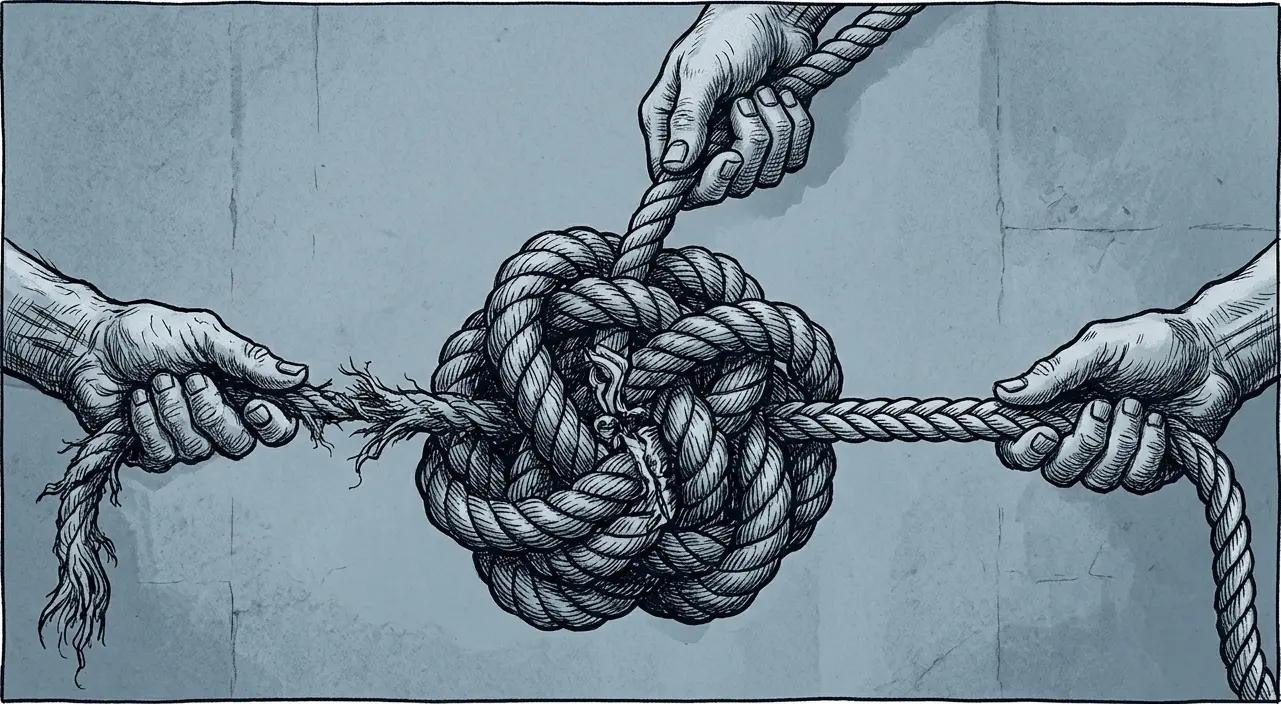
Block 12, Article 1 — The Coin Was Never Fair
“Just pass campaign finance reform.” Congress could, tomorrow — a bill capping campaign spending would clear both chambers if leadership ever brought it to the floor. It would not survive contact with the bench that decided Buckley v. Valeo and Citizens United v. FEC. Money is speech, the doctrine holds, and speech cannot be capped. The new statute reopens the same door the Court has already held shut, from two different directions, across four decades.
“Just vote the bums out.” The general election is not where that decision gets made. Block 3 documented the map drawn to make an incumbent’s seat mathematically safe regardless of performance. Blocks 4 and 5 documented the primary that decides the outcome before a single general-election vote is counted, in a system 45 percent of voters are structurally excluded from. By the time “vote the bums out” reaches a ballot, the bums have already been selected twice.
“Just reform the filibuster.” True — it is a Senate rule, not a law, changeable by a simple majority vote. But the majority that would have to change it is elected under the same map, through the same primaries, protected by the same bench. The fix and the obstacle sit in the same body, and the body has no structural incentive to fix itself.
Three fixes. Three different locks — the bench, the map, the chamber’s own rules. Same result each time, and not by coincidence: each was tried in isolation against a system built to absorb single-lever attacks. What connects them is not that any one is uniquely broken. It’s a rule this whole block will keep testing.
Each of those three fixes failed for the same underlying reason, and the reason has a name. The installed lens is the frame inherited as normal — the bench’s reading of the First Amendment, the map as drawn, the filibuster as tradition — presented as the natural shape of things rather than as a series of specific choices made by specific people in specific rooms. A lens installed carefully enough doesn’t need to be defended. It just needs to go unnoticed. Every article in this block is an attempt at the opposite: naming the lens, then showing what a working frame produces once it’s set aside.
Every guarantee in this series has an enforcement record. Look at both sides of it.
The royalty rate written into federal leasing law in 1920 was reaffirmed in 2025’s budget reconciliation bill — the same 12.5 percent, untouched for the sixth decade running, protected by an act of Congress. The Bayh-Dole Act gave the federal government the statutory right to license publicly funded pharmaceutical patents to competing manufacturers whenever the price runs too high. Forty-five years, and the right has never once been used. Citizens United’s line of cases has been extended in every subsequent ruling, never narrowed. Guarantees that protect extraction get enforced, re-affirmed, and left running. Nobody has to file a motion. The room takes care of it.
The 2025 reaffirmation of the 1920 royalty rate was framed as routine language in a must-pass reconciliation bill, unremarkable next to everything else the bill did. That it was the sixth consecutive decade the same rate had been affirmatively re-committed to, rather than merely left unrevisited, was not in that frame.
Now look at the other side of that same room. The Voting Rights Act’s preclearance formula — the requirement that states with a history of voting discrimination get federal approval before changing their voting laws — was gutted in 2013, and has not been restored in the thirteen years since — the “temporary” impairment now outlasting the “temporary” protections it once enforced. Treaty fishing rights, forty acres, tribal land allotments: each written into law with the same formal weight as the royalty rate, each treated afterward as though the paper had never been signed. In June 2026 the Supreme Court ruled, in Mullin v. Doe, that federal Temporary Protected Status determinations — the status that lets people from countries in active crisis stay and work legally rather than being deported into it — are not subject to judicial review at all — not wrongly decided, not narrowly interpreted, simply outside the courts’ authority to examine, whichever administration invokes it and for whatever reason it gives. A guarantee running toward the dispossessed doesn’t get weakened. It gets a door built into it, in advance, the exit already marked before the guarantee was fully signed.
This is not a coincidence occurring twelve separate times. It is a single rule, applied without exception across two centuries and every mechanism this series has documented: the room enforces what it wrote for itself, permanently, and treats what it wrote for everyone else as provisional. Call it heads I win, tails you lose. The coin was never fair. It was never meant to be flipped.
That asymmetry has a mechanism underneath it, and naming the mechanism matters more than naming the pattern, because the mechanism is what tells you which repairs will actually work.
The room does not fail to enforce guarantees at random. It responds to threatened revenue — not to visibility, not to consensus, not to correctness. Start with proximity. Food inspectors exist because the executive who owns the plant eats from the same supply chain as everyone else; contamination doesn’t check income before it spreads. Extraction oversight stayed thin for the opposite reason: the aquifer being drawn down, the royalty rate held at 1920 levels, none of it reaches the table of the person who could fix it. Proximity to harm, not the scale of the harm, predicts whether a check ever got built.
The second mechanism is exit. People with the means to leave a degrading shared system do — better schools, private security, a house upwind of the smoke — and each exit removes one more voice that might otherwise have pushed to fix the system everyone else stays stuck inside. Exit has its own failure mode, running right now: the wildland-urban interface was the affordable escape from urban decline for decades. Wildfire has started closing that exit specifically for the people who needed it to stay affordable — insurers have withdrawn from fire-prone markets, state insurer-of-last-resort plans are overloaded, and property values in the most exposed counties are already measurably falling. The truly wealthy can still self-insure through the loss. The people who bought the affordable version of the same exit can’t.
The third mechanism used to be optics, but optics only ever worked as a proxy for the first mechanism, not a substitute for it. Factory floor deaths photographed in the street were a cost the room couldn’t keep off its own ledger; that is what forced safety regulation, not a sudden attack of conscience. A union strike works the same way — visible, disruptive, expensive to ignore. What automated workforce reduction removes is exactly this lever. A layoff-by-algorithm produces no photograph. It is a line on an earnings call, individualized, diffuse, impossible to organize a picket around because there is no single decision anyone can point to. The mechanism that used to convert visibility into revenue pressure has lost its grip, and nothing has replaced it.
None of the firms making that calculation is wrong about its own ledger, which is what makes the trap durable. Every firm optimizing its own labor cost is making a locally rational choice. The aggregate is where the wage base that funds aggregate demand quietly disappears, and no single firm’s ledger has a line for that.
Run the whole model against its hardest case, and it survives. Ninety percent of the public supports background checks. Eighty-three percent supports drug price negotiation. Eighty-six percent supports raising the minimum wage. None of the three has ever received a floor vote, because none of the three threatens a donor relationship that already sits inside the room. Even the cases that look like pure moral victory ran on the same fuel underneath: the Montgomery bus boycott was a sustained revenue strike against a transit system, and Birmingham’s downtown business community pushed the city toward desegregation because sustained unrest was measurably killing commerce. The model doesn’t just explain why the room ignores ninety percent of the public. It explains how the ninety percent wins, on the rare occasions it does — not by being right, and not by being loud, but by finding the specific place where being ignored costs someone money.
Four of this block’s own repairs sit inside a single Congress-shaped version of that same room. The next article shows them, one at a time, then handed back whole.
OpenSecrets and FEC filings show donor industry breakdowns for any sitting member of Congress by name.
Pick one of the three supermajority-supported policies named above — background checks, drug price negotiation, minimum wage — and check whether your own representative’s top donor industries have a stated position against it. The pattern this article describes is either visible in that one search or it isn’t. Both answers tell you something.
— — —
Steve Sagnotti
is a serious amateur photographer, writer, and technologist based in Oregon. With his camera he tries to capture common images not often seen, leading to common questions not often asked.
© 2026 Steve Sagnotti
— — —
Sources
- Wildfire/insurability: insurance industry and state regulatory reporting — State Farm continues withdrawal from state (United Policyholders); Bloomberg: California Insurance Crisis Hits Even Homes Facing Lower Wildfire Risk; Cotality Wildfire Risk Report 2025 (FAIR Plan overload, insurer retreat from WUI); Resetting California’s homeowners insurance market (McKinsey, on the private-insurance coverage gap).
- Ford’s 1914 five-dollar day: standard labor-history record — Ford’s Five-Dollar Day (The Henry Ford).
- Background checks/drug pricing/minimum wage supermajority figures: polling aggregates — Pew Research — Continued Bipartisan Support for Expanded Background Checks on Gun Sales; Gallup — Public Solidly Supports Increase in Minimum Wage; KFF — The Public Weighs In On Medicare Drug Negotiations.
- Montgomery bus boycott / Birmingham business community: standard civil rights historical record — Montgomery Bus Boycott – Facts, Significance & Rosa Parks (HISTORY); Black economic boycotts of the civil rights era still offer lessons on how to achieve a just society (The Conversation, on the Birmingham business community angle).
- Mullin v. Doe, 609 U.S. ___ (2026), decided June 25, 2026: Mullin v. Doe | Justia U.S. Supreme Court Center; official slip opinion, supremecourt.gov.
- Buckley v. Valeo, 424 U.S. 1 (1976): Justia. Citizens United v. FEC, 558 U.S. 310 (2010): Justia.
- Shelby County v. Holder, 570 U.S. 529 (2013): Justia.
- 12.5% royalty rate, 2025 reconciliation bill: already established in Block 8 and Block 10 sourcing — no new link needed here; flagging only that your existing Block 8/10 source register entries should carry this citation forward rather than duplicating.
- Bayh-Dole Act march-in rights unused 45 years: GAO-09-742 (2009) — Federal Research: Information on the Government’s Right to Assert Ownership Control over Federally Funded Inventions; CRS IF12582 — Pricing and March-In Rights Under the Bayh-Dole Act. Note: both sources say march-in rights have never been exercised in the “more than 40/43 years” since 1980 — if your draft states a specific “45 years,” that number should trace to the current year (2025/2026) minus 1980, which checks out arithmetically, but neither primary source uses “45” verbatim, so it’s your own calculation, not a quoted figure.
Leave a Reply