Block 6, Article 3 — The End Run Around the Electoral College
© 2026 Steve Sagnotti.
There is a way to fix the Electoral College without a constitutional amendment. It has been available for twenty years. Sixty-three percent of Americans support it. Not one Republican governor has ever signed it into law.
That gap — between what the public wants and what the legislators deliver — is the article.
What winner-take-all actually is
Most people assume winner-take-all is written into the Constitution. The rule that gives every one of a state’s electoral votes to whoever wins the state, even by a single vote, even when 49 percent voted the other way — surely that’s foundational law.
It isn’t. The Constitution says states appoint electors “in such manner as the Legislature thereof may direct.” That is the entire instruction. What states do with their electors is a state-level decision, made independently by each state legislature through competitive mimicry. By 1836 every state had adopted winner-take-all because no state wanted to unilaterally reduce its leverage while others kept their full bloc. The rule that shapes the entire presidential campaign was never voted on nationally. It was adopted state by state, legislator by legislator, each one following the others.
What states chose, states can unchose. Maine and Nebraska already award some electoral votes by congressional district rather than statewide winner. The door is open. It has always been open.
The pledge
The National Popular Vote Interstate Compact is an agreement among states to award all their electoral votes to whoever wins the most votes nationally — not the state winner, the national winner. A state that voted 60-40 Republican would still cast all its electoral votes for the Democrat if the Democrat won the national popular vote. That is the mechanism. It uses the same state-level authority that built winner-take-all to dismantle it.
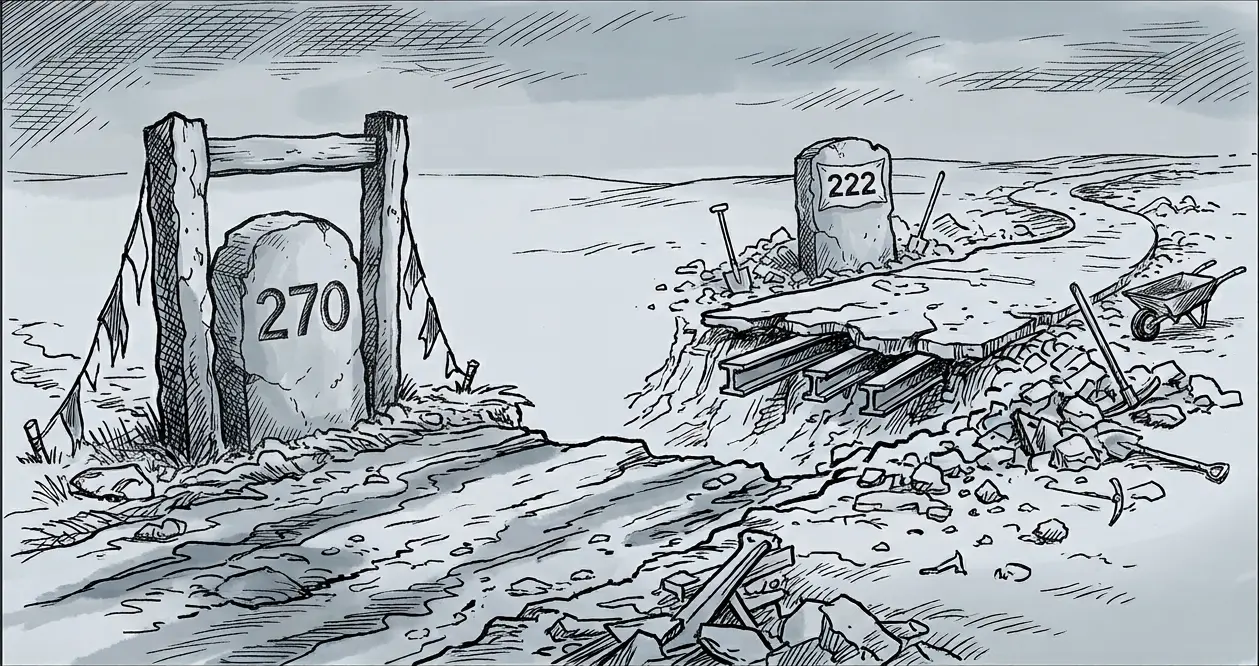
The compact has one condition built into its design: it doesn’t activate until states holding a combined total of at least 270 electoral votes have joined. Two hundred seventy is the number required to win the presidency. Below that threshold, joining is a commitment, not a binding act — no state gives up its leverage early. Once 270 is reached, every member state’s pledge activates simultaneously, and the winner of the national popular vote wins the presidency regardless of how the remaining states vote.
No constitutional amendment. No act of Congress. State legislatures using authority the Constitution already gave them.
Maryland enacted it first in 2007. As of April 2026, nineteen states and the District of Columbia — holding a combined 222 electoral votes — have joined. Virginia was the most recent. The compact needs 48 more electoral votes to take effect.
Six states have already passed it in at least one legislative chamber: Arizona, Michigan, New Hampshire, Nevada, Pennsylvania, and Wisconsin.
One more thing about the pledge: states can withdraw. A legislature that joins under one political majority can repeal under the next. The compact bars withdrawal within six months of a presidential election, but outside that window the door swings both ways. That vulnerability is real and will matter when the compact gets close enough to test.
Why it hasn’t closed
Forty-eight electoral votes. That is the distance between the current system and a president chosen by the national popular vote. What explains the gap?
Not ignorance. The compact has been introduced in legislatures across the country for twenty years. It has passed Republican-led chambers. It has cleared committees in red states. The argument has been made everywhere.
Not public opposition. A 2024 Pew Research Center poll found 63 percent of Americans support replacing the Electoral College with a national popular vote. At 63 percent nationally, that number includes substantial Republican and rural voter support. This is not a blue-state position. It is a majority position.
What explains the gap is the frame.
Republican-controlled legislatures have killed the compact with a single argument: national popular vote helps Democrats. Set that frame, and every Wyoming voter who might otherwise support it is now defending a partisan position instead of demanding their money back.
Here is what that framing displaces. Wyoming is the nation’s largest federal coal producer. Its state budget — its schools, its roads, its municipal governments — runs substantially on the 50 percent share of federal mineral royalties the state receives under the current 50-50 split. When the One Big Beautiful Bill Act cut federal coal royalty rates from 12.5 percent to 7 percent, Wyoming’s own budget analysts estimated a $50 million annual loss. The co-chairs of Wyoming’s Joint Appropriations Committee wrote to the state’s three congressional representatives a week before the bill was signed, asking them to act. All three voted for it anyway.
North Dakota derives more than half its state tax revenue from severance taxes on extraction. New Mexico more than a third. Montana’s effective coal tax rate is among the highest in the west — and its state revenues depend on the federal royalty flow. These are states whose school funding, road budgets, and municipal operations run on mineral royalty revenue negotiated under federal rates set in 1920 and protected by a Congress their senators influence disproportionately because of the Electoral College math.
The same system that undercharges for their resources gives them the political leverage to protect the undercharging. The president who appoints the Interior Secretary, who sets royalty enforcement posture, who decides how aggressively BLM pursues idle leases, is chosen by a mechanism that overweights exactly these states. Joining NPVIC changes that calculation. Under a national popular vote, the majority pushing for royalty reform is larger. The extraction industry understands this. The voters in these states have largely not been told.
There have been no ads in Wyoming explaining that the compact, if joined, could produce a president more accountable to a national majority — including the majority that believes publicly owned resources should return fair market value to the public that owns them. There have been no mailers in Montana connecting the royalty rate cut, the school budget shortfall, and the electoral system that produced the Congress that voted for it. The NPVIC advocates have fought on constitutional law terrain and democratic fairness terrain for twenty years. Both are losing arguments in Cheyenne and Billings. The roads-and-schools argument has never been made at scale.
The frame was set first. Then the argument was made inside it. That is how it always works.
NPVIC was framed as a partisan workaround by blue states. What the frame excluded was the voter in Wyoming whose school budget runs on royalties set in 1920 — and the question of which president actually serves them.
The bench at the end of the road
Even if the compact reaches 270, it faces one more obstacle.
The constitutional argument against NPVIC is that interstate compacts altering the balance of power between states require congressional consent under Article I. The compact’s architects argue it doesn’t — that states are exercising authority they already hold, not altering constitutional structure. The argument is plausible. It is untested, because the compact has never activated.
When it does — when a presidential election is held under NPVIC terms and the result differs from what winner-take-all would have produced — the challenge will go to the Supreme Court.
The Supreme Court that would hear it ended federal review of partisan gerrymandering in Rucho. Gutted the Voting Rights Act in Shelby County. Closed the racial redistricting remedy in Callais. Eliminated agency deference in Loper Bright. The same bench that closed every other door in this series sits at the end of this one too.
Block 7 is the story of how that bench was built. It is also the story of why it matters that the bench exists independently of who is president — because the mechanism that selects the president, and the mechanism that selected the bench, were built in the same rooms by the same money.
The frozen room drew the map. The map produced the committee. The committee funded the pipeline. The pipeline filled the bench. The bench now holds the door on the only workaround that doesn’t require going through any of them.
The record is public. Look it up.
Has your state joined the National Popular Vote Interstate Compact — and if not, has it been introduced and voted on in your legislature?
| Your state’s NPVIC status — joined, introduced, or neither | https://www.nationalpopularvote.com/state-status |
| Your senators’ and representatives’ positions on Electoral College reform | https://www.congress.gov/search?q=%22national+popular+vote%22 |
Ask an AI: “What is the status of the National Popular Vote Interstate Compact in [your state]? Has it passed any legislative chamber, and what arguments were used to support or oppose it?”
Sources
1. NPVIC history — Maryland first, 2007. National Popular Vote. https://www.nationalpopularvote.com/news-history
2. Current status — 222 electoral votes, 19 jurisdictions, Virginia April 2026. National Popular Vote. https://www.nationalpopularvote.com/state-status
3. No Republican governor has signed. Ballotpedia. https://ballotpedia.org/National_Popular_Vote_Interstate_Compact
4. 63% support national popular vote. Pew Research Center, 2024.
5. Winner-take-all as state choice, not constitutional requirement. FairVote. https://fairvote.org/how-the-electoral-college-became-winner-take-all/.
6. Maine and Nebraska district allocation. Ballotpedia, Electoral College allocation methods. https://ballotpedia.org/National_Popular_Vote_Interstate_Compact
7. Six states passed in one chamber — Arizona, Michigan, New Hampshire, Nevada, Pennsylvania, Wisconsin. National Popular Vote. https://www.nationalpopularvote.com/state-status
8. Wyoming $50M royalty revenue loss, Joint Appropriations letter. WyoFile, August 2025. https://wyofile.com — carried from B3-WY-A.
9. North Dakota severance tax — over half state tax revenue. Tax Policy Center, March 2026. https://taxpolicycenter.org
10. New Mexico — over one-third state revenues from severance. Tax Policy Center, ibid.
11. NPVIC compact clause legal vulnerability. Congressional Research Service, “Interstate Compacts and Congressional Consent.”
Block 6, Article 3.. © 2026 Steve Sagnotti.
Leave a Reply