Notes from the Field — September 18, 2026
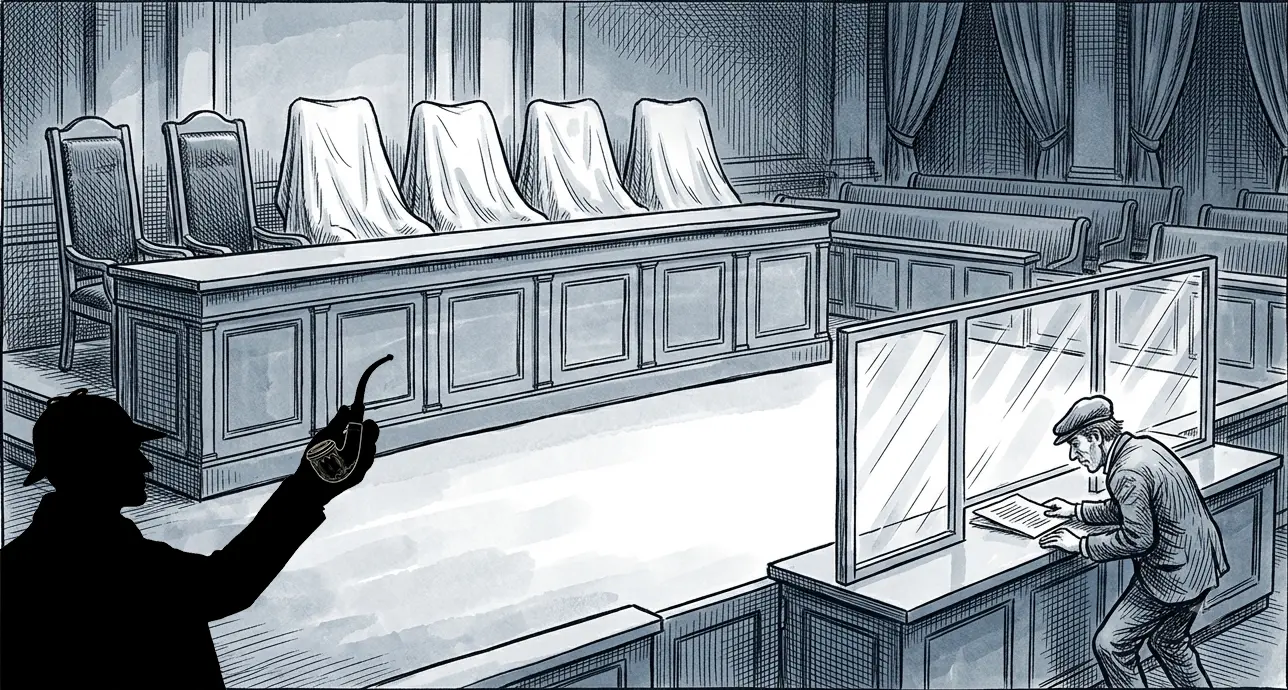
Six seats. Two commissioners. One complaint.
A rule is only as real as the room where someone can say it was broken.
Federal law bars anyone who holds federal office from directing how a political group spends money raised without contribution limits. On September 4, in the Oval Office, President Trump said of MAGA Inc., the roughly $400 million super PAC (an outside group that can take donations of any size) run by his advisers: “This is my money that I control.” When a Punchbowl News interviewer described the group as controlled by his allies, he corrected the interviewer. He controls it himself.
This week the Campaign Legal Center filed a complaint with the Federal Election Commission arguing that the president’s own words describe a violation. The center’s Saurav Ghosh called it a “clear violation.” Whether that is right is the question a complaint exists to ask. The hard part is who can answer it.
The FEC has six commissioners and needs at least four of them, a quorum, to act. Without four, it cannot open an investigation, levy a fine, audit a campaign or issue guidance. It can still receive complaints, and they wait. It has two commissioners.
How it got there is a sequence. Sean Cooksey resigned on January 20, 2025. Eleven days later Trump removed Ellen Weintraub, the chair; she says the removal was illegal. Allen Dickerson left on April 30, and the agency lost its quorum. James Trainor resigned that October, leaving two sitting commissioners, both Democrats, Shana Broussard and Dara Lindenbaum. On February 11 of this year Trump nominated two Republicans, Ashley Stow and Andrew Woodson. Seven months on, they are still not seated. The commission has now gone more than sixteen months without the votes to do its job.
The Times reports that this is the main reason Trump is unlikely to be reined in: the commission doesn’t have enough confirmed members to meet, let alone weigh a complaint.
The agency was built after Watergate to police exactly this kind of money. This is the fourth time in its history it has lost its quorum, according to the group Issue One. The earlier lapses came in 2008 and around 2019 and 2020.
Filling the two open nominations would not make the referee a tiebreaker. A four-member board of two Democrats and two Republicans needs all four to agree before it can act. That is arithmetic, not a prediction about anyone’s vote. Nor does the lapse touch criminal enforcement, which belongs to the Justice Department. Its attorney general, Todd Blanche, was Trump’s personal defense lawyer before Trump nominated him.
A commissioner resigned. A commissioner was removed. A third left, and the quorum went with him. A fourth followed. Two nominees were named and have not been seated. Then the president said the money is his and that he controls it, and a watchdog put the words on paper and sent them to an office that cannot vote.
The silence won’t feel like silence. It will just feel like the way things are.
The law against an officeholder directing that money is still on the books. It is enforceable only when four commissioners are seated to say so.
Origin case: TNG Essay 6 — The Evidence They Won’t Answer
Copyright 2026 — Steve Sagnotti
Sources: Shane Goldmacher and Maggie Haberman, New York Times, September 18, 2026; Campaign Legal Center, complaint to the Federal Election Commission, September 2026; Congressional Research Service, “Federal Election Commission: Membership and Policymaking Quorum,” March 2026; The Hill, on the FEC’s loss of quorum, April 30 and June 16, 2025; Perkins Coie, “Federal Election Commission Loses Quorum,” May 2025; State and Federal Communications, February 12, 2026; FEC notice of lack of quorum, April 6, 2026.
Leave a Reply