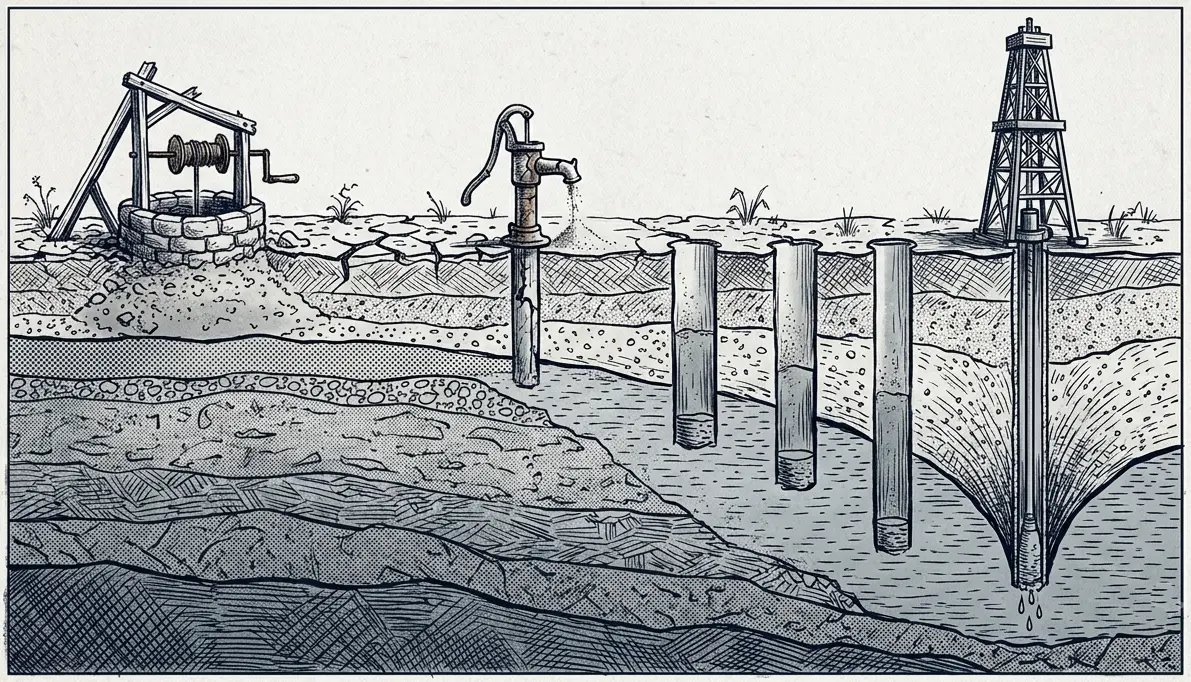
Category: Broken Frames

  • The Room Competes to Shelter You

    The Room Competes to Shelter You

    Block 8, Article 6 — Two Rooms, One Buyer’s Market

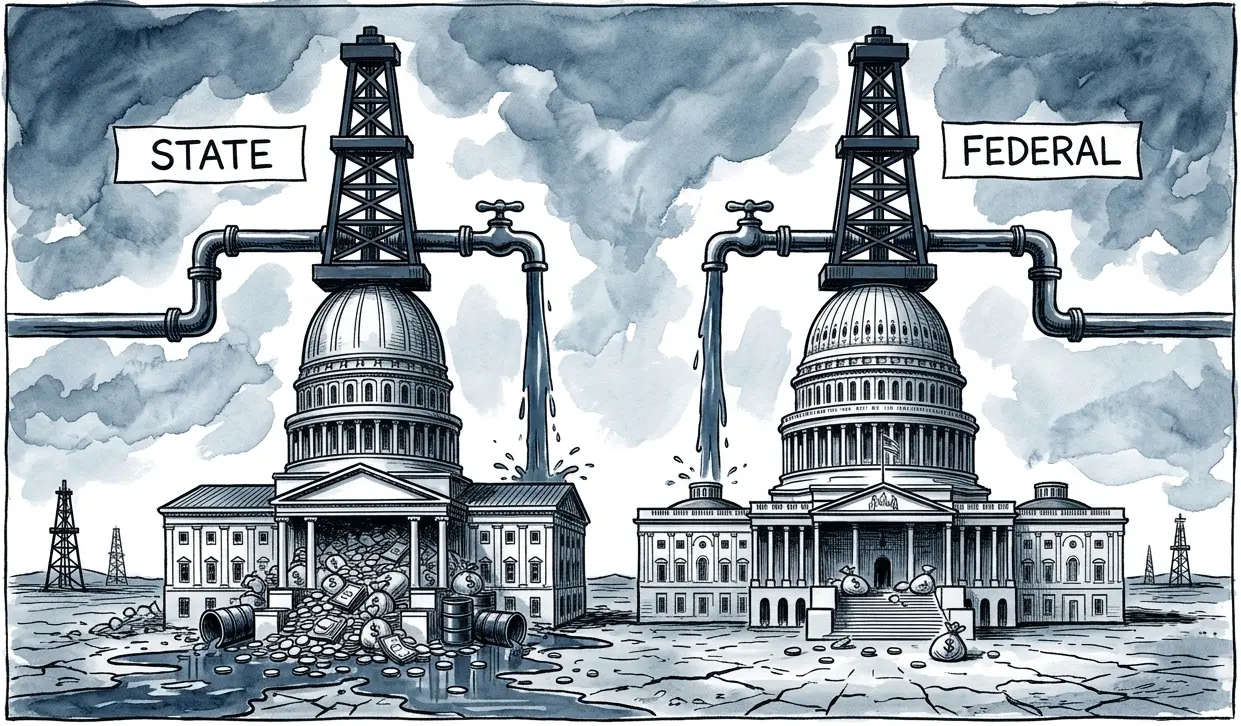
    In 1899 Delaware passed a corporate law built to win a competition nobody had officially announced: which state could offer the least accountability to the people running a company. In 1983 South Dakota won a different round of the same competition, this time for families instead of corporations. Eighty-four years apart, two state legislatures wrote the same kind of victory into law, and the country barely noticed either one happen.

    — — —

    The corporation that shed its conditions

    Before the Civil War, a corporation was a specific grant of public authority for a specific public purpose — a bridge, a canal, a bank, limited in duration, revocable if it worked against the public interest. Delaware’s General Corporation Law of 1899 was written deliberately to attract corporate registrations by stripping that logic out entirely: low fees, minimal restrictions, maximum protection for management from shareholder and public accountability. New Jersey had briefly held the lead in attracting incorporations. Delaware undercut it, and every other state that tried to compete lost the same way New Jersey did — by refusing to cut as deep.

    The timing is not incidental. The same decades that saw Reconstruction’s broken promises — the 40 acres rescinded, sharecropping and convict leasing replacing slavery in fact if not in name — also saw the corporation built on top of that labor shed its remaining public conditions. The transcontinental railroad, completed in 1869, ran on 170 million acres of public land grants, federal subsidies, Chinese immigrant labor paid starvation wages, and the labor of formerly enslaved and free Black workers in the South. The corporations that built it kept the commons they were handed. The freedmen who were promised a stake in the country received nothing. The corporate form that emerged from that moment — freed from public conditions by Delaware law, granted personhood by Santa Clara seventeen years later, funded by the extraction Block 1 and Block 10 already document — is the same legal entity whose political spending Citizens United completed 141 years after Delaware wrote the law that let it stop answering to anyone.

    Delaware’s corporate law was framed as attracting business through efficiency and predictability. What efficiency required — stripping the conditions that had made a corporation answerable to the public that chartered it — was not in the frame.

    — — —

    The race never stopped running

    Delaware still hosts more than half of the Fortune 500, and its Court of Chancery remains the reason: a specialized business court with a century of precedent that gives large, investor-backed companies the legal predictability they want. But Nevada has spent the last two decades undercutting Delaware exactly the way Delaware once undercut New Jersey. Nevada corporations shield officers and directors from liability for anything short of intentional fraud or a proven breach of loyalty — Delaware’s protection is narrower and has to be opted into. Nevada charges no corporate income tax. Nevada discloses less.

    The competition is not history. Since 2024, a documented wave of companies has left Delaware for Nevada — reported in industry press as “Dexit” — following a string of Delaware Chancery Court rulings that unsettled founders and boards used to predictable outcomes. Delaware still wins on prestige and case law depth. Nevada wins on how little a director has to answer for. The two states are not offering different products. They are offering the same product, priced by how much accountability the buyer wants to shed, exactly as they were in 1899 — just with a second bidder in the room now.

    — — —

    The same competition, run for families instead of companies

    In 1983, South Dakota abolished the rule against perpetuities — the centuries-old common-law limit that forced a trust to terminate within twenty-one years of its last named beneficiary’s death. Once that limit was gone, a trust could hold assets forever. No forced distribution ever means no estate-tax event ever, indefinitely, across as many generations as the family wants.

    What that trust actually delivers makes the parallel to Delaware’s corporation exact. Perpetual existence — a corporation never dies either. Sealed privacy — South Dakota trust records can be sealed from public view in perpetuity, the same shield Nevada sells corporations. Protection from creditors and divorcing spouses — the corporate veil, rebuilt for a bloodline. Tax-free compounding, because assets that are never distributed are never taxed. A corporation and a South Dakota dynasty trust are the same four advantages, purchased by whoever can afford the legal architecture to build either one.

    The scale is not a rounding error. More than $360 billion in trust assets sit in South Dakota alone, a figure that roughly quadrupled in the decade before the 2021 Pandora Papers investigation exposed how the industry actually works — no residency requirement, no requirement the beneficiary ever set foot in the state, and no obligation for South Dakota to share information about the trust with any other government on earth. One trust company alone administers relationships worth more than $165 billion for over 120 billionaire and 430 centimillionaire families, 15 percent of them foreign nationals from 54 countries. The Pandora Papers found trusts connected to foreign officials accused of embezzlement, bribery, and human rights abuses, protected by the identical mechanism a domestic family uses to keep a modest fortune out of the estate tax.

    — — —

    The barrier was never the law

    Nothing in the mechanism requires blood or marriage, and nothing in the mechanism requires billionaire status. The federal Generation-Skipping Transfer tax — the tax dynasty trusts are built to avoid — already has rules for unrelated beneficiaries: anyone more than roughly 37.5 years younger than the person setting up the trust is automatically treated the same way a grandchild would be, assigned to a “generation” by age rather than lineage. A mutual-aid society or a fraternal order could build the identical structure a wealthy family uses — a family limited liability company holding pooled assets, member interests sitting inside each member’s own individual trust rather than in their name directly, a private trust company the group itself controls sitting on top to administer it — and the tax code would treat it exactly as it treats a bloodline.

    South Dakota’s own minimum trust charter is $200,000 in assets, not the millions the billionaire headlines suggest. Wealth managers cite $5 million as the point where the annual administration cost — 150 to 250 basis points, 1.5 to 2.5 percent of assets every year — actually pays for itself against decades of compounding. The gap between $200,000 and $5 million is not a legal barrier. It is the gap between knowing this mechanism exists and not knowing, and between having the capital to make the fee drag worth it and not having it. Both gaps run through the same apparatus of lawyers and information the rest of this block has already documented protecting extraction industries and campaign donors. They protect estates the identical way.

    — — —

    What happens if the applecart gets crowded

    Congress has already tested the water, twice, in opposite directions. A 2021 reconciliation proposal would have cut the estate tax exemption from $11.7 million to $6 million, aimed specifically at slowing dynasty-trust growth. It did not pass. Four years later Congress moved the other way entirely: the 2025 One Big Beautiful Bill Act permanently raised the exemption to $15 million per individual, effective 2026, and eliminated the scheduled sunset that would have cut it back down to roughly $6–7 million. The door did not narrow. It opened wider, and stayed there. If broader use — mutual-aid societies, fraternal orders, families further down the wealth ladder than $5 million — ever did start meaningfully affecting federal revenue, the pattern this series documents everywhere else predicts what tightening would look like: not closing the mechanism outright, but grandfathering the trusts already built while narrowing the door for anyone arriving after. So far the actual test case has run the other way. The wealth already inside the structure did not just stay protected. It got a bigger room to grow in.

    — — —

    Two rooms, one buyer’s market

    Delaware built a room for corporations in 1899. South Dakota built a parallel room for families in 1983. Nevada and a half-dozen other states have spent the years since undercutting both, each competing to offer whoever can pay the least accountability the law will still call legal. None of it required breaking a rule. That is the point this entire block has been making from the Powell Memo forward: the room does not need to be captured by force when it can simply be built, state by state, to sell exactly what its buyers are shopping for.

    Closing either room requires the same thing: a state willing to compete the other direction — chartering corporations and trusts on terms that require accountability rather than sell its absence. No state currently does. Block 12’s repair argument depends on one existing.

    Look up your own state’s corporate chartering statute and compare its director-liability provisions against Delaware’s and Nevada’s. Then look up whether your state has adopted South Dakota-style perpetual trust law. Both are public record. Neither took a conspiracy to write — only a legislature willing to compete for the business.

    — — —

    Steve Sagnotti

    is a serious amateur photographer, writer, and technologist based in Oregon. With his camera he tries to capture common images not often seen, leading to common questions not often asked.

    steves-head.space

    © 2026 Steve Sagnotti

    — — —

    Sources

    1. Delaware General Corporation Law, 1899. Lawrence Mitchell, The Speculation Economy (2007); Bebchuk and Hamdani, “Vigorous Race or Leisurely Walk.”

    2. Railroad land grants, 170 million acres: Paul Gates, History of Public Land Law Development (1968). Transcontinental Railroad completion 1869.

    3. Santa Clara County v. Southern Pacific Railroad, 118 U.S. 394 (1886). supreme.justia.com

    4. Citizens United v. FEC, 558 U.S. 310 (2010). supreme.justia.com

    5. Nevada corporate liability provisions: Nev. Rev. Stat. §§ 78.138, 78.7502. leg.state.nv.us

    6. “Dexit” trend 2024–2026: Tornetta v. Musk and Maffei v. Palkon (TripAdvisor).

    7. South Dakota rule against perpetuities repeal, 1983: South Dakota Trust Company; Forbes, “South Dakota Turned Itself Into A Tax Haven. But Why?”, October 2021.

    8. $360B+ South Dakota trust assets; Pandora Papers findings: FRONTLINE/ICIJ, “Pandora Papers,” November 2021. pbs.org

    9. South Dakota Trust Company client figures: South Dakota Trust Company, “Why South Dakota.” sdtrustco.com

    10. GST “skip person” generation-assignment rule: 26 U.S.C. § 2651. law.cornell.edu

    11. South Dakota $200,000 minimum trust charter: SDCL § 51A-6A-19; South Dakota Division of Banking. dlr.sd.gov/banking

    12. 2021 estate tax exemption reduction proposal ($11.7M→$6M); reversal via OBBBA to $15M per individual (2026).

  • The Treasury They Wrote for Themselves

    The Treasury They Wrote for Themselves

    Block 8, Article 5 — Buy, Borrow, Die

    Fifty-five of the largest companies in America paid zero federal income tax in at least one profitable year between 2018 and 2022. Not a loophole nobody noticed. Not an accident of a badly drafted bill. Every exit was written into the code by the people who would use it, the same way the royalty rate on the oil beneath public land was written by the industries that would pay it.

    The rest of this block has shown how the room was purchased — the think tanks, the judges, the dark money, the franchise bills. This article shows what the purchasers did with the treasury once they had it.

    — — —

    The room used to run on the commons itself

    From 1789 to 1861 the federal government had no income tax and no corporate tax. It ran almost entirely on tariffs and the proceeds of public land sales — the commons, sold and taxed, funding the government directly. Block 10’s balance sheet documents where that arrangement led once the land itself ran out. What matters here is what came next.

    The first federal income tax arrived in 1861, a war measure to fund the Union Army — progressive by design, 3 percent above $800, higher rates on higher incomes. It was repealed in 1872. The railroad barons, steel magnates, and war contractors who had built fortunes during the war funded the campaigns that ended the tax that might have reached those fortunes. The emergency that justified it ended. The wealth it might have taxed did not go anywhere. Only the tax did.

    — — —

    The Court protects what the vote could not

    By the 1890s industrial wealth had concentrated enough to produce a genuine political crisis, and the Populist movement forced Congress’s hand: a 2 percent tax on incomes above $4,000, passed in 1894, aimed squarely at the wealthy. The Supreme Court struck it down the following year.

    Pollock v. Farmers’ Loan and Trust Co. held that a tax on income from property was a direct tax requiring apportionment among the states — a technicality that made taxing concentrated wealth effectively unconstitutional without amending the Constitution itself.

    The justices who wrote that decision were appointed by presidents whose campaigns had been funded by the same industrial fortunes the tax would have reached. Justice Harlan dissented, calling the ruling a disaster for working people and a shield for accumulated wealth. He was outvoted 5 to 4. The people who wrote the ruling were protected by it. The wages that would later replace the tax those fortunes escaped were never put to a comparable vote — payroll withholding asks no permission — while the fortunes themselves kept funding the campaigns that produced the bench that ruled in their favor. This is the template — a judicial outcome that protects the financial interests of the people who produced it — that runs from Pollock in 1895 to Citizens United in 2010, a straight line through everything Block 7 already documented about this bench.

    — — —

    The twenty years it actually worked

    It took a constitutional amendment to get around Pollock. The 16th Amendment passed in 1913 after that two-decade fight, and the tax structure that followed briefly did what it was designed to do. The top marginal rate reached 77 percent by 1918, aimed explicitly at wartime profiteers. By the Eisenhower administration it stood at 91 percent. Corporate rates ran above 50 percent through the 1950s. The estate tax was strengthened under Roosevelt specifically to prevent dynastic accumulation.

    That period — 1945 to 1975 — was also the highest sustained period of middle-class income growth in American history. The correlation is not incidental. High marginal rates reduced the incentive to hoard past a certain point and increased the incentive to pay workers and reinvest in production. The tax structure shaped the economy it taxed. Everything the rest of this series documents as dismantled was built, in part, on top of that structure.

    — — —

    The first reversal has a name

    Andrew Mellon ran the Treasury from 1921 to 1932 — one of the wealthiest men in the country, whose family’s aluminum and banking fortune sat directly in the path of the rates he was in charge of setting. He cut the top marginal rate from 77 percent to 25 percent inside four years. He cut corporate rates alongside it. The argument was that high rates discouraged investment. The unstated fact was that his own fortune, and the industrial class he came from, would keep substantially more of it.

    This is the first large-scale, documented instance of the exact pattern this series prosecutes everywhere else: the people writing the rules write them in their own interest, using the authority the Constitution grants them, and frame the private benefit as public good. The 1920s boomed, which was called vindication. Then 1929 happened, and the revenue base that could have cushioned it had already been dismantled. The New Deal rebuilt the progressive structure that Eisenhower would later inherit. The lesson was learned once. It did not stay learned.

    — — —

    The apparatus this block already documented did it again

    Reagan cut the top rate from 70 percent to 50 percent in 1981, then to 28 percent by 1986. Corporate rates fell. Depreciation schedules accelerated. The estate tax exemption grew. The intellectual cover — supply-side economics, the Laffer curve, trickle-down growth — came out of the same think tank infrastructure Article 2 already documented Powell’s memo commissioning. Forty years of evidence followed: wages for the bottom half stagnated, corporate profits hit records, the gap between the top 1 percent and the bottom half widened every decade running. The theory did not survive contact with the data it was supposed to produce. The tax cuts survived anyway, because the people who benefited from them funded the campaigns of the people who kept voting for them.

    The 2017 Tax Cuts and Jobs Act ran the identical play with better documentation. The Congressional Budget Office scored the bill before passage and confirmed the benefit ran overwhelmingly to the top 1 percent and to corporations, with individual cuts structured to expire while the corporate cut was made permanent. The bill passed anyway. Fifty-five major corporations paying zero federal tax in a profitable year, between 2018 and 2022, is not a glitch in that bill. It is the bill working.

    — — —

    The hinge nobody votes on

    The rate cuts get the headlines. The more consequential change was quieter: the gap between what labor pays and what capital pays. Wages are taxed as ordinary income, up to 37 percent at the top bracket. Capital gains — profit from selling an asset held more than a year — top out at 23.8 percent including the investment surtax. Roughly half the rate, for the same hundred thousand dollars, depending only on whether you earned it or owned it.

    Carried interest sharpens the point further. It is the fee private equity and hedge fund managers earn for managing other people’s money — plainly compensation — and it is taxed at capital gains rates anyway, a preference written into the code by the people who collect it, through a Congress their industry funds heavily. Every administration in the last thirty years, both parties, has proposed closing it. None has. The people it protects fund the campaigns of the people who would have to vote it away.

    — — —

    The tax that only touches work

    Franklin Roosevelt built Social Security’s payroll tax deliberately, and said so plainly: tying benefits to a dedicated tax gave workers “a legal, moral, and political right” to collect them, so that “no damn politician” could ever take the program away. The design worked exactly as intended — Social Security has survived every attempt to dismantle it since.

    But the tax he built as a shield became the most regressive piece of the federal system. It applies to every dollar of wages from the first one earned — 15.3 percent, split on paper between worker and employer, borne in practice by the worker as a cost of employment. It does not touch capital income at all. A billionaire living on dividends and realized gains pays nothing in payroll tax no matter the total. A worker earning $40,000 pays 7.65 percent of every dollar. Both funds pay for programs that serve everyone, including the billionaire. Only one side of the economy is asked to fund them.

    — — —

    The shearing runs on a schedule

    Every reform in this article followed an identical sequence. A real problem produced a genuine reform, publicly justified. Then the people with resources — lawyers, accountants, lobbyists, the same think tanks documented in Article 2 — found the exits. Depletion allowances. Stepped-up basis. Carried interest. Accelerated depreciation. Offshore structuring. Each exit was written into the code by the people who would use it, each one described as a technical correction or an investment incentive. The workers and small owners the reform was meant to help had no lobbyist writing exits on their behalf. They paid the rate as written.

    The Alternative Minimum Tax is the case study in miniature. Congress created it in 1969 after discovering that 155 of the highest-income Americans had paid zero federal income tax in 1966 — legally, using provisions written for exactly that purpose. The public outrage produced a parallel minimum-tax system aimed at those 155 filers. Within twenty years it had drifted down the income scale until it was catching upper-middle-class families with children, state taxes, and mortgage interest — not the wealthy the AMT was built to reach, who had already found the next exit. A tax designed to make the very wealthy pay something became a tax on the professional class instead. The people who wrote the exits were never the people who got shorn.

    The Alternative Minimum Tax was framed as a floor beneath the wealthiest filers, ensuring the 155 who paid nothing in 1966 could never do so again. The exits those same filers would find next — and the middle-class families who would inherit the tax meant to catch them — were not in the frame.

    — — —

    The extraction industries never needed a separate tax code — the royalty structure already was one

    The oil and gas depletion allowance dates to 1926, the same era the mining royalty rate was frozen at 12.5 percent. It lets a company deduct a share of gross income from a producing well as a tax-free “return of capital” — the theory being that the oil itself is a depreciating asset. Follow the chain: the public owns the land, grants extraction rights at a below-market royalty already documented in Block 10, and then subsidizes the extraction of its own resource a second time through the tax code. The public pays twice. The company collects twice.

    Agricultural subsidies run the identical shape at a different scale. Direct payments, crop insurance, and conservation payments flow disproportionately to large agribusiness, mostly exempt from the income caps that would otherwise limit them — including, in places, to the same operations drawing the Ogallala Aquifer down at documented unsustainable rates, insured against the risk of depleting water that costs them nothing to begin with. The tax code and the royalty structure are not two systems. They are the same mechanism, wearing two different names.

    — — —

    The exit that needs no loophole at all

    Every mechanism in this article requires selling something eventually — a stock, a business, a depletion-eligible well — and paying tax on the gain when you do. The wealthiest households mostly don’t. They borrow against appreciated assets instead of selling them: a portfolio worth $500 million can collateralize a loan at a fraction of that value, at interest far below what the capital gains tax on a sale would cost, with no sale and therefore no taxable event at all. The loan funds the yacht, the house, the lifestyle. The stock keeps appreciating, untaxed, inside the loan. When the borrower dies, the “stepped-up basis” rule resets the asset’s cost basis to its value at death — erasing the entire lifetime of gain for tax purposes in a single stroke. The heirs inherit appreciated wealth that has never been taxed and, if they sell immediately, may owe nothing at all.

    Buy, borrow, die. No loophole was closed to make this possible, because none needed to exist in the first place — the mechanism is just the ordinary tax code, used exactly as written, by people with enough collateral to make borrowing cheaper than selling. It is the logical endpoint of every exit documented in this article: not evading the tax, but arranging never to trigger it.

    — — —

    Ninety-one percent under Eisenhower. Twenty-three-point-eight percent on capital gains today. Zero, repeatedly, for corporations profitable enough to owe billions. The treasury that once ran on the commons itself now runs on whoever didn’t have a lobbyist in the room when the code was written. The room that built this treasury is the same room the rest of this block has already shown you — and the states are still competing to build the next version of it. That is Article 6.

    Look up the Congressional Budget Office’s most recent distributional analysis of federal tax law and compare the share of benefit going to the top 1 percent against your own bracket’s share. The data is public. The comparison takes five minutes.

    — — —

    Steve Sagnotti

    is a serious amateur photographer, writer, and technologist based in Oregon. With his camera he tries to capture common images not often seen, leading to common questions not often asked.

    steves-head.space

    © 2026 Steve Sagnotti

    — — —

    Sources

    1. Revenue Act of 1861, 12 Stat. 292. Income tax repeal, Act of June 6, 1872, ch. 315, 17 Stat. 230.

    2. Historical Statistics of the United States, Cambridge University Press.

    3. Pollock v. Farmers’ Loan and Trust Co., 158 U.S. 601 (1895). supreme.justia.com

    4. Harlan dissent, Pollock v. Farmers’ Loan and Trust Co. en.wikisource.org

    5. 16th Amendment, ratified February 3, 1913. archives.gov

    6. War Revenue Act of 1917, 40 Stat. 300.

    7. Top marginal rates 1945–1975: Tax Policy Center, “Historical Highest Marginal Income Tax Rates.” taxpolicycenter.org

    8. Mellon Treasury tenure 1921–1932; rate reduction. Federal Reserve History. federalreservehistory.org

    9. Economic Recovery Tax Act of 1981, Pub.L. 97-34. Tax Reform Act of 1986, Pub.L. 99-514. Tax Cuts and Jobs Act of 2017, Pub.L. 115-97. congress.gov

    10. 55 corporations paid zero tax: Institute on Taxation and Economic Policy, “Corporate Tax Avoidance in the First Five Years of the Trump Tax Law,” February 2023. itep.org

    11. CBO distributional analysis, TCJA: CBO, “The Distribution of Household Income, 2017,” November 2020. cbo.gov

    12. Capital gains rates: IRS Publication 550. Net investment income surtax: IRC § 1411. Carried interest: IRC § 1(h), § 1231. law.cornell.edu

    13. Roosevelt payroll tax quote. ssa.gov/history/Gulick.html

    14. Payroll tax rates: IRC § 3101, § 3111. law.cornell.edu

    15. Jennifer Harris fiscal mechanism: New York Times, April 8, 2026.

    16. AMT creation: Tax Reform Act of 1969, Pub.L. 91-172.

    17. Oil and gas depletion allowance: IRC § 613, § 613A. law.cornell.edu

    18. Agricultural subsidy concentration: Environmental Working Group Farm Subsidy Database, 2024. farm.ewg.org

    19. Buy-borrow-die mechanism: stepped-up basis at IRC § 1014. law.cornell.edu

  • The Social Welfare of the Donor Class

    The Social Welfare of the Donor Class

    Block 8, Article 4 — The Same Amendment. A Consistent Set of Beneficiaries.

    The largest political ad campaigns in American history were funded by organizations legally required to keep their donors secret.

    Not hidden by clever lawyers. Not exposed by investigative reporters. Required by law to stay secret. That requirement did not arrive by accident. It was built — from tools originally designed for the opposite purpose, redirected by the same apparatus Powell set in motion, defended by the same money it was built to conceal.

    — — —

    The tool was a hundred years old before it was weaponized.

    Section 501(c)(4) of the tax code has existed since 1913 — the same year the income tax itself was created. Congress carved it out for civic leagues and social welfare organizations: the volunteer fire department, the community garden association, the neighborhood improvement league. Organizations doing work the market wouldn’t fund and the government didn’t need to run. The protection made sense. The work was genuine.

    By mid-century the vehicle carried the civil rights movement. The NAACP operated as a 501(c)(4). The ACLU. The League of Women Voters. Organizations doing work so genuinely in the public interest that the state actively tried to stop them.

    In 1958 Alabama demanded the NAACP’s membership list. The state wanted names. The Supreme Court said no — unanimously. Compelled disclosure of membership in an unpopular organization violated the First Amendment right of association. The privacy protection built into 501(c)(4) status was not an accounting convenience. It was a shield against state retaliation against people doing dangerous civic work. NAACP members in Alabama in 1958 had reason to fear what happened when their names reached the wrong desk.

    That unanimous decision — NAACP v. Alabama — is the legal foundation the dark money apparatus now stands on. The protection designed to keep civil rights workers alive became the protection that keeps the political spending of the industries that funded Citizens United invisible. Same statute. Same legal precedent. Opposite direction.

    Section 501(c)(4) was framed as protection for civic organizations doing work the state couldn’t reach without retaliating against them. The industries and donors who would use that same anonymity to hide unlimited election spending from the public whose elections it was buying were not in the frame.

    — — —

    The turn happened in a single cycle.

    For decades 501(c)(4) political activity existed but was modest. The IRS applied an informal standard: political activity could not be an organization’s “primary purpose.” Nobody defined primary precisely. The ambiguity was manageable because the money involved was manageable.

    Citizens United did not create the legal architecture that made the flood possible. It completed a project that started thirty-four years earlier. In 1976, Buckley v. Valeo upheld contribution limits but struck down spending limits — the Court’s logic was that capping how much money a candidate or donor could spend restricted political expression protected by the First Amendment. Money, as a vehicle for speech, could not be capped. Justice Byron White dissented that unlimited spending was “a mortal danger against which effective preventive and curative steps must be taken.” The majority disagreed. Money equals speech has governed campaign finance law ever since.

    Citizens United changed the scale. January 21, 2010: the Supreme Court held that corporations have First Amendment rights equivalent to individuals with respect to political speech. Spending limits on independent political expenditures are unconstitutional. Within twenty-four hours, the D.C. Circuit applied the same logic in SpeechNow.org v. FEC — corporations and individuals could now make unlimited contributions to committees that spent independently of candidates. The super PAC was born. Four years later, McCutcheon v. FEC (2014) eliminated the aggregate limit on what a single donor could give across all federal candidates combined in a two-year cycle. Thirty-eight years, four cases, one continuous project: Buckley built the foundation, Citizens United and SpeechNow built the walls, McCutcheon took the roof off entirely.

    Within months of Citizens United, Karl Rove had filed Crossroads GPS as a 501(c)(4) social welfare organization. The vehicle that had carried the NAACP now carried the largest Republican outside spending operation in American history. Donors invisible. Spending unlimited. Social welfare undefined.

    In 2006 dark money spending on federal elections totaled approximately $5 million. By 2012 it crossed $300 million. By 2020 it exceeded $750 million. In 2024 it crossed $1 billion for the first time — $1.9 billion in the presidential cycle alone. Two hundred times the 2006 figure in eighteen years. From 2010 to 2024, the fourteen years following Citizens United, outside groups spent more than $4 billion on federal elections in total. The law did not change that much. The money found the architecture and filled it.

    The anonymity is not incidental to the design; it is the design. A corporation, a foreign government, or a billionaire with regulatory exposure across a dozen industries can route unlimited funds through a 501(c)(4) whose donors are never disclosed, into a super PAC that runs ads in competitive districts — shaping the outcome of elections that will determine who regulates them. Hawaii State Senator Karl Rhoads, lead author of the state’s corporate-spending law, made the point directly: under the current architecture, it is genuinely difficult to know whether money from Russia, Iran, or China is being routed into American elections through the same opacity built for domestic donors. The system was not designed to hide that possibility. It was designed to make no one able to check.

    The IRS proposed new rules in 2013 that would have tightened the definition of political activity for 501(c)(4)s. The comment period generated over 150,000 responses, many of them orchestrated by the organizations the rules would have affected. The IRS withdrew the proposed rules in 2014. They have never been reintroduced. Congress could have written a clearer standard into statute at any point. The DISCLOSE Act — requiring donor disclosure for organizations spending on federal elections — has passed the House twice since 2010. It has died in the Senate both times on a party-line vote. The party that killed it had just discovered the vehicle was as useful for their donors as it was for the other side’s. Reversing the anonymity requires a statute the funded legislators won’t pass, or a bench revisiting Citizens United itself — the same bench Block 7 documents as this pipeline’s own construction.

    — — —

    27 percent. 27 percent. 45 percent.

    Registered Republicans: approximately 27% of the electorate. Registered Democrats: approximately 27%. Voters registered with neither party: approximately 45% — the largest single bloc in the American electorate.

    The $1 billion in “social welfare” spending in the 2024 cycle went entirely toward electing members of two private clubs that together represent 54% of voters. The 45% with no party registration received none of it. No candidate pipeline. No committee infrastructure. No 501(c)(4) operation running ads on their behalf. The organizations spending a billion dollars on “social welfare” are spending it to service the donor class of two clubs the largest share of the electorate doesn’t belong to.

    The NAACP used the vehicle to protect people the state was trying to kill. The current apparatus uses it to elect members of private clubs who then service the donors who funded the clubs. The social welfare in question belongs to a very specific constituency. It is not the public.

    — — —

    The return is documented.

    In 2009 economists Alexander, Mazza, and Sherrick published their analysis of the American Jobs Creation Act of 2004 — a tax repatriation provision that let corporations bring overseas profits home at fifteen percent instead of thirty-five. The corporations that lobbied for it spent $282 million on the campaign. The tax benefit they received: $62 billion. Return on investment: 22,000 percent.

    The Strategas Lobbying Index tracks the fifty companies that spend the most on lobbying. It has outperformed the S&P 500 by approximately four percentage points annually since its inception. Not occasionally. Consistently. The market recognized the signal before the rest of us named it.

    The apparatus did not build a bribery system. It built a system where the structural incentives make donor service rational, constituent service optional, and a 22,000 percent return on a $282 million investment entirely legal. Nobody goes to jail. Nobody needs to.

    — — —

    The 14th Amendment ran the same play.

    The 14th Amendment was ratified in 1868 to protect the formerly enslaved from state deprivation of rights. By 1886 its equal protection clause was being applied to corporations. By 1896 Plessy v. Ferguson had effectively suspended it for the people it was written to protect. By 2010 it was the constitutional foundation for unlimited corporate political spending in Citizens United. By 2013 Shelby County used it to gut the Voting Rights Act — and Texas implemented a voter ID law within hours.

    The same amendment. A consistent set of beneficiaries. They were not the people in the fields in 1868.

    The apparatus does not need to write new law. It needs to find existing law pointing in a useful direction and redirect it. The NAACP’s shield became the donor’s cloak. The freed person’s amendment became the corporation’s charter. The social welfare organization became the good ol’ boys’ slush fund. Same instruments. Opposite results. The label stays. The mechanism turns.

    The dark money funded the campaigns that confirmed the judges that eliminated the oversight that set and enforced the royalty rates on what the public owned. The causal chain is not metaphor. In 2025 the royalty rate on federal mineral leases — locked at 12.5 percent by the One Big Beautiful Bill — was the same rate set in 1920. The billion dollars in dark money spent on the 2024 cycle purchased, among other things, the legislative majority that locked it there.

    Powell wrote it down in 1971. The river was already on fire. He identified accountability as the problem. Fifty years later accountability is the one thing the architecture is specifically designed to prevent.

    The legal architecture behind this mechanism connects to Essay 12 of The Narrow Gate.

    — — —

    The dark money is disclosed in aggregate, if not by name. OpenSecrets’ dark money database tracks total spending by group and cycle, updated as filings arrive: opensecrets.org/dark-money

    — — —

    Steve Sagnotti

    is a serious amateur photographer, writer, and technologist based in Oregon. With his camera he tries to capture common images not often seen, leading to common questions not often asked.

    steves-head.space

    © 2026 Steve Sagnotti

    — — —

    Sources

    1. NAACP v. Alabama, 357 U.S. 449 (1958).

    2. Citizens United v. Federal Election Commission, 558 U.S. 310 (2010). supreme.justia.com

    3. Buckley v. Valeo, 424 U.S. 1 (1976). supreme.justia.com

    4. SpeechNow.org v. FEC, 599 F.3d 686 (D.C. Cir. 2010). cadc.uscourts.gov

    5. McCutcheon v. FEC, 572 U.S. 185 (2014). supreme.justia.com

    6. Shelby County v. Holder, 570 U.S. 529 (2013). supreme.justia.com

    7. Alexander, Raquel; Mazza, Stephen; Sherrick, Susan. “Measuring Rates of Return for Lobbying Expenditures.” Journal of Law and Politics, Vol. 25, 2009.

    8. Strategas Research Partners. Lobbying Index performance data.

    9. American Jobs Creation Act of 2004. Pub.L. 108-357. congress.gov

    10. IRS proposed 501(c)(4) rules 2013; withdrawal 2014. IRS Notice 2013-54.

    11. DISCLOSE Act. H.R. 5175 (111th Congress, 2010) | H.R. 1134 (117th Congress, 2021). congress.gov — H.R. 5175 | H.R. 1134

    12. Dark money totals 2006–2024. opensecrets.org/dark-money

    13. Outside spending 2010–2024 ($4B+): Federal Election Commission data. fec.gov/data

    14. Dark money 2024 presidential cycle ($1.9B). opensecrets.org/dark-money

    15. Hawaii State Senator Karl Rhoads, on foreign-money risk (MSNBC broadcast).

    16. Mayer, Jane. Dark Money. Doubleday, 2016.

    17. Plessy v. Ferguson, 163 U.S. 537 (1896). supreme.justia.com

    18. Santa Clara County v. Southern Pacific Railroad, 118 U.S. 394 (1886). supreme.justia.com

  • Your Member of Congress Is a Franchise Owner

    Your Member of Congress Is a Franchise Owner

    Block 8, Article 3 — The Member Isn’t Bought. They’re Marinated.

    Legislators pay $50 to join the American Legislative Exchange Council. Corporations pay tens of thousands of dollars each — collectively, as much as $6 million a year, tax records show. The $50 buys the credential of authorship. The corporate money writes the bill and hands it to whoever gets the credential.

    — — —

    The franchise model

    The American Legislative Exchange Council was founded in 1973 — the same year as the Heritage Foundation, by the same network, for a more direct purpose. Heritage produced the ideas. ALEC converted them into statutory language and handed them to legislators in fifty states who would introduce them as their own.

    The model is a franchise. The corporation supplies the bill. The legislator supplies the constitutional authority to pass it. The same text — with state names and dates swapped — appears in thirty legislatures in a single session. From 2010 to 2018 ALEC-based bills were introduced nearly 2,900 times across all fifty states. More than 600 became law.

    The subject matter is not random. Voter ID requirements. Right-to-work statutes. Environmental regulation rollbacks. Prison privatization provisions. Each item corresponds directly to a corporate interest that paid the membership fee. The legislature that passed the bill did not commission the research, develop the policy, or draft the language. It was handed the product at a conference where the people who paid for it sat in the same room and voted on it alongside the legislators who would carry it home. The member goes home as the author. The corporation goes home with the law.

    This is not hypothetical. Citigroup drafted 70 of 85 lines in a House banking deregulation bill. Two paragraphs copied nearly verbatim. Two words changed to make them plural. The member’s name went on the bill. Citigroup got the deregulation.

    — — —

    The other half of the transaction

    ALEC prices the bill. A second machine prices the member who carries it, and that machine is Block 4 Article 3’s story in full: the DCCC and NRCC dues schedules that assess committee seats by regulatory value — a seat on Ways and Means or Financial Services costs more than a seat on Agriculture, because it affords more leverage over more industries with more money. The call center across the street from the Capitol, beyond Capitol Police jurisdiction, where members spend four to six hours a day dialing for the party instead of working the public office they were elected to — drawing the public salary that office pays for the entire time. The whiteboard that turns the dues assessment into a leaderboard everyone in the room can see. The escalation where exceeding your number this cycle gets you a better committee assignment — and a bigger number next cycle. Committee seats are sold. The currency is call time. The price rises with the regulatory value of what the seat controls.

    What that machine prices is access. What ALEC provides is content. A member whose seat was priced by the energy industry’s dues assessment, whose call time was spent on energy donors, arrives at an ALEC conference already primed to receive the energy industry’s model legislation. The two machines were built the same year, by the same network, to work together.

    The calls go to a narrow pool. Lawrence Lessig documented that fewer than 150,000 Americans — roughly the number of people in the country named Lester — function as the relevant funders of congressional campaigns. A member on the Financial Services Committee calls bank executives and hedge fund managers. A member on the Energy Committee calls oil company PAC directors. Nothing illegal is said. Nothing needs to be. The donor knows which committee the member sits on. The member knows the donor knows. The conversation proceeds.

    — — —

    What moves on the call besides money

    The donor is briefing the member on the industry’s legislative priorities in real time, voluntarily, because the member asked how they were doing. Staff notes it. It informs the vote. The call that produces no contribution still produces access — twelve minutes with the member of the Financial Services Committee, the awareness that this donor’s priorities have been heard, the implicit acknowledgment that the relationship is current. The donor who gives nothing got something. The member gave it away before a dollar moved.

    And the member is not just receiving the industry’s position. In many cases they are receiving the only expert-level information they will get. The Office of Technology Assessment — Congress’s independent analytical body — was eliminated in 1995. Committee staff was gutted the same year. The member who wants to understand what a drug pricing bill will actually do to development pipelines has two options: take the industry’s word for it on the call, or read a summary their overworked legislative director produced from public sources in forty-five minutes. The donor isn’t just biasing the information. They’re filling a vacuum the apparatus created deliberately. Defund the independent analytical capacity, then be the only expert in the room.

    — — —

    One more thing happens on that call

    The member who sits on the Armed Services Committee and holds defense contractor stocks is not just fundraising. They are receiving information — about contracts, about budget priorities, about what the industry expects from the next appropriations cycle — that moves markets. Congress passed the Stop Trading on Congressional Knowledge Act in 2012 after 60 Minutes broadcast footage of members trading stocks in companies their committees regulated. The STOCK Act requires disclosure within 45 days. The penalty for non-disclosure is $200. Not $200,000. Not a percentage of the trade. Two hundred dollars — set by the people whose trading profits it was calibrated not to threaten. No member has ever been prosecuted under it.

    The New York Times found in 2022 that 44 of the 50 members most active in the markets had bought or sold securities in companies their committees regulated. Senator Richard Burr sold hundreds of thousands in stocks one week before the COVID market collapse — after a classified Senate Intelligence Committee briefing on the pandemic’s severity. The FBI investigated. There was no prosecution. One year after the STOCK Act passed, Congress quietly amended it to remove the requirement that senior staffers file public financial disclosures online. The amendment was attached to unrelated legislation and passed without debate. The constituent who watched the 60 Minutes broadcast and believed the problem had been addressed did not see the amendment. It was not on 60 Minutes.

    The direct trade is the clumsy move. The intelligent move does not go through the member’s brokerage account at all. The donor who bundled $50,000 for the campaign last cycle gets a call that afternoon — a friendly check-in, nothing specific said — and happens to reposition their portfolio before the news breaks. None of that triggers the STOCK Act. The paper trail has three separate owners and no single document spans all three. What exists instead is the pattern: members who sit on the committees that regulate specific industries consistently outperform the market in those industries’ stocks during periods when their committees are active. The outperformance is documented in academic studies. The mechanism is inferred. The inference is not complicated.

    The Powell apparatus identified Congress as a target in 1971. It did not need to bribe individual members. It needed to build a system in which the structural incentives of membership made donor service rational, constituent service optional, and independent judgment nearly impossible. Three cycles of calls build a relationship. The relationship builds a worldview. The worldview is the industry’s. The independent analysis that arrives late, from an underfunded source, arguing against a framework the member has inhabited for years — against a person they’ve had dinner with, against a portfolio position they hold, against the only expert they’ve had time to consult — doesn’t stand much of a chance.

    The member isn’t bought. They’re marinated.

    The marination shows up on the balance sheet. Representatives’ wealth grew over the 2004–2014 period at nearly seven times the rate of the wealthiest five percent of Americans — not the median, the top five percent already outpacing everyone else. Half of sitting members match or beat the S&P 500 in their own portfolios. Nobody has to be corrupt for that pattern to hold. They just have to keep taking the calls.

    The marination produces specific outputs. ALEC’s model Environmental Audit Privilege Act — passed in more than twenty states — shields corporations from liability for self-reported environmental violations. The company that discovers it has been contaminating the groundwater can report it internally, claim audit privilege, and keep the finding from the regulator and the public. It is the same below-market logic that governs the royalty rate on the resource itself: the cost of extraction is priced by statute, not by damage done, and the statute was written at an ALEC conference. The member who introduced the bill in their state legislature was handed the language there. The aquifer that got the contamination got nothing.

    ALEC was framed as a nonpartisan association of state legislators sharing policy ideas. The $50 fee that gives legislators their vote, and the tens of thousands of dollars each corporate member pays for theirs — totaling as much as $6 million a year collectively — was not in the frame.

    Defunding either machine requires defunding the other. ALEC’s corporate dues and the party’s call-time dues trace back to the same donor networks — the ones Article 4 documents in full.

    — — —

    Closing question: Look up ALEC’s model legislation tracker at alecexposed.org and search for bills your state legislature has introduced. Cross-reference the sponsor against ALEC’s membership roster. Then look up that same legislator’s committee assignments and stock holdings in their financial disclosure. The overlap is not a coincidence. It is the pricing structure made visible.

    The structural argument behind this mechanism lives in Essay 13 of The Narrow Gate.

    — — —

    Steve Sagnotti

    is a serious amateur photographer, writer, and technologist based in Oregon. With his camera he tries to capture common images not often seen, leading to common questions not often asked.

    steves-head.space

    © 2026 Steve Sagnotti

    — — —

    Sources

    1. Representative wealth growth 2004–2014 vs. 95th percentile: Jonathan Klick, “The Wealth of Congress,” Harvard Journal on Legislation.

    2. Members matching/beating S&P 500: wealthincongress.com

    3. Center for Public Integrity. “You Elected Them to Write New Laws. They’re Letting Corporations Do It Instead.” publicintegrity.org

    4. NPR. “When Lobbyists Literally Write the Bill.” November 11, 2013. npr.org

    5. Lessig, Lawrence. The USA Is Lesterland. Harvard Law School, 2014. hls.harvard.edu

    6. STOCK Act. Pub.L. 112-105 (2012). 5 U.S.C. § 13103. congress.gov

    7. STOCK Act amendment removing staffer online disclosure. Pub.L. 113-7.

    8. Ziobrowski et al. “Abnormal Returns from the Common Stock Investments of the U.S. Senate.” Journal of Financial and Quantitative Analysis, 2004.

    9. Drutman, Lee. The Business of America Is Lobbying. Oxford University Press, 2015.

    10. Alberta, Tim. American Carnage. Harper, 2019.

    11. New York Times congressional stock-trading investigation, 2022 (“44 of 50” figure). spanberger.house.gov

    12. Burr investigation: DOJ closed without charges Jan. 19, 2021; SEC closed without action Jan. 2023.

    13. Ziobrowski, Boyd, Cheng, and Ziobrowski. “Abnormal Returns From the Common Stock Investments of Members of the U.S. House of Representatives.” Business and Politics, Vol. 13, Issue 1 (2011).

    14. OTA elimination: Legislative Branch Appropriations Act, 1995.

    15. ALEC membership fee figures: NPR, “Shaping State Laws With Little Scrutiny,” 2010.

  • The Machine That Was Built

    The Machine That Was Built

    Block 8, Article 2 — The Argument Feels Spontaneous. It Is Not.

    Same think tank. Same talking points. Same op-ed in three different papers the same week. Same expert on three different networks the same morning. The argument feels spontaneous. It is not. It is the output of an infrastructure that Powell called for in 1971 and that took approximately one decade to build and has not stopped running since.

    Here is what was built, in order: one institution to write the arguments, one to train the judges who would rule on them, one to draft the bills that would enact them. Three roles, three institutions, filled over three decades, starting with the argument.

    — — —

    Where a policy idea goes between someone wanting it and it becoming law

    The Heritage Foundation was founded in 1973, seeded with $250,000 from the Coors family. Its stated mission was research and education. Its operational mission was to produce policy blueprints that elected officials could implement without having to develop the ideas themselves. By 1980 it had done exactly that — Mandate for Leadership, 1,093 pages, covering every major federal agency and department. Specific recommendations. Specific mechanisms. Specific language. Handed to Ronald Reagan’s transition team before he took office. Sixty percent implemented in year one.

    The Cato Institute followed in 1977, funded by Charles Koch. The American Enterprise Institute predated the Powell Memo by decades — founded in 1938 — but its recapitalization followed the memo’s blueprint precisely: a budget of $1 million in 1970 grew to $10 million by 1980, funded substantially by corporate donors whose industries AEI scholarship consistently defended. By the mid-1980s the infrastructure Powell described as missing in 1971 existed, was fully funded, and was producing. The ideas that arrived in legislative offices pre-formed, pre-argued, and pre-sourced were not arriving by accident. They were being delivered.

    By 2016 the Koch network alone was coordinating approximately $889 million in political spending per election cycle — more than either major party’s official campaign apparatus. That figure funded candidates and ballot initiatives, but it also kept the intellectual infrastructure running: the think tanks producing the arguments, the chairs training the scholars who would produce the next generation of arguments, the law school chapters identifying the clerks who would become the judges.

    What the think tank produces, the lobbyist deploys. What the lobbyist deploys, the legislator introduces. The legislator is the named author of an idea they did not originate, argued with evidence they did not produce, drafted into language they did not write. The think tank’s fingerprints are not on the bill. That is the design. The full machinery of that transaction is Article 3.

    No independent party checks any link in that chain. The research came from a think tank funded by the industry it defends. The lobbyist’s assurances aren’t tested against analysis Congress generates for itself. The legislator introducing the bill took an oath to the constituents who elected them, not to the industry that wrote what they’re introducing. Nobody in the chain has to lie. The chain is built so nobody has to check.

    — — —

    The same legal arguments keep winning in court, filed by the same organizations, in front of judges who share a remarkably coherent philosophy

    That coherence was engineered.

    The Olin Foundation put $370 million into law schools over three decades. Not into legal aid. Not into constitutional theory broadly defined. Into law and economics — a doctrine holding that markets allocate resources more efficiently than regulation, that regulatory costs are presumed to outweigh regulatory benefits, and that judges should evaluate legal questions through an economic lens. The University of Chicago became its intellectual home. Richard Posner, Frank Easterbrook, and Robert Bork — the architects of modern conservative legal doctrine — came out of Chicago, funded by Olin, executing the strategy Powell outlined.

    Federal judges take two oaths, not one: the constitutional oath every officer takes, and a judicial oath committing them specifically to “administer justice without respect to persons” and “do equal right to the poor and to the rich.” Law and economics doesn’t violate that oath on its face — a judge who believes markets allocate resources more efficiently than regulation can sincerely believe an economic lens serves the poor and the rich equally, by keeping outcomes efficient rather than politically determined. That’s a real position, arguable on its own terms. What Olin’s $370 million bought wasn’t a judge willing to break that oath. It was thirty years of ensuring the judges taking it would already hold that position before a single case arrived.

    The Olin money went primarily to Chicago, Harvard, Yale, Virginia, and George Mason. Schools that took it got chairs, journals, and fellowships. Schools that didn’t found themselves producing graduates who faced a bench increasingly fluent in a doctrine their training hadn’t centered. You don’t have to capture every law school. You have to capture enough of the pipeline that the doctrine becomes the common language of appellate argument. In 2016 George Mason’s law school was renamed the Antonin Scalia School of Law after a $30 million donation. The investment had come full circle.

    — — —

    The organization named itself after the Federalist Papers. Worth asking which parts it left out.

    The Federalist Society was founded in 1982 with seed money from the Olin and Scaife foundations. The name invokes Madison and Hamilton — the architects of constitutional checks and balances, the theorists of faction, the men who designed a system specifically to prevent any single interest from capturing the government. Madison in Federalist 51 described the entire constitutional architecture as a system of countervailing pressures designed to make self-dealing costly and accountability inescapable. Hamilton in Federalist 78 argued for an independent judiciary as a check on legislative excess. The Society selected the name. It did not select the argument. The Federalist Papers warned against exactly the kind of sustained factional capture the Society was built to execute. The founders are useful when they support the case and invisible when they don’t. This series has noted that pattern before. It will note it again.

    The Society’s structure was deliberate: law school chapters recruited students. Students became clerks. Clerks became associates. Associates became partners. Partners became nominees. Not a list of preferred candidates — a network. A community of legal thinkers who shared a philosophy, knew each other, vouched for each other, and moved through the same institutional doors. A law student who joined in 1985 had access to mentorship, clerkship opportunities, and a professional community the existing legal establishment did not provide. By 2020 six of nine Supreme Court justices had Federalist Society connections. By 2024 a majority of the federal appellate bench had passed through the pipeline. The annual budget grew from nothing in 1982 to approximately $20 million by 2018, funded by the same donor networks that funded Heritage and Cato.

    The Federalist Society’s rise to judicial dominance was framed as merit — the natural ascent of talented lawyers into influential positions. The forty-year, $370-million-funded pipeline built specifically to produce that “natural” ascent was not in the frame.

    — — —

    What forty years of that pipeline produces

    In 2024 the Supreme Court handed down Loper Bright Enterprises v. Raimondo. For forty years federal agencies — the EPA, the FDA, OSHA, the FTC — had been granted authority to interpret ambiguous language in the laws they administered. If Congress wrote a statute that didn’t specify exactly how many parts per million of a chemical were permissible in drinking water, the agency with the expertise got to decide. Loper Bright ended that. Interpretation goes to courts now.

    The doctrine behind Loper Bright was developed in law and economics scholarship. Argued in Cato amicus briefs. Refined at Federalist Society panels. Rehearsed in lower court opinions written by judges who had clerked for judges who had spoken at Federalist Society events. Adopted by a Supreme Court majority six of whose nine members came out of the pipeline. The investment was made in 1982. The return arrived forty-two years later.

    The consequences are specific. The EPA can no longer determine what clean air requires without judicial review by courts that have spent forty years being taught that regulatory costs outweigh regulatory benefits. The FDA cannot define safe without the same gauntlet. The Bureau of Land Management’s authority to set and enforce royalty rates on federal mineral leases faces the identical exposure — the same de novo standard (courts deciding the question fresh, giving no weight to the agency’s own expert judgment) — that stripped the EPA’s deference strips BLM’s, at the exact moment an agency might otherwise have revisited a rate frozen since 1920. The agency that stood between you and the industry it regulated has been made structurally dependent on a judiciary built to distrust it. And if you have tried to challenge what a corporation did to you directly — through your credit card agreement, your cell phone contract, your employment terms — you have already discovered that the courthouse door has a different kind of lock on it. Mandatory arbitration. Class action waiver. Nine percent consumer win rate. That wall was built by the same apparatus, in the same rooms, for the same reasons. That story is documented later in this block.

    Loper Bright did not fall in an empty field. The agencies it stripped of interpretive authority were the agencies standing between the public and the industries that had spent forty years building the bench that issued the ruling. PFAS — the class of synthetic chemicals now detectable in the blood of 97 percent of Americans — had been in the EPA’s regulatory queue for decades. The agency that might have moved faster on the standard now needs a court’s permission to define what safe means. The court that grants or denies that permission was built in the rooms Article 2 documents.

    The think tanks wrote the ideas. The law schools trained the judges. What about the legislation itself? That required a different institution — one purpose-built to convert policy frameworks into statutory language that legislators in fifty states could introduce as their own. Founded the same year as Heritage, by the same network, for exactly that purpose.

    Reversing what forty years built would require either a future Court willing to revisit doctrine it just adopted, or a Congress able to rebuild the independent analytical capacity it eliminated in 1995 — and the legislators who would have to authorize either path were elected with the pipeline’s own money. No comparable investment ever reached the other side: no forty-year, coordinated fund built the institutions, trained the scholars, or elected the legislators who might claw the doctrine back or rebuild the analytical capacity Congress dismantled in 1995.

    That is Article 3. What keeps this entire machine’s own funding untraceable and undefundable — the same Citizens United architecture its forty-year investment helped produce — is Article 4.

    The structural argument behind this mechanism lives in Essay 11 of The Narrow Gate.

    — — —

    The pipeline’s financial ties are disclosure record, not speculation. ProPublica’s Supreme Connections tool traces documented ties between sitting justices and the Federalist Society from the justices’ own financial disclosures: projects.propublica.org/supreme-connections/organizations/the-federalist-society/

    — — —

    Steve Sagnotti

    is a serious amateur photographer, writer, and technologist based in Oregon. With his camera he tries to capture common images not often seen, leading to common questions not often asked.

    steves-head.space

    © 2026 Steve Sagnotti

    — — —

    Sources

    1. Mayer, Jane. Dark Money: The Hidden History of the Billionaires Behind the Rise of the Radical Right. Doubleday, 2016.

    2. Teles, Steven. The Rise of the Conservative Legal Movement. Princeton University Press, 2008.

    3. Millhiser, Ian. The Agenda: How a Republican Supreme Court Is Reshaping America. Simon & Schuster, 2021.

    4. Heritage Foundation. Mandate for Leadership. January 1981.

    5. Cato Institute. “About Cato.” cato.org/about

    6. Loper Bright Enterprises v. Raimondo, 603 U.S. ___ (2024). supremecourt.gov

    7. AT&T Mobility LLC v. Concepcion, 563 U.S. 333 (2011). supreme.justia.com

    8. George Mason/$30M Scalia donation: $30M total pledges announced March 31, 2016.

    9. Federalist Society annual budget ~$20M by 2018: Wikipedia; InfluenceWatch analysis of FY2018 Form 990.

    10. Six of nine Supreme Court justices Federalist Society connections: Ballotpedia, “The Federalist Society.” ballotpedia.org/The_Federalist_Society

    11. 9% consumer arbitration win rate: CFPB, Arbitration Study: Report to Congress (2015). consumerfinance.gov

    12. Madison Federalist 51 / Hamilton Federalist 78 (paraphrase). avalon.law.yale.edu/18th_century/fed51.asp | fed78.asp

    13. AEI founding 1938 and budget growth 1970–1980. aei.org/about

    14. Koch network $889M 2016 political spending coordination: Washington Post, Politico, Jan. 26, 2015.

  • Powell’s Bitter Remedy

    Powell’s Bitter Remedy

    Block 8, Article 1 — He Was Not Describing a Conspiracy. He Was Writing a Business Plan.

    On August 23, 1971, a corporate attorney named Lewis Powell sent a confidential memorandum to the U.S. Chamber of Commerce. He was not a fringe figure. He sat on the boards of eleven corporations, served as the Chamber’s counsel, and two months after writing this memo was confirmed to the Supreme Court of the United States. He was precisely the kind of man the system was designed to produce — credentialed, connected, and operating entirely within the rules.

    He was not describing a conspiracy. He was writing a business plan.

    — — —

    What was his complaint?

    Powell looked at 1971 and saw American business losing on every front. The regulatory state had expanded dramatically in a single decade. The Environmental Protection Agency was founded in 1970. The Occupational Safety and Health Administration in 1970. The Consumer Product Safety Commission was coming in 1972. Ralph Nader had published “Unsafe at Any Speed” in 1965, become a national figure, and spawned a consumer movement that was winning in court. University campuses were producing economists, lawyers, and policy thinkers openly hostile to corporate power. The media was giving them platforms. The courts were ruling against business with regularity.

    His diagnosis was precise: business had wealth and no institutional presence. Its opponents had spent decades building universities, influencing media, populating regulatory agencies, and training the lawyers who were now winning the cases. Business had written checks to political campaigns and assumed that was sufficient. It was not. You cannot win an institutional war with electoral donations. You need institutions.

    — — —

    What the memo left out.

    The agencies Powell named as enemies were not ideological impositions. They were responses to documented, undeniable harm. The Cuyahoga River caught fire in 1969. PG&E had been poisoning a California town’s drinking water since 1952 and concealing it. Thalidomide had deformed more than 10,000 children across 46 countries — the United States was spared only because one FDA examiner named Frances Kelsey refused to approve it without adequate safety evidence, against sustained industry pressure. DDT was destroying food chains and the industry knew. Lead paint was in every American home. The Surgeon General reported in 1964 what the tobacco industry had known for years. Ford had calculated that Pinto fuel tank settlements were cheaper than a redesign. In July 1977, six years before the Federalist Society was founded, Exxon’s own scientists told management the planet was warming and burning fossil fuels was the cause. The company marked the report not for external distribution and spent the next four decades funding the doubt machine Powell had just finished building.

    The regulatory pressure Powell described as an attack on American business was the public’s response to what business had already delivered without it: cheap goods, low wages, the highest possible margin, and no price tag on the damage. Call it a market failure and it sounds like an accident — a system that tried to work and stumbled. Nothing stumbled. Profit maximized exactly as designed the moment nobody was required to pay for what got poisoned, deformed, or burned. The hole was not in the market. The hole was in what the market was ever required to answer for. He was not wrong that business was under pressure. The pressure was the point.

    The Powell Memo was framed as a defense against an attack on free enterprise. What the attack actually consisted of — a market delivering exactly what an unaccountable market delivers, documented at Cuyahoga, Hinkley, thalidomide, the Pinto, Exxon’s own buried climate research — was not in the frame.

    — — —

    What he proposed.

    Powell’s argument was precise and his remedy was specific. The free enterprise system — which he genuinely believed was the foundation of American political freedom, not merely economic convenience — was losing because it had surrendered the institutional battlefield. The solution was to take it back. Not through a single election or a single court case. Through a generational, patient, institutional reconstruction of every room where the argument was being lost.

    Fund the think tanks that produce the ideas. Endow the academic chairs that train the next generation of lawyers and economists. Build the legal foundations that bring the cases. Develop the media infrastructure that shifts the public conversation. Place people in the institutions. Staff the agencies. Appoint the judges.

    The goal was not to win the next argument. It was to make certain arguments impossible to mount by removing the institutions that produced them. Not a level playing field. Not a defense. Permanent structural advantage — and the pendulum bolted where it lands.

    The Chamber of Commerce filed the memo and began executing it.

    — — —

    What followed is the subject of this block.

    The Heritage Foundation was founded two years later. The Federalist Society eleven years later. Citizens United was decided thirty-nine years later. Each is a chapter in the execution of a plan written down, filed, funded, and carried out by specific people with specific amounts of money whose names are in the donor records and whose institutions are still operating.

    The government you were taught about has three branches, checks and balances, a representative legislature, and courts that enforce rights. The government you actually interact with was rebuilt in the image of that memo. The blocks before this one documented how the room was frozen, the map was rigged, the door was locked, and the bench was bought. This block documents who paid for it, how it was built, and what it has cost.

    The apparatus Powell built did not work in the abstract. It worked on specific things. The federal royalty rate on mineral extraction from public lands — the rent the public charged for oil and gas pulled from ground the public owned — had not been meaningfully updated since 1920. The industries extracting at that rate were among the industries funding the apparatus that protected it. Powell sat on eleven corporate boards. The memo was not written by a disinterested observer.

    The apparatus split into two pipelines as it grew. The judicial pipeline — the clerkships, the vetting, the bench Powell wanted built — is Block 7’s story. The political pipeline that funds the campaigns of the legislators who protect the whole arrangement, election after election, is Block 4’s. Both trace back to the same memo, the same year, the same diagnosis.

    The structural argument behind this mechanism lives in Essay 11 of The Narrow Gate.

    — — —

    Read the memo — the record is public. The Powell Memorandum, August 23, 1971, is archived in full at scholarlycommons.law.wlu.edu/powellmemo/1/. Ask an AI: “Which specific institutions did the Powell Memo call for building, and which ones exist today?”

    — — —

    Steve Sagnotti

    is a serious amateur photographer, writer, and technologist based in Oregon. With his camera he tries to capture common images not often seen, leading to common questions not often asked.

    steves-head.space

    © 2026 Steve Sagnotti

    — — —

    Sources

    1. Powell, Lewis F. Confidential Memorandum to Eugene Sydnor Jr., U.S. Chamber of Commerce. August 23, 1971. scholarlycommons.law.wlu.edu/powellmemo/1/

    2. EPA founded 1970; OSHA founded 1970; CPSC founded 1972. epa.gov/history

    3. Cuyahoga River fire 1969: Time, August 1, 1969 issue (“The Cities: The Price of Optimism”).

    4. PG&E/Hinkley chromium-6 contamination 1952–1966; $333M settlement 1996. grist.org

    5. Thalidomide 10,000+ birth defects; Frances Kelsey FDA refusal. fda.gov

    6. Ford Pinto fuel tank cost-benefit calculation. Automotive News; contemporaneous reporting.

    7. Exxon internal climate research 1977; “not to be distributed externally” 1982 document. InsideClimate News investigation 2015. Supran, G., Rahmstorf, S., & Oreskes, N. “Assessing ExxonMobil’s Global Warming Projections.” Science 379(6628), eabk0063 (Jan. 13, 2023). doi.org/10.1126/science.abk0063

    8. James Black 1977 memo. insideclimatenews.org

  • The Question the Court Never Asked

    The Question the Court Never Asked

    Block 7, Article 4 — The Door That Doesn’t Require the Bench

    Steve Sagnotti · thebrokenframes.substack.com

    Citizens United v. FEC asked one question: can the government restrict how corporations spend money on elections?

    The Court answered no.

    It never asked the prior question: where does a corporation get the authority to spend money on elections in the first place?

    Those are not the same question. The first assumes the authority exists and asks whether government can limit it. The second asks where the authority came from. The Roberts Court answered the first question with a ruling that has reshaped American politics. It left the second question untouched.

    A 200-year-old Supreme Court ruling has the answer. And several states have started using it.

    What corporations actually are

    In 1819 Chief Justice John Marshall wrote the opinion in Dartmouth College v. Woodward. The case was about a college charter, not corporate power. But Marshall’s reasoning established a principle that has sat largely dormant for two centuries: a corporation is an artificial being, invisible, intangible, existing only in contemplation of law. It possesses only those properties which the charter of its creation confers upon it.

    That sentence means something specific. A corporation exists because a state created it. It has authority because a state granted it. The authority it has is exactly the authority the state chose to confer — no more. What the state grants, the state can decline to grant, or withdraw.

    The antebellum corporation operated on exactly this logic. Block 1 documented it: before the Civil War, corporations were specific grants of public authority for specific public purposes. A bridge. A canal. A bank. The charter was limited in duration and scope. The legislature retained the power to amend or revoke it if the corporation acted against the public interest. The corporation derived its existence from the public. That grant carried conditions. The public retained sovereignty over what it had created.

    Santa Clara’s headnote changed what corporations could claim under the 14th Amendment. Delaware’s general incorporation law — which let anyone form a corporation through a standard registration process, no legislature required, no individualized public-interest conditions attached — changed what conditions applied to them. Citizens United completed the transformation by giving the entity corporations had become — unlimited in duration, unconditioned by charter, constitutionally protected — unlimited political spending rights.

    But none of those developments changed the foundational fact Marshall named in 1819: corporations are creatures of state law. They possess only the authority their charter confers.

    Citizens United asked whether government can restrict authority it assumed corporations had. It never asked whether states — the governments that created corporations — had granted that authority in the first place.

    Citizens United was framed as a ruling about campaign finance. The question of whether corporations have the authority to spend — prior to any First Amendment analysis — was not in the frame.

    Hawaii’s answer

    In May 2026 Hawaii Governor Josh Green signed SB 2471 into law. The bill is straightforward. Hawaii declines to grant corporations chartered or doing business in the state the authority to spend money on elections or ballot measures. Super PACs can still operate in Hawaii — but only on money raised from human beings whose names must be disclosed. The anonymous corporate fuel source is cut off at the point of origin.

    The mechanism is not a restriction on existing corporate speech. It is a definition of what authority corporations operating in Hawaii possess. The state that created the corporation never granted it the authority to spend on elections. Therefore — under Marshall’s 1819 reasoning, which the Roberts Court never overturned — it doesn’t have that authority. Citizens United said government cannot restrict corporate election spending. It said nothing about whether states must grant that authority when they create corporations.

    The drafters of Hawaii’s law understood a second implication. A challenge to SB 2471 will require the Court to explain exactly where corporate election spending authority comes from. The only available answer runs through the 14th Amendment personhood that subsequent courts built on Santa Clara’s headnote — a prefatory remark recorded by a former railroad executive before oral argument began, never voted on, never included in any majority opinion, never a holding of the Court. Defending Citizens United against the Corporate Power Reset requires defending that citation chain as legitimate. The headnote was never a decision. It was treated as one for 138 years. A court asked to protect corporate election spending from state chartering conditions will have to explain, in a written opinion, why a court reporter’s summary of a remark constitutes the legal foundation for one of the most consequential doctrines in American constitutional law. For the first time in 138 years, the foundation will have to be named in open court and held up to scrutiny.

    Violations of Hawaii’s law carry consequences proportionate to the stakes: loss of tax privileges, suspension of the right to sell to state government, potential loss of the right to do business in Hawaii entirely. These are not fines. They are conditions on the charter.

    The trap the doing-business provision sets

    The Roberts Court’s most likely response is to route around the chartering question entirely. A Delaware-incorporated corporation doing business in Hawaii is not a creature of Hawaiian law, the argument goes — Hawaii didn’t grant its authority, Delaware did, therefore Hawaii cannot condition what it never conferred. Strike the “doing business” provision, limit the damage, and leave the chartering principle intact but toothless — since virtually every major corporation operating in America is chartered in Delaware, not Hawaii.

    States routinely regulate foreign corporations as a condition of market access. That is settled law. But the Court could attempt to carve out an exception where the condition touches First Amendment speech rights — essentially asserting that Citizens United preempts state market-access authority when the condition involves political spending. That argument avoids the headnote question. It guts the practical effect of the law while leaving the theoretical chartering principle intact but empty.

    The “doing business” provision is where the forcing function operates. If Hawaii alone enacts it, the Court can strike the provision and limit the damage. If a critical mass of states enact it — if California and New York are among them — the Court cannot strike it without issuing a nationwide ruling that explicitly preempts state market-access authority over corporate political spending. To do that on First Amendment grounds, the majority must explain in a published opinion where corporate First Amendment rights come from. The only available answer runs through 14th Amendment personhood. The only foundation for that personhood is a court reporter’s headnote from 1886, written before oral argument, never voted on, never a holding of the Court.

    The Roberts Court has assumed that foundation since 2010, without ever having to defend it in writing. The Corporate Power Reset asks it to do exactly that. Either the headnote becomes a holding — exposed, examined, and challengeable on its own terms — or the Court finds a different foundation that doesn’t exist in 200 years of written opinions. The majority can also attempt to assert corporate speech rights without explaining their source — a ruling that protects the architecture without defending it, which is legally incoherent but has the practical effect of extending Citizens United indefinitely.

    Stare decisis, we have established, is sturdier in some directions than others. The question is whether it can hold a headnote.

    Fourteen states and a ballot

    Hawaii is not alone. Fourteen other states have introduced legislation on the same framework. California, New York, Maryland, Vermont, Georgia, Minnesota among them. If California and New York adopt it, a substantial portion of the American corporate economy operates under charters that decline to confer election spending authority.

    Montana has taken the mechanism directly to voters. Initiative 194 — a citizen-led ballot measure — cleared a unanimous Montana Supreme Court dismissal of a business coalition challenge in April 2026, then cleared the signature threshold in June with nearly 50,000 signatures submitted against the 30,121 required. Official certification is still pending, but the margin makes it a formality. Montana voters will decide in November whether corporations doing business in their state possess the authority to spend on their elections.

    If it passes, the question the Court never asked will have been answered — not by the Court, but by voters acting directly, without waiting for a legislature that answers to the same donors the measure targets. Block 12’s repair argument depends on this thread being planted here: a bench that closes every remedy running through it still cannot reach a door that was never on its floor to begin with.

    A Politico/Public First poll published in May 2026 found that 72 percent of Americans — not just voters, the general public, including people who don’t vote at all — believe there is too much money in politics. Only 5 percent disagreed. The agreement crossed party lines: 80 percent of 2024 Harris voters, 77 percent of 2024 Trump voters.

    What that looks like in practice showed up two years earlier, in a different state’s ballot fight entirely. When Alaska voters considered repealing their ranked-choice voting system in 2024, the side defending the existing system outraised the repeal effort by nearly 100 to one — $14 million to $150,000 — and the large majority of that $14 million came from outside Alaska. The money wasn’t representing Alaskans’ preferences about their own election system. It was representing whoever could afford to have an opinion about Alaska’s elections from somewhere else. The imbalance the poll respondents were describing in the abstract is what it looks like once it’s actually spent. Citizens United is why there’s no limit on how much of it there can be.

    The door that doesn’t require the bench

    Three articles into Block 7 the reader has watched the bench close every remedy documented in the prior six blocks. Federal gerrymandering challenge — gone. Voting Rights Act preclearance — gutted. Agency deference — eliminated. The apparatus that built the bench funded it through the same corporate spending Citizens United protected.

    The Corporate Power Reset doesn’t require the bench to act. It doesn’t require Congress to pass legislation. It doesn’t require a constitutional amendment. It operates where corporations are born — in state capitols, in the offices of secretaries of state, in the charter conditions that define what a corporation is permitted to do.

    The bench may yet reach this mechanism. If it does, it will have to answer the question it avoided in 2010. And the answer will require defending, or demolishing, a headnote.

    The bench closed the doors. The states created the corporations that paid to close them. The states can decide what they created.

    Block 7 is the lock on every other lock. Block 8 shows who paid to install it — who funded the pipeline, what they built, and what fifty years of that investment purchased. The money that bought the bench is the same money the Corporate Power Reset cuts off at the source. It is also the same money financing the campaigns that keep royalty rates below market, spectrum allocations undervalued, and agency rules favorable to the industries paying for them — the specific commons arrangements this series has documented block by block. Cut off the spending at its source, and the rates, the leases, and the rules it currently protects lose the campaign that keeps them unchallenged.

    Before you close this block

    Four doors, verified separately across four articles: the Federalist Society’s donor disclosures, the corporate-personhood citation chain running back to a single headnote, the four Supreme Court rulings that closed federal remedy after federal remedy, and the state chartering statutes now moving through fourteen legislatures. Each was public record on its own. Together, they are the pipeline, named end to end.

    Your senator took an oath to provide for the general welfare of the United States. Ask them to explain how a bench built by a single donor-funded pipeline — one that closed every federal remedy this block has documented — advances the general welfare of their constituents rather than the specific welfare of the industries that funded their confirmation votes. Then look up the Federalist Society’s donor disclosures for the judges your own state’s senators confirmed. Both answers are already public. They have just never been asked in the same sentence.

    The legislation is public. Read it.

    Dartmouth College v. Woodward (1819) — Marshall on corporations as creatures of state lawsupreme.justia.com/cases/federal/us/17/518
    Hawaii SB 2471 — Corporate Power Reset, signed May 14, 2026capitol.hawaii.gov/sessions/session2026/bills/SB2471_CD1_.HTM
    Center for American Progress — Corporate Power Reset frameworkamericanprogress.org/article/corporate-power-reset
    Montana I-194 status — November 2026 ballotsosmt.gov/elections/ballot-issues

    — — —

    Steve Sagnotti

    is a serious amateur photographer, writer, and technologist based in Oregon. With his camera he tries to capture common images not often seen, leading to common questions not often asked.

    steves-head.space

    © 2026 Steve Sagnotti

    — — —

    Sources

    1. Dartmouth College v. Woodward, 17 U.S. 518 (1819). https://supreme.justia.com/cases/federal/us/17/518/

    2. Citizens United v. FEC, 558 U.S. 310 (2010). https://supreme.justia.com/cases/federal/us/558/310/

    3. Santa Clara County v. Southern Pacific Railroad, 118 U.S. 394 (1886) — headnote only; not a holding. https://supreme.justia.com/cases/federal/us/118/394/

    4. Hawaii SB 2471, Act 011, signed May 14, 2026. Governor Josh Green. capitol.hawaii.gov/sessions/session2026/bills/SB2471_CD1_.HTM

    5. Tom Moore, Center for American Progress — Corporate Power Reset framework. americanprogress.org/article/corporate-power-reset

    6. Montana Initiative 194: Montana Supreme Court unanimous dismissal of business coalition challenge, April 2, 2026; signature threshold cleared June 19, 2026 — nearly 50,000 submitted against 30,121 required. sosmt.gov/elections/ballot-issues

    7. Fourteen states with introduced legislation: Ballotpedia News, “Hawaii legislators advance bill to restrict corporate political activity,” May 13, 2026.

    8. Politico/Public First poll — 72% of Americans (5% disagree) say there is too much money in politics; 80% of 2024 Harris voters, 77% of 2024 Trump voters agree. Published May 2026.

    9. Alaska Ballot Measure 2 (2024) campaign finance: No on 2 (anti-repeal) raised ~$14 million against Yes on 2’s ~$150,000, roughly 100-to-1, majority of No on 2 funds from out-of-state donors including Article IV and Unite America PAC. Alaska Public Offices Commission disclosures; Alaska Beacon, October 2024. https://alaskabeacon.com/briefs/alaska-ranked-choice-voting-repeal-effort-outraised-a-hundredfold-campaign-finance-filings-show/

    10. Dormant Commerce Clause / state market-access authority over foreign corporations: standard constitutional law doctrine.

  • Every Remedy, Closed

    Every Remedy, Closed

    Block 7, Article 3 — The Referee Was Appointed by the Team

    Steve Sagnotti · thebrokenframes.substack.com

    By 2010 the pipeline was producing. The bench was six seats held by Federalist Society affiliations. The legal architecture Article 2 documented — corporate personhood, money as speech — was in place. What remained was to use it.

    The Supreme Court seat count is the visible number. The appellate courts are where the pipeline’s reach actually shows up day to day: of the 179 federal appellate judgeships, 92 are currently held by Republican appointees, and the share of those appointees affiliated with the Federalist Society has climbed for two generations — roughly half under George W. Bush, roughly eighty to ninety percent under Trump. The Supreme Court hears under a hundred cases a year. The appeals courts hear tens of thousands. That is the bench that actually decides most of what the pipeline was built to decide — and it is not confined to the judiciary. A 2025 academic count found twenty-five sitting U.S. senators affiliated with the Federalist Society as well. The pipeline did not stop at the bench.

    What followed across the next fourteen years was not a series of separate decisions. It was a sequence. Each ruling closed a specific door. By 2024 the doors were gone.

    The money door opens

    Citizens United v. FEC was decided on January 21, 2010. The question before the Court was narrow: could the government restrict a nonprofit corporation from broadcasting a political film close to a primary election? The majority answered broadly: the government may not suppress political speech based on the speaker’s corporate identity.

    The ruling eliminated limits on independent political expenditures by corporations, unions, and other organizations. It did not technically allow direct contributions to candidates — that distinction exists on paper. In practice it created a parallel system. Super PACs can raise and spend unlimited amounts on elections so long as they don’t formally coordinate with campaigns. The money flows. The candidate benefits. The coordination requirement is a formality.

    The extraction industries understood immediately what the ruling produced. ExxonMobil, Koch Industries, Chevron, the coal operators, the agricultural conglomerates — entities with revenues larger than most national economies — now had unrestricted ability to spend on the elections that determined who sat on the committees that set royalty rates, who appointed the Interior Secretary, who confirmed the judges that would hear challenges to agency rules. An individual citizen giving to the same candidate remained capped at a few thousand dollars per election, a limit the ruling left untouched. One side of that transaction got unlimited. The other got a ceiling.

    The door didn’t open gradually. It opened all at once.

    The gerrymandering door closes

    Rucho v. Common Cause was decided in 2019. The question: can federal courts review maps drawn to guarantee partisan outcomes? The majority answer: no. Partisan gerrymandering presents a political question beyond the reach of federal courts. No federal standard exists. No federal remedy is available.

    Block 3 documented the maps. REDMAP cost $30 million and produced a 33-seat Republican majority from 1.4 million fewer votes. The maps that made that possible were drawn by the same legislators who benefited from them, in rooms with NDAs, using software that optimized outcomes at the census-block level.

    Rucho said: not our problem.

    The communities most concentrated near extraction sites — the ones packed into noncompetitive districts by the same maps — lost their federal remedy in the same ruling. The line that diluted their representation and the line that protects the royalty rate paid on the resources beneath their feet were drawn by the same hand. The courthouse door that might have challenged both closed in 2019.

    The racial remedy closes

    Shelby County v. Holder was decided in 2013. The Voting Rights Act of 1965 had required states with documented histories of voter discrimination to obtain federal preclearance before changing voting rules. The majority held the preclearance formula was outdated. Congress could write a new one. Until it did, enforcement was suspended.

    Congress did not write a new one.

    Callais v. Landry followed in 2026, closing the remaining racial redistricting remedy. The communities the Voting Rights Act had protected — the same communities the census undercounts, the same communities packed into noncompetitive districts, the same communities bearing the highest extraction costs — lost their last structural federal protection.

    Three years after Citizens United gave corporations unlimited political spending, Shelby County removed the voting protection from the communities whose political dilution made that spending most effective. The spending goes in one door. The remedy goes out another.

    The agency door closes

    Loper Bright Enterprises v. Raimondo was decided on June 28, 2024. For forty years, courts had granted federal agencies authority to interpret ambiguous language in the statutes they administered — the doctrine called Chevron deference. If Congress wrote a law without specifying exactly how many parts per million of a chemical were permissible in drinking water, the agency with the expertise and the mission got to decide. Loper Bright ended that. Courts now conduct de novo review of agency interpretations. The judge substitutes their reading for the agency’s.

    In 1995, Congress eliminated the Office of Technology Assessment — the one institution that gave it independent technical capacity to write precise statutes rather than ambiguous ones. Cost: $22 million a year. The ambiguity the OTA would have prevented became the ambiguity Chevron deference was built to manage. Loper Bright eliminated the management. The courts now interpret statutes that Congress could not write precisely because it disbanded the office that would have helped it do so. The vacuum was created in 1995. The weapon was loaded in 2024.

    The doctrine the ruling eliminated had been in place for forty years. It was settled law. Stare decisis — the principle that prior decisions hold — had protected it through every administration since Reagan. The same principle did not protect Roe v. Wade’s forty-nine years. Did not protect the Voting Rights Act’s preclearance formula. Does not threaten Citizens United’s fourteen years of corporate spending rights, or Santa Clara’s 138 years of corporate personhood built on a headnote. Stare decisis, it has become clear, is sturdier in some directions than others. Precedents protecting corporate and property rights hold. Precedents protecting individual and regulatory rights are “egregiously wrong” when the current majority needs them to be.

    The clearest instance arrived on a single day. On June 29, 2026, the same Court decided two cases about the same question — can the president remove an independent agency official without cause — hours apart. In Trump v. Slaughter, it overruled Humphrey’s Executor, a 1935 precedent that had stood for 91 years, stripping removal protection from the FTC and, by extension, the NLRB, the CPSC, and other consumer- and worker-facing agencies. In Trump v. Cook, decided the same day, it preserved that same protection for the one agency whose independence capital markets depend on: the Federal Reserve, citing its “unique historical status.” Neither opinion mentions the other case. Ninety-one years of precedent held for the institution that protects investors and fell for the institutions that protect everyone else, on the same afternoon, from the same bench.

    The Loper Bright decision was framed as administrative law reform. The agency rules it subjects to de novo review — the BLM venting rule, the BLM split estate oversight framework, the EPA fracking groundwater protections — were not in the frame.

    What the sequence bought — in one example

    The industry argument against environmental compliance has been structurally identical for a century: too expensive, too complex, the technology isn’t ready, the regulation is premature. The Superfund program exists because that argument won. The tailings ponds exist because that argument won. The PFAS contamination now detectable in 97 percent of American blood exists because that argument won. The cost of losing that argument was never zero. It was only ever deferred, and transferred, to whoever was downstream when the bill came due. What follows is the same argument, one step earlier, with the technology already sitting at the well site.

    In April 2024 — two months before Loper Bright — the Bureau of Land Management issued a rule requiring oil and gas operators on federal lands to capture natural gas rather than flare or vent it, and to pay royalties on publicly owned gas that was wasted.

    The economics of flaring are straightforward. When an operator drills for oil, natural gas comes out of the well with it — associated gas. Building the infrastructure to capture and sell that gas costs money. Flaring it is free. Under the prior rules, operators could self-certify most flared gas as “unavoidably lost” and pay no royalty on publicly owned resources they were burning off. In a single decade, operators reported losing 300 billion cubic feet of natural gas from federal land leases — $949 million in value, at least $76 million in royalties never collected.

    The technology to capture it exists. Compressed gas tube trailers can be filled at the well site by a mobile compressor and trucked to a distribution point — no pipeline required. Mobile processing units are already deployed commercially when the economics justify capture. On-site generators run on the captured gas, eliminating transport entirely. The barrier was never the technology. It was the incentive: flaring was free, capture cost money, and regulators — with almost no capacity to audit the “unavoidably lost” self-certification — rarely challenged it. The gas keeps burning because the argument keeps winning — the same argument, the same century, headed for the same place the last one did.

    The seat belt argument was the same argument. After the mandate, every car had one within a model year. The barrier was never the technology. It was the requirement. Block 12 makes that repair argument directly: the fix here required no new invention, only a mandate the room has so far declined to issue.

    In September 2024 — two months after Loper Bright — a federal judge in North Dakota granted a preliminary injunction blocking the BLM rule. North Dakota, Montana, Texas, Wyoming, and Utah had sued to stop it. The court found BLM had failed to adequately explain its reasoning. Under Loper Bright’s de novo review standard, the agency’s expert judgment receives no deference. The court reads the statute for itself.

    The gas keeps burning. Nobody collects the royalties. Companies destroy the publicly owned resource, for free, on publicly owned land — with a right confirmed by a bench built over forty years to confirm exactly that.

    The pattern is older than any of these rulings. The apex law of 1872 gave the mineral owner the right to follow a vein beneath a neighbor’s claim. The bench that validated that framework for 150 years is the same bench that declined to hear Schroeder’s constitutional challenge to the frozen House in 2024. The Stock Raising Homestead Act of 1916 split 70 million acres of western surface from the mineral estate beneath them. The regulatory framework protecting surface owners on those split estates runs through BLM oversight — the oversight that Loper Bright has now subjected to de novo judicial review. The Halliburton Loophole, written into the 2005 Energy Policy Act, exempts fracking from the Safe Drinking Water Act; its trade secret provision means investigators cannot test for chemicals they do not know are present. The bench that would review a constitutional challenge to that loophole is the same bench this article has just finished describing.

    The public’s only recourse against the injunction runs through appeal to appellate courts drawn from the same pipeline, or through Congress rewriting the statute in more explicit terms — the same Congress whose committees this series has already shown are priced, funded, and staffed by the industries the rewrite would burden. Both paths run back through rooms this series has already opened.

    How it holds together

    This architecture works only when four conditions hold simultaneously. The public is kept in the dark — not through concealment but through structural inaccessibility; the information exists in lease schedules, voting records, and disclosure forms that no single source assembles into a chain anyone can follow. The industry frames the issue before anyone else can — too expensive, kills jobs, technology not ready. The OTA’s elimination and Loper Bright together ensure no independent institution can effectively challenge that framing. The media doesn’t cover what it can’t make spectacular — the royalty rate set in 1920 is not an oil spill; it doesn’t photograph. And the people who do make the argument become a small number of ever more shrill voices, easy to ridicule, screaming into a wind the apparatus spent fifty years arranging.

    Break any one condition and the architecture becomes visible. The apparatus is designed to prevent that break.

    The referee was appointed by the team

    Four doors. One sequence. Fourteen years.

    Citizens United opened the money that funds the legislators who appoint the nominees.

    Rucho closed the federal challenge to the maps that protect those legislators.

    Shelby County and Callais closed the voting protections for the communities the maps diluted.

    Loper Bright closed the agency deference that let regulators protect what the maps and the money left exposed.

    This is not a broken system. The doors did not fall accidentally. Each one was built, challenged, and held by a bench that the pipeline selected, that the money funded, and that the maps protected from democratic correction.

    The referee was appointed by the team.

    The final article asks a question the Court never asked — and finds the door that’s still open.

    The decisions are public record. Read them.

    Citizens United v. FEC (2010) — full opinionsupreme.justia.com/cases/federal/us/558/310
    Rucho v. Common Cause (2019) — full opinionsupreme.justia.com/cases/federal/us/588/18-422
    Shelby County v. Holder (2013) — full opinionsupreme.justia.com/cases/federal/us/570/529
    Loper Bright v. Raimondo (2024) — full opinionsupreme.justia.com/cases/federal/us/603/22-451
    BLM venting rule and North Dakota injunctiontaxpayer.net/energy-natural-resources/blm-delays-2024-methane-waste-rule

    — — —

    Steve Sagnotti

    is a serious amateur photographer, writer, and technologist based in Oregon. With his camera he tries to capture common images not often seen, leading to common questions not often asked.

    steves-head.space

    © 2026 Steve Sagnotti

    — — —

    Sources

    1. Citizens United v. FEC, 558 U.S. 310 (2010). Individual federal candidate contribution limit (per election, per candidate): FEC, Contribution Limits

    2. Rucho v. Common Cause, 588 U.S. 684 (2019). https://www.oyez.org/cases/2018/18-422

    3. Shelby County v. Holder, 570 U.S. 529 (2013). https://supreme.justia.com/cases/federal/us/570/529/

    4. Callais v. Landry (2026). https://www.law.cornell.edu/supremecourt/text/24-109_2026-04-29

    5. Loper Bright Enterprises v. Raimondo, 603 U.S. 369 (2024). https://www.supremecourt.gov/opinions/23pdf/22-451_7m58.pdf

    6. Dobbs v. Jackson Women’s Health Organization, 597 U.S. 215 (2022). https://www.oyez.org/cases/2021/19-1392

    7. OTA elimination January 1995: Congressional Record; B8-OTA-A nugget.

    8. BLM Waste Prevention Rule, April 2024: blm.gov/about/laws-and-regulations/2024-waste-prevention-rule

    9. North Dakota preliminary injunction, September 12, 2024: environmentalenergybrief.sidley.com

    10. 300 billion cubic feet lost / $949M value / $76M royalties: Taxpayers for Common Sense, taxpayer.net

    11. Trump v. Slaughter, No. 25-332, 609 U.S. ___ (2026), decided June 29, 2026, 6-3, overruling Humphrey’s Executor v. United States, 295 U.S. 602 (1935). Trump v. Cook, No. 25A312 (2026), decided the same day, 5-4, preserving for-cause removal protection for Federal Reserve Board governors. NPR, “Supreme Court expands Trump’s power over agencies long considered independent,” June 29, 2026. Congressional Research Service, “Trump v. Slaughter and the Future of For-Cause Removal Protections,” LSB11448. https://supreme.justia.com/cases/federal/us/609/25-332/ | slip opinion: https://www.supremecourt.gov/opinions/25pdf/25-332_qn12.pdf | NPR, “Supreme Court expands Trump’s power over agencies long considered independent,” June 29, 2026. | CRS, “Trump v. Slaughter and the Future of For-Cause Removal Protections,” LSB11448: https://www.congress.gov/crs-product/LSB11448

    12. Superfund program: epa.gov/superfund. https://www.epa.gov/superfund

    13. PFAS detected in 97 percent of American blood samples: CDC National Health and Nutrition Examination Survey (NHANES).

    14. General Mining Law of 1872, apex rule (right to follow a mineral vein beneath adjoining claims): 30 U.S.C. § 26. https://www.law.cornell.edu/uscode/text/30/26

    15. Stock Raising Homestead Act of 1916, 70 million acres split-estate figure: BLM, “Split Estate Fact Sheet”; General Mining Law history, congress.gov.

    16. Halliburton Loophole, 2005 Energy Policy Act §322 (hydraulic fracturing exemption from Safe Drinking Water Act) and trade-secret provision: EPA, “Study of the Potential Impacts of Hydraulic Fracturing on Drinking Water Resources” (2016) https://www.epa.gov/hfstudy
     Energy Policy Act of 2005, Pub. L. 109-58. https://www.congress.gov/bill/109th-congress/house-bill/6

  • The Amendment That Wasn’t for Them

    The Amendment That Wasn’t for Them

    Block 7, Article 2 — Same Amendment. Different Outcomes. Consistent Beneficiaries.

    Steve Sagnotti · thebrokenframes.substack.com

    In 1868 Congress ratified the Fourteenth Amendment. Section 1 established the citizenship and constitutional rights of formerly enslaved people. The language was direct: all persons born or naturalized in the United States are citizens. No state shall deprive any person of life, liberty, or property without due process of law, nor deny any person the equal protection of the laws.

    Person. Due process. Equal protection.

    The amendment was written for human beings who had been treated as property. Within twenty years it was being used primarily by corporations.

    The headnote that became precedent

    Santa Clara County v. Southern Pacific Railroad reached the Supreme Court in 1886 on a tax dispute between California and a railroad company. Before oral argument the Chief Justice stated from the bench that the Court did not wish to hear argument on whether the equal protection clause of the Fourteenth Amendment applied to corporations — all the justices, he said, were already of the opinion that it did.

    That statement was not in the Court’s written opinion. It was not a majority ruling. It was not a holding of any kind. It was a prefatory remark, recorded only in a headnote written by the court reporter — a man named Bancroft Davis, who had previously worked as a railroad executive.

    That headnote was subsequently cited in later cases as though it were a judicial decision. It became the legal foundation for corporate personhood under the Fourteenth Amendment. Not a Supreme Court holding. Not a vote. A former railroad executive’s summary of a remark made before argument began, elevated to precedent by repetition. It was challengeable from the start — headnotes have no binding authority, and the opinion itself never addressed corporate personhood at all. The doctrine that holds prior decisions in place — stare decisis — kept it there. The same doctrine that would later abandon forty years of agency deference in Loper Bright and forty-nine years of reproductive rights in Dobbs. Stare decisis, it turns out, is sturdier in some directions than others.

    Between 1868 and 1912 the Supreme Court heard 28 cases involving the rights of Black Americans under the Fourteenth Amendment and 312 cases involving the rights of corporations. The people the amendment was written to protect lost most of their cases. The corporations that appropriated its language won most of theirs.

    The logic that kept running

    The Fourteenth Amendment gave personhood to formerly enslaved people. A court reporter’s headnote gave corporations a claim to it. The next step was to give that claimed personhood rights.

    The Lochner era — named for Lochner v. New York (1905), where the Court struck down a state law limiting bakers’ work hours — ran on a simple-sounding idea: a worker and an employer are two free parties who agree to terms, and the Constitution protects their right to make that deal without government interference. In practice it meant that if a company offered sixteen-hour shifts or none at all, the law called that a contract freely entered into, not an offer the worker had no power to refuse. Courts used that logic to strike down minimum wage laws, child labor restrictions, workplace safety regulations, and labor organizing protections. The corporation’s right to contract freely with workers on any terms was constitutionally protected. The worker’s right not to be worked to exhaustion or injury was not. The same amendment written to establish human liberty for people who had been property was now protecting corporate liberty against the people whose labor built the corporations’ wealth.

    Franklin Roosevelt threatened to pack the Court in 1937. The Court pivoted. West Coast Hotel v. Parrish upheld a state minimum wage law. The Lochner era ended. For forty years the constitutional protection of corporate power against labor retreated.

    Then the Powell Memo commissioned the intellectual and judicial infrastructure to rebuild it.

    Buckley v. Valeo (1976): money spent on political campaigns is speech protected by the First Amendment. First National Bank of Boston v. Bellotti (1978): corporations have First Amendment rights to spend on ballot initiatives. Citizens United v. FEC (2010): corporations may spend unlimited amounts on independent political expenditures. The majority opinion: the government may not suppress political speech based on the speaker’s corporate identity.

    A headnote — not a ruling, not an opinion, not a vote — handed corporations the Fourteenth Amendment. The First Amendment gave that appropriated personhood free speech. Citizens United gave that speech unlimited money. The three steps together produced a legal entity with the political rights of a person, the financial resources of a treasury, the liability protection of a legal fiction, and no obligation to die, retire, or limit its political activity to one vote.

    The logic began with a headnote in 1886. It took 124 years to complete.

    The inversion

    Here is the sequence in dates.

    1868: the Fourteenth Amendment ratified to protect Black Americans.

    1886: the amendment extended to corporations via a headnote written by a railroad executive.

    1896: Plessy v. Ferguson. Separate but equal. The equal protection guarantee the amendment had established for Black Americans effectively nullified. The same bench that had granted corporations equal protection denied it to the people the amendment was written for.

    2010: Citizens United. Corporations gain unlimited political spending rights under the First and Fourteenth Amendments.

    2013: Shelby County v. Holder. The Voting Rights Act preclearance requirement gutted. Black voters lose the federal protection that had been enforcing the Fifteenth Amendment for forty-eight years.

    Three years apart. Same bench. Corporations gained unrestricted political spending rights in 2010. Black voters lost preclearance protection in 2013. The bench that did both was built by the same Federalist Society pipeline Article 1 documented.

    The formerly enslaved person denied forty acres in 1865. The corporation chartered in Delaware in 1899 with no conditions and no expiration. The Supreme Court decision in 2010 giving that corporation unlimited political speech. The Supreme Court decision in 2013 removing the voting protection from the descendants of the person denied the forty acres.

    Same amendment. Different outcomes. Consistent beneficiaries.

    Citizens United was framed as a First Amendment protection for political speech. The 14th Amendment’s original purpose — protecting people who had been treated as property — was not in the frame.

    What the inversion purchased

    The extraction economy did not build the pipeline and fill the bench out of civic-mindedness. It built it because the legal architecture the bench would produce was worth building it for.

    A headnote gave corporations the Fourteenth Amendment’s personhood. Citizens United completed that personhood with unlimited political spending. The money went into the campaigns, the committees, the party infrastructure that set royalty rates, wrote lease terms, and determined how aggressively federal agencies enforced the rules that governed what was taken from the public’s land at what price.

    The bench that granted corporations unlimited political spending is the same bench that later eliminated the agency deference that let the EPA and Interior defend their own regulatory interpretations. The political spending bought the legislators who appointed the pipeline’s nominees. The nominees eliminated the agencies’ ability to protect the commons without a judicial fight before judges the pipeline had already selected. The public whose royalties and land were at stake had no comparable channel — no coordinated spending vehicle, no equivalent access to the legislators or the bench that decided the outcome. A vote was the only tool available, and it reached none of the decisions that mattered.

    The corporate spending rights the inversion created are the same rights that make Block 8’s money pipeline constitutionally protected today. Reversing the inversion requires either a constitutional amendment or a bench willing to reconsider a headnote it has treated as a holding for 138 years. Both paths run through the argument this block is making.

    The inversion is not a metaphor. It is the mechanism.

    The next article names what that mechanism has closed — each door, in sequence, since 2010.

    The record is documented. Read it.

    Santa Clara County v. Southern Pacific Railroad (1886) — the headnote casesupreme.justia.com/cases/federal/us/118/394
    Citizens United v. FEC (2010) — full opinionsupreme.justia.com/cases/federal/us/558/310
    Shelby County v. Holder (2013) — full opinionsupreme.justia.com/cases/federal/us/570/529

    — — —

    Steve Sagnotti

    is a serious amateur photographer, writer, and technologist based in Oregon. With his camera he tries to capture common images not often seen, leading to common questions not often asked.

    steves-head.space

    © 2026 Steve Sagnotti

    — — —

    Sources

    1. 14th Amendment text and ratification 1868: U.S. Constitution, Amendment XIV. National Archives, archives.gov/founding-docs/amendments-11-27

    2. Santa Clara County v. Southern Pacific Railroad, 118 U.S. 394 (1886). https://supreme.justia.com/cases/federal/us/118/394/ Headnote author Bancroft Davis, railroad background: Howard Jay Graham, “The Conspiracy Theory of the Fourteenth Amendment,” Yale Law Journal, 1938.

    3. 28 vs. 312 cases figure: Adam Winkler, We the Corporations: How American Businesses Won Their Civil Rights (2018) — between 1868 and 1912 the Supreme Court heard 28 Fourteenth Amendment cases on the rights of African Americans and 312 on the rights of business corporations. Graham (1938) retained as supporting secondary source.

    4. Lochner v. New York, 198 U.S. 45 (1905). https://supreme.justia.com/cases/federal/us/198/45/

    5. West Coast Hotel v. Parrish, 300 U.S. 379 (1937). https://supreme.justia.com/cases/federal/us/300/379/

    6. Buckley v. Valeo, 424 U.S. 1 (1976). https://supreme.justia.com/cases/federal/us/424/1/

    7. First National Bank of Boston v. Bellotti, 435 U.S. 765 (1978). https://supreme.justia.com/cases/federal/us/435/765/

    8. Citizens United v. FEC, 558 U.S. 310 (2010). https://supreme.justia.com/cases/federal/us/558/310/

    9. Plessy v. Ferguson, 163 U.S. 537 (1896). https://supreme.justia.com/cases/federal/us/163/537/

    10. Shelby County v. Holder, 570 U.S. 529 (2013). https://supreme.justia.com/cases/federal/us/570/529/

    11. Dobbs v. Jackson Women’s Health Organization, 597 U.S. ___ (2022). https://www.oyez.org/cases/2021/19-1392

    12. Loper Bright Enterprises v. Raimondo, 603 U.S. ___ (2024). https://www.supremecourt.gov/opinions/23pdf/22-451_7m58.pdf

  • The Forty-Year Project

    The Forty-Year Project

    Block 7, Article 1 — Nobody Voted on the Powell Memo. Nobody Had To.

    Steve Sagnotti · thebrokenframes.substack.com

    In August 1971, corporate lawyer Lewis Powell wrote a confidential memo to the U.S. Chamber of Commerce calling for a coordinated, generational apparatus — funded think tanks, academic chairs, legal organizations — to retake American institutions from what he called an assault by academia, the media, and the courts. Block 8 tells that story in full. What matters here is one detail: Powell named the judiciary specifically. The way to change how courts ruled was to change who sat on them, and what doctrine those judges believed before they got there.

    Two months after writing the memo, Richard Nixon nominated Powell to the Supreme Court. He was confirmed 89 to 1.

    Nobody voted on the Powell Memo. Nobody had to. No comparable channel existed on the other side — there was no fund, no fifty-year plan, no coordinated pipeline available to the institutions Powell wrote about retaking. There still isn’t one.

    1982: a meeting at Yale

    Eleven years after the memo, a group of law students at Yale and the University of Chicago held a symposium. They called their new organization the Federalist Society — a name that invokes Madison and Hamilton, the architects of constitutional checks and balances, the men who specifically designed the American system to prevent any single faction from capturing it.

    The Federalist Papers are 85 essays written by Madison, Hamilton, and Jay to argue for ratification of the Constitution. They are the founders’ own explanation of what the document was designed to do and why. The Federalist Society selected the name. It did not select the argument.

    Madison had more to say than the essays the Society cites. In 1822 he wrote to a colleague that a popular government without popular information, or the means of acquiring it, is but a prologue to a farce or a tragedy, or perhaps both — that knowledge will forever govern ignorance, and a people who mean to be their own governors must arm themselves with the power that knowledge gives. An institution built to control who has access to legal scholarship, who clerks for which judges, who gets vetted before nomination, is one specific way of arming the wrong side.

    Federalist No. 10 is Madison’s definition of faction — “a number of citizens united and actuated by some common impulse of passion, or of interest, adverse to the rights of other citizens, or to the permanent and aggregate interests of the community” — and his argument that the entire constitutional architecture exists to break its power. A coordinated network of funders, scholars, clerks, and judges advancing a specific legal doctrine on behalf of specific economic interests is Madison’s definition of faction, organized at generational scale.

    Federalist No. 58 is Madison’s argument that the House must grow with the population — that a small, diluted chamber is easier for a “few” to control and harder for the many to use as a check on concentrated power. Block 2 documented what happened when Congress froze the House in 1929. No. 58 named the danger in 1788. The Society invokes the founding era. It does not invoke this paper.

    Federalist No. 78 is Hamilton’s argument for an independent judiciary — insulated from political selection precisely because a pre-selected bench is the condition that makes individual rights unenforceable. The pipeline the Society built is the specific mechanism Hamilton said the independence requirement was designed to prevent. Hamilton’s argument for lifetime appointments was an argument against ideological vetting before nomination. The Society exists to conduct that vetting.

    The founders are invoked when they support the case. They are invisible when they indict it. The texts are hosted by the law school where the Society was founded.

    The Federalist Society was framed as a legal education organization, defending the founders’ Constitution as written. Federalist 58 — Madison’s guarantee that the House would grow with the population — was not in that frame; the 1929 freeze it was built to prevent stands unchallenged. Federalist 78 — Hamilton’s argument that judicial independence requires insulation from political selection — was not in that frame either; the pipeline exists to conduct the exact vetting Hamilton said independence was designed to prevent. The founders are cited when they support the arrangement. Ignored when they would dismantle it.

    The pipeline

    The Society received seed money from the Olin Foundation and the Scaife family foundations — the same funders building the think tank infrastructure the Powell Memo had called for. Their portfolios ran through the same industries this series has already documented extracting the commons at below-market rates. The bench they were building would later rule on the royalty rates, the agency rules, and the campaign spending limits that governed those industries’ returns. Its structure was deliberate: law school chapters recruited students. Students clerked for judges. Clerks became associates. Associates became partners. Partners became nominees. Not a preferred candidate list — a network. A community of legal thinkers who shared a philosophy, knew each other, vouched for each other, and moved through the same institutional doors.

    A law student who joined in 1985 found mentorship, clerkship access, and a professional community the existing legal establishment did not provide. The career path was real and it was open. The pipeline filled.

    By 2020, six of nine Supreme Court justices had Federalist Society affiliations. By 2024, a majority of the federal appellate bench had passed through the pipeline. The organization’s annual budget grew from nothing in 1982 to approximately $20 million by 2018, funded by the same donor networks that built Heritage and Cato.

    Every proposal to change the bench’s composition meets the same objection: it would politicize the courts. The objection assumes politicization is a future risk rather than a completed fact. A court six justices deep into a single donor-funded, single-network pipeline is not apolitical and waiting to be corrupted. It is the outcome of forty years of exactly that kind of politics, conducted patiently enough that by the time anyone called it politics, it looked like judicial philosophy instead.

    The funding detail behind that apparatus — the Olin Foundation’s $370 million into law school economics programs, the think tank architecture, the full machine — is Block 8’s story. One sentence here: it was documented, it was deliberate, and it worked.

    The rule that was invented, used, and discarded

    The pipeline’s product is a bench. A bench requires vacancies. And in February 2016 a vacancy opened.

    Justice Antonin Scalia died on February 13. President Obama nominated Merrick Garland to fill the seat on March 16 — a centrist federal appellate judge, widely respected, with bipartisan confirmation history. Senate Majority Leader Mitch McConnell refused to hold hearings. His stated justification: the vacancy had arisen in a presidential election year, and the people should have a voice in who filled it through their vote for the next president. No hearings. No vote. Two hundred ninety-three days of vacancy.

    Donald Trump won the election. Neil Gorsuch was nominated and confirmed. The seat was filled.

    In 2020, Justice Ruth Bader Ginsburg died on September 18 — forty-six days before the presidential election. McConnell moved immediately to fill the seat. The rule he had invented four years earlier — election year vacancies must wait for the people’s voice — was not applied. Amy Coney Barrett was confirmed eight days before the election.

    The rule existed for one vacancy and one vacancy only. It was the precise vacancy that allowed a one-term president to appoint three justices — Gorsuch, Kavanaugh, Barrett — and cement a six-three supermajority that the forty-year pipeline had been built to produce.

    The Federalist Society named itself after papers warning against faction. The rule that completed the project was invented for a single application, applied once, and discarded.

    The old way to handle an inconvenient ruling

    The pipeline was not the first way power has dealt with a court that ruled the wrong way. In 1832 the Supreme Court held in Worcester v. Georgia that the Cherokee Nation was a sovereign political entity, and Georgia’s laws had no force inside its territory. Andrew Jackson is reported to have said that Chief Justice Marshall had made his decision — now let him enforce it. Jackson did not defy the ruling on paper. He simply proceeded as though it had not been made. Removal went forward anyway.

    The pattern surfaced again in 2020 — this time with a citation instead of a shrug. Here’s what happened, in plain terms: the Supreme Court told Oklahoma that roughly half the state was still legally Native land — a promise the U.S. government made by treaty in the 1830s and never formally took back. Oklahoma didn’t want that to be true. Its own courts started narrowing the ruling almost immediately, and two years later the Supreme Court itself handed down a follow-up decision letting the state prosecute crimes on that same land anyway.

    The reasoning is the part worth sitting with. Justice Kavanaugh — one of the pipeline’s own confirmations — didn’t say the 2020 ruling was wrong. He said the older idea behind it, that Native land is genuinely separate from the state, had already been abandoned in practice for nearly two hundred years. In plain terms: the promise doesn’t count anymore because people have been breaking it since 1832 — the same year Jackson ignored the first ruling. The violation became the excuse for more violation. Justice Gorsuch — another of the pipeline’s confirmations — dissented: “Where this Court once stood firm, today it wilts.” The pipeline does not guarantee unanimity. It guarantees the majority.

    One hundred ninety years apart, the tool changed and the outcome didn’t. Jackson broke the promise by refusing to show up. The bench this pipeline built broke it by writing the citation. Either way: a promise on paper, and a system that guarantees it doesn’t survive contact with anyone who doesn’t want it to.

    What the investment bought

    The reader has now encountered the bench’s product in five prior blocks. Rucho v. Common Cause (2019): federal courts have no power to review partisan gerrymandering — the rigged maps in Block 3 are beyond federal judicial reach. Shelby County v. Holder (2013) and Callais (2026): the Voting Rights Act preclearance gutted, the racial redistricting remedy closed. The compact in Block 6 faces a Supreme Court challenge if it activates. In 2024: Loper Bright Enterprises v. Raimondo abolished Chevron deference — federal agencies can no longer interpret ambiguous statutory language without de novo judicial review. Every commons protection that runs through federal regulation is now subject to challenge before a bench that the pipeline built.

    The pipeline produced the bench. The bench produced the outcomes. The outcomes are documented. The investment behind the pipeline will be documented in full in Block 8. The money pipeline needed protecting too, from the campaign finance rules and lobbying disclosure requirements that might have slowed it down. The political pipeline documented in Block 4 provided that protection. Three pipelines. One system: the money built the bench, the politics protected the money, and the bench now protects both from anything either one might have to answer for.

    The commons — the minerals, the water, the airwaves, the fisheries, the knowledge infrastructure built on public money — is protected, when it is protected at all, by federal agencies operating under federal statutes interpreted by federal courts. The pipeline was built to reach all three. It has reached all three.

    The next article shows what the bench inherited — a 124-year legal project it didn’t build but completed.

    Read what the founders actually wrote — then compare it to what the Society built.

    Federalist No. 10 — Madison on factionavalon.law.yale.edu/18th_century/fed10.asp
    Federalist No. 58 — Madison on representation and captureavalon.law.yale.edu/18th_century/fed58.asp
    Federalist No. 78 — Hamilton on judicial independenceavalon.law.yale.edu/18th_century/fed78.asp
    Federalist Society — funding and affiliated judgesopensecrets.org/orgs/federalist-society

    — — —

    Steve Sagnotti

    is a serious amateur photographer, writer, and technologist based in Oregon. With his camera he tries to capture common images not often seen, leading to common questions not often asked.

    steves-head.space

    © 2026 Steve Sagnotti

    — — —

    Sources

    1. Powell Memo — Lewis F. Powell, “Confidential Memorandum: Attack on American Free Enterprise System,” August 23, 1971. reclaimdemocracy.org/powell_memo_lewis

    2. Powell board memberships including Philip Morris: Jane Mayer, Dark Money (Doubleday, 2016), Chapter 2.

    3. Powell Supreme Court nomination and 89-1 confirmation: U.S. Senate confirmation records.

    4. Federalist No. 10 — Madison, faction defined: avalon.law.yale.edu/18th_century/fed10.asp

    5. Federalist No. 58 — Madison, representation and capture: avalon.law.yale.edu/18th_century/fed58.asp

    6. Federalist No. 78 — Hamilton, judicial independence: avalon.law.yale.edu/18th_century/fed78.asp

    7. Federalist Society founding 1982, Yale and University of Chicago: federalistsociety.org/about-us

    8. Olin Foundation and Scaife seed funding: Mayer, Dark Money, Chapter 4.

    9. Federalist Society annual budget ~$20M by 2018: Federalist Society Form 990; Mayer, Dark Money.

    10. Six of nine justices Federalist Society affiliations by 2020: Ballotpedia, The Federalist Society

    11. Merrick Garland nomination March 16, 2016; 293-day vacancy: U.S. Senate records; Congressional Research Service.

    12. McConnell election-year rule stated and discarded: Washington Post, New York Times, February–March 2016 and September–October 2020.

    13. Amy Coney Barrett confirmed October 26, 2020: U.S. Senate records.

    14. Rucho v. Common Cause, 588 U.S. 684 (2019). https://www.oyez.org/cases/2018/18-422

    15. Shelby County v. Holder, 570 U.S. 529 (2013). https://supreme.justia.com/cases/federal/us/570/529/

    16. Loper Bright Enterprises v. Raimondo, 603 U.S. ___ (2024). https://www.supremecourt.gov/opinions/23pdf/22-451_7m58.pdf

    17. Madison, James, letter to W.T. Barry, August 4, 1822. The Writings of James Madison, ed. Gaillard Hunt (1910), Vol. 9, p. 103. https://press-pubs.uchicago.edu/founders/documents/v1ch18s35.html

    18. Worcester v. Georgia, 31 U.S. 515 (1832). Jackson quote to subordinate: New Georgia Encyclopedia. https://supreme.justia.com/cases/federal/us/31/515/

    19. McGirt v. Oklahoma, 591 U.S. 894 (2020). https://www.oyez.org/cases/2019/18-9526

    20. Oklahoma v. Castro-Huerta, 597 U.S. 629 (2022). Kavanaugh majority on Worcester-era understanding abandoned; Gorsuch dissent “Where this Court once stood firm, today it wilts.” https://www.oyez.org/cases/2021/21-429