Block 10, Article 8 — The Reddest States Already Ran This Experiment for Fifty Years
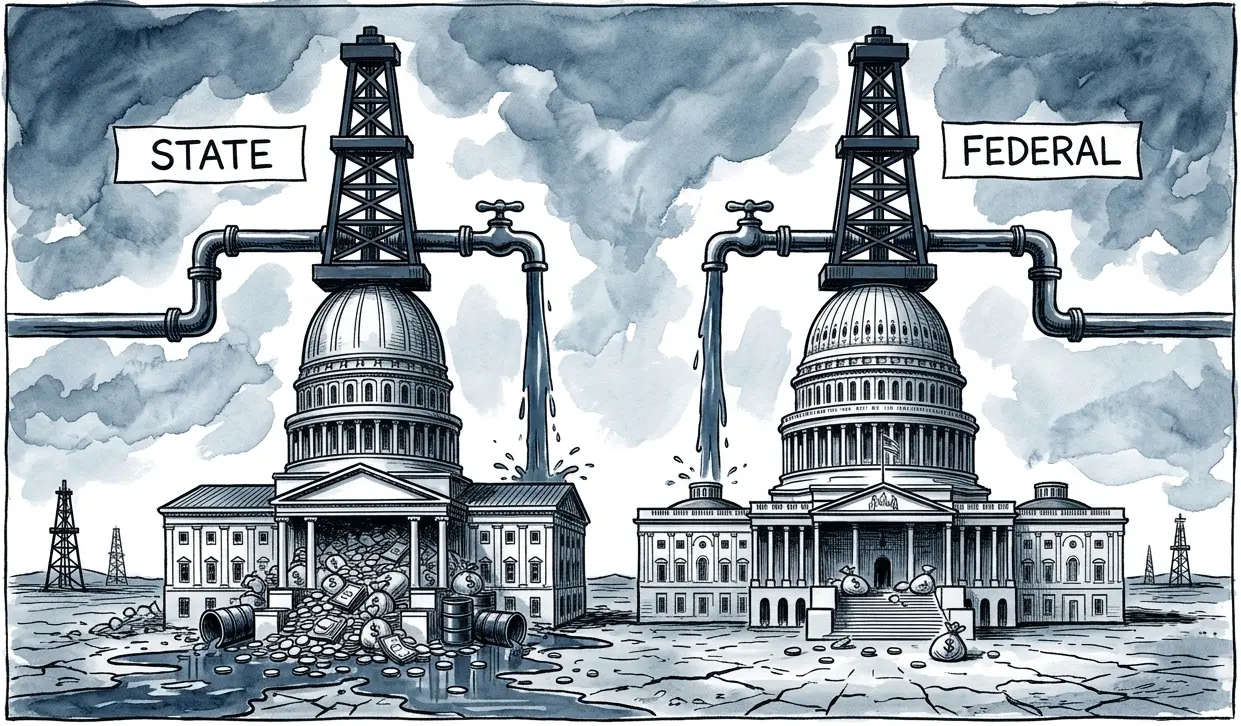
Wyoming charges itself more for its own coal than the federal government charges for coal on federal land in Wyoming. So does North Dakota, for oil. So does Montana. None of these are coastal states. None of them are liberal. All three built permanent wealth funds on the exact resources the federal government keeps giving away — which means the argument that a fair royalty rate would kill an extraction economy has already been tested, in red states, by the people who run those economies, and it failed to hold.
What “impossible” actually looks like when someone tries it
Wyoming established its Permanent Mineral Trust Fund in 1975 by constitutional amendment — a 1.5 percent severance tax stacked on top of federal royalties, covering coal, petroleum, natural gas, and oil shale. The fund now holds more than $12 billion. Five percent of its five-year average value flows into the state’s general fund every year, permanently, regardless of what the extraction industry is doing in any given quarter.
North Dakota did the same thing in 2010, by constitutional amendment approved by its own voters: 30 percent of oil and gas tax revenue diverted into the Legacy Fund before it ever reaches the general budget. The fund passed $10 billion in 2024, taking in roughly $54 million a month in oil tax deposits. The 2023–2025 biennium transfer to the state’s general fund alone was $686 million.
Montana built its Coal Severance Tax Trust Fund the same year Wyoming did — 1975, one year before Alaska built the Permanent Fund that pays every resident a dividend. Montana’s fund now finances schools, local infrastructure grants, and economic development without an additional cent from the state’s own taxpayers. New Mexico holds $53.4 billion across its permanent funds combined, distributing more than $2 billion a year — and its own state investment office projects the funds will out-earn oil and gas revenue entirely by 2039, the point at which a finite resource will have been fully converted into wealth that outlasts it.
Texas charges 25 percent royalty on oil pulled from state land. The federal government charges 12.5 percent on oil pulled from federal land in the same formations, sometimes from wells a few miles away.
The people who built these funds are not the series’ usual heroes
The federal royalty debate was framed around production incentives and international competitiveness — the argument that charging more would push drilling elsewhere. Wyoming, North Dakota, and Montana — the three states most economically dependent on the exact extraction industries in question — were not in that frame, because they had already answered the question the frame was built to avoid asking.
These are not states run by people looking for reasons to tax industry more. Wyoming, North Dakota, and Montana are among the most reliably Republican states in the country, governed for decades by legislatures with every ideological reason to leave extraction revenue exactly where the industry wanted it. They built these funds anyway, because the logic is inescapable once you’re the one who has to explain to your own constituents what happens after the coal seam or the oil field runs out: a finite resource has to become something permanent, or the town that grew up around it has nothing left when the truck stops coming.
The federal government owns and leases far more mineral wealth than any of these states. It has never built the equivalent fund. It has a debt approaching $40 trillion instead.
The clearest proof arrived in 2025, from Wyoming’s own legislature
When the One Big Beautiful Bill Act cut the federal coal royalty rate from 12.5 percent to 7 percent, Wyoming — the nation’s largest federal coal producer, entitled to half of every royalty dollar collected — stood to lose an estimated $50 million a year. The co-chairs of Wyoming’s Joint Appropriations Committee saw it coming a week before the bill was signed and wrote to the state’s three congressional representatives, all Republicans, asking them to amend the bill or bring follow-up legislation to protect Wyoming’s share.
All three voted for the bill without seeking a single revision.
Wyoming legislators then proposed a fix: reweight the federal-state royalty split from 50-50 to 87.5 percent Wyoming, 12.5 percent federal — making the state whole by taking the loss out of the federal government’s already-reduced share instead. If that fix ever extends to every producing state with the same grievance — Montana, North Dakota, New Mexico, Utah, Colorado, Alaska — the federal government will have handed the industry a rate cut and then quietly surrendered nearly all of what was left of its own return, while the states that saw the problem coming get protected and the deficit absorbs the rest. The industry pays less either way. The public pays twice: once at the wellhead, once in the federal budget that made the states whole for a cut it never should have taken in the first place.
Wyoming’s own committee chairs identified the mechanism, in writing, before it happened. Wyoming’s own delegation voted for it anyway.
The distance between a state that built a $12 billion trust fund on its own extraction and a federal government that gave away the same category of resource for a century and called it economically necessary is not a distance of geography, ideology, or resource type. It is the distance between a room that was captured and rooms that were not.
Block 12’s repair argument for a federal sovereign wealth fund does not have to invent the mechanism or defend it as untested. Wyoming, North Dakota, Montana, and New Mexico already ran the experiment, for fifty years, in the reddest states in the country. The only open question is why the federal government is the one jurisdiction in this entire comparison that never tried it.
Look up whether your state has a severance tax permanent fund.
If it sits on mineral wealth and has no fund, ask your state legislature why not — and ask your congressional delegation why the federal rate on the same resource is lower than your own state charges for it. State treasurer and state investment office websites publish the fund balances and distribution formulas directly.
— — —
Steve Sagnotti
is a serious amateur photographer, writer, and technologist based in Oregon. With his camera he tries to capture common images not often seen, leading to common questions not often asked.
© 2026 Steve Sagnotti
— — —
Sources
Wyoming Permanent Mineral Trust Fund, $12B balance, established 1975 by constitutional amendment.
https://statetreasurer.wyo.gov/TreasurerOffice.aspx
North Dakota Legacy Fund, $10B (2024), created 2010 by constitutional amendment, 30% of oil/gas tax revenue, North Dakota Monitor.
https://northdakotamonitor.com/briefs/north-dakota-legacy-fund-tops-10-billion/
North Dakota Legacy Fund background, North Dakota State Treasurer.
https://www.treasurer.nd.gov/north-dakota-government-funds
North Dakota Legacy Fund 2023–2025 biennium transfer, $686,881,085.65, North Dakota State Treasurer.
https://www.treasurer.nd.gov/north-dakota-legacy-fund-0
Montana Coal Severance Tax Trust Fund, established 1975, Montana Board of Investments Annual Report FY2025.
https://investmentmt.com/_shared/docs/Annual-Reports/ANNUALREPORTFY25.pdf
Colorado/Montana/New Mexico/Wyoming severance tax permanent fund pattern, Headwaters Economics, “Comparing Coal Fiscal Policies for Western States,” April 2021.
https://headwaterseconomics.org/energy/coal/coal-fiscal-policies/
New Mexico $53.4B total permanent funds, FY25 distribution, funds projected to exceed oil/gas revenue by 2039, New Mexico Department of Finance and Administration, September 2024.
https://www.nmdfa.state.nm.us/2024/09/17/permanent-fund-investments-to-surpass-oil-and-gas-revenue-securing-new-mexicos-future-by-2038/
Texas 25% state land oil royalty, Texas General Land Office (Permanent School Fund lands).
https://www.glo.texas.gov/about-glo/press-releases/oil-and-gas-revenues-generate-record-shattering-1b-permanent-school-fund
Federal royalty 12.5% (OBBBA reversion from 16.67%), BLM/DOI press release, July 22, 2025.
https://www.doi.gov/pressreleases/interior-department-advances-energy-dominance-through-one-big-beautiful-bill-act
Federal hardrock mineral royalty zero, General Mining Law of 1872, 30 U.S.C. § 21 et seq.
https://www.govinfo.gov/content/pkg/USCODE-2021-title30/html/USCODE-2021-title30-chap2.htm
National debt approaching $40 trillion, Treasury “Debt to the Penny” data ($39.41T as of July 10, 2026).
https://fiscaldata.treasury.gov/datasets/debt-to-the-penny/
Wyoming $50M annual loss from OBBBA coal royalty cut (12.5%→7%), Wyoming Consensus Revenue Estimating Group report via WyoFile, August 7, 2025.
https://wyofile.com/forecasters-big-beautiful-bill-will-cost-wyoming-50m-in-coal-royalties/
Joint Appropriations Committee letter to Wyoming delegation, June 25, 2025, and 87.5/12.5 royalty split reweighting proposal, WyoFile, August 9, 2025.
https://wyofile.com/republican-lawmakers-urge-wyomings-federal-delegation-to-give-state-larger-share-of-coal-royalties/
Leave a Reply