Block 10, Article 5 — The Seller Set the Price. The Seller Owned the Room That Set the Price.
The previous four articles documented what was spent. This one names who collected.
The royalty rate no one adjusted
The Mining Law of 1872 set the royalty rate for hardrock minerals extracted from federal land at zero. Not reduced. Not indexed. Zero. It has not been changed in 154 years. The oil and gas royalty rate written into federal leasing law in 1920 was set at 12.5 percent — half of what Texas charges on production from its own state lands, and one-sixth of Norway’s effective rate on North Sea extraction. ExxonMobil alone earned $32.5 billion in 2014, a year in which its production included substantial federal acreage leased at those rates. The public that owns the land received 12.5 cents on every dollar of value companies like it extracted from it.
ExxonMobil earned $32.5 billion in a single year on production that included public land at royalty rates set in 1920.
The federal royalty rate was framed around production incentives — the argument that charging more would push drilling elsewhere or cost jobs. Texas charging double that rate on its own state land, and Norway charging six times as much on the same resource, without losing either industry, were not in that frame.
The Koch brothers built the second-largest private fortune in the United States substantially on oil extracted from federal and Native American lands at those rates. A portion of that fortune was then invested in the political infrastructure that maintained them: the Heritage Foundation, the Cato Institute, the American Legislative Exchange Council, the Federalist Society pipeline. The political investment paid for itself. The royalty rate stayed fixed. The fortune compounded. No comparable investment protected the public’s side of the ledger — no fund built institutions to elect legislators who might index the rate, audit the extraction, or claw back the difference.
The timber math
The timber industry logged federal land at below-market stumpage rates — the price paid per unit of standing timber, the industry’s basic cost of the wood itself — arranged by the congressional delegations it funded, while the Forest Service built and maintained the roads that made the logging accessible — more than 380,000 miles of them, over eight times the mileage of the entire U.S. Interstate Highway System, at a cost exceeding $5 billion since 1975. The public paid for the road. The industry paid below-market rates for the timber the road reached. A 1984 GAO study found that below-cost timber sales in four western regions produced shortfalls of $64 million in 1981 and $92 million in 1982 — the government spending more to administer the sales than it collected from them.
The Tongass National Forest in Alaska — the same Alaska operation Article 2 already documented losing money on its 50-year sweetheart timber contracts — ran an additional net loss of $130 million in taxpayer-funded timber program costs against proceeds over the 2005–2014 decade alone, on top of the losses already shown there. The Forest Service built the roads. The timber companies took the trees. The commercial salmon fishery those watersheds support is worth an average $88 million a year — a decade-long peer-reviewed study found the Tongass and neighboring Chugach forest together produce roughly a quarter of Alaska’s entire commercial salmon catch. Logging-damaged culverts and stream crossings are a documented, ongoing threat to that fishery, even in a forest researchers rate as comparatively less degraded than many others. The timber profits were kept. The risk to a resource worth its own fortune, every year, indefinitely, was carried by someone else.
The grazing fee frozen in 1966
On 155 million acres of federal land across 16 western states, the fee to graze livestock is set by a formula anchored to a 1966 baseline. The unit is the animal unit month, or AUM — the amount of forage one cow-calf pair eats in a month, the standard measure the whole grazing-fee system is priced against. In 2024, the average private grazing lease in those states ran $23.40 per AUM. The federal fee, raised to $1.69 per AUM effective March 1, 2026, still means the government charges roughly seven cents for every dollar the market charges — a 93 percent discount, courtesy of the public.
A 2005 GAO report found the Bureau of Land Management and Forest Service spent $132.5 million managing grazing programs that year and collected $17.5 million in fees — a net loss of $115 million in a single year. The program covers approximately 25,000 permits and produces roughly 3 percent of U.S. beef. The subsidy is not feeding the country. It is feeding the gap between $1.69 and $23.40, multiplied across 8.6 million animal unit months per year, compounded since 1934.
The permits are not paper losses that expire annually. By custom and regulation, they attach to adjacent private land — which means their value capitalizes into the land price. The subsidy is not paid to struggling ranchers year by year and absorbed. It converts into a private asset: appraised, mortgaged, inherited, sold. The grazing right on public land became private wealth. The fee stayed fixed at 1966 rates. The asset appreciated at market rates.
The forest you own, for a fee
The national forest is public land. The visitor who arrives finds a private contractor operating the campground on infrastructure the Forest Service built and maintains. Aramark, Delaware North, and Xanterra hold concession contracts on some of the most visited public lands in the country. They collect fees on facilities they did not build. The Forest Service maintains the roads to the contractor’s parking lot. The maintenance cost is public. The revenue the maintenance enables is private.
The visitor who purchased an America the Beautiful pass — a direct payment to the public land management system — arrives to find the pass does not apply in the contractor’s operating area. The contractor’s fee is separate, payable to the contractor, not to the Forest Service. The public has paid twice before getting out of the car: once in taxes that built the infrastructure, and again in a pass whose validity ends where the contractor’s fence begins.
To reserve the campsite, the visitor uses Recreation.gov, operated by a private contractor. The $8 to $10 transaction fee goes to the contractor, not the public. Popular sites have a documented history of being captured and resold: Yosemite park officials confirmed scalpers using automated tools to snag cancellations within seconds of the reservation window opening, then reselling $20 campsites on Craigslist for $100 or more. Public land, public infrastructure, private toll, private arbitrage.
Three outputs. Three decisions.
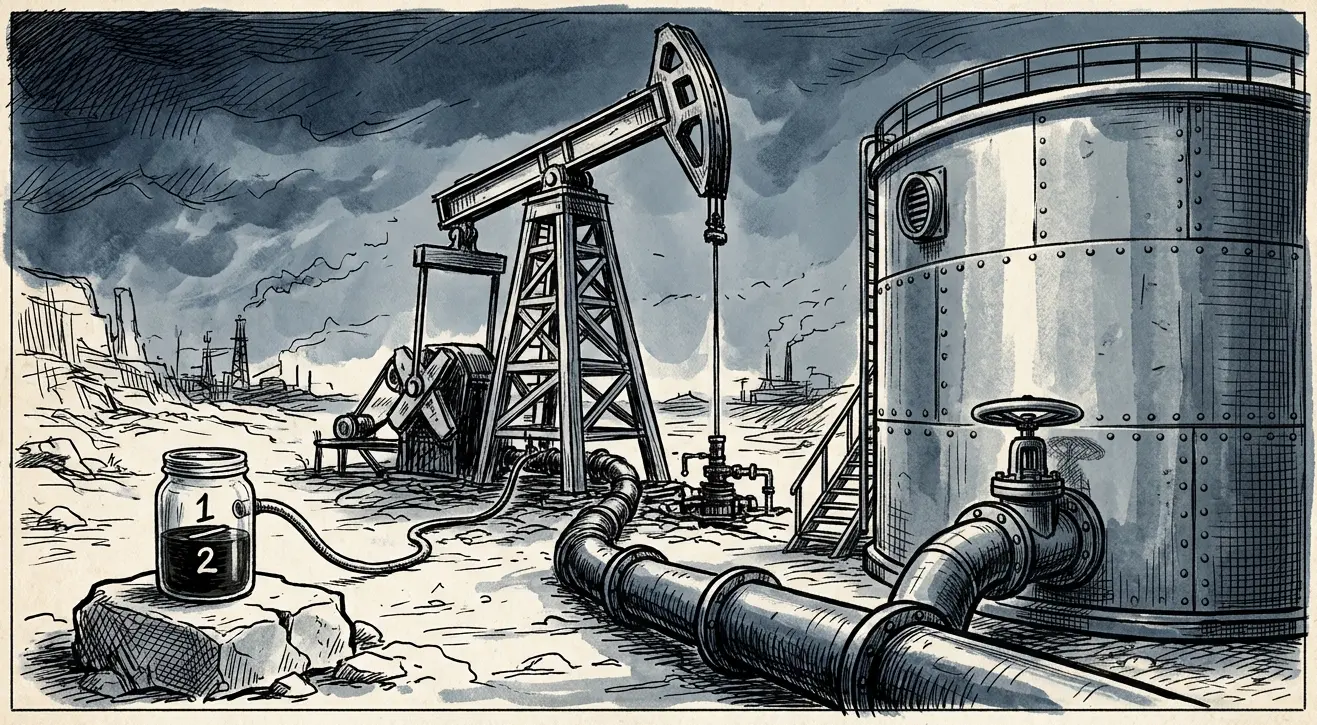
A single oil well does not produce one thing. It produces three, and the same logic prices all three the same way.
The oil itself pays the 12.5 percent royalty already documented above — the rate frozen since 1920. Alongside the oil comes produced water: three to five barrels of contaminated wastewater for every barrel of oil, which the operator injects underground rather than treats, externalizing the disposal cost and the aquifer risk onto the public land it’s injected into. And alongside both comes associated natural gas, which the operator can flare or vent into the atmosphere for free rather than build the infrastructure to capture and sell — self-reported losses across Texas run about 120 billion cubic feet a year, but RMI’s independent measurement in May 2026 put the real figure at up to 551 billion cubic feet, four and a half times what operators disclosed. A meaningful share of that gas comes from wells on federal land, since federal leases make up roughly 10 percent of Permian production — meaning the gap, scaled to just the federal share, is still worth real money in royalties the public will never collect, on gas that was never reported lost in the first place.
Oil, water, gas — three outputs from the same well, three decisions about who bears the cost. And behind all three sits the same unaudited starting point: the volume extracted and its value at the wellhead are both self-reported by the operator, with no independent metering requirement and no third-party verification of either number. The gas figure above isn’t an isolated accounting failure — it’s the one output where an outside party happened to measure the gap. Nothing suggests oil and produced water are reported more honestly; nothing currently checks whether they are. Texas requires metered production reporting on its own state leases. Norway’s licensing regime includes independent verification. The federal government asks the company extracting the resource to report, unverified, how much it took and what it was worth. On every one, the private party captures the value and the public absorbs what’s left over. The ledger was not built this way by accident. It was built this way once, by the people who benefited from the design, and it has not been rebuilt since.
The consensus that held
None of this persisted by accident. Every below-market royalty rate, every unused march-in right, every unregulated aquifer withdrawal was protected by a legislative room where both parties agreed not to touch it — not because they agreed on everything, but because the industries funding both parties made sure the commons extraction stayed off the table for both. The commons was not depleted because one party failed. It was depleted because both parties agreed, implicitly and repeatedly, not to fix it.
The market the extraction industries invoke to argue against regulation is the same market their political investment distorted. The 1872 Mining Law zero-royalty rate is not a market outcome. It is a legislative choice, maintained for 154 years, to exempt one industry from the pricing mechanism that applies to every other transaction in the economy. The market requires honest weights. The ephah small for the buyer, the shekel great for the seller — both measures set by the same hand.
The seller set the price. The seller owned the room that set the price. The commons paid the difference.
The Koch loop — federal extraction funding the political investment that protects federal extraction rates — is a closed circuit. Block 12’s sovereign wealth fund argument is the alternative closed circuit: extraction funding a public return instead of a private one.
The grazing fee resets every year, and it’s always public — check this year’s rate against the private lease rate cited above.
blm.gov/press-release/blm-usda-forest-service-announce-2026-grazing-fees
— — —
Steve Sagnotti
is a serious amateur photographer, writer, and technologist based in Oregon. With his camera he tries to capture common images not often seen, leading to common questions not often asked.
© 2026 Steve Sagnotti
— — —
Sources
Mining Law of 1872, 30 U.S.C. § 21 et seq.
https://www.govinfo.gov/content/pkg/USCODE-2021-title30/html/USCODE-2021-title30-chap2.htm
Mineral Leasing Act of 1920, 30 U.S.C. § 181 et seq., 12.5% royalty rate.
https://ballotpedia.org/General_Mining_Law_of_1872
ExxonMobil 2014 earnings: $32.5 billion, ExxonMobil press release, Feb. 2, 2015.
https://investor.exxonmobil.com/company-information/press-releases/detail/524/exxonmobil-earns-32-5-billion-in-2014-6-6-billion-during
Koch brothers federal/Native American land extraction (Osage oil theft), corroborating account.
https://theflaw.org/articles/corporate-greed-in-indian-country/
GAO, below-cost timber sales, 1984, GAO/RCED-84-96.
https://gao.justia.com/department-of-agriculture/1984/6/congress-needs-better-information-on-forest-service-s-below-cost-timber-sales-rced-84-96
Tongass National Forest cost/revenue, Taxpayers for Common Sense.
https://www.taxpayer.net/energy-natural-resources/new-report-taxpayers-losing-hundreds-of-millions-of-dollars-on-tongass-timber-sales-over-last-two-decades-2/
Forest Service road construction, 380,000+ miles, $5 billion since 1975, Taxpayers for Common Sense.
https://www.taxpayer.net/article/road-woes-at-the-forest-service/
Pacific salmon/logging watershed study, Tongass/Chugach $88M annually, ~25% of Alaska’s commercial salmon catch, USDA Forest Service research page.
https://research.fs.usda.gov/treesearch/59395
BLM 2026 grazing fee announcement ($1.69/AUM effective March 1, 2026), BLM press release.
https://www.blm.gov/press-release/blm-usda-forest-service-announce-2026-grazing-fees
USDA NASS private lease rate average, western states.
https://www.outdoorlife.com/conservation/proposed-blm-grazing-rules/
GAO, 2005 grazing cost report (BLM/FS spent $132.5M, collected $17.5M), GAO-05-869.
https://www.gao.gov/assets/gao-05-869.pdf
Taxpayers for Common Sense, “Grazing on Federal Lands,” May 2025.
https://www.taxpayer.net/energy-natural-resources/grazing-on-federal-lands/
Aramark/Delaware North/Xanterra concessionaire revenue and franchise fee figures.
https://www.americanprogress.org/article/yosemite-for-sale/
(11.75% Yosemite fee specifically: https://www.bloomberg.com/features/2024-yosemite-national-park-aramark-mess/)
Recreation.gov transaction fee schedule ($8–10).
https://recreation.gov/reservation-policies
Bot capture of reservation windows, Yosemite campsite scalping, NPR reporting.
https://www.npr.org/2011/07/07/137496875/yosemite-cracks-down-on-campsite-scalpers
Produced water ratio (3–5 barrels per barrel oil, Permian/Delaware Basin).
https://davisgraham.com/news-events/u-s-produced-water-the-emerging-value-chain-reshaping-energy-water-and-critical-minerals/
Associated gas flaring, self-reported ~120 Bcf vs. RMI estimate up to 551 Bcf, “Drilling Down on Methane Loss.”
https://rmi.org/drilling-down-on-methane-loss/The previous four articles documented what was spent. This one names who collected.
The royalty rate no one adjusted
The Mining Law of 1872 set the royalty rate for hardrock minerals extracted from federal land at zero. Not reduced. Not indexed. Zero. It has not been changed in 154 years. The oil and gas royalty rate written into federal leasing law in 1920 was set at 12.5 percent — half of what Texas charges on production from its own state lands, and one-sixth of Norway’s effective rate on North Sea extraction. ExxonMobil alone earned $32.5 billion in 2014, a year in which its production included substantial federal acreage leased at those rates. The public that owns the land received 12.5 cents on every dollar of value companies like it extracted from it.
ExxonMobil earned $32.5 billion in a single year on production that included public land at royalty rates set in 1920.
The federal royalty rate was framed around production incentives — the argument that charging more would push drilling elsewhere or cost jobs. Texas charging double that rate on its own state land, and Norway charging six times as much on the same resource, without losing either industry, were not in that frame.
The Koch brothers built the second-largest private fortune in the United States substantially on oil extracted from federal and Native American lands at those rates. A portion of that fortune was then invested in the political infrastructure that maintained them: the Heritage Foundation, the Cato Institute, the American Legislative Exchange Council, the Federalist Society pipeline. The political investment paid for itself. The royalty rate stayed fixed. The fortune compounded. No comparable investment protected the public’s side of the ledger — no fund built institutions to elect legislators who might index the rate, audit the extraction, or claw back the difference.
The timber math
The timber industry logged federal land at below-market stumpage rates — the price paid per unit of standing timber, the industry’s basic cost of the wood itself — arranged by the congressional delegations it funded, while the Forest Service built and maintained the roads that made the logging accessible — more than 380,000 miles of them, over eight times the mileage of the entire U.S. Interstate Highway System, at a cost exceeding $5 billion since 1975. The public paid for the road. The industry paid below-market rates for the timber the road reached. A 1984 GAO study found that below-cost timber sales in four western regions produced shortfalls of $64 million in 1981 and $92 million in 1982 — the government spending more to administer the sales than it collected from them.
The Tongass National Forest in Alaska — the same Alaska operation Article 2 already documented losing money on its 50-year sweetheart timber contracts — ran an additional net loss of $130 million in taxpayer-funded timber program costs against proceeds over the 2005–2014 decade alone, on top of the losses already shown there. The Forest Service built the roads. The timber companies took the trees. The commercial salmon fishery those watersheds support is worth an average $88 million a year — a decade-long peer-reviewed study found the Tongass and neighboring Chugach forest together produce roughly a quarter of Alaska’s entire commercial salmon catch. Logging-damaged culverts and stream crossings are a documented, ongoing threat to that fishery, even in a forest researchers rate as comparatively less degraded than many others. The timber profits were kept. The risk to a resource worth its own fortune, every year, indefinitely, was carried by someone else.
The grazing fee frozen in 1966
On 155 million acres of federal land across 16 western states, the fee to graze livestock is set by a formula anchored to a 1966 baseline. The unit is the animal unit month, or AUM — the amount of forage one cow-calf pair eats in a month, the standard measure the whole grazing-fee system is priced against. In 2024, the average private grazing lease in those states ran $23.40 per AUM. The federal fee, raised to $1.69 per AUM effective March 1, 2026, still means the government charges roughly seven cents for every dollar the market charges — a 93 percent discount, courtesy of the public.
A 2005 GAO report found the Bureau of Land Management and Forest Service spent $132.5 million managing grazing programs that year and collected $17.5 million in fees — a net loss of $115 million in a single year. The program covers approximately 25,000 permits and produces roughly 3 percent of U.S. beef. The subsidy is not feeding the country. It is feeding the gap between $1.69 and $23.40, multiplied across 8.6 million animal unit months per year, compounded since 1934.
The permits are not paper losses that expire annually. By custom and regulation, they attach to adjacent private land — which means their value capitalizes into the land price. The subsidy is not paid to struggling ranchers year by year and absorbed. It converts into a private asset: appraised, mortgaged, inherited, sold. The grazing right on public land became private wealth. The fee stayed fixed at 1966 rates. The asset appreciated at market rates.
The forest you own, for a fee
The national forest is public land. The visitor who arrives finds a private contractor operating the campground on infrastructure the Forest Service built and maintains. Aramark, Delaware North, and Xanterra hold concession contracts on some of the most visited public lands in the country. They collect fees on facilities they did not build. The Forest Service maintains the roads to the contractor’s parking lot. The maintenance cost is public. The revenue the maintenance enables is private.
The visitor who purchased an America the Beautiful pass — a direct payment to the public land management system — arrives to find the pass does not apply in the contractor’s operating area. The contractor’s fee is separate, payable to the contractor, not to the Forest Service. The public has paid twice before getting out of the car: once in taxes that built the infrastructure, and again in a pass whose validity ends where the contractor’s fence begins.
To reserve the campsite, the visitor uses Recreation.gov, operated by a private contractor. The $8 to $10 transaction fee goes to the contractor, not the public. Popular sites have a documented history of being captured and resold: Yosemite park officials confirmed scalpers using automated tools to snag cancellations within seconds of the reservation window opening, then reselling $20 campsites on Craigslist for $100 or more. Public land, public infrastructure, private toll, private arbitrage.
Three outputs. Three decisions.
A single oil well does not produce one thing. It produces three, and the same logic prices all three the same way.
The oil itself pays the 12.5 percent royalty already documented above — the rate frozen since 1920. Alongside the oil comes produced water: three to five barrels of contaminated wastewater for every barrel of oil, which the operator injects underground rather than treats, externalizing the disposal cost and the aquifer risk onto the public land it’s injected into. And alongside both comes associated natural gas, which the operator can flare or vent into the atmosphere for free rather than build the infrastructure to capture and sell — self-reported losses across Texas run about 120 billion cubic feet a year, but RMI’s independent measurement in May 2026 put the real figure at up to 551 billion cubic feet, four and a half times what operators disclosed. A meaningful share of that gas comes from wells on federal land, since federal leases make up roughly 10 percent of Permian production — meaning the gap, scaled to just the federal share, is still worth real money in royalties the public will never collect, on gas that was never reported lost in the first place.
Oil, water, gas — three outputs from the same well, three decisions about who bears the cost. And behind all three sits the same unaudited starting point: the volume extracted and its value at the wellhead are both self-reported by the operator, with no independent metering requirement and no third-party verification of either number. The gas figure above isn’t an isolated accounting failure — it’s the one output where an outside party happened to measure the gap. Nothing suggests oil and produced water are reported more honestly; nothing currently checks whether they are. Texas requires metered production reporting on its own state leases. Norway’s licensing regime includes independent verification. The federal government asks the company extracting the resource to report, unverified, how much it took and what it was worth. On every one, the private party captures the value and the public absorbs what’s left over. The ledger was not built this way by accident. It was built this way once, by the people who benefited from the design, and it has not been rebuilt since.
The consensus that held
None of this persisted by accident. Every below-market royalty rate, every unused march-in right, every unregulated aquifer withdrawal was protected by a legislative room where both parties agreed not to touch it — not because they agreed on everything, but because the industries funding both parties made sure the commons extraction stayed off the table for both. The commons was not depleted because one party failed. It was depleted because both parties agreed, implicitly and repeatedly, not to fix it.
The market the extraction industries invoke to argue against regulation is the same market their political investment distorted. The 1872 Mining Law zero-royalty rate is not a market outcome. It is a legislative choice, maintained for 154 years, to exempt one industry from the pricing mechanism that applies to every other transaction in the economy. The market requires honest weights. The ephah small for the buyer, the shekel great for the seller — both measures set by the same hand.
The seller set the price. The seller owned the room that set the price. The commons paid the difference.
The Koch loop — federal extraction funding the political investment that protects federal extraction rates — is a closed circuit. Block 12’s sovereign wealth fund argument is the alternative closed circuit: extraction funding a public return instead of a private one.
The grazing fee resets every year, and it’s always public — check this year’s rate against the private lease rate cited above.
blm.gov/press-release/blm-usda-forest-service-announce-2026-grazing-fees
— — —
Steve Sagnotti
is a serious amateur photographer, writer, and technologist based in Oregon. With his camera he tries to capture common images not often seen, leading to common questions not often asked.
© 2026 Steve Sagnotti
— — —
Sources
Mining Law of 1872, 30 U.S.C. § 21 et seq.
https://www.govinfo.gov/content/pkg/USCODE-2021-title30/html/USCODE-2021-title30-chap2.htm
Mineral Leasing Act of 1920, 30 U.S.C. § 181 et seq., 12.5% royalty rate.
https://ballotpedia.org/General_Mining_Law_of_1872
ExxonMobil 2014 earnings: $32.5 billion, ExxonMobil press release, Feb. 2, 2015.
https://investor.exxonmobil.com/company-information/press-releases/detail/524/exxonmobil-earns-32-5-billion-in-2014-6-6-billion-during
Koch brothers federal/Native American land extraction (Osage oil theft), corroborating account.
https://theflaw.org/articles/corporate-greed-in-indian-country/
GAO, below-cost timber sales, 1984, GAO/RCED-84-96.
https://gao.justia.com/department-of-agriculture/1984/6/congress-needs-better-information-on-forest-service-s-below-cost-timber-sales-rced-84-96
Tongass National Forest cost/revenue, Taxpayers for Common Sense.
https://www.taxpayer.net/energy-natural-resources/new-report-taxpayers-losing-hundreds-of-millions-of-dollars-on-tongass-timber-sales-over-last-two-decades-2/
Forest Service road construction, 380,000+ miles, $5 billion since 1975, Taxpayers for Common Sense.
https://www.taxpayer.net/article/road-woes-at-the-forest-service/
Pacific salmon/logging watershed study, Tongass/Chugach $88M annually, ~25% of Alaska’s commercial salmon catch, USDA Forest Service research page.
https://research.fs.usda.gov/treesearch/59395
BLM 2026 grazing fee announcement ($1.69/AUM effective March 1, 2026), BLM press release.
https://www.blm.gov/press-release/blm-usda-forest-service-announce-2026-grazing-fees
USDA NASS private lease rate average, western states.
https://www.outdoorlife.com/conservation/proposed-blm-grazing-rules/
GAO, 2005 grazing cost report (BLM/FS spent $132.5M, collected $17.5M), GAO-05-869.
https://www.gao.gov/assets/gao-05-869.pdf
Taxpayers for Common Sense, “Grazing on Federal Lands,” May 2025.
https://www.taxpayer.net/energy-natural-resources/grazing-on-federal-lands/
Aramark/Delaware North/Xanterra concessionaire revenue and franchise fee figures.
https://www.americanprogress.org/article/yosemite-for-sale/
(11.75% Yosemite fee specifically: https://www.bloomberg.com/features/2024-yosemite-national-park-aramark-mess/)
Recreation.gov transaction fee schedule ($8–10).
https://recreation.gov/reservation-policies
Bot capture of reservation windows, Yosemite campsite scalping, NPR reporting.
https://www.npr.org/2011/07/07/137496875/yosemite-cracks-down-on-campsite-scalpers
Produced water ratio (3–5 barrels per barrel oil, Permian/Delaware Basin).
https://davisgraham.com/news-events/u-s-produced-water-the-emerging-value-chain-reshaping-energy-water-and-critical-minerals/
Associated gas flaring, self-reported ~120 Bcf vs. RMI estimate up to 551 Bcf, “Drilling Down on Methane Loss.”
https://rmi.org/drilling-down-on-methane-loss/
Leave a Reply