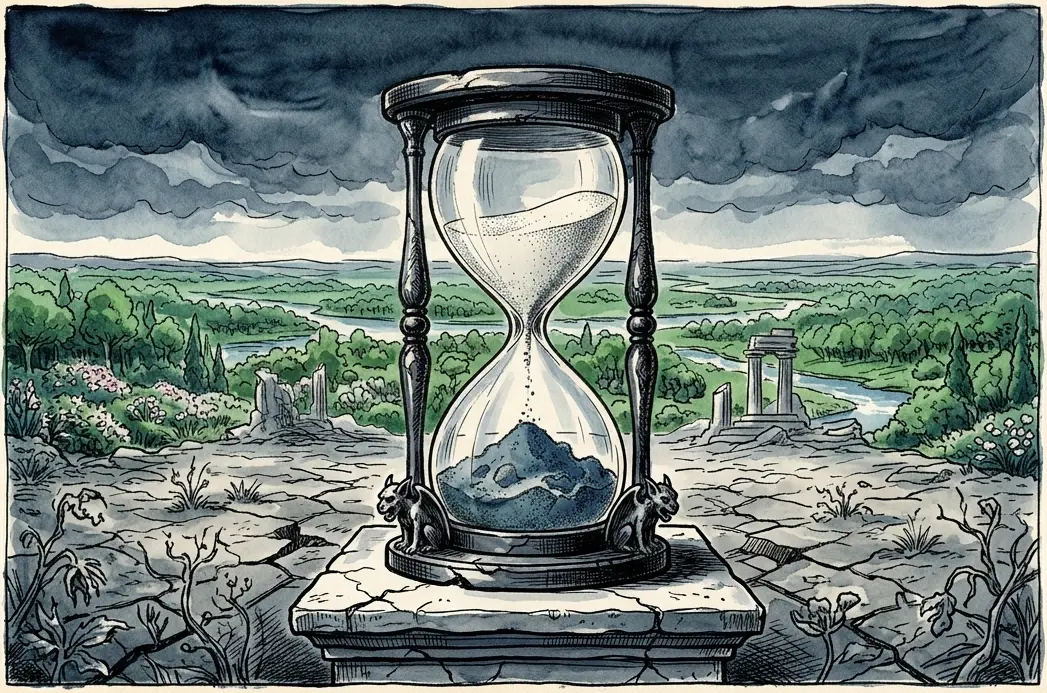
Block 10, Article 6 — The Profit Was Privatized. The Loss Was Socialized.
Every member of Congress takes an oath to support and defend the Constitution of the United States and to well and faithfully discharge the duties of the office. Article I, Section 8 names one of those duties specifically: Congress shall have power to provide for the general welfare of the United States.
What did that oath produce?
What every generation assumed
Every generation of Americans has operated on an assumption so basic it was never stated: there will be a future, and it will resemble the present in its basic conditions. Productive land. Clean water. Functioning fisheries. A manageable fiscal situation. The assumption is embedded in the social contract at a level below politics — it is what makes long-term investment, child-rearing, and civic participation rational. You plant trees you will not sit under because someone planted trees for you.
The current generation is the first in American history to be on track to pass forward a measurably depleted version of what it received, across multiple categories simultaneously.
The natural balance sheet
The topsoil that took ten thousand years to accumulate is being spent as an operating expense. Iowa farmers today work 6.8 fewer inches of topsoil than their great-grandparents did. More than a third of the Corn Belt has lost its A-horizon entirely — the biologically active layer that no human technology can recreate on any agricultural planning horizon. The aquifers that took millions of years to fill are being drawn down on a timeline measured in decades. In Kansas, Oklahoma, and the Texas Panhandle, communities are already drilling deeper and finding less. The fisheries that sustained coastal economies for four centuries were harvested to collapse. The Atlantic cod has not recovered in thirty years of moratorium. The old-growth forest that took a millennium to develop was processed into lumber in a generation; less than 6 percent of the pre-colonial extent remains in the lower 48 states.
These are not four separate failures. They are the same balance sheet, drawn in different resource categories, across the same timeline, by the same mechanism: extraction at rates that exceeded replenishment, at prices that did not reflect the real cost, protected by rooms that were paid to look the other way.
The ledger they terminated
The fiscal balance sheet is the one that gets reported. The natural capital debt does not appear in any official federal accounting — no line for topsoil lost, no entry for aquifer drawn down, no charge for fisheries spent. The mechanism that would have begun producing that accounting for the first time was terminated before it generated a single official figure.
On Earth Day 2022, Executive Order 14072 directed the establishment of government-wide natural capital accounts — a parallel ledger that would have measured the economic value of clean water, forests, fisheries, wetlands, topsoil. After more than 150 years of accelerated commons extraction, the government was going to count what had been taken.
On January 20, 2025 — Day One — Executive Order 14154 revoked EO 14072 by number. The books were closed. The commons extraction continues. The official record will not show it.
The fiscal commons
The federal debt is approaching $40 trillion and climbing on a trajectory the Congressional Budget Office projects will become self-reinforcing by 2031 — interest payments exceeding defense spending, consuming an expanding share of revenue, crowding out everything else. The Social Security trust fund is projected to be exhausted by late 2032. At that point, the program can pay 78 cents on every dollar of promised benefits. The people who will absorb that cut are today’s workers in their thirties and forties, who paid into the system their entire working lives under the assumption that the deal would hold.
The debt did not accumulate by accident. Someone cut the taxes. The revenue shrank. The deficit grew. The debt compounded. Then the people who cut the taxes pointed at the debt and said the programs had to go.
The national debt was framed as a spending problem — entitlements grown too large, government grown too generous. The revenue never collected from the public’s own resources — the royalty rate frozen since 1920, the grazing fee frozen since 1966, the spectrum given away for free — was not in that accounting.
Grover Norquist named the plan out loud in 2001: shrink government until it’s small enough to drown in a bathtub. The 2017 tax bill cut the corporate rate from 35 to 21 percent — the Congressional Budget Office put the ten-year cost at $1.3 trillion. The carried interest loophole, which lets hedge fund managers pay lower tax rates than their assistants, has been on the closure list of both parties for twenty years. It’s still open. A lobbying campaign for a 2004 repatriation provision returned 22,000 percent on the investment.
The debt is the bathtub. It was filled on purpose. The child born in 2026 inherits the bill she didn’t run up. The debt she inherits is the record of what that power was used for instead.
The human labor ledger
The natural resource extractions documented in this block have dollar figures attached. The human labor extraction runs the same accounting. The inputs are harder to total because the enterprise operated continuously for 160 years.
The convict leasing system ran from 1865 to approximately 1928 in its original corporate-lease form — men convicted under statutes written to criminalize the act of leaving a job or being unemployed, leased to private operators who paid the state a fee and paid the workers nothing. Tennessee Coal, Iron and Railroad Company, later acquired by U.S. Steel, held a 10-year exclusive contract in 1888 to all able-bodied Alabama state prisoners at $9 to $18.50 per prisoner per month. The workers received nothing. In the first full year of U.S. Steel’s ownership, nearly 60 prison workers died from workplace accidents at that single company. Annual workforce turnover reached 400 percent — not because workers left, but because they died or were worked past function.
The formal system was largely abolished by 1930. The constitutional exception was not. The 13th Amendment’s punishment clause — neither slavery nor involuntary servitude, except as a punishment for crime whereof the party shall have been duly convicted — remains unchanged. The prison labor system that operates today pays wages ranging from nothing to approximately $1.15 per hour, for work that includes manufacturing, agriculture, and call center operations for private corporations under contract with state systems. The population performing this labor is disproportionately Black, by a margin documented by the Bureau of Justice Statistics across every decade since the data was collected. The Walk Free Foundation’s Global Slavery Index places the United States in the same category as China and Russia for state-imposed forced labor. The United Nations Special Rapporteur on Contemporary Forms of Slavery submitted a formal report to the Human Rights Council in 2024 documenting what the 13th Amendment exception produces. The extraction sequence that began with the Black Codes in 1865 has never closed.
The logic that ran on everything
The 1976 pork industry trade publication gave its instruction plainly: forget the pig is an animal. Treat it like a machine in a factory. When California and Massachusetts voters passed ballot measures requiring minimum animal welfare standards — by 63 and 78 percent majorities — the industry lost in court and at the ballot box, so it went to Congress. The House farm bill now contains a provision that nullifies both state laws and preempts future state action. The five-step capture sequence has reached its logical extension: the purchased room can now reverse the outcomes of direct democracy.
The private prison industry’s per-diem model requires maximum occupancy at minimum cost per body. Alabama’s private prison system, under federal court oversight for homicide rates among the highest ever recorded in American corrections, continued collecting the per-diem while the constitutional violations ran. The gestation crate and the private prison cell are not analogous structures. They are the same optimization logic at different scales, applied to different species, protected by the same purchased room.
The profession against the record
The nation that received the inheritance documented in Block 1 also received the obligation that came with it. It sold the mineral rights at 12.5 percent of market value. It grazed the public range at seven cents on the dollar. It gave away the broadcast spectrum for sixty-five years. It built four dams that drowned treaty-guaranteed fishing places. It pumped the fossil water at rates that will exhaust the southern portions within the working lifetime of a child born today. It logged 90 to 95 percent of the old-growth forest. It watched the cod fishery collapse in five documented steps and declared itself unable to act until the fish did not come back.
The nation that did all of this opens its legislative sessions with prayer. It swears its officials in on a Bible. It prints In God We Trust on the currency it collected while the commons was being spent. The tradition it professes is specific about what it requires. Every member of Congress takes that oath on a book that contains Matthew 6:24: You cannot serve both God and money. The verse is not an accusation. It is a description of what divided loyalty produces. The master you serve is the one whose interests you protect when the two conflict.
The policy outcomes are public record. The oath is on file. The verse names the binary. The reader applies the math.
The profit was privatized. The loss was socialized. The citizen got the bill on both ends and was given no vote on any of it. The children who will inherit the depleted balance sheet — the exhausted aquifer, the spent topsoil, the compounding federal debt, the constitutional exception that has never been closed — did not vote for any of it. They were not born yet. The rooms where the decisions were made are still in operation. The mechanisms that protect those rooms are what this series has been documenting.
The debt documented here is the fiscal expression of everything else in this ledger — the revenue never collected is the debt that compounded instead. Block 11 shows what happens when that debt spiral meets a displacement wave the same debt-strapped room has no capacity to answer.
The books were closed by executive order, and the order number is public record.
The Federal Register’s entry for EO 14154 lists EO 14072 by number and date among the orders it revokes: federalregister.gov/documents/2025/01/29/2025-01956/unleashing-american-energy
— — —
Steve Sagnotti
is a serious amateur photographer, writer, and technologist based in Oregon. With his camera he tries to capture common images not often seen, leading to common questions not often asked.
© 2026 Steve Sagnotti
— — —
Sources
Federal debt approaching $40T, CBO “The Budget and Economic Outlook: 2026 to 2036,” February 2026.
https://www.cbo.gov/publication/61882
Treasury “Debt to the Penny” data confirms $39.41T as of July 10, 2026.
https://fiscaldata.treasury.gov/datasets/debt-to-the-penny/
Social Security OASI trust fund exhaustion late 2032, 78% payable, Social Security Board of Trustees Annual Report, 2026.
https://www.ssa.gov/news/en/press/releases/2026-06-09.html
Iowa topsoil 6.8 inches, USDA NRCS Iowa data.
https://www.businessrecord.com/cruse-iowa-has-lost-6-8-inches-of-topsoil-a-1-billion-a-year-economic-hit/
Old-growth forest <6% remaining lower 48, Rainforest Action Network.
https://www.ran.org/the-understory/how_much_old_growth_forest_remains_in_the_us/
Old-growth forest figures, Save America’s Forests.
https://www.saveamericasforests.org/pages/educationrtfacts.htm
Atlantic cod moratorium 1992, DFO Canada moratorium documentation.
https://www.heritage.nf.ca/articles/economy/moratorium.php
Executive Order 14072 (April 22, 2022), natural capital accounting.
https://www.federalregister.gov/documents/2022/04/27/2022-09138/strengthening-the-nations-forests-communities-and-local-economies
Executive Order 14154, “Unleashing American Energy” (January 20, 2025), revocation of EO 14072.
https://www.federalregister.gov/documents/2025/01/29/2025-01956/unleashing-american-energy
Tax Cuts and Jobs Act of 2017, Pub.L. 115-97, CBO analysis.
https://www.cbo.gov/publication/53651
CBO, corporate rate cut/TCJA primary deficit impact scored at $1.3 trillion over ten years.
https://www.cbo.gov/publication/53787
Grover Norquist bathtub quote, NPR Morning Edition, May 25, 2001.
https://en.wikiquote.org/wiki/Grover_Norquist
Tennessee Coal Iron and Railroad 1888 contract, $9–$18.50/prisoner/month, Douglas Blackmon, Slavery by Another Name.
https://www.npr.org/89037811
Prison wages $0–$1.15/hour, Prison Policy Initiative, “How Much Do Incarcerated People Earn in Each State.”
https://www.prisonpolicy.org/blog/2017/04/10/wages/
Leave a Reply