Notes from the Field — September 25, 2026
A waiting period built to protect Congress, and an end date it can’t outlast.
In 1974, Congress wrote a rule to stop a president from sitting on money Congress had ordered him to spend. On the last Friday of September, the White House used that rule to hold back $810 million Congress had ordered spent, five days before the federal fiscal year ended.
The list is specific. The largest piece, $567 million, is for refugee programs run through the Department of Health and Human Services. The rest: $70 million for international education grants and fellowships, $56 million for housing counseling, $28 million for health research, $25 million for migrant students. The White House called the package “historic action to eliminate wasteful and harmful spending” and labeled the education grants “woke international education.”
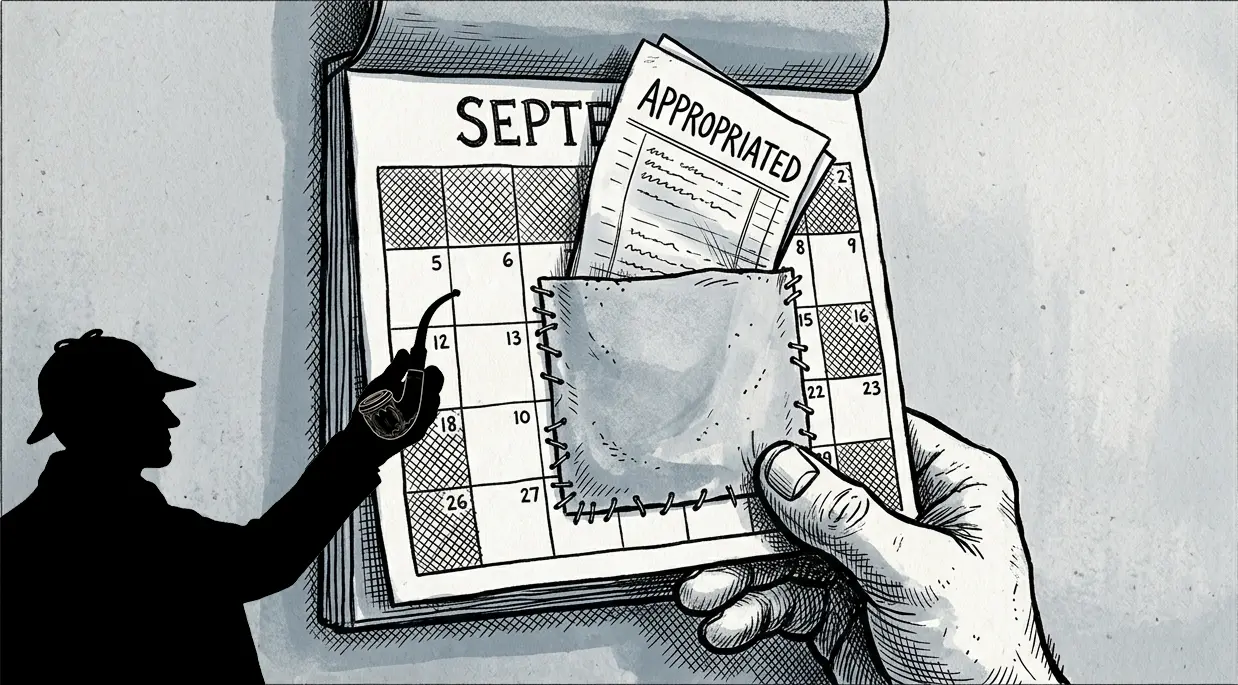
The way it works is simple once you see the calendar. The 1974 law lets a president ask Congress to cancel spending he doesn’t want, and lets him hold the money for 45 days while Congress decides. But money Congress sets aside for a given year expires with that year. Send the request when fewer than 45 days remain, and the hold outlasts the money. It lapses. No bill passes, no vote is taken, and none was needed. That is a “pocket rescission,” named for the pocket veto, where a president wins by letting the clock run.
The law exists because of Nixon, who refused to spend money Congress had appropriated for programs he didn’t like. Congress answered with the Impoundment Control Act, which cleared the Senate unanimously and the House 401 to 6, according to the Center on Budget and Policy Priorities. The center argues that the 45 days were meant to give Congress time to answer a president, and that the pocket rescission bends the law toward the opposite end.
The tactic then sat unused for nearly fifty years. The administration revived it last August with $4.9 billion in foreign aid. The Supreme Court let the money stay frozen while the case went on, without saying whether the move is lawful, and the cancellation stood. This is the second year.
The Government Accountability Office, Congress’s auditor, says the Act can’t be used this way. The Congressional Research Service reports that the office likens it to the line-item veto the Supreme Court struck down in 1998. White House budget director Russell Vought defends it as a legitimate tool. Senate Appropriations Chair Susan Collins, a Republican, called it “a clear violation of the law” and said the package arrived without warning. She issued nearly the same warning last August.
In a budget of roughly $7 trillion, $810 million is small, as the National Taxpayers Union points out. The dollar figure isn’t the story. The story is the question most of the coverage skipped: who gets a vote?
So far the answer comes from courts, and courts are slower than calendars. The National Urban League and local housing groups sued on September 29 over the $56 million in housing money, a day before the year ended. Last year’s round shows the pace: the case moved, the money stayed frozen, and the cancellation stood. As of October 1, the suit is pending, and Collins has said she will work with colleagues to respond.
Congress passes a spending bill. The president signs it. In the last days of the year, the White House asks Congress to cancel part of it and freezes the money. The year ends. The money is gone, and Congress never voted on whether it should be.
What this looks like is a safeguard that works only if the calendar leaves room for it. As long as the end of the year comes sooner than any answer to the freeze, the waiting period protects the freeze, not Congress.
Copyright 2026 — Steve Sagnotti
Sources: Roll Call, “White House cancels health, education funds approved by Congress,” Sept. 28, 2026, and “Housing groups challenge Trump funding clawback,” Sept. 30, 2026. American Action Forum, analysis of the $810 million rescissions request, September 2026. National Taxpayers Union, analysis of the pocket rescissions proposal, September 2026. Higher Education Dive, September 2026. Fox News, September 2026. IBTimes UK, September 2026. Congressional Research Service, “Pocket Rescissions and the Impoundment Control Act,” Sept. 25, 2025. Center on Budget and Policy Priorities, “Pocket Rescissions Are Illegal,” 2025. States Newsroom, Sept. 9, 2025.
Leave a Reply