Notes from the Field — September 29, 2026
The ads say who paid. They don’t say who gets to decide whether that was allowed.
The ads run during college football and prime-time shows. One resembles a black-and-white video from the president’s own 2024 campaign: Trump walking down a hallway, warning of a last confrontation. Each ends with an on-screen line saying the government paid for it.
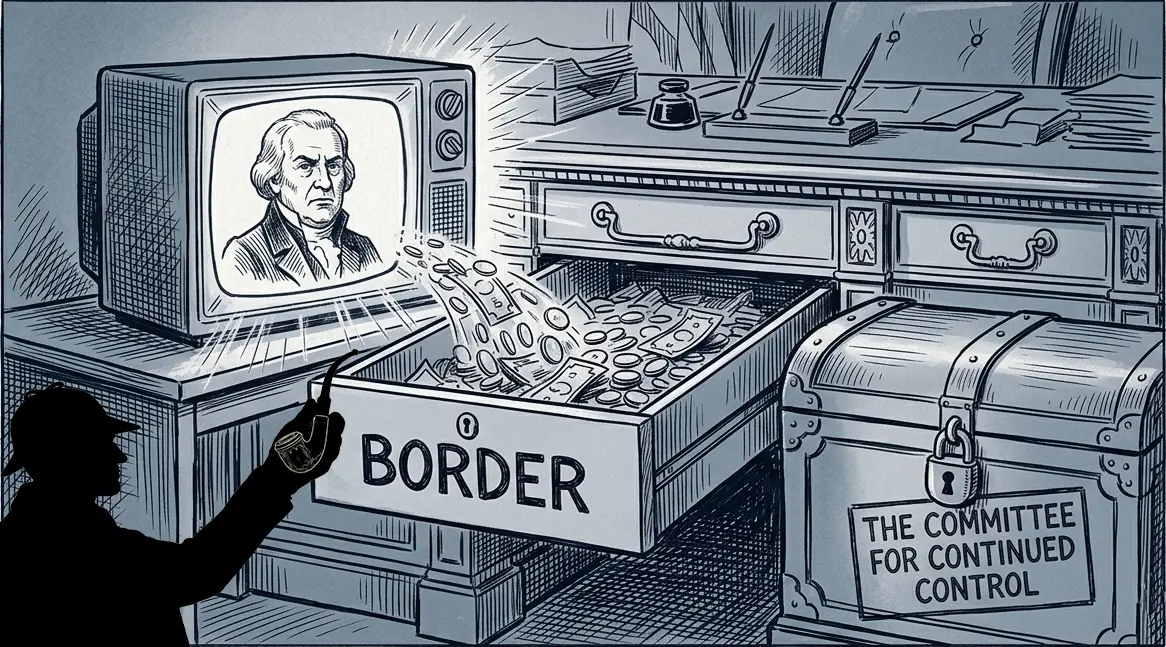
The money was meant for the border. Congress gave the Department of Homeland Security $175 billion in last year’s reconciliation law for immigration enforcement. House Democrats say the White House budget director, Russell Vought, moved $20 million of it into an ad campaign on September 19. The next day, federal contract data show, a $20 million “National Media Campaign” went to LMD Agency of Maryland. The tracking firm AdImpact counted more than $2.5 million spent on three ads in one week, a figure that may be low.
Republicans noticed too. Senate Majority Leader John Thune said the ads shouldn’t be paid for with taxpayer dollars. Sen. Thom Tillis compared them to the ads of Hungary’s Viktor Orbán. Sen. John Kennedy told CBS “there ought to be a rule” against it, then allowed that it is probably illegal. Democratic Sens. Patty Murray and Chris Murphy wrote to Homeland Security Secretary Markwayne Mullin calling it illegal and demanding answers in 48 hours, and Reps. Jamie Raskin and George Whitesides asked federal watchdogs to investigate. The White House calls the ads public service announcements and points out that they disclose the government’s funding.
Is it legal? Critics point to a long-standing ban on using appropriated money for propaganda. But the test the Government Accountability Office has applied in past cases asks whether the government hid its role. That is how it found violations in a Bush-era Medicare campaign and in the Obama administration’s social-media push for a water rule: the public wasn’t told who was speaking. These ads say who is speaking. Experts told the Associated Press the ads still look different from past public-service campaigns, because they aren’t built to help anyone use a specific program. As of October 1, no court and no GAO decision has said either way.
Whichever way that question comes out, look at where each piece of this sits. The budget office moved the money. A department the president runs awarded the contract. The White House has already ruled on its own ads: public service announcements. And when the GAO found in 2015 that the Environmental Protection Agency had broken the same ban, the remedy it set was a report: the agency had to tell the President and Congress about its own violation. The room that spends is the room that receives the verdict.
One more fact sits in the AP’s account. MAGA Inc., the super PAC that backs Trump, is holding hundreds of millions of dollars that could go to the midterms, and allied groups have already started spending. The ads were bought with the public’s money anyway.
The money was meant for the border. A budget office moved it. A department signed the contract. The networks aired the ads. A line on the screen said who paid. Six days after the transfer date House Democrats give, on September 25, the same budget office sent Congress a request to cancel $810 million in programs Congress had funded.
Until someone other than the office that ordered the ads can order them off the air, the ads and the verdict on them will sit in the same place.
Origin case: TNG Essay 3 — The People in the Room
Copyright 2026 — Steve Sagnotti
Sources: The Associated Press (Lisa Mascaro and Ali Swenson), “Homeland Security taps $20M in taxpayer funds for pro-Trump ads,” Sept. 29, 2026. The Guardian, Sept. 27, 2026 (Sen. Kennedy) and Oct. 1, 2026 (Reps. Raskin and Whitesides). The Associated Press via Fox 10 Phoenix, September 2026, on the GAO’s prior findings. Snell & Wilmer, “Waters of the U.S. Rule Drowning to Start 2016,” Jan. 21, 2016, on the GAO’s EPA decision. American Action Forum, analysis of the $810 million rescissions request, September 2026.
Leave a Reply