Notes from the Field — July 23, 2026
There is a sentence in the Constitution that has sat mostly dormant for forty years, doing nothing, waiting. It says the House judges its own elections. Not a court. Not a state. The House.
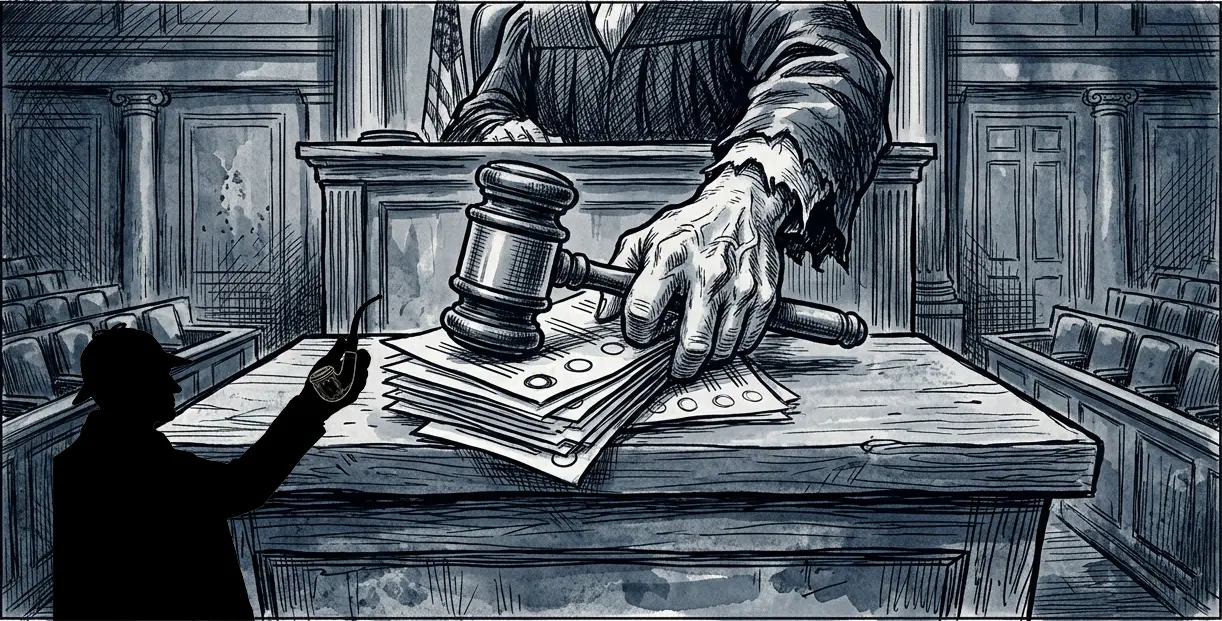
Article I, Section 5 gives each chamber of Congress sole authority to decide who its own members are — and the Supreme Court has already closed the only door that might check it. In 1972, in Roudebush v. Hartke, the Court called the question of who belongs in a congressional seat “nonjusticiable.” Translation: no judge will touch it. The Federal Contested Elections Act of 1969 supplies the mechanics — a losing candidate has 30 days after certification to file a challenge, the House Administration Committee investigates, and a simple majority of the very body whose composition is in dispute decides the outcome.
The people counting the ballots and the people who benefit from the count are the same people.
The room has done this before
This isn’t theoretical. In 1985, Indiana’s 8th District — nicknamed the “Bloody Eighth” for its habit of unseating incumbents — produced a razor-thin, twice-recounted result. The state certified Republican Richard McIntyre the winner. The Democratic-controlled House disagreed, sent its own task force to Indiana, and changed which ballots counted under rules the state itself hadn’t used. The House seated Democrat Frank McCloskey by a margin of four votes out of 233,000 cast. Republicans walked out in protest. Historians now treat the episode as a proximate cause of the 1994 Republican takeover — a grievance that reshaped a decade of politics, born from a rule most voters didn’t know existed.
The one fence, and what it doesn’t cover
There is a limit on this power, and it’s worth being precise about where it sits. In 1969 the Supreme Court ruled in Powell v. McCormack that the House cannot exclude a duly elected member for any reason beyond the qualifications the Constitution actually lists — age, citizenship, residency. It cannot invent new grounds for disqualifying a winner. That much is settled.
But Powell governs only who can be kept out. It says nothing about the separate power that the Bloody Eighth used and that Roudebush left standing — the power to decide which votes count in the first place. Nothing in the text requires that method to bear any relationship to the actual dispute; the 1985 task force at least anchored its recount in Indiana’s own technical standards. Nothing compels the next one to. The same 1972 ruling that keeps courts out of who won a contested seat keeps them equally out of how that count gets made. One half of this power has a fence. The other does not.
“Close enough” is a belief, not a measurement
Nothing in the Federal Contested Elections Act requires the underlying margin to actually be close. The 30-day filing window and the majority vote apply to any contested race — a comfortable loss is just as eligible to be challenged as a four-vote squeaker. Closeness has functioned as a practical filter, not a legal one. It’s what let the 1985 recount read as a genuine dispute instead of the majority simply picking its preferred winner. But “genuine dispute” is a judgment made by whoever accepts the outcome afterward — it was never a threshold written into the statute.
That judgment is exactly what’s easiest to manufacture in a country sorted into two camps that no longer expect to lose fairly. Each side’s information diet already tells the same story before a single vote is counted: our candidate is decent, theirs is dangerous, and a loss under those terms doesn’t compute as legitimate. When neither camp can picture someone sincerely voting for the other side, any result that doesn’t confirm the expected outcome reads as evidence of fraud rather than evidence of an actual electorate. French’s own account of 2020 traces the sequence precisely: cast the opponent as an existential threat, and it takes no further leap to conclude they’d cheat to win — after which any margin, wide or narrow, is something a caucus can treat as suspect. Once that premise is shared widely enough inside a chamber, the House doesn’t need an actual four-vote race to invoke the process. It only needs enough of its own members already convinced the loss couldn’t have been real.
That’s a rewrite of the fence, not a discovery of a legal boundary. The margin was never binding. What’s disappeared is a shared expectation that losing sometimes just means losing.
Why the room is paying attention now
Heading into the 2026 midterms, the conditions that kept Article I, Section 5 dormant are eroding. Generic-ballot polling favors Democrats, a special election in Tennessee’s 7th District came within single digits in a seat drawn to be safe, and the sitting president has spent years describing any election he loses as illegitimate. The infrastructure for contesting a close House race already exists, tested, unreviewable, and waiting on a majority willing to use it.
David French’s column names Speaker Mike Johnson specifically — not incidentally. Johnson filed a brief at the Supreme Court in 2020 supporting Trump’s challenges to certified results in four states. The same figure now presides over the chamber that would decide whether to seat a contested winner in 2027.
What the coverage leaves out
The frame most coverage uses treats this as a partisan question: will Republicans use it against Democrats. That frame excludes the more durable fact underneath — this isn’t a power either party owns. It’s a standing feature of the chamber, dormant until a majority decides a close enough seat is worth the cost of using it. It was Democrats in 1985, and the backlash it produced arguably helped cost them the House nine years later. It was nearly Democrats again in 2020, when House leadership considered contesting Iowa’s 2nd District before backing off. This isn’t a partisan weapon pointed rightward this cycle — it’s a tool built into the room itself, available to whoever holds it when a vote is close enough to matter, and, as of 1972, answerable to no one for how it counts.
Power does not require conspiracy. It only requires that the people in the room share a common interest in the outcome.
The sequence
An election is held. It is close, or close enough for someone in the room to say so. A state certifies a winner. A losing candidate, or the party behind them, files a challenge under a 1969 statute few voters have heard of. A committee controlled by the winning party’s majority investigates, using a counting standard of its own choosing. The full chamber, controlled by the same majority, votes. No court will hear an appeal, because the Supreme Court decided in 1972 that there is nothing to appeal.
The silence won’t feel like silence. It will just feel like the way things are — a seating vote, procedural, unremarkable, the kind of House business that happens on a Thursday and is forgotten by Friday.
What would have to change for this gear to stop turning is not a new law. It’s a majority large enough, in either party, that no contested seat is ever close enough to need it.
Essay 11 — Out of Frame
(Broken Frames — Block 4: The Private Government (Party) (not yet published — thebrokenframes.substack.com/s/broken-frames))
Copyright 2026 — Steve Sagnotti
Sources: David French, “This Is What’s Keeping Me Up at Night,” The New York Times, July 23, 2026. Matt Ford, “The Simple, Legal Way Trump Could Steal the Midterms,” The New Republic, December 11, 2025. Powell v. McCormack, 395 U.S. 486 (1969). Roudebush v. Hartke, 405 U.S. 15 (1972). “Messy Elections,” Roll Call, 2008 (Indiana 8th District, 1984–85). “Disputed Elections in the U.S. House,” Broadstreet, 2025.
Leave a Reply