Block 8, Article 1 — He Was Not Describing a Conspiracy. He Was Writing a Business Plan.
On August 23, 1971, a corporate attorney named Lewis Powell sent a confidential memorandum to the U.S. Chamber of Commerce. He was not a fringe figure. He sat on the boards of eleven corporations, served as the Chamber’s counsel, and two months after writing this memo was confirmed to the Supreme Court of the United States. He was precisely the kind of man the system was designed to produce — credentialed, connected, and operating entirely within the rules.
He was not describing a conspiracy. He was writing a business plan.
— — —
What was his complaint?
Powell looked at 1971 and saw American business losing on every front. The regulatory state had expanded dramatically in a single decade. The Environmental Protection Agency was founded in 1970. The Occupational Safety and Health Administration in 1970. The Consumer Product Safety Commission was coming in 1972. Ralph Nader had published “Unsafe at Any Speed” in 1965, become a national figure, and spawned a consumer movement that was winning in court. University campuses were producing economists, lawyers, and policy thinkers openly hostile to corporate power. The media was giving them platforms. The courts were ruling against business with regularity.
His diagnosis was precise: business had wealth and no institutional presence. Its opponents had spent decades building universities, influencing media, populating regulatory agencies, and training the lawyers who were now winning the cases. Business had written checks to political campaigns and assumed that was sufficient. It was not. You cannot win an institutional war with electoral donations. You need institutions.
— — —
What the memo left out.
The agencies Powell named as enemies were not ideological impositions. They were responses to documented, undeniable harm. The Cuyahoga River caught fire in 1969. PG&E had been poisoning a California town’s drinking water since 1952 and concealing it. Thalidomide had deformed more than 10,000 children across 46 countries — the United States was spared only because one FDA examiner named Frances Kelsey refused to approve it without adequate safety evidence, against sustained industry pressure. DDT was destroying food chains and the industry knew. Lead paint was in every American home. The Surgeon General reported in 1964 what the tobacco industry had known for years. Ford had calculated that Pinto fuel tank settlements were cheaper than a redesign. In July 1977, six years before the Federalist Society was founded, Exxon’s own scientists told management the planet was warming and burning fossil fuels was the cause. The company marked the report not for external distribution and spent the next four decades funding the doubt machine Powell had just finished building.
The regulatory pressure Powell described as an attack on American business was the public’s response to what business had already delivered without it: cheap goods, low wages, the highest possible margin, and no price tag on the damage. Call it a market failure and it sounds like an accident — a system that tried to work and stumbled. Nothing stumbled. Profit maximized exactly as designed the moment nobody was required to pay for what got poisoned, deformed, or burned. The hole was not in the market. The hole was in what the market was ever required to answer for. He was not wrong that business was under pressure. The pressure was the point.
The Powell Memo was framed as a defense against an attack on free enterprise. What the attack actually consisted of — a market delivering exactly what an unaccountable market delivers, documented at Cuyahoga, Hinkley, thalidomide, the Pinto, Exxon’s own buried climate research — was not in the frame.
— — —
What he proposed.
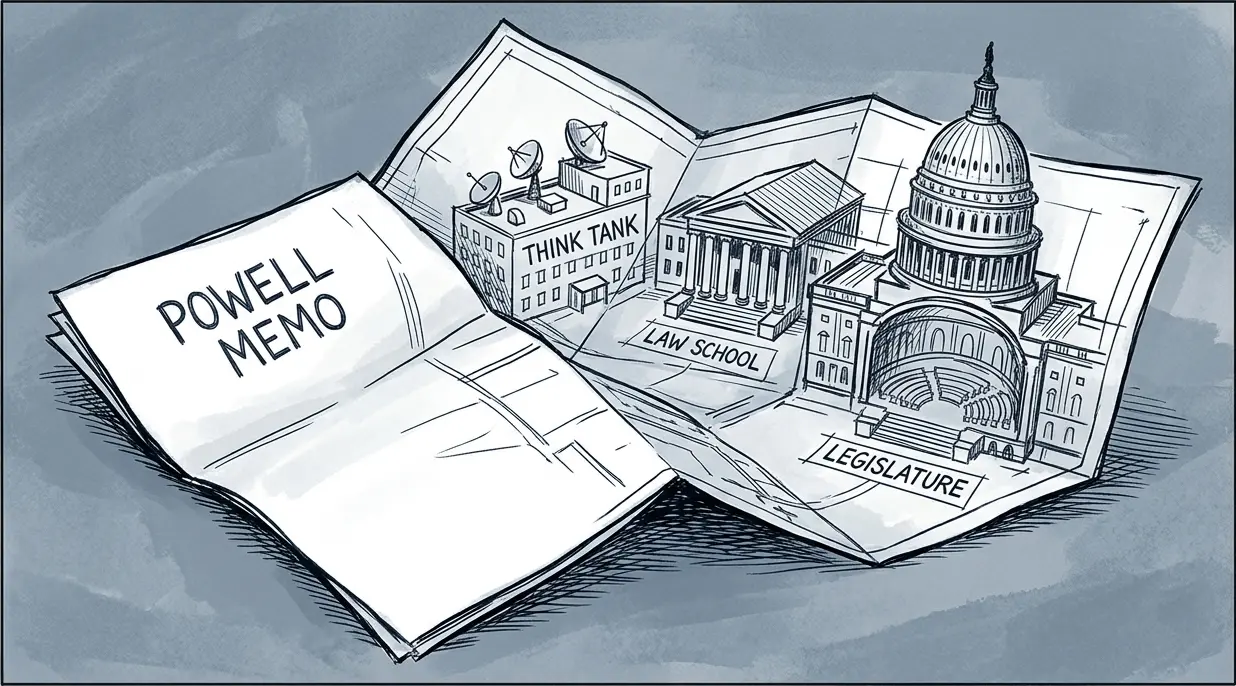
Powell’s argument was precise and his remedy was specific. The free enterprise system — which he genuinely believed was the foundation of American political freedom, not merely economic convenience — was losing because it had surrendered the institutional battlefield. The solution was to take it back. Not through a single election or a single court case. Through a generational, patient, institutional reconstruction of every room where the argument was being lost.
Fund the think tanks that produce the ideas. Endow the academic chairs that train the next generation of lawyers and economists. Build the legal foundations that bring the cases. Develop the media infrastructure that shifts the public conversation. Place people in the institutions. Staff the agencies. Appoint the judges.
The goal was not to win the next argument. It was to make certain arguments impossible to mount by removing the institutions that produced them. Not a level playing field. Not a defense. Permanent structural advantage — and the pendulum bolted where it lands.
The Chamber of Commerce filed the memo and began executing it.
— — —
What followed is the subject of this block.
The Heritage Foundation was founded two years later. The Federalist Society eleven years later. Citizens United was decided thirty-nine years later. Each is a chapter in the execution of a plan written down, filed, funded, and carried out by specific people with specific amounts of money whose names are in the donor records and whose institutions are still operating.
The government you were taught about has three branches, checks and balances, a representative legislature, and courts that enforce rights. The government you actually interact with was rebuilt in the image of that memo. The blocks before this one documented how the room was frozen, the map was rigged, the door was locked, and the bench was bought. This block documents who paid for it, how it was built, and what it has cost.
The apparatus Powell built did not work in the abstract. It worked on specific things. The federal royalty rate on mineral extraction from public lands — the rent the public charged for oil and gas pulled from ground the public owned — had not been meaningfully updated since 1920. The industries extracting at that rate were among the industries funding the apparatus that protected it. Powell sat on eleven corporate boards. The memo was not written by a disinterested observer.
The apparatus split into two pipelines as it grew. The judicial pipeline — the clerkships, the vetting, the bench Powell wanted built — is Block 7’s story. The political pipeline that funds the campaigns of the legislators who protect the whole arrangement, election after election, is Block 4’s. Both trace back to the same memo, the same year, the same diagnosis.
The structural argument behind this mechanism lives in Essay 11 of The Narrow Gate.
— — —
Read the memo — the record is public. The Powell Memorandum, August 23, 1971, is archived in full at scholarlycommons.law.wlu.edu/powellmemo/1/. Ask an AI: “Which specific institutions did the Powell Memo call for building, and which ones exist today?”
— — —
Steve Sagnotti
is a serious amateur photographer, writer, and technologist based in Oregon. With his camera he tries to capture common images not often seen, leading to common questions not often asked.
© 2026 Steve Sagnotti
— — —
Sources
1. Powell, Lewis F. Confidential Memorandum to Eugene Sydnor Jr., U.S. Chamber of Commerce. August 23, 1971. scholarlycommons.law.wlu.edu/powellmemo/1/
2. EPA founded 1970; OSHA founded 1970; CPSC founded 1972. epa.gov/history
3. Cuyahoga River fire 1969: Time, August 1, 1969 issue (“The Cities: The Price of Optimism”).
4. PG&E/Hinkley chromium-6 contamination 1952–1966; $333M settlement 1996. grist.org
5. Thalidomide 10,000+ birth defects; Frances Kelsey FDA refusal. fda.gov
6. Ford Pinto fuel tank cost-benefit calculation. Automotive News; contemporaneous reporting.
7. Exxon internal climate research 1977; “not to be distributed externally” 1982 document. InsideClimate News investigation 2015. Supran, G., Rahmstorf, S., & Oreskes, N. “Assessing ExxonMobil’s Global Warming Projections.” Science 379(6628), eabk0063 (Jan. 13, 2023). doi.org/10.1126/science.abk0063
8. James Black 1977 memo. insideclimatenews.org
Leave a Reply