Block 7, Article 1 — Nobody Voted on the Powell Memo. Nobody Had To.
Steve Sagnotti · thebrokenframes.substack.com
In August 1971, corporate lawyer Lewis Powell wrote a confidential memo to the U.S. Chamber of Commerce calling for a coordinated, generational apparatus — funded think tanks, academic chairs, legal organizations — to retake American institutions from what he called an assault by academia, the media, and the courts. Block 8 tells that story in full. What matters here is one detail: Powell named the judiciary specifically. The way to change how courts ruled was to change who sat on them, and what doctrine those judges believed before they got there.
Two months after writing the memo, Richard Nixon nominated Powell to the Supreme Court. He was confirmed 89 to 1.
Nobody voted on the Powell Memo. Nobody had to. No comparable channel existed on the other side — there was no fund, no fifty-year plan, no coordinated pipeline available to the institutions Powell wrote about retaking. There still isn’t one.
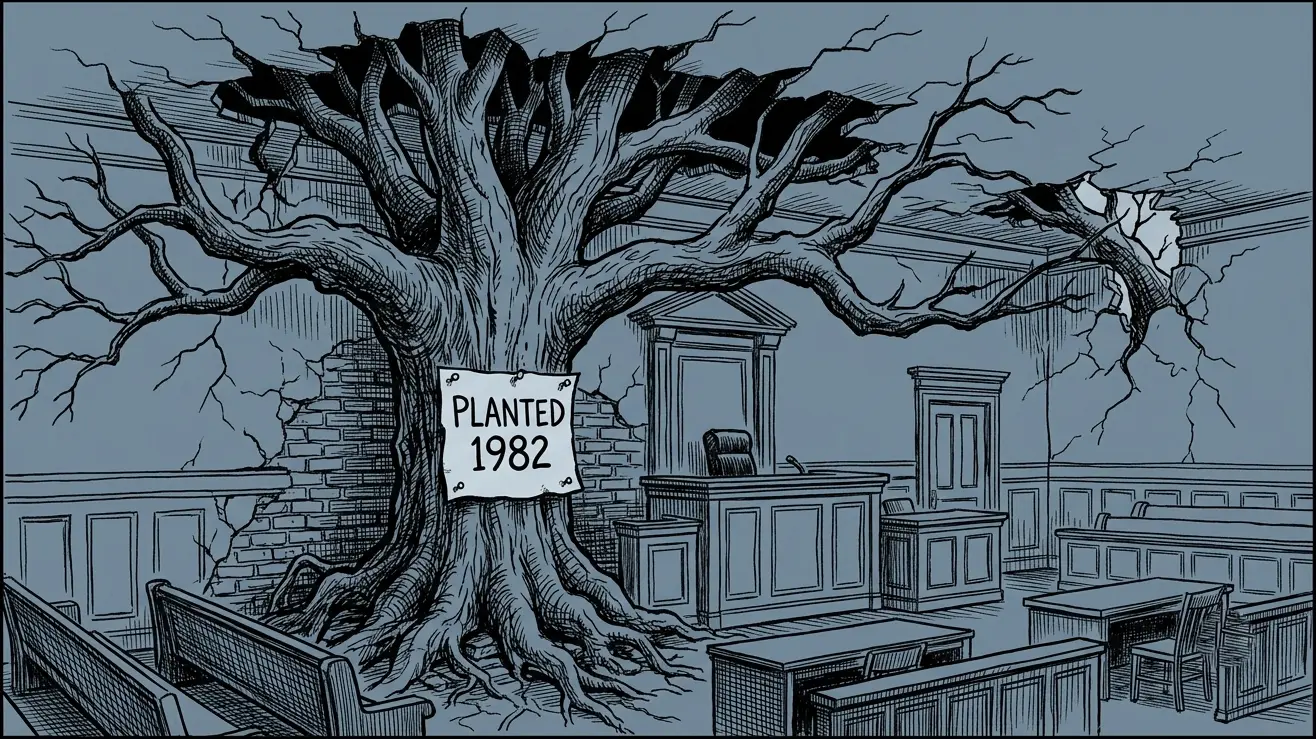
1982: a meeting at Yale
Eleven years after the memo, a group of law students at Yale and the University of Chicago held a symposium. They called their new organization the Federalist Society — a name that invokes Madison and Hamilton, the architects of constitutional checks and balances, the men who specifically designed the American system to prevent any single faction from capturing it.
The Federalist Papers are 85 essays written by Madison, Hamilton, and Jay to argue for ratification of the Constitution. They are the founders’ own explanation of what the document was designed to do and why. The Federalist Society selected the name. It did not select the argument.
Madison had more to say than the essays the Society cites. In 1822 he wrote to a colleague that a popular government without popular information, or the means of acquiring it, is but a prologue to a farce or a tragedy, or perhaps both — that knowledge will forever govern ignorance, and a people who mean to be their own governors must arm themselves with the power that knowledge gives. An institution built to control who has access to legal scholarship, who clerks for which judges, who gets vetted before nomination, is one specific way of arming the wrong side.
Federalist No. 10 is Madison’s definition of faction — “a number of citizens united and actuated by some common impulse of passion, or of interest, adverse to the rights of other citizens, or to the permanent and aggregate interests of the community” — and his argument that the entire constitutional architecture exists to break its power. A coordinated network of funders, scholars, clerks, and judges advancing a specific legal doctrine on behalf of specific economic interests is Madison’s definition of faction, organized at generational scale.
Federalist No. 58 is Madison’s argument that the House must grow with the population — that a small, diluted chamber is easier for a “few” to control and harder for the many to use as a check on concentrated power. Block 2 documented what happened when Congress froze the House in 1929. No. 58 named the danger in 1788. The Society invokes the founding era. It does not invoke this paper.
Federalist No. 78 is Hamilton’s argument for an independent judiciary — insulated from political selection precisely because a pre-selected bench is the condition that makes individual rights unenforceable. The pipeline the Society built is the specific mechanism Hamilton said the independence requirement was designed to prevent. Hamilton’s argument for lifetime appointments was an argument against ideological vetting before nomination. The Society exists to conduct that vetting.
The founders are invoked when they support the case. They are invisible when they indict it. The texts are hosted by the law school where the Society was founded.
The Federalist Society was framed as a legal education organization, defending the founders’ Constitution as written. Federalist 58 — Madison’s guarantee that the House would grow with the population — was not in that frame; the 1929 freeze it was built to prevent stands unchallenged. Federalist 78 — Hamilton’s argument that judicial independence requires insulation from political selection — was not in that frame either; the pipeline exists to conduct the exact vetting Hamilton said independence was designed to prevent. The founders are cited when they support the arrangement. Ignored when they would dismantle it.
The pipeline
The Society received seed money from the Olin Foundation and the Scaife family foundations — the same funders building the think tank infrastructure the Powell Memo had called for. Their portfolios ran through the same industries this series has already documented extracting the commons at below-market rates. The bench they were building would later rule on the royalty rates, the agency rules, and the campaign spending limits that governed those industries’ returns. Its structure was deliberate: law school chapters recruited students. Students clerked for judges. Clerks became associates. Associates became partners. Partners became nominees. Not a preferred candidate list — a network. A community of legal thinkers who shared a philosophy, knew each other, vouched for each other, and moved through the same institutional doors.
A law student who joined in 1985 found mentorship, clerkship access, and a professional community the existing legal establishment did not provide. The career path was real and it was open. The pipeline filled.
By 2020, six of nine Supreme Court justices had Federalist Society affiliations. By 2024, a majority of the federal appellate bench had passed through the pipeline. The organization’s annual budget grew from nothing in 1982 to approximately $20 million by 2018, funded by the same donor networks that built Heritage and Cato.
Every proposal to change the bench’s composition meets the same objection: it would politicize the courts. The objection assumes politicization is a future risk rather than a completed fact. A court six justices deep into a single donor-funded, single-network pipeline is not apolitical and waiting to be corrupted. It is the outcome of forty years of exactly that kind of politics, conducted patiently enough that by the time anyone called it politics, it looked like judicial philosophy instead.
The funding detail behind that apparatus — the Olin Foundation’s $370 million into law school economics programs, the think tank architecture, the full machine — is Block 8’s story. One sentence here: it was documented, it was deliberate, and it worked.
The rule that was invented, used, and discarded
The pipeline’s product is a bench. A bench requires vacancies. And in February 2016 a vacancy opened.
Justice Antonin Scalia died on February 13. President Obama nominated Merrick Garland to fill the seat on March 16 — a centrist federal appellate judge, widely respected, with bipartisan confirmation history. Senate Majority Leader Mitch McConnell refused to hold hearings. His stated justification: the vacancy had arisen in a presidential election year, and the people should have a voice in who filled it through their vote for the next president. No hearings. No vote. Two hundred ninety-three days of vacancy.
Donald Trump won the election. Neil Gorsuch was nominated and confirmed. The seat was filled.
In 2020, Justice Ruth Bader Ginsburg died on September 18 — forty-six days before the presidential election. McConnell moved immediately to fill the seat. The rule he had invented four years earlier — election year vacancies must wait for the people’s voice — was not applied. Amy Coney Barrett was confirmed eight days before the election.
The rule existed for one vacancy and one vacancy only. It was the precise vacancy that allowed a one-term president to appoint three justices — Gorsuch, Kavanaugh, Barrett — and cement a six-three supermajority that the forty-year pipeline had been built to produce.
The Federalist Society named itself after papers warning against faction. The rule that completed the project was invented for a single application, applied once, and discarded.
The old way to handle an inconvenient ruling
The pipeline was not the first way power has dealt with a court that ruled the wrong way. In 1832 the Supreme Court held in Worcester v. Georgia that the Cherokee Nation was a sovereign political entity, and Georgia’s laws had no force inside its territory. Andrew Jackson is reported to have said that Chief Justice Marshall had made his decision — now let him enforce it. Jackson did not defy the ruling on paper. He simply proceeded as though it had not been made. Removal went forward anyway.
The pattern surfaced again in 2020 — this time with a citation instead of a shrug. Here’s what happened, in plain terms: the Supreme Court told Oklahoma that roughly half the state was still legally Native land — a promise the U.S. government made by treaty in the 1830s and never formally took back. Oklahoma didn’t want that to be true. Its own courts started narrowing the ruling almost immediately, and two years later the Supreme Court itself handed down a follow-up decision letting the state prosecute crimes on that same land anyway.
The reasoning is the part worth sitting with. Justice Kavanaugh — one of the pipeline’s own confirmations — didn’t say the 2020 ruling was wrong. He said the older idea behind it, that Native land is genuinely separate from the state, had already been abandoned in practice for nearly two hundred years. In plain terms: the promise doesn’t count anymore because people have been breaking it since 1832 — the same year Jackson ignored the first ruling. The violation became the excuse for more violation. Justice Gorsuch — another of the pipeline’s confirmations — dissented: “Where this Court once stood firm, today it wilts.” The pipeline does not guarantee unanimity. It guarantees the majority.
One hundred ninety years apart, the tool changed and the outcome didn’t. Jackson broke the promise by refusing to show up. The bench this pipeline built broke it by writing the citation. Either way: a promise on paper, and a system that guarantees it doesn’t survive contact with anyone who doesn’t want it to.
What the investment bought
The reader has now encountered the bench’s product in five prior blocks. Rucho v. Common Cause (2019): federal courts have no power to review partisan gerrymandering — the rigged maps in Block 3 are beyond federal judicial reach. Shelby County v. Holder (2013) and Callais (2026): the Voting Rights Act preclearance gutted, the racial redistricting remedy closed. The compact in Block 6 faces a Supreme Court challenge if it activates. In 2024: Loper Bright Enterprises v. Raimondo abolished Chevron deference — federal agencies can no longer interpret ambiguous statutory language without de novo judicial review. Every commons protection that runs through federal regulation is now subject to challenge before a bench that the pipeline built.
The pipeline produced the bench. The bench produced the outcomes. The outcomes are documented. The investment behind the pipeline will be documented in full in Block 8. The money pipeline needed protecting too, from the campaign finance rules and lobbying disclosure requirements that might have slowed it down. The political pipeline documented in Block 4 provided that protection. Three pipelines. One system: the money built the bench, the politics protected the money, and the bench now protects both from anything either one might have to answer for.
The commons — the minerals, the water, the airwaves, the fisheries, the knowledge infrastructure built on public money — is protected, when it is protected at all, by federal agencies operating under federal statutes interpreted by federal courts. The pipeline was built to reach all three. It has reached all three.
The next article shows what the bench inherited — a 124-year legal project it didn’t build but completed.
Read what the founders actually wrote — then compare it to what the Society built.
| Federalist No. 10 — Madison on faction | avalon.law.yale.edu/18th_century/fed10.asp |
| Federalist No. 58 — Madison on representation and capture | avalon.law.yale.edu/18th_century/fed58.asp |
| Federalist No. 78 — Hamilton on judicial independence | avalon.law.yale.edu/18th_century/fed78.asp |
| Federalist Society — funding and affiliated judges | opensecrets.org/orgs/federalist-society |
— — —
Steve Sagnotti
is a serious amateur photographer, writer, and technologist based in Oregon. With his camera he tries to capture common images not often seen, leading to common questions not often asked.
© 2026 Steve Sagnotti
— — —
Sources
1. Powell Memo — Lewis F. Powell, “Confidential Memorandum: Attack on American Free Enterprise System,” August 23, 1971. reclaimdemocracy.org/powell_memo_lewis
2. Powell board memberships including Philip Morris: Jane Mayer, Dark Money (Doubleday, 2016), Chapter 2.
3. Powell Supreme Court nomination and 89-1 confirmation: U.S. Senate confirmation records.
4. Federalist No. 10 — Madison, faction defined: avalon.law.yale.edu/18th_century/fed10.asp
5. Federalist No. 58 — Madison, representation and capture: avalon.law.yale.edu/18th_century/fed58.asp
6. Federalist No. 78 — Hamilton, judicial independence: avalon.law.yale.edu/18th_century/fed78.asp
7. Federalist Society founding 1982, Yale and University of Chicago: federalistsociety.org/about-us
8. Olin Foundation and Scaife seed funding: Mayer, Dark Money, Chapter 4.
9. Federalist Society annual budget ~$20M by 2018: Federalist Society Form 990; Mayer, Dark Money.
10. Six of nine justices Federalist Society affiliations by 2020: Ballotpedia, The Federalist Society
11. Merrick Garland nomination March 16, 2016; 293-day vacancy: U.S. Senate records; Congressional Research Service.
12. McConnell election-year rule stated and discarded: Washington Post, New York Times, February–March 2016 and September–October 2020.
13. Amy Coney Barrett confirmed October 26, 2020: U.S. Senate records.
14. Rucho v. Common Cause, 588 U.S. 684 (2019). https://www.oyez.org/cases/2018/18-422
15. Shelby County v. Holder, 570 U.S. 529 (2013). https://supreme.justia.com/cases/federal/us/570/529/
16. Loper Bright Enterprises v. Raimondo, 603 U.S. ___ (2024). https://www.supremecourt.gov/opinions/23pdf/22-451_7m58.pdf
17. Madison, James, letter to W.T. Barry, August 4, 1822. The Writings of James Madison, ed. Gaillard Hunt (1910), Vol. 9, p. 103. https://press-pubs.uchicago.edu/founders/documents/v1ch18s35.html
18. Worcester v. Georgia, 31 U.S. 515 (1832). Jackson quote to subordinate: New Georgia Encyclopedia. https://supreme.justia.com/cases/federal/us/31/515/
19. McGirt v. Oklahoma, 591 U.S. 894 (2020). https://www.oyez.org/cases/2019/18-9526
20. Oklahoma v. Castro-Huerta, 597 U.S. 629 (2022). Kavanaugh majority on Worcester-era understanding abandoned; Gorsuch dissent “Where this Court once stood firm, today it wilts.” https://www.oyez.org/cases/2021/21-429
Leave a Reply