Notes from the Field – May 22, 2026
The executives who announced the layoffs didn’t use the same words by accident. They used them because the words are accurate.
Standard Chartered CEO Bill Winters, at an investor briefing in Hong Kong on May 19, announced the elimination of approximately 7,800 back-office jobs — more than 15% of the bank’s support workforce — by 2030. The framing was deliberate: “It’s not cost cutting. It’s replacing, in some cases, lower-value human capital with the financial capital and the investment capital we’re putting in.” He added that the bank would have “job role reductions in favour of the machines, and that will accelerate as we go forward into AI.” Standard Chartered shares rose 2.4% the same day.
The same week, Meta began laying off 8,000 employees globally — roughly 10% of its worldwide workforce — as it redirected capital toward AI infrastructure spending projected at up to $145 billion in 2026. Meta’s chief people officer was explicit: headcount is being converted into compute.
In Australia, WiseTech Global — one of the country’s largest publicly listed technology companies — began informing the first wave of its 2,000 workers that their jobs were gone. The company had announced the restructure in February, describing it as a “deep AI transformation.” In emails sent to staff outside China, the subject line read: “Our AI Transformation — next steps.” The email sent to workers inside China read: “Our global transformation — next steps.” The word AI was removed. Under Chinese labor law, companies can face legal liability for citing AI as the reason for redundancy. The message was adjusted accordingly.
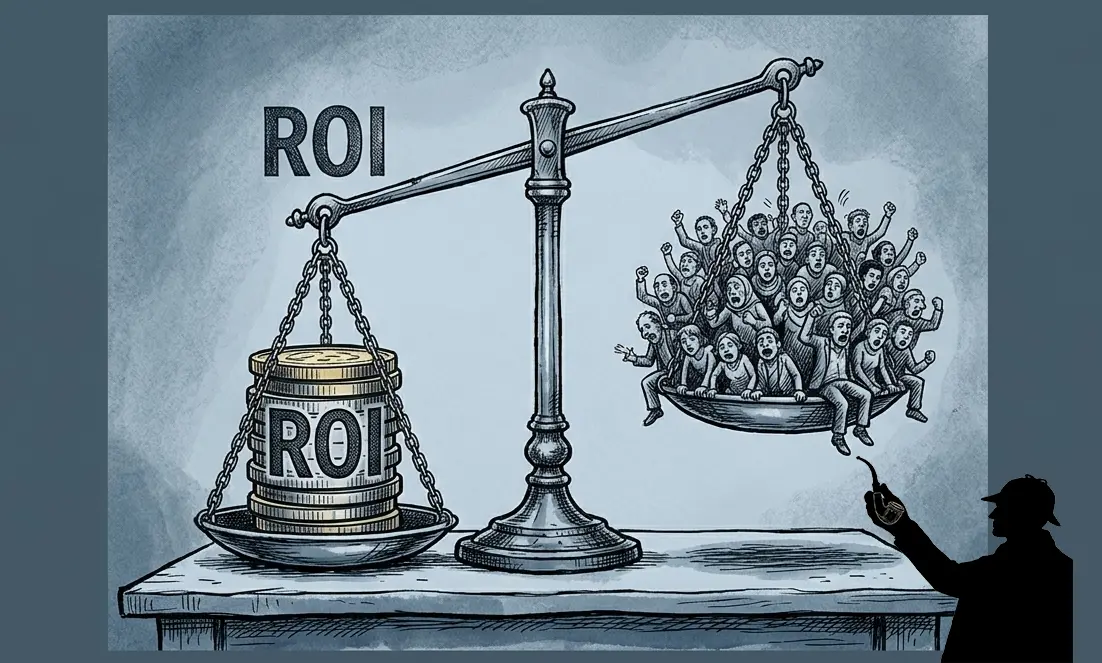
Three companies. Three countries. One week. The mechanism is identical across all three: economic returns from AI infrastructure flow upward to shareholders and owners while the costs — job loss, income disruption, career displacement — flow outward to workers. WiseTech’s founder Richard White told an investment conference earlier in May that “it doesn’t take much effort to convince people, in the end, that they’re stupid to be paying $100 for labor when you can pay $2 for the AI.” His own employees were apparently among the people who needed convincing. Over 590 of them — more than half of WiseTech’s Australian technical workforce — signed a petition calling for fair consultation and transparency on severance. According to their union, those concerns were largely ignored.
This is not new. The pattern of capital-intensive transformation that concentrates gains for owners while externalizing costs to workers has a history that predates every executive in every one of these boardrooms. The first Industrial Revolution produced factory conditions that required a century of labor organizing, workplace safety legislation, and eventually basic legal protections to partially correct. Those protections — severance requirements, wrongful termination standards, collective bargaining rights — were built piecemeal, unevenly, jurisdiction by jurisdiction, after the damage was already done.
What WiseTech’s two-email system reveals is that those protections are patchwork and unequal — and that large global firms know it. A company that can structure redundancy communications to avoid legal liability in one country while citing the true reason in another is operating inside a compliance map, not an ethical one. There is no global standard for severance when AI displaces workers. There is no international framework governing what a company owes the people it eliminates in favor of machines. The rules were written for a different era. The companies deploying AI in 2026 know that.
Morgan Stanley estimated in early 2026 that up to 200,000 jobs in European banking alone may disappear by 2030 — concentrated in risk, compliance, and back-office operations, precisely the functions Standard Chartered is now targeting. The tech industry cut 80,000 jobs in the first quarter of 2026 alone, with nearly half attributed to AI adoption. Standard Chartered’s announcement, investors have noted, creates pressure on every peer institution that hasn’t yet published its own AI headcount reduction plan. The market is now rewarding the announcement itself.
Power does not require conspiracy. It only requires that the people in the room share a common interest in the outcome.
The Standard Chartered shareholder briefing was that room. The outcome — 7,800 jobs converted to higher return on equity — produced a 2.4% share price gain the same day. No law was broken. No coordination was necessary. Every other major bank’s board is now asking its executives why their number isn’t at least as large.
The tool changed with the century. The problem being solved did not.
Essay 12 — The Converging Frames
(See also: Essay 13 — The False Frame)
Sources:
PYMNTS.com, “Standard Chartered Cutting 8,000 Jobs as AI Focus Accelerates,” May 19, 2026.
European Business Magazine, “Standard Chartered Is Cutting 8,000 Jobs and Calling It ‘Replacing Lower-Value Human Capital,’” May 19, 2026.
Human Resources Director Canada, “Major International Lender Targets ‘Lower-Value Human Capital,’” May 19, 2026.
The Guardian / Josh Taylor, “WiseTech Begins Redundancies — But Omits ‘AI’ from Emails to Chinese Employees,” May 22, 2026.
Information Age / ACS, “WiseTech’s ‘Damaging’ AI Layoffs Hit by Scandal,” May 2026.
Human Resources Director Australia, “This CEO Announced Huge Job Cuts Because of AI,” May 2026.
New York Times, “Meta Begins Laying Off 8,000 Employees Amid A.I. Transformation,” May 20, 2026.
Reuters, “Meta Lays Out Details of May 20 Restructuring,” May 20, 2026.
Leave a Reply