Notes from the Field – May 25, 2026
In the same week in May 2026, two opinion pieces appeared in two countries about the same problem — and neither author knew the other was writing it.
In the United States, political scientist Lee Drutman appeared in a New York Times opinion video with columnist Ezra Klein to make a point that has animated his work for years: America’s two-party system is not an organic outgrowth of civic culture or political preference. It is a direct result of electoral structure. Single-member districts with first-past-the-post voting mechanically produce two parties. Not because voters want two parties — survey after survey shows they don’t — but because the rules make any other outcome mathematically punishing. Drutman’s prescription: multi-member districts with proportional representation, the system used by most mature democracies and the one both John Adams and James Madison warned would be necessary to prevent the tyranny of faction.
In England, journalist Jason Okundaye wrote in The Guardian about the drama at Worcestershire county council, where Reform UK had won a plurality of seats in 2025 local elections and taken control — without a majority. What followed was, by Okundaye’s account, chaos: two different leaders, two different deputies, two cabinet members sacked, promised efficiencies never found, a council left £600 million in debt by its predecessor now being run by people who’d spent twenty minutes reviewing a billion pounds in spending. In May 2026, a rainbow coalition of Conservatives, Greens, Liberal Democrats, and independents removed Reform from power. The national Conservative Party promptly suspended the local Conservative leader who’d made it happen.
The Worcestershire situation is not primarily a story about Reform UK’s competence or incompetence. It is a story about what happens when a voting system built for two parties is used by an electorate that has fractured into five or six. Britain’s first-past-the-post system — identical in structure to the American single-member district system Drutman describes — produces distorted outcomes in a multiparty environment. A party that wins a plurality but not a majority governs with the full authority of a majority, and parties that don’t know how to form coalitions or share power are left with no legitimate mechanism for doing so. The Electoral Reform Society has been saying this since before the Brexit vote, Okundaye notes. Westminster has declined to listen.
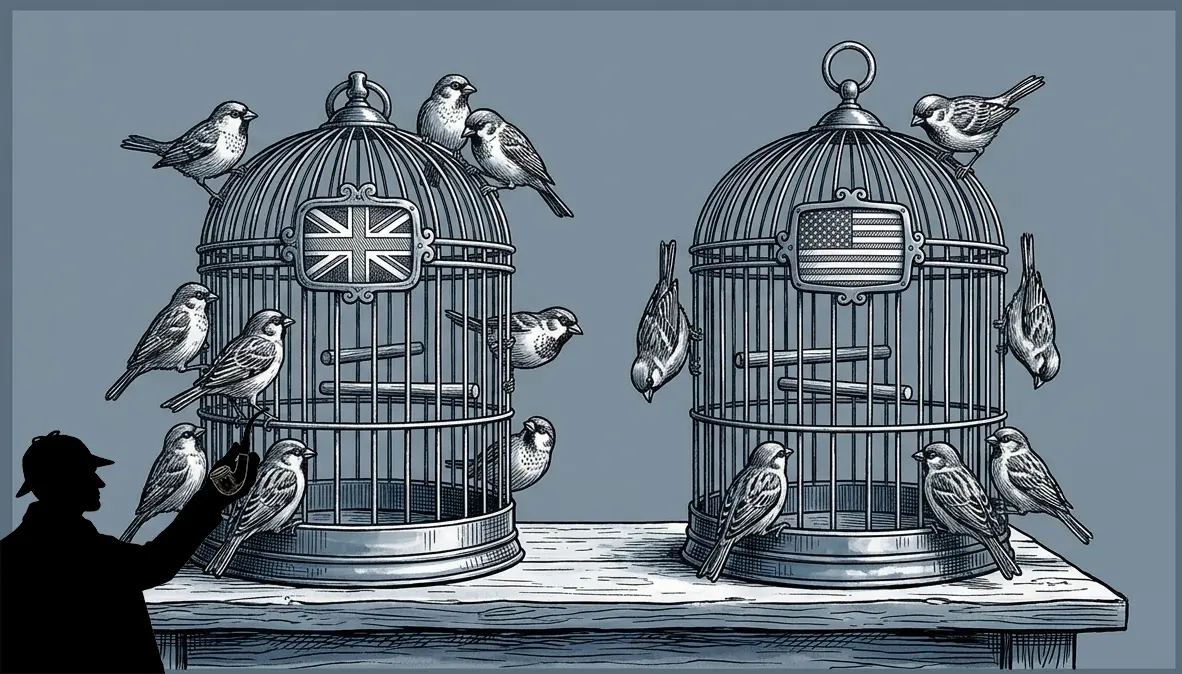
Two countries. The same electoral architecture. The same structural consequence: a system designed for a two-party world, operating in a world that has moved on.
The American version of this problem has a specific origin. The single-member district system that produces the two-party doom loop — Drutman’s phrase — was not an inevitable feature of democratic governance. It was a choice, embedded in law and reinforced by decades of rules that make third-party ballot access expensive, primary structures that reward ideological purity over coalition-building, and a House of Representatives that stopped growing in 1929 and has remained frozen at 435 members ever since. The frozen House is not an accident of history. It is a constructed artifact — a room that stopped making room for new people precisely when the country began to look like something other than what the room had been built to represent.
Britain’s room was built differently but locked by the same logic: if the existing parties benefit from the existing rules, they have no incentive to change them. The Electoral Reform Society can publish reports. Local councils in Worcestershire can collapse. Westminster will govern like it’s 1950 until it can’t.
“The public wants a fairer, more honest, more cooperative politics,” the Electoral Reform Society wrote — three years after the Brexit vote, when two-party democracy looked fragile but still robust. In 2026, first-past-the-post is producing distorted outcomes in English local elections and an American electorate that wants more than two choices is being offered the same two it has always been offered, dressed in new packaging.
The silence won’t feel like silence. It will just feel like the way things are.
Essay 11 — Out of Frame
Broken Frames — Block 4: The Private Government (Party) (not yet published — thebrokenframes.substack.com/s/broken-frames)
Broken Frames — Block 5: The Locked Door (not yet published)
Sources:
New York Times Opinion, “Breaking the Two-Party System” (video, Ezra Klein with Lee Drutman), May 19, 2026.
The Guardian / Jason Okundaye, “To Understand Britain’s New Politics, Look No Further Than This Shakespearean Saga in Worcestershire,” May 25, 2026.
British Brief, “Worcestershire Council Saga Shows UK Failing to Adapt to Multiparty Politics,” May 2026.
Lee Drutman, Breaking the Two-Party Doom Loop, Oxford University Press, 2020.
Electoral Reform Society, survey on public preferences for electoral reform (cited in Guardian piece).
Leave a Reply