Essay 12 — Two Rooms. Two Frames. One Year: 2031.
Steve Sagnotti · steves-head.space
“It is difficult to get a man to understand something when his salary depends upon his not understanding it.”
Upton Sinclair, I, Candidate for Governor: And How I Got Licked, 1935
“The hour is coming, and now is.”
John 5:25
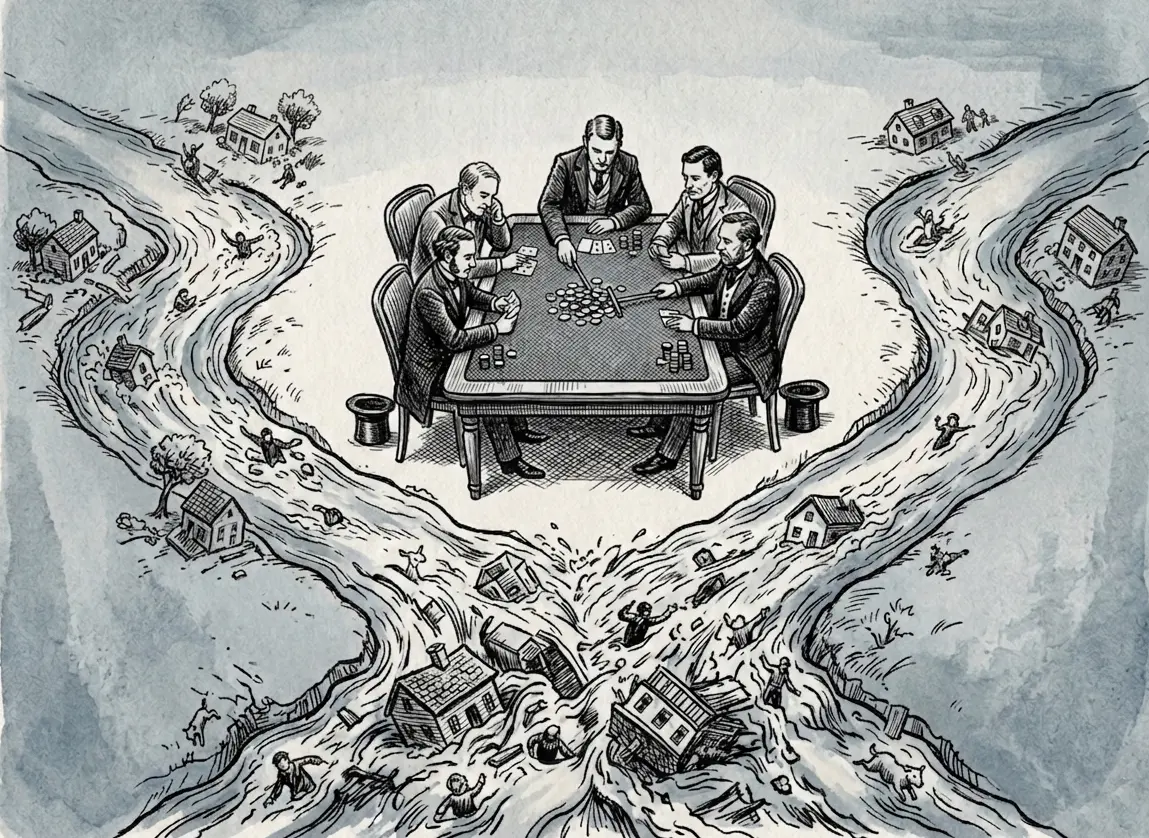
Essay 11 documented the extraction. This essay documents the room where it was arranged — and the second crisis converging on it that the room is not tracking.
Two separate conversations are happening right now. The people in each room are not talking to the people in the other. Nobody has put what they are saying on the same page.
This essay puts them on the same page.
I. The First Room: The Displacement Wave
In the first room, labor economists and workforce researchers are tracking what employers say they intend to do. The numbers are not projections from critics or advocates. They come from employers themselves, asked directly.
The displacement has a starting point. In November 2022, when OpenAI released ChatGPT, the employment curve for entry-level workers in AI-exposed roles began to move. It has not stopped. The Stanford Digital Economy Lab, tracking payroll data across 25 million workers, documented a 13 percent relative decline in employment for workers aged 22 to 25 in the most AI-exposed occupations from that date through 2025, while experienced workers in the same fields held steady or gained. For software developers in that cohort, the Stanford HAI AI Index confirmed the decline reached nearly 20 percent by 2026. The Goldman Sachs U.S. Daily note published in April 2026 put the current net rate: AI is erasing approximately 16,000 U.S. jobs per month on a net basis — 25,000 destroyed by substitution, 9,000 created by augmentation. Since November 2022, Challenger, Gray & Christmas has tracked AI-attributed announced job cuts totaling more than 120,000 through April 2026 — with 2025 producing three times the volume of 2023, and the 2026 pace through four months already running at 90 percent of the entire 2025 total. In March and April 2026, AI led all stated reasons for employer-announced job cuts for two consecutive months, at 25 and 26 percent of all cuts respectively. The curve is not plateauing.
The Randstad Workmonitor survey, published in 2026, found that 76 percent of employers predict that at least half of all entry-level roles will disappear within five years. The World Economic Forum found that 41 percent of employers worldwide intend to reduce their workforces through AI automation by 2030. Dario Amodei — the CEO of Anthropic, the company building the most capable AI systems currently in commercial deployment — said AI will eliminate half of entry-level white-collar jobs within one to five years. Mustafa Suleyman, the CEO of Microsoft AI, told the Financial Times in February 2026 that AI will achieve human-level performance on most, if not all, professional tasks — accounting, legal work, marketing, project management — within twelve to eighteen months. Ford CEO Jim Farley said AI will cut in half the number of white-collar jobs in the United States.
These are not fringe projections. They are the mainstream view of the people doing the displacing. They share a timestamp: the steepest part of the displacement curve arrives between 2029 and 2032. Some of those people have since moved their own timelines forward. These are not critics revising the consensus upward. They are the people running the displacement, on the record, naming a schedule shorter than their own earlier estimates.
The named eliminations are accumulating. Salesforce cut 4,000 customer support roles and attributed the decision directly to agentic AI. HP announced up to 6,000 cuts by 2028. Duolingo announced it would no longer use human contractors for any work AI can handle. Snap cut sixteen percent of its entire staff because AI now writes more than sixty-five percent of its code.
Michelah is already there. She applied for thirty jobs in six months. She described the labor market to a New York Times moderator this way: “It’s like a desert. There’s nothing really there. You can be out there, but you’re not being hydrated.” She is in her twenties. She did everything she was told. The desert was already there when she arrived.
She is not alone in the desert. Approximately 2.2 million people will earn bachelor’s degrees this spring — one of the largest graduating classes in American history, and statistically among the least likely to find the work their degrees were supposed to open. The unemployment rate for recent college graduates hit 5.7 percent at the start of 2026, a four-year high, running above the national rate for the fifth consecutive year. More than four in ten are already underemployed — working jobs that do not require the degree they just finished paying for. Nine in ten say they are worried AI will eliminate the entry-level roles they were trained to fill. One in three say their college prepared them to use AI in the workplace. The desert Michelah described is the market the Class of 2026 is entering this month.
And they are entering it in debt. The average bachelor’s degree graduate who borrowed carries approximately $30,000 to $35,000 in student loan debt — monthly payments due regardless of whether the degree produced the job it was supposed to produce. Total outstanding student loan debt in the United States stands at $1.84 trillion, held by 42.8 million borrowers. The credential was the price of entry. The entry point is closing. The debt remains.
Three economists — Engbom, Baksy, and Caratelli — published a study in April 2026 analyzing forty years of federal labor data. Their finding: workers today are half as likely to receive a competing job offer as workers were in the 1980s. Half. Employer consolidation eliminated the competing employers. Noncompete agreements — signed by over a third of the American workforce, including hourly and part-time workers — made it illegal to take the offers that remained. The Federal Trade Commission banned noncompetes in 2024. Business groups sued. A court blocked the ban.
Michelah’s ladder was pulled up before she got on it. The ladder the Class of 2026 was promised is closing from both ends simultaneously.
Logistics, service, administration — the work done by people who were already paying payroll taxes on every dollar they earned while the ownership class paid them on none. That is where the displacement is moving first, and fastest. Michelah is not in tech. It does not matter. The displacement is moving through job categories in order. Customer support was in the first wave. The water left before she got thirsty.
— — —
II. The Second Room: The Debt Spiral
In the second room, fiscal economists are watching a different number.
The Congressional Budget Office’s February 2026 baseline projects that by fiscal year 2031, the average interest rate on the federal debt will exceed the rate of economic growth. The Committee for a Responsible Federal Budget confirmed the mechanism in March 2026: both R and G are projected to hit approximately 3.8 percent nominally in 2031 — and then diverge, with R pulling ahead. When that threshold is crossed, the debt becomes self-reinforcing: higher debt pushes interest rates up, higher rates slow economic growth, slower growth means less tax revenue, less revenue means more borrowing, more borrowing means higher debt. The Committee for a Responsible Federal Budget has a name for what follows. They call it a debt spiral. The Federal Reserve chair said at Harvard in March 2026: “It will not end well if we don’t do something fairly soon.”
The CBO numbers are specific. The federal deficit in FY 2026 is $1.9 trillion — 5.8 percent of GDP. It grows to $3.1 trillion by 2036. Federal debt is already at 101 percent of GDP; it surpasses the post-WWII record of 106 percent before FY 2030 and reaches 120 percent by 2036. Interest payments in FY 2026 are $1.0 trillion — already exceeding defense spending and the fastest-growing component of all federal spending. The reconciliation act passed in 2025 added $4.7 trillion to projected deficits for 2026 through 2035. Tariff revenue offsets approximately $3 trillion of that. The net effect: the spiral is steeper than earlier projections captured. The Social Security trust fund exhaustion date has moved forward to 2032 — inside the displacement steepening window — with the CBO projecting a 28 percent across-the-board benefit cut in the year following exhaustion. Note: these projections were modeled before oil prices spiked and fertilizer supply contracted following the conflict in Iran. The baseline is the floor.
Two rooms. Two frames. One year: 2031.
If you are thirty-five now, you will be forty. If you are fifty, you will be fifty-five. The threshold is not abstract. It arrives on a specific Tuesday morning, in a specific fiscal year, in the middle of whatever your life looks like then.
— — —
III. The Connection Nobody Is Drawing
Here is what nobody in either room is saying out loud.
The people being displaced by automation are the tax base. Every worker who loses her job stops paying payroll taxes and starts drawing on unemployment, food assistance, Medicaid. She moves from the revenue column to the expenditure column. At the exact moment the fiscal system is least able to absorb the shift.
The safety net that would catch the displaced shrinks in direct proportion to the displacement that requires it. Jennifer Harris, a former National Security Council economics official, documented the mechanism: as one dollar of value creation shifts from workers to owners, total tax revenue falls ten to fifteen cents. The fiscal collapse and the labor collapse are not parallel stories. They are the same event, viewed from two angles, arriving at the same moment. This is not a forecast. The displacement leading edge is already moving workers from the revenue column to the expenditure column in the current quarter. The reconciliation act simultaneously reduces the expenditure side: the programs those workers would draw on are being cut in the same legislation that accelerates the conditions putting them there. There is no interval between the fiscal deterioration and the labor deterioration in which relief could arrive. The floor is dropping while the ceiling is falling.
Each room is operating inside a frame that makes the other room’s crisis invisible. The labor economists’ frame — workforce transition, reskilling timelines, net job creation across a long enough horizon — has no category for fiscal collapse. The fiscal economists’ frame — debt-to-GDP ratios, interest rate spreads, sovereign borrowing capacity — has no category for a tax base that is simultaneously shrinking and becoming a net expenditure. The frames are not wrong. They are professionally sufficient. That is precisely what makes them dangerous. Two conversations, each internally coherent, each blind to the other, running their subjects toward the same wall.
The standard institutional reassurance is that new jobs will emerge. Workers will retrain. The transition from agricultural to industrial labor took decades. People adapted before. They will adapt again.
The reassurance fails on two variables: speed and symmetry. Those transitions played out across generations. The gap between displacement and replacement was wide enough to cross on foot. And in those transitions, the recovery was symmetric — the new jobs were accessible to the displaced workers if they could reach them. AI-era displacement does not recover symmetrically. The graduate who spends two years underemployed in 2026 and 2027 does not simply lose two years of earnings. She loses two years of skill accumulation at precisely the moment when the gap between those who built AI-fluency early and those who did not is widening fastest. The lag compounds. By the account of the people creating it, the lag is now.
The safety net that would catch her is being cut in the same legislation that builds the containment infrastructure described in the next section. That is not a coincidence. It is a sequence. The vested interests that benefit from a fiscally precarious population have found a legislature structurally willing to provide both outcomes simultaneously.
— — —
IV. The Infrastructure Already Waiting
The Trump administration said it was going after the worst of the worst. Murderers. Gang members. People who posed a direct threat to public safety. That was the stated justification for building the largest immigration detention infrastructure in American history.
Here is what the data shows.
As of April 4, 2026, 70.8 percent of the 60,311 people in ICE detention have no criminal conviction at all. A Cato Institute analysis found that only 5 percent had a violent conviction. More than one in three people deported in 2025 had no criminal record — no pending charges, no prior conviction. Just 2 percent were tagged as suspected gang members. For every one at-large arrest involving someone with a serious prior conviction, there were twelve arrests of people with no criminal record.
The worst of the worst turned out to be whoever was standing there.
The infrastructure built to hold them is not temporary. ICE has launched what it calls the Detention Reengineering Initiative. The plan: purchase commercial warehouses outright, retrofit them into a national network of permanent facilities, and consolidate the current system of roughly 300 facilities down to 34 — organized as 8 mega-centers holding 7,000 to 10,000 people each, and 16 regional processing centers. Total planned capacity: 92,600 people. As of early 2026, ICE has spent more than $690 million acquiring at least seven industrial warehouses in Maryland, Arizona, Georgia, Texas, Pennsylvania, and Michigan. The total acquisition and retrofit budget is $38.3 billion.
Before February 2025, ICE owned 10 of the 220 facilities it used. The stated plan is now to own the infrastructure entirely. That shift — from leasing to owning — is the critical structural fact. Leased facilities can be returned when the stated purpose is complete. Owned infrastructure cannot. Once the federal government holds title to 34 warehouse-scale facilities distributed across the national geography, the infrastructure exists independent of its current stated purpose.
The acting ICE director described the goal of the new system as “Amazon Prime, but with human beings.” Amazon’s warehouse network is not built for one product. It is built for throughput. The product changes. The infrastructure scales.
The Ground This Was Built On
Camp East Montana, the largest ICE detention facility in American history, sits at Fort Bliss in El Paso, Texas — on the same military base where the United States government held people of Japanese descent in 1942. The people held there then were labeled enemy aliens. Over 125,000 people of Japanese descent were forcibly removed and incarcerated across a network of military bases and internment camps. More than half were American citizens. Born here. Their citizenship did not protect them.
Mary Murakami was fourteen years old when soldiers lined the streets of San Francisco’s Japantown with guns pointed at her neighborhood. Her family was sent to the Topaz internment camp in Utah. She is 98 now. When the new detention center opened at Fort Bliss in August 2025, she said: “I never thought these thoughts would so vividly come back with another group of people. It’s amazing that you see your life all over again.”
The government’s response came from DHS Assistant Secretary for Public Affairs Tricia McLaughlin: “Comparisons of illegal alien detention centers to internment camps used during World War II are deranged and lazy.”
The Japanese Americans held at Fort Bliss and across the internment camp system in 1942 were told something similar: they were a threat, the worst of the worst by the logic of the moment. Their citizenship did not protect them. American birth did not protect them. The legal designation of who qualifies for the worst treatment changed once. It can change again. The containment infrastructure does not require a consistent rationale. It requires only a population and a designation.
Michelah in 2031
Now consider what Michelah’s Tuesday looks like in 2031.
No stable job in two years. Savings gone. Student loan payments still due — the debt that was supposed to be the price of entry to a ladder that was pulled up. The safety net has been means-tested and time-limited into something that runs out before the jobs come back. Her kids need to eat. She takes groceries from a Whole Foods self-checkout — the same automated system the corporation built knowing it would increase shrinkage, the loss already factored into margins that no longer include the cashier who used to stand there.
Jia Tolentino, a writer who is financially comfortable, wrote about stealing four lemons from Whole Foods as a mild gesture of political solidarity. She felt no guilt. Jeff Bezos paid 0.98 percent in taxes on his real wealth. The social contract, she figured, had already been broken on the other end. She got a podcast.
Michelah gets a record.
Same action. Different situation. Different designation. That asymmetry is not an accident of the justice system. It is the justice system working as designed. Wage theft — billions of dollars stolen annually from workers through unpaid overtime, illegal deductions, and minimum wage violations — is a civil matter, handled quietly, rarely prosecuted. Taking groceries is a crime. The asymmetry tells you exactly whose property the system exists to protect.
Scale that across a hundred thousand people in a hundred cities because the jobs are gone and the safety net has run out. Survival behavior at scale gets a different name than survival behavior alone. The people who own the buildings and write the checks to the legislators decide which name it gets.
The containment infrastructure to execute that decision is already built. Owned. Geographically distributed. A warehouse retrofitted to hold 1,500 people is — after its current occupants have been deported — a facility that holds 1,500 people. The legal designation of who qualifies for detention is a policy decision. Policy decisions change. Buildings do not.
— — —
V. The Question This Raises
The mass detention infrastructure cannot be sustained at the scale the displacement will eventually require. The math is simple. Detention costs roughly $150 to $400 per person per day. At the low end, that is $55,000 per person per year. For a million people: $55 billion annually. Against a federal budget already paying more than a trillion dollars a year in interest, with the debt spiral tightening.
Mass warehousing is not the primary plan. It is the backstop. The demonstration. The signal to the population outside the room about what the room is capable of when it decides the problem requires a different kind of response.
The primary mechanisms are cheaper. Cut the programs. Means-test the benefits into inaccessibility. Make the process of claiming support so administratively burdensome that a significant fraction gives up. The result is not people in warehouses. It is people in cars, in tent cities, in the category of no longer counted — invisible to the system that produced them, entirely visible to everyone else. The neighbor who calls the city. The business owner who calls the police. The city that clears the encampment and moves it six blocks. Not solving the problem. Managing its location.
The Supreme Court settled the legal question in June 2024. In City of Grants Pass v. Johnson, the Court ruled 6 to 3 that cities may enforce anti-camping ordinances — with fines and jail time for repeat violations — even when no shelter beds are available. The Eighth Amendment’s prohibition on cruel and unusual punishment, the Court held, does not prevent a city from criminalizing the act of sleeping outside when there is nowhere else to go. The legal permission to criminalize the condition of having nowhere to go is not pending legislation. It is settled law. Grants Pass, Oregon — a city of 38,000 with an estimated 600 unhoused residents — was the case. The ruling applies everywhere.
Criminalize the survival behavior the cuts produce. Detain enough people visibly enough to produce compliance in the remainder. The infrastructure does not need to hold everyone. It needs to demonstrate to everyone else what happens to the people who become sufficiently visible in their desperation. Mass incarceration in America never held the majority of the Black community. It held enough of it, consistently enough, to restructure the political engagement and economic behavior of entire communities. The threat does not need to be universal to be universally effective.
A warehouse in Berks County, Pennsylvania, retrofitted to hold 1,500 people, is — after its current occupants are gone — a facility that holds 1,500 people. The legal designation of who qualifies is a policy decision. Owned buildings are not. The infrastructure persists independent of the rationale that built it.
— — —
The silence on all of this won’t feel like silence.
It will just feel like the way things are.
That is not an accident. The next essay documents how the room where something might be done about it was converted, step by step, into a room that cannot — and names the specific people who did the converting.
— — —
Steve Sagnotti
is a serious amateur photographer, writer, and technologist based in Oregon. With his camera he tries to capture common images not often seen, leading to common questions not often asked.
steves-head.space
© 2026 Steve Sagnotti
— — —
Sources
Section I — The Displacement Wave
Brynjolfsson, Erik, Bharat Chandar, and Ruyu Chen. “Canaries in the Coal Mine?” Stanford Digital Economy Lab, November 2025. Confirmed via Dallas Fed coverage and Yale Insights. (13% relative employment decline, workers aged 22–25 in AI-exposed occupations since ChatGPT launch, November 2022.)
Stanford HAI AI Index 2026, April 2026. (Employment for software developers aged 22–25 down nearly 20% since 2024.)
Peng, Elsie. Goldman Sachs U.S. Daily Note, April 6, 2026. Reported in Fortune. (AI substitution eliminating net 16,000 U.S. jobs per month; 25,000 destroyed, 9,000 created by augmentation.)
Challenger, Gray & Christmas. April 2026 Job Cuts Report. AI led stated reasons for employer-announced job cuts March 2026 (25%) and April 2026 (26%) — two consecutive months. YTD through April 2026: 49,135 AI-attributed announced cuts. Cumulative since 2023 tracked start: more than 120,000. See also March 2026 Report and full archive: challengergray.com.
Randstad USA. Workmonitor 2026 press release. (76% of employers predict at least half of entry-level roles disappear within five years.)
World Economic Forum. Future of Jobs Report 2025, January 2025. Full report: weforum.org. (41% of employers worldwide intend to reduce workforces through AI automation by 2030.)
Amodei, Dario (CEO, Anthropic). Remarks on AI employment displacement, 2025–2026. Reported in TheStreet. (50% of entry-level white-collar jobs eliminated within one to five years.)
Suleyman, Mustafa (CEO, Microsoft AI). Interview with the Financial Times, February 2026. Reported in Fortune and eWeek. (Human-level performance on most professional tasks within 12–18 months.)
Farley, Jim (CEO, Ford). Remarks on AI and white-collar employment. Reported in Tom’s Hardware. (AI will cut in half the number of white-collar jobs in the United States.)
Salesforce workforce reduction (4,000 customer support roles attributed to Agentforce). Fox 5 DC.
HP restructuring (up to 6,000 positions by fiscal year 2028). CFO Dive.
Duolingo contractor policy change. Staffing Industry Analysts.
Snap 16% workforce reduction (AI writes 65%+ of code). GeekWire.
The Rich don’t play by the rules. So whey should I? New York Times labor market testimony, 2026.
Federal Reserve Bank of New York. Labor Market for Recent College Graduates, Q1 2026. (5.7% unemployment rate for recent college graduates, four-year high; running above national rate for fifth consecutive year; 41.5% underemployment rate.)
ZipRecruiter / PureSpectrum. Annual Grad Report 2026. Survey of 1,500 recent graduates and 1,500 Class of 2026 rising graduates, January–March 2026. (9 in 10 graduates worried AI will eliminate entry-level roles; 29% received extensive AI training; only 19% say it is a good time to find quality work, down from 70%+ in 2022.)
Education Data Initiative and NerdWallet. Student Loan Debt Statistics 2026. (Total outstanding U.S. student loan debt: $1.84 trillion; 42.8 million federal borrowers; average bachelor’s degree debt for those who borrowed: approximately $29,560–$35,530 for public university graduates. Class of 2026 average projected at $43,500 per NerdWallet.) See also getoutofdebt.org.
Engbom, Niklas, Aniket Baksy, and Daniele Caratelli. “The Long-Term Decline of the U.S. Job Ladder.” NBER Working Paper 34981, March 2026. DOI: 10.3386/w34981. (Employed workers today approximately half as likely to receive a better-paying outside offer as workers in the 1980s; employer concentration and noncompete agreements identified as primary mechanisms.)
FTC noncompete ban (April 2024) and court stay: Ryan LLC v. Federal Trade Commission, No. 3:24-cv-00986-E, U.S. District Court for the Northern District of Texas, Judge Ada Brown. Nationwide injunction issued August 20, 2024. FTC appealed to Fifth Circuit, October 18, 2024. See Holland & Knight analysis and Cooley analysis.
Section II — The Debt Spiral
Congressional Budget Office. The Budget and Economic Outlook: 2026 to 2036, February 11, 2026. Full PDF: cbo.gov. Director’s statement: cbo.gov.
Committee for a Responsible Federal Budget. “CBO Projects Possible Debt Spiral, R Exceeds G”, March 9, 2026. (R and G both projected to reach approximately 3.8% nominally in FY 2031, then diverge.) See also Fortune coverage, March 16, 2026, and CRFB full CBO summary.
Powell, Jerome (Federal Reserve Chair). Remarks at Harvard University, “Principles of Economics” class, March 30, 2026. Primary sources: Harvard Gazette (April 2, 2026) and Harvard Crimson (March 30, 2026). Fortune coverage: fortune.com. (“It will not end well if we don’t do something fairly soon.”)
Social Security OASI trust fund exhaustion date (2032) and 28% benefit cut projection. CBO testimony by Molly Dahl, Senate Budget Committee, March 25, 2026. Reported in CNBC, Motley Fool (April 28, 2026), and Kiplinger (April 10, 2026).
Section III — The Connection Nobody Is Drawing
Harris, Jennifer (former National Security Council economics official). On tax revenue effects of labor-to-capital value shift. New York Times, April 8, 2026.
Section IV — The Infrastructure Already Waiting
ICE detention population data (70.8% of 60,311 detainees with no criminal conviction, as of April 4, 2026). U.S. Immigration and Customs Enforcement. ICE Detention Statistics, FY2026 Year to Date (data as of April 4, 2026). U.S. Department of Homeland Security.
Cato Institute analysis of criminal records in ICE detention population (5% with violent conviction; 12:1 ratio of no-criminal-record arrests to serious-prior-conviction arrests).
ICE Detention Reengineering Initiative (34 facilities, 8 mega-centers, 92,600 capacity, $38.3 billion budget, $690 million in warehouse acquisitions): American Immigration Council, February 2026 [Steve to supply direct article link]; Brennan Center for Justice, February 24, 2026; Axios, February 2026 [Steve to supply]; Bloomberg, January 2026 [Steve to supply]. See also Migration Policy Institute, October 2025, and National Immigration Forum, November 2025.
Japanese American internment history (125,000+ people forcibly removed and incarcerated; more than half U.S. citizens). National Archives, War Relocation Authority records: archives.gov. See also Densho Encyclopedia: densho.org.
Murakami, Mary (born 1927; interned at Topaz, Utah, 1942). NPR / Texas Public Radio, “To a survivor of Japanese incarceration, ICE detentions feel painfully familiar,” September 23, 2025. Reporter: Juana Summers. TPR transcript. (“I never thought these thoughts would so vividly come back with another group of people. It’s amazing that you see your life all over again.” Note: Murakami’s testimony was given about her broader internment experience, prompted by the Fort Bliss facility opening; she was not interned at Fort Bliss specifically.)
Government response to internment comparisons. DHS Assistant Secretary for Public Affairs Tricia McLaughlin, statement to press, August 2025. Reported in Newsweek, NBC News, and Rolling Stone, August 2025. (“Comparisons of illegal alien detention centers to internment camps used during World War II are deranged and lazy.”)
Michelah in 2031
The Rich don’t play by the rules. So whey should I? New York Times labor market testimony, 2026.
Bezos, Jeff — effective tax rate. Eisinger, Jesse, Jeff Ernsthausen, and Paul Kiel. “The Secret IRS Files: Trove of Never-Before-Seen Records Reveal How the Wealthiest Avoid Income Tax”. ProPublica, June 8, 2021. (Bezos’ “true tax rate” — taxes paid as a percentage of wealth growth, 2014–2018 — confirmed at 0.98% per ProPublica’s methodology, as reported by The Daily Beast. ProPublica’s own text states “less than 1%” for the same period; the 0.98% figure is the precise calculated rate.)
Wage theft (estimated $50 billion annually). Economic Policy Institute: “An Epidemic of Wage Theft Is Costing Workers Hundreds of Millions of Dollars a Year” (foundational study); “Employers Steal Billions from Workers’ Paychecks Each Year” ($15 billion annually from minimum wage violations alone); “More Than $1.5 Billion in Stolen Wages Recovered for Workers Between 2021 and 2023”, January 2025.
Section V — The Question This Raises
ICE detention cost per person per day. FY 2025 official bed rate: $164.65 per detainee-day (DHS). Average reported rate as of September 2025: $152 per day, average length of stay 44 days. Sources: Migration Policy Institute (October 2025); National Immigration Forum (November 2025). Note: the essay’s “$150 to $400” range reflects variation across facility types; the current system-wide average is approximately $152–$165.
City of Grants Pass v. Johnson, 603 U.S. ___ (2024). Argued April 22, 2024; decided June 28, 2024. Justice Gorsuch, majority (6–3). Holding: enforcement of anti-camping ordinances does not constitute cruel and unusual punishment under the Eighth Amendment, even when no shelter beds are available. Supreme Court opinion (Justia). Congress.gov analysis. NYSBA analysis.
Mass incarceration as deterrence model — restructuring of political engagement and economic behavior across communities. Alexander, Michelle. The New Jim Crow: Mass Incarceration in the Age of Colorblindness. New York: The New Press, 2010. Particularly Chapters 4–5. Cited more than 18,000 times; over one million copies sold. See also Cambridge Core review of literature.
Leave a Reply