Essay 13 — How the room that worked was converted into one that cannot
Steve Sagnotti · steves-head.space
“The liberties of a people never were, nor ever will be, secure, when the transactions of their rulers may be concealed from them.”
— Patrick Henry, Virginia Ratifying Convention, 1788
“This disposition to admire, and almost to worship, the rich and the powerful… is, at the same time, the great and most universal cause of the corruption of our moral sentiments.”
— Adam Smith, The Theory of Moral Sentiments, 1759
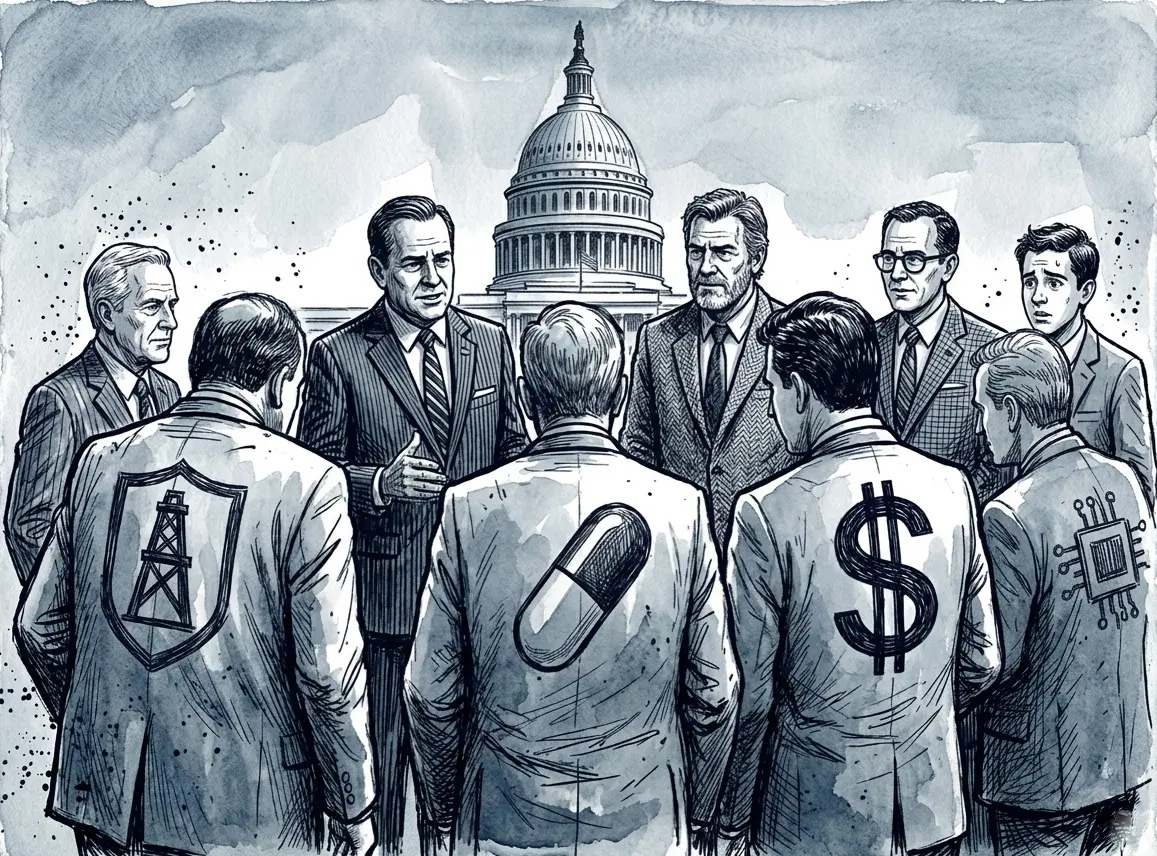
What follows is not a theory about dysfunction. It is a sequence — five steps, documented — that names how the room that cannot respond was built, when each piece was added, and what it was designed to protect.
The room where your laws are made did not always work the way it works now. For roughly thirty years after 1945, something real was happening inside it. Then specific people made specific decisions that converted it — step by step, instrument by instrument — from a room that produced shared outcomes into one that produces private ones. Those people are not abstractions. The decisions are documented. The personal gains are in the disclosure forms, the post-service employment records, and the net worth figures that no congressional salary can explain.
I. When Both Wheels Were Turning
A bicycle stays upright through momentum. Both wheels have to be turning in the same direction. When they do, the whole thing is stable. From roughly 1945 to 1975, both wheels were turning. Not perfectly — the period excluded women and people of color in ways that were deeply unjust and whose consequences are still arriving. But for the people it included, something genuine was happening. Workers expected to do better than their parents. A factory job could support a family, buy a house, send children to college. The middle class was not a precarious thing. It was a reasonable expectation.
People did not become better during those years. Human nature did not improve. What changed was the architecture. Unions were strong enough to push back on concentrated corporate power. The top marginal tax rate on the highest incomes was 91 percent under Eisenhower — a Republican president — which made extreme accumulation less rewarding and broad distribution more so. The GI Bill sent millions of working-class men to college who would never have gone otherwise. The Marshall Plan rebuilt Western Europe and Japan. The interstate highway system. The National Institutes of Health. The public university system. The EPA. The Clean Air Act, passed with overwhelming bipartisan support. The architecture of those years rewarded shared motion. Then the architecture changed.
Not by accident. Not by inevitable historical forces. The Powell Memo in 1971 — a confidential call to arms addressed to the U.S. Chamber of Commerce by future Supreme Court Justice Lewis Powell — was explicit: the free enterprise system was under assault and business had to organize to defend it. What followed was thirty years of deliberate investment in the institutions that would turn the argument into architecture: think tanks, law school funding, judicial appointments, campaign finance vehicles. The commons was being converted to private yield. The shared motion was ending. Lewis Powell did not need to name the vested interest his memo was written to serve. The Chamber of Commerce members receiving it had the same vested interest he did. They recognized themselves in the document immediately.
What followed those thirty years is documented in the sections below.
II. The Freeze: 435 and Permanent
The Constitution set a floor, not a ceiling. One representative for every thirty thousand people. The House was designed to grow as the country grew — the people’s branch, numerically tethered to the people it claimed to represent. For a hundred and twenty years, that is what it did.
The ratio held through 1910. The House reached 435 members. Then Congress passed the Permanent Apportionment Act of 1929 and froze it there. The word “permanent” was working hard in that title. A body constitutionally designed to track a growing population was capped at a fixed number by the very people whose power depended on it staying fixed.
The reason was visible in the census data. The 1920 count had delivered an uncomfortable fact: for the first time in American history, more people lived in cities than in rural areas. An expanding House would mean more seats for New York, Chicago, and Los Angeles — and fewer, proportionally, for the rural districts that had held disproportionate sway since the founding. The cities were filling with people whose names were unfamiliar, whose languages weren’t English, whose religions weren’t Protestant. The Great Migration was moving Black Americans north in numbers that would register in a larger House. The people in the room in 1929 had a vested interest in a House that could not reflect the population arriving to outvote them. The outcome was a House frozen before it could.
Today one member of the House represents approximately 760,000 people. The ratio the Framers designed was one to thirty thousand. The room where your laws are made is twenty-five times less connected to you than the people who built it intended.
But the 1929 Act did something else that the current reform conversation rarely names. Every apportionment act from 1842 through 1911 had required that congressional districts be contiguous, compact, and equally populated. The 1929 Act dropped all three requirements. Not inadvertently — the legislative record makes clear it was a deliberate choice. The Congress that froze the House size also removed the three structural constraints that made extreme district manipulation difficult. You cannot effectively gerrymander a district that is required to be compact and equally populated. The 1929 Act didn’t cause gerrymandering in the abstract sense. It made gerrymandering legally available by removing the requirements that had previously constrained it. The Freeze and the manipulation of district boundaries are not two separate problems with separate histories. They are one act, from one room, in one year, whose consequences are still compounding a century later.
The Permanent Apportionment Act has never been fully tested against the plain text of Article I, Section 2, which requires that apportionment reflect population. In 2024, a constitutional challenge reached the Supreme Court making exactly that argument. The Court denied certiorari in October 2024 — not on the merits, but on jurisdiction. The constitutional question whether a statute that permanently caps a body designed to grow with population is valid on its face remains formally unresolved. The Court was handed the question and put it down without answering it.
The pattern is worth noting. The same Court that has spent decades intervening in the downstream consequences of the 1929 Act — voting rights, redistricting, the shape of districts — declined to examine the Act itself. It will manage the symptoms indefinitely. It will not look at the cause.
The freeze compounds regardless. When a district holds 760,000 people, winning it requires money at a scale that filters candidates before voters see them. You do not run for one of 435 seats with a kitchen table and a neighborhood. You run with a fundraising apparatus. The average House member spends between a third and half of their working hours in call time — dialing donors, not writing legislation. The people with money to give are not passive participants waiting to be asked. They are the operating condition under which everything else happens.
III. The Lobotomy: Eliminating the One Office That Knew Things
Congress did not always have to take the private sector’s word for it.
From 1972 to 1995, the Office of Technology Assessment provided legislators with independent technical analysis. Before a vote on satellite communications, pharmaceutical regulation, or early internet governance, members could consult analysts whose only obligation was accuracy. Not the accuracy convenient for a client. Not the accuracy that supported a position already taken. Just accurate.
In 1995, Newt Gingrich’s incoming House majority eliminated it as a cost-cutting measure. The annual savings: twenty-two million dollars. Less than the catering budget of a mid-sized defense contract.
The expertise did not disappear. It moved. When Congress needed to understand a technical question after 1995, it turned to testimony from the industries it was supposed to be regulating. The committee hearing became a sales call. The information asymmetry that followed was the predictable consequence of eliminating the one institution whose job was to close that gap. Every major legislative failure of the next three decades has this asymmetry somewhere in its architecture. The financial instruments that produced 2008 were too complex for the oversight committees to evaluate independently. The pharmaceutical pricing structures that consume a fifth of the economy were designed by people who understood them better than any regulator in the building. The AI systems now reshaping the labor market are being governed by a Congress that, thirty years after eliminating its independent technical capacity, has still not replaced it.
The vacuum was filled by people with a professional interest in filling it a particular way. Consulting firms. Industry associations. Former government officials who spoke both the language of the bureaucracy and the priorities of private clients. By 2025, several federal agencies were spending more on private contractors than on their own employees. DOGE — the Department of Government Efficiency, staffed in 2025 by personnel drawn from private technology companies, some of them holding or seeking federal contracts — was the logical endpoint of thirty years of preparation. An oversight body occupied by people with a financial interest in the agencies being dismantled. The industries that filled the information vacuum had a vested interest in the vacuum staying filled by them. The preparation took decades. The occupancy looks inevitable only because the preparation was never documented as a sequence.
IV. The Purchase: Making the Room Legally Buyable
Every loophole in the tax code was purchased — a provision wanted, money changed hands, the provision appeared. Someone with money and access sat down with someone who writes legislation. They reached an agreement. The provision was inserted. The money flowed — in campaign contributions, in speaking fees, in the soft currency of access and gratitude that does not appear in any disclosure. No conspiracy required. No room full of villains. The ordinary operation of a system where the same hands hold both the pen and the checkbook.
The legal architecture that made this total came in stages. Political action committees have existed since 1947. The Federal Election Campaign Act of 1974 codified contribution limits after Watergate — the most serious attempt at campaign finance reform in American history. It lasted two years before the Supreme Court began dismantling it. Buckley v. Valeo, 1976: spending money to influence elections is protected speech. Applied to an economy where a handful of individuals control more wealth than half the country combined, it means some people’s speech fills an auditorium and some people’s speech is a conversation at a kitchen table. The Constitution guarantees everyone the right to speak. It says nothing about acoustics.
Citizens United v. FEC in January 2010 removed the remaining constraints on corporate political spending. That same year, SpeechNow.org v. FEC created the super PAC — unlimited spending from any source, no direct coordination required. The coordination requirement is a formality. Everyone in the building knows what the building is for. Outside spending in federal elections went from roughly $750 million in 2008 to over $3 billion in 2012. A significant portion now flows through 501(c)(4) nonprofits that can spend on elections without disclosing donors. The purchase became untraceable.
The result is a system in which specific crises remain permanently unresolved — and in which the financial structure rewards that outcome. E-Verify has existed since 1996. If mandatory, the main economic incentive for undocumented labor would shrink dramatically. It has been optional for thirty years. The agricultural and construction industries that depend on undocumented labor fund the same politicians giving speeches about the border. The politician sells border security to constituents and labor access to employers. The crisis funds both transactions. Resolution ends the revenue.
Gun legislation. Healthcare. Climate. Each has a technically available solution with majority public support. Each has been introduced, diluted, and killed across multiple cycles. In each case, the industries with the most to lose from resolution are also among the largest donors to the legislators whose committees control the legislation. The structure of the transaction is identical to the E-Verify example: the unresolved crisis is worth more, as a fundraising instrument, than the resolved one would be. The donors who fund perpetuation have a structural interest in the question staying open. A resolved crisis generates no counter-donation.
V. The Toll: How the People in the Room Get Paid
Congressional salary is $174,000 a year — roughly three times the national median household income. The median net worth of a House member on arrival is near the national median. The median net worth on departure is well over a million dollars. Many members leave as multi-millionaires. The salary does not explain the gap.
Financial disclosure forms use ranges rather than specific numbers. Opacity is structural, not accidental. The STOCK Act of 2012 prohibits trading on material non-public legislative information. The fine for a violation is $200. A single well-timed trade on inside knowledge of a regulatory decision can generate hundreds of thousands of dollars. The fine is not a deterrent. It is a fee schedule.
The revolving door is not metaphor. Senators face a two-year restriction on lobbying their former colleagues. House members face one year. Congressional staffers — the people who actually write the legislation, who know where every provision is and why it is there — face no mandatory cooling-off period at all. A staffer can leave on a Friday and begin lobbying their former office on Monday. What the staffer sells is not just access. It is the institutional memory of a room they helped build.
The defense industry variant is specific enough to describe precisely. Officers retire from the Pentagon with intimate knowledge of procurement processes, contractor relationships, and capability gaps. They join the boards and consulting arms of the contractors they oversaw. Their former offices are staffed by their former subordinates. The retired officer helps a contractor understand how to write requirements documents for systems the contractor builds. The bid is not rigged. It is evaluated against criteria one bidder helped write. The distinction is legally significant and practically invisible. Every person passing through the revolving door carries a vested interest on both sides of it — in the access they sell and in the regulatory outcomes their former office produces.
VI. The Reform Arc: How the Performance Funds the Career
When a legislator introduces a reform bill they know will fail, they are not failing. They are executing a revenue strategy. The sequence: introduce legislation to address a visible crisis. Generate press coverage and constituent enthusiasm. Watch the industries affected recognize the threat and increase their donations — to the opponents and, critically, to the sponsor. Dilute the legislation in committee. Allow it to fail. Send the fundraising email to constituents describing the valiant effort and the forces arrayed against it. Repeat in two years.
The threat unlocks the counter-donation. The counter-donation funds the campaign alongside the constituent donation. Both sides paying. Resolution would end one revenue stream. The permanent campaign is not a dysfunction of the system. It is the system working as designed.
This is not corruption in the legal sense. The legal architecture of campaign finance was specifically constructed to make these arrangements not corruption. The contribution limits, the disclosure requirements, the definitions of coordination — every provision was negotiated by people who understood exactly what they were permitting and what they were forbidding. The legal definition of corruption is narrow because the people who write the legal definition of corruption are the people whose conduct the definition would otherwise constrain.
What this produces, at scale, is a ledger of unresolved problems whose resolution has been specifically purchased. The Superfund liability gap, the march-in rights never exercised, the grazing fee unchanged for ninety years, the financial instruments rebuilt after Dodd-Frank — each of those is an entry in this ledger too. The public paid the cost. The private parties collected the gains. The legislators who arranged the outcome collected their portion. The form of accountability was intact throughout. The substance was elsewhere. The legislator who introduces the bill and the lobbyist who kills it share a structural interest in the performance continuing. The constituent who donates to both is the only one in the transaction without one. Legal historian Zephyr Teachout and Harvard Law professor Lawrence Lessig have each documented this architecture in detail: the legal definition of corruption is narrow because the people who write it are the people whose conduct a broader definition would constrain.
VII. The Engineered Friction: Making the Vote Hard to Cast
The mechanisms above capture the room. This one shapes who gets to send representatives into it.
In 1845, Congress set federal Election Day as the first Tuesday after the first Monday in November. The logic was agricultural and pre-industrial: farmers needed Sunday for church, Monday to travel to the county seat by horse, and Tuesday to vote before the long ride home. It was a reasonable accommodation for an 1845 economy.
It has never been changed. Every other major democracy has since moved to weekend voting, multi-day voting, or a national holiday. The United States has not. The result is that the most consequential civic act available to an American citizen is scheduled on a workday, in a single-day window, with no federal requirement for paid time off, in a country where roughly a third of workers are hourly employees who lose wages when they leave the floor.
This is not inertia. The people who benefit from low turnout among hourly workers, shift workers, single parents, young voters, and people without reliable transportation have a consistent and documented record of opposing every proposal to modernize the system. Early voting expansions, mail voting, same-day registration, extended polling hours — each one has been challenged, restricted, or reversed in the states where the current arrangement most benefits the people currently in power. The friction is not a historical artifact waiting to be updated. It is a mechanism being actively maintained.
The Selective Service makes the frame visible. When an American male turns 18, the federal government automatically enrolls him in the Selective Service System. No form required. No opt-in. The government knows he exists — through birth records, Social Security, school enrollment — and adds him to the register because his potential conscription is too important to leave to individual initiative. The infrastructure for finding 18-year-olds and enrolling them in a federal system automatically has existed and worked for decades.
Twenty-four states and the District of Columbia now have automatic voter registration. The federal government does not. The argument against it is not administrative — the Selective Service demonstrates the administration is straightforward. The argument is political. A government that can find you at 18 to register you for the draft cannot find you at 18 to register you to vote. One enrollment empowers the government. One enrollment empowers the citizen. The asymmetry is not accidental. It is the point.
The turnout consequence is documented. Nations with automatic registration and accessible voting infrastructure routinely produce 70 to 90 percent turnout. The United States, in a high-stakes midterm with control of Congress at issue, produces 47 percent. The gap is not cultural. It is not a reflection of civic disengagement as a fixed national characteristic. It is the predictable output of a system specifically designed to make participation difficult for the people whose participation would change the outcome.
The party operatives, state legislators, and incumbent officeholders who maintain the Tuesday window, purge the rolls, and understaff urban polling places have a vested interest in an electorate that stays at 47 percent. A higher-turnout electorate would contain more of the 45 percent with no structural home. The friction is the feature. It has always been the feature.
VIII. The Recursive Trap, the Duopoly, and the Pressure System
At the bottom of every mechanism described in this essay is the same sentence: the people who would need to change this are the people it currently rewards. The 435 members who would need to vote for a larger House are the members whose individual power a larger House would dilute. The legislators who would need to sever the campaign finance apparatus are the legislators whose campaigns it funds. The committee chairs who would need to hold hearings on pharmaceutical pricing, AI commons, and the revolving door are the chairs those industries have been cultivating for decades. The people in the room share a vested interest in the outcome. The outcome is the room staying as it is.
This is the recursive trap. It is not a conspiracy. It does not require that anyone meet in a private room and agree to preserve the arrangement. It requires only that the people who benefit from the arrangement each act in their individual interest, and that those interests all point in the same direction. No coordination needed. Vested interest operating at institutional scale produces the behavior without requiring anyone to intend the structure.
In 2025, a record 45 percent of American adults identified as political independents — the largest single group in the electorate, larger than either party. In the same year, 62 percent of Americans told Gallup that the two parties do such a poor job representing them that a third party is needed, essentially matching the record high. Both parties’ favorability ratings sit near historic lows. The shift of independents toward Democrats in 2025 was not, Gallup noted explicitly, evidence of any warming toward the Democratic Party — it was the lesser-of-two-evils calculus made visible in polling data. The largest single group in the American electorate is not without a structural home by accident. The ballot access laws, the debate commission rules, the winner-take-all structure are documented earlier in this essay. What the polling adds is this: the desire to exit the binary is a majority position. The architecture that prevents that exit is the same architecture this essay has been describing all along.
The two parties appear to be enemies. On immigration they disagree. On healthcare they disagree. On climate they disagree. On the fundamental architecture that determines who gets to be in the room and on what terms — the campaign finance system, the ballot access laws, the debate commission rules, the winner-take-all structure — they agree completely. Both parties built the current campaign finance architecture. Both parties wrote the ballot access laws that make third-party competition structurally unviable in most states. Both parties created and maintained the Commission on Presidential Debates, which has excluded every third-party candidate from the national stage since 1992. They fight over the room. They agree completely on who gets to be in it. Both have a vested interest in the binary remaining the only visible option.
The architecture produces a predictable human output.
The turnout data completes the picture. In the 2022 midterm elections — a high-stakes cycle, control of Congress at stake — turnout was roughly 47 percent. The largest single bloc in the American electorate is substantially also the bloc that has concluded participation is not worth the cost. They showed up. Nothing changed that affected their lives. They stopped showing up. That is not apathy. It is a correct reading of the physics.
The system is not just failing to serve them. It has lost them as active participants. That loss arrives at a specific moment: when the frames converge. By fiscal year 2031, the CBO projects that the average interest rate on federal debt will exceed the economic growth rate — the point at which debt becomes self-reinforcing — while employer surveys project peak AI-driven displacement of entry-level roles in the same window. The institutional channels for response — the elections, the legislation, the oversight hearings — will be operating at reduced legitimacy precisely when maximum legitimacy is required. A system that needs the participation of the majority to maintain its authority has spent thirty years giving the majority systematic reasons not to participate. The bill is in the mail.
Forty-five percent of the electorate with no structural home is a pressure system. The record of pressure systems without legitimate channels is consistent: the pressure discharges. The question is never whether. It is what it gets organized around — a frame that names the mechanism, or one that names a neighbor. A structural argument about who built the room, or a tribal argument about who belongs in the country. The pressure is the same. The direction it goes depends entirely on what is available to receive it.
The two parties understand this. The negative campaign — run entirely on fear of the other side, never on what either side will deliver to the 45 percent — is not an accident of political culture. It is the rational strategy of two institutions that cannot run on their record with the largest bloc in the electorate, because their record with that bloc is the room described in this essay.
The architecture documented in this essay did not freeze the bicycle in place — it spent the momentum over thirty years, mechanism by mechanism. The bicycle was moving in 1975. Each mechanism documented above was another degree of deceleration. Without forward momentum, a bicycle cannot remain upright. Not broken in a single dramatic moment. Drained of the motion that was keeping it functional.
For the people who benefit from the inability to act — whose extraction depends on no corrective action being taken — an ungovernable system is not a failure. It is a condition they have learned to work with, and have spent money to maintain.
The frame does not announce itself as a frame. The instability does not announce itself as designed. The 45 percent do not experience the architecture as architecture — they experience it as the way things are, until enough of them stop experiencing it that way at the same time.
The argument that names the mechanism has to be built before the window opens. Franklin Roosevelt’s advisors did not design the New Deal during the Depression. They designed it in the years when there was no political path to pass it. When the Depression arrived and the window opened, the argument was ready. The suffragists in 1900 had no path. The labor movement in 1905 had no path. The Civil Rights Act in 1955 had no path. The path did not exist until the cost of the arrangement became visible enough to enough people at the same time. In each case the argument was built before the window. The argument is what gave the pressure somewhere to go when it discharged.
The 45 percent with no structural home is that pressure system. The next essay names what the pressure is about and gives it somewhere to go.
The room is documented. The mechanisms are named. What comes next is whether the argument finds the pressure — or the room does first.
A different room is not a fantasy. It has existed — inside the American record, in other democracies still running, in the years before the conversion was complete. The next essay names what it looked like.
Steve Sagnotti is a serious amateur photographer, writer, and technologist based in Oregon. With his camera he tries to capture common images not often seen, leading to common questions not often asked.
steves-head.space
© 2026 Steve Sagnotti
Sources
Section I — When Both Wheels Were Turning
Lewis Powell, Confidential Memorandum to Eugene Sydnor Jr., U.S. Chamber of Commerce, August 23, 1971. Washington and Lee University School of Law Powell Archives.
Top marginal tax rates 1945–1975: IRS Statistics of Income Historical Table 23. GI Bill: Pub.L. 78-346. Clean Air Act: Pub.L. 91-604, 1970 — passed Senate 73-0, House 374-1.
Section II — The Freeze
Permanent Apportionment Act of 1929: Pub.L. 71-13. Constitution, Article I, Section 2. Madison, James. Federalist No. 58. The Avalon Project, Yale Law School, 1788.
Apportionment requirements 1842–1911: Act of June 25, 1842, Ch. 47 (contiguity, compactness, equal population); dropped in 1929 Act. Wood v. Broom, 287 U.S. 1 (1932).
Schroeder v. United States, No. 23-1331. Petition for certiorari denied October 7, 2024. Prior proceedings: E.D. Wash. No. 2:22-cv-00172-MKD; 9th Cir. No. 23-35606, decided May 9, 2024.1920 Census: U.S. Census Bureau historical data. Current district size (760,000): U.S. Census Bureau, 2020 apportionment.
Congressional call time: Grim, Ryan and Siddiqui, Sabrina. “Call Time For Congress Shows How Fundraising Dominates Bleak Work Life.” HuffPost, January 8, 2013.
Section III — The Lobotomy
Office of Technology Assessment: established Pub.L. 92-484, 1972; terminated January 1995. Annual budget: $22 million.
ProPublica, “The DOGE 100: Musk Is Out, but More Than 100 of His Followers Remain to Implement Trump’s Blueprint,” June 10, 2025.
ProPublica, “DOGE Aide Who Helped Gut CFPB Was Warned About Potential Conflicts of Interest,” 2025.
ProPublica, “Who’s Running the DOGE Wrecking Machine: The World’s Richest Man or a Little-Known Bureaucrat?,” March 14, 2025.
Section IV — The Purchase
Federal Election Campaign Act: Pub.L. 93-443, 1974. Buckley v. Valeo: 424 U.S. 1 (1976). Citizens United v. FEC: 558 U.S. 310 (2010). SpeechNow.org v. FEC: 599 F.3d 686 (D.C. Cir. 2010).
Outside spending: FEC and OpenSecrets.org. E-Verify: IIRIRA 1996, Section 403.
Section V — The Toll
Congressional salaries: 2 U.S.C. § 4501. Member net worth: Roll Call Wealth of Congress reports, 2022 and 2024. Pay perks for congress; Stock trades in congress.
STOCK Act: Pub.L. 112-105, 2012; civil fine: 5 U.S.C. App. § 101 note. Revolving door: 18 U.S.C. § 207.
Procurement revolving door: Project On Government Oversight, ‘Brass Parachutes,’ 2018.
Section VI — The Reform Arc
Teachout, Zephyr. Corruption in America: From Benjamin Franklin’s Snuff Box to Citizens United. Harvard University Press, 2014.
Lessig, Lawrence. Republic, Lost: The Corruption of Equality and the Steps to End It, rev. ed. Twelve, 2015.
Section VII — The Engineered Friction
Election Day statute: 2 U.S.C. § 7 (1845, codified). International voting day comparisons: International IDEA Voter Turnout Database, 2024.
Selective Service automatic enrollment: 50 U.S.C. § 3802; Military Selective Service Act, Pub.L. 80-759.
Automatic voter registration: 24 states and the District of Columbia as of November 2025, National Conference of State Legislatures; Ballotpedia, “Automatic Voter Registration,” accessed November 2025.
Turnout comparisons: International IDEA. Voter Turnout Trends Around the World. Updated 2024. See also Voter Turnout Database, continuously updated.
U.S. 2022 midterm turnout (47%): McDonald, Michael P. 2022 General Election Turnout. United States Elections Project / UF Election Lab, University of Florida. Note: McDonald’s data has moved to UF Election Lab; electproject.org maintained for archive.
Polling place closures and purges: Leadership Conference on Civil and Human Rights. Democracy Diverted: Polling Place Closures and the Right to Vote. September 2019. Brennan Center for Justice. Voting Laws Roundup 2025. January 21, 2026.
Automatic voter registration: Ballotpedia. Automatic Voter Registration. Updated 2025. Brennan Center for Justice (above). MIT Election Data and Science Lab. Automatic Voter Registration. February 16, 2023. National Conference of State Legislatures. Automatic Voter Registration. March 28, 2026.
Section VIII — The Recursive Trap
Party identification (45% independent); third-party desire (62%): Gallup. Party Affiliation. 2025 annual average. Gallup. Americans See Need for Third Party, but Offer Soft Support. October 2025.
2022 midterm turnout (47%): McDonald, Michael P. United States Elections Project (above).
Commission on Presidential Debates: CPD founded 1987 by Democratic and Republican parties. 15% polling threshold for third-party inclusion established January 6, 2000. LOC web archive of CPD site, 2000. See also FEC complaint documentation.
Ballot access laws: Ballotpedia. Ballot Access for Presidential Candidates. 2025.
Leave a Reply