Block 9, Article 2 — The Wolfman No Longer Needed Mexico
Steve Sagnotti · thebrokenframes.substack.com
In 1963 a disc jockey named Bob Smith took a job at a radio station just across the Rio Grande from Del Rio, Texas. XERF broadcast at 250,000 watts — five times the legal American maximum. At night the signal carried across North America. The FCC had no jurisdiction south of the border.
Smith became Wolfman Jack. Without American content regulations to constrain him, he played R&B and rock and roll to the white middle-class teen market from a transmitter in Mexico. George Lucas immortalized the signal in American Graffiti. ZZ Top wrote a song about it. The border blasters existed because the American spectrum was so tightly regulated that the only way to reach the public with content outside those guardrails was to broadcast from another country at illegal power levels. The regulation was real. It had teeth.
The Fairness Doctrine was eliminated in 1987. Rush Limbaugh launched his national program the year after it fell. Fox News launched the year the Telecommunications Act passed. The Wolfman no longer needed Mexico.
The airwaves you watch television on are yours. Not metaphorically. Legally. The electromagnetic spectrum is a public commons — like the national forests, like the navigable waterways, like the mineral rights under federal land. You own it. Broadcasters hold licenses to use it. For forty years, the price of that license included one condition: if you want to use the public’s airwaves, you present the public’s business to them fairly.
That condition had a name. The Fairness Doctrine. And in 1987, the Reagan administration’s FCC eliminated it without a vote of Congress, without a referendum, without asking the public whether it wanted to stop charging rent on its own property.
The Doctrine was established by the FCC in 1949. It did not mandate equal time or demand political balance by the clock. It required something narrower and more important: that broadcasters holding public licenses present controversial issues of public importance in a way that gave the public a genuine picture of the debate. The condition was the rent. The license was the grant. Extinguishing the condition converted the grant into property — handed permanently to whoever held the license, with no further obligation to the public that owned the underlying resource.
The FCC eliminated it on August 4, 1987, under Chairman Dennis Patrick. The stated rationale was marketplace self-regulation — the proliferation of cable channels and media voices meant the public no longer needed the protection. The argument required ignoring that every voice in the proliferating marketplace was broadcasting on spectrum the public owned and had licensed at below-market rates for decades. The public interest obligation was the one condition that distinguished a license from a deed. The FCC removed it and handed the deeds out.
Eliminating the Fairness Doctrine was framed as recognizing that a proliferating media marketplace no longer needed a single regulatory protection. That every one of those proliferating voices was still broadcasting on the same publicly owned spectrum, under the same below-market license, was not in the frame.
Congress disagreed. The House and Senate passed a bill to restore the Doctrine, 59 to 31. President Reagan vetoed it. The veto was not overridden.
Rush Limbaugh’s national radio program launched in 1988. The Commission on Presidential Debates — a private corporation controlled by the two major parties — was founded in 1987, the same year the Doctrine fell, specifically to replace the League of Women Voters’ nonpartisan debates. Fox News launched in 1996. The information environment that would reshape American political life was assembled in the nine years following the Doctrine’s elimination, on infrastructure the public had built, licensed, and then surrendered without conditions.
The Fairness Doctrine’s elimination was the hinge. The Telecommunications Act of 1996 was the door swinging open.
In 1983, fifty companies controlled 90 percent of American media. The ownership limits that produced that distribution were deliberate FCC policy — concentration of media ownership was understood as a structural threat to the democratic information environment. The limits held for decades. Then the Telecommunications Act of 1996 eliminated the national radio station ownership cap, relaxed television ownership rules, and enabled cross-ownership of newspapers and broadcast outlets in the same market.
The people who wrote the Act were receiving contributions from the telecommunications and media companies whose consolidation the Act enabled. The Money Pipeline — documented in the block before this one — ran directly through the relevant committees. The bill passed with broad bipartisan support. President Clinton signed it. It passed a House whose districts had been diluted to a 747,000-constituent average by the frozen room Block 2 documents — a chamber structurally distant from the constituents its vote would affect. Clear Channel went from 40 radio stations to 1,200 within a few years of passage. The consolidation that followed was not a market outcome. It was a legislative product purchased through the mechanisms Block 8 documents and delivered through the room those mechanisms controlled.
Today six companies — Comcast, Walt Disney, Warner Bros. Discovery, Paramount Skydance, Sony, and Amazon — control 90 percent of what Americans see and hear. The fifty are gone. The six have no Fairness Doctrine obligation, no meaningful ownership limits, and broadcast licenses whose public interest conditions were extinguished in 1987. The public owns the spectrum. Six companies own everything that runs on it.
The consequences of that consolidation were not abstract. January 18, 2002. 1:37 in the morning. A Canadian Pacific freight train derailed four miles west of Minot, North Dakota. Tanker cars carrying anhydrous ammonia ruptured. A poisonous gas cloud moved across the city. One person died. Three hundred and thirty-three were injured.
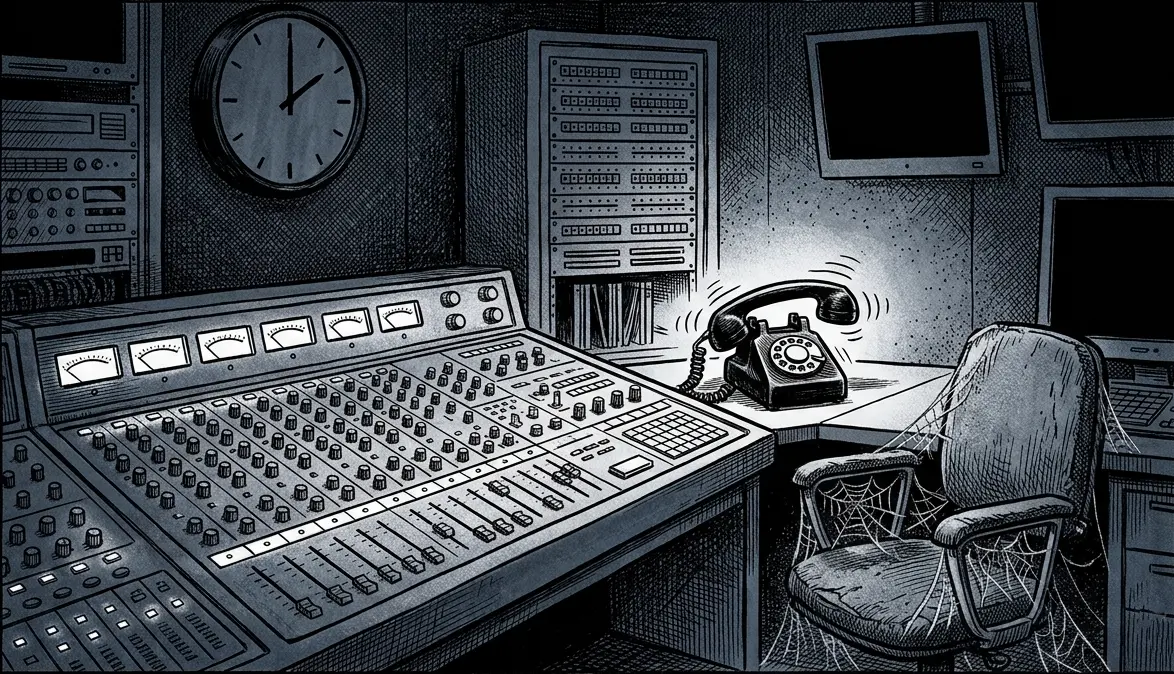
Minot police needed to warn residents immediately. They called KCJB, 910 AM — the station designated by federal authorities as the city’s primary Emergency Alert System broadcaster. Nobody answered. The station was automated, running Clear Channel programming piped in from another city. Police called the other Minot stations. All six commercial stations in Minot were owned by Clear Channel. All six were automated. No one answered at any of them.
No formal emergency warnings were issued for several hours. North Dakota’s public radio network — not a Clear Channel property — heard about the disaster and broadcast warnings. The six stations holding the public’s emergency broadcast licenses were silent. The license was still a public license. The public interest obligation was still on the books. There was simply no one there to fulfill it.
There is a law on the books — Section 310(b) of the Communications Act of 1934 — that prohibits foreign nationals from holding American broadcast licenses. The reasoning was straightforward: the public airwaves are a national resource, and foreign control of them is a sovereignty question. The law has been in force for ninety years.
Rupert Murdoch was an Australian citizen when he began acquiring American television stations in the 1980s. The law was unambiguous. He could not hold those licenses. The solution was documented and deliberate: Murdoch became an American citizen in 1985 — a naturalization expedited specifically to enable the broadcast acquisitions. He renounced his Australian citizenship the same year. The FCC granted the licenses with full knowledge of the purpose. Fox News launched in 1996 on that foundation: a foreign national who obtained citizenship of convenience, a regulatory agency that accommodated the transaction, and a Fairness Doctrine that had been eliminated nine years before the network went to air.
The architecture was assembled piece by piece. Each piece was legal. The result was not what the law was designed to produce.
The consolidation did not stop at broadcast. Jeff Bezos purchased the Washington Post in 2013; Amazon, his primary business, holds billions in federal cloud contracts with the CIA and the Department of Defense — the same federal government the Post is charged with covering. What that ownership produced, in real time, in October 2024, is the next article’s story in full.
The Fairness Doctrine protected the public’s right to balanced information on its own airwaves. The Telecommunications Act handed those airwaves to six companies. The ownership laws were accommodated for a foreign national. The national press that survived is owned by federal contractors.
Without the Fairness Doctrine, no broadcaster using the public’s spectrum was required to cover what was being done to the public’s resources. The Telecommunications Act handed that spectrum to six companies with no public interest conditions attached. The extraction that Block 8 documents ran in the districts those stations served. No one was required to report it. No one did.
Look up who owns your local radio and television stations at the FCC’s public database (fcc.gov/media/radio).
Find the parent company. Find what else that company owns in your market. Then ask: if there were an industrial emergency in your area tonight requiring an emergency broadcast, who would actually answer the phone?
— — —
Steve Sagnotti
is a serious amateur photographer, writer, and technologist based in Oregon. With his camera he tries to capture common images not often seen, leading to common questions not often asked.
© 2026 Steve Sagnotti
— — —
Sources
1. Fairness Doctrine established: FCC Report on Editorializing, 13 FCC 1246 (1949).
2. Fairness Doctrine eliminated: FCC, Repeal of the Fairness Doctrine, 2 FCC Rcd 5272 (August 4, 1987). https://legalclarity.org/what-is-the-fairness-doctrine-and-what-does-it-mean-for-broadcasters/
3. Reagan veto: June 19, 1987. Congressional Record.
4. Telecommunications Act of 1996: Pub.L. 104-104. https://www.congress.gov/bill/104th-congress/senate-bill/652
5. Six companies / 90%: Committee to Protect Journalists, April 7, 2026. cpj.org
6. Communications Act of 1934 foreign ownership: 47 U.S.C. § 310(b). https://www.law.cornell.edu/uscode/text/47/310
7. Fox News launch, 1996
https://www.britannica.com/money/Fox-News-Channel
8. Bezos Washington Post acquisition, $250M, 2013
https://www.washingtonpost.com/business/economy/amazon-founder-jeff-bezos-will-purchase-the-washington-post-for-250-million/2013/08/06/1cc215c8-fea1-11e2-9711-3708310f6f4d_story.html
9. Bezos endorsement killing, October 2024
https://www.cnbc.com/2024/10/25/jeff-bezos-killed-washington-post-endorsement-of-kamala-harris-.html
10. Limbaugh 1988 syndication
https://en.wikipedia.org/wiki/The_Rush_Limbaugh_Show
(confirms Aug 1, 1988 syndication via EFM Media, McLaughlin, WABC base)
11. Murdoch 1985 citizenship / Metromedia acquisition
- Citizenship, Sept. 4, 1985: https://www.upi.com/Archives/1985/09/04/Rupert-Murdoch-Australian-born-publishing-magnate-became-a-US-citizen/6074494654400/
- Washington Post, June 25, 1985 (FCC filing, the article your note references): https://www.washingtonpost.com/archive/business/1985/06/25/murdoch-asks-fcc-approval-of-acquisition/1be81e45-43ad-4626-946c-af5b16511999/
12. Clear Channel 40 → 1,200 stations
https://www.congress.gov/crs-product/R45338
(CRS report — authoritative on the pre-1996 40-station national cap and its elimination; for the ~1,200-station 2002–2003 figure, a secondary corroborating source: https://www.claymoresound.com/essays/clear-channel-killed-radio)
13. Amazon CIA/DoD contract values
https://www.nextgov.com/modernization/2021/08/nsa-awards-secret-10-billion-contract-amazon/184390/
(covers all three: 2013 C2S at $600M/10yr, 2020 C2E “tens of billions”/15yr, 2022 NSA WildandStormy up to $10B)
14. Bezos subscriber loss, 200,000+/250,000
- NPR original 200,000+ report: https://www.npr.org/2024/10/28/nx-s1-5168416/washington-post-bezos-endorsement-president-cancellations-resignations
- WaPo’s own later 250,000 figure: https://www.washingtonpost.com/style/media/2024/10/29/washington-post-cancellations-number/
15. Ellison/Skydance-Paramount acquisition details
- Merger closed Aug. 7, 2025, $8B: https://www.hollywoodreporter.com/business/business-news/skydance-paramount-global-merger-close-david-ellison-1236174784/
- $16M Trump/”60 Minutes” settlement: https://www.yahoo.com/news/skydance-early-talks-acquire-free-184044516.html
- Free Press acquisition + Weiss as CBS News editor-in-chief: https://www.nbcnews.com/business/business-news/paramount-cbs-news-acquires-free-press-bari-weiss-rcna220672?rand=26684 (note: reported price varies $100–200M across outlets, not a clean $150M figure — worth flagging in the article if precision matters)
- DOJ approval of WBD takeover, June 12, 2026: https://www.npr.org/2026/06/13/nx-s1-5856558/doj-approves-paramount-skydances-111-billion-acquisition-of-warner-bros-discovery
Leave a Reply