Notes from the Field | April 15, 2026
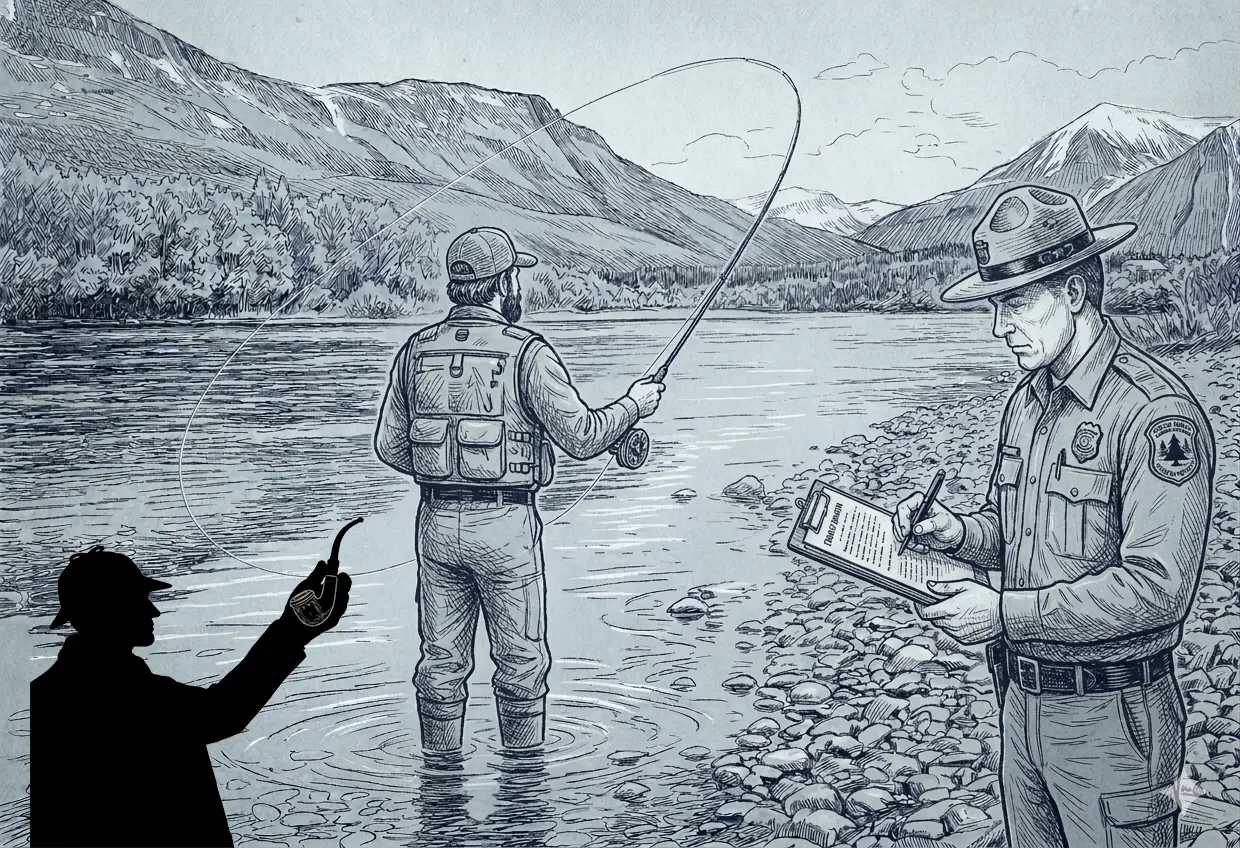
In December 2025, Tate Pulliam went to Yellowstone to fish. He left facing 18 months in prison for violating rules a park superintendent wrote — rules Congress never passed. His lawyers argue that’s unconstitutional. The government argues the superintendent had authority Congress delegated. Both are right. Neither is the point.
The point is that Congress created the agencies, funds the agencies, and campaigns against the agencies it created. The ambiguity isn’t an oversight. It’s the product. Every unresolved agency fight is a perpetual fundraising grievance. Clarity ends the revenue stream. The debt ceiling, gun legislation, comprehensive immigration reform — the pattern holds across thirty years and both parties in power. The crisis is the product. Resolution is the risk.
This is not a new observation. It’s a pattern. And once you see it, it’s everywhere.
The Infrastructure That Already Exists
This month, the Selective Service System moved to implement automatic draft registration by December 2026. Under a defense bill signed in December, the federal government will automatically register every male citizen between 18 and 26 by cross-referencing Social Security records, Census data, and other federal databases. No action required from the individual. The infrastructure to find you, identify you, and enroll you in a federal database at 18 is now operational.
That same infrastructure could register every eligible citizen to vote. Automatically. At 18. The technical complexity is identical. 46 states and territories already do some version of automatic registration at the state level. The silence at the federal level is not a technical problem. It is a political one. One party’s election math depends on the gap staying open.
Congress can build a database to find you for the draft. It will not build one to find you for the ballot. The difference is not capability. The difference is who benefits from the gap staying open.
The Tool That Would Work
If E-Verify were mandatory, any employer who hired an undocumented worker would be breaking the law and would know it instantly. No documents to fake. No gray area. The jobs dry up, the main reason to make the crossing weakens, and the border gets quieter — not because of The Wall, but because the work isn’t there anymore.
That doesn’t happen because the farmers and construction companies who write big checks to the same politicians giving speeches about the border need that labor to show up every Monday morning. The speech is for the voters. The policy is for the donors. You’re paying for both.
E-Verify has existed since 1996. For nearly thirty years it has sat available, functional, and voluntary — while the border has been a reliable source of campaign outrage for the same thirty years. The mandatory participation bill introduced in Congress in March 2025 has not moved. 11 states require it for most private employers. The rest don’t. Nearly three decades in and the actual lever stays optional.
E-Verify costs a fraction of what containment costs. The math is not complicated. Instead, $38 billion is being spent to acquire and convert 24 warehouses into permanent government-owned detention infrastructure — 8 of them built to hold 10,000 people each. The stated goal is 135,000 beds. The tool that addresses the cause stays optional. The infrastructure for managing the consequence gets a government title and a four-year budget.
The immigrants being held there now are the first population designated surplus. The infrastructure is already built and government-owned. The question is who fills it next.
The Disruptor Is Inside the Building
In March 2026, the White House released its plan for dealing with AI. It runs to several pages. It doesn’t require anything of anyone. Congress gets a list of suggestions from an institution that hasn’t had its own technology experts since 1995, when they fired them all to save money. Since then, what Congress knows about technology is mostly what the tech industry tells them. The industry’s suggestion for how hard to regulate AI is: not very. Congress is inclined to agree.
Here’s what nobody in that building is talking about. Every time technology displaced workers before — the assembly line, the computer, the internet — there was enough time for people to adjust. Your grandfather lost one kind of job and found another. Your parents retrained. It was hard but the gap was bridgeable. AI may not leave that gap. The jobs may go faster than new ones appear.
Henry Ford paid his workers enough to buy the cars they built. Not because he was generous. Because he understood that workers who can’t afford his product aren’t the consumers he needed for success. That math hasn’t changed. AI is about to create that problem at a scale nobody in a position to do anything about it is willing to say out loud. The people making AI policy either don’t know it or don’t care.
The warehouses are already built and sitting on the government’s deed — the facility in Hagerstown, Maryland, the 826,000-square-foot complex outside El Paso built on the same ground once used to hold Japanese Americans during World War II, eight more planned nationwide each built for 10,000 people. They were built for immigrants. When the next wave of people find themselves with no work, no income, no longer consumers in an economy that has no place for them — will the warehouses get used again?
What This Is
This is not dysfunction. Dysfunction implies trying and failing. The optional E-Verify system, the voter registration gap, the non-binding AI framework, the $38 billion in containment infrastructure — these are the systems working as designed. Designed by a political class that has learned, through nothing more sophisticated than self-interest, that the problem unsolved is worth more than the problem solved. Unsolved problems fill campaign coffers. Unsolved problems give every member a permanent enemy to campaign against.
The solutions — sitting there, available, technically feasible, quietly killed by the coalition most loudly claiming to want them — stay off the table.
The question that doesn’t have a donor sits in the center of the room. Everyone in the room is looking somewhere else.
The Narrow Gate — the essay series this dispatch documents in real time. Start here.
Sources
Opening — Yellowstone/Pulliam case
- Clair McFarland, “Oregon Man Challenges Yellowstone’s Rules As Unconstitutional Overreach,” Cowboy State Daily, April 15, 2026
The Infrastructure That Already Exists — Selective Service
- “Automatic Registration: FY2026 NDAA,” Selective Service System, sss.gov
- “Automatic military draft registration takes effect in the US in December 2026,” CNN Politics, April 9, 2026
- “Selective Service automatic registration to start in December,” The Hill, April 9, 2026
The Tool That Would Work — E-Verify
- S.1151, Accountability Through Electronic Verification Act, 119th Congress, introduced March 26, 2025, congress.gov
- “E-Verify Requirements by State 2026,” i-9intelligence.com, March 2026
- “How ICE’s Budget Boom Is Changing Immigration Detention,” Brennan Center for Justice, February 2026
- “Why Cities Are Resisting ICE’s Detention Expansion,” NPR, March 2026
The Disruptor Is Inside the Building — AI/OTA
- “National Policy Framework for Artificial Intelligence,” White House, March 20, 2026
- “U.S. Tech Legislative & Regulatory Update — First Quarter 2026,” Global Policy Watch, April 2026
- “Rebuilding a Technology Assessment Office in Congress,” R Street Institute, 2024
- “In 1995, OTA was defunded as part of Republican Speaker Newt Gingrich’s balanced budget initiative,” Center for Study of Responsive Law, July 2025
Leave a Reply