NOTES FROM THE FIELD
April 1, 2026
— THE INFRASTRUCTURE REMAINS —
The Warehouse Acquisition Program as Durable Architecture
— WHAT IS ACTUALLY BEING BUILT —
In July 2025, Congress allocated $45 billion to ICE for immigration detention — more than a decade of normal detention funding delivered in a single appropriation. ICE is now the highest-funded law enforcement agency in the United States.
The initial plan was leased tent camps. One was built — Camp East Montana on Fort Bliss in El Paso — and became immediately notorious. Three people have died there since it opened in August 2025, including what is reported as the first homicide in a modern ICE detention facility. Conditions documented by ICE’s own inspectors included dozens of violations of federal detention standards in the first two months of operation.
The tent camp model was abandoned. What replaced it is more consequential.
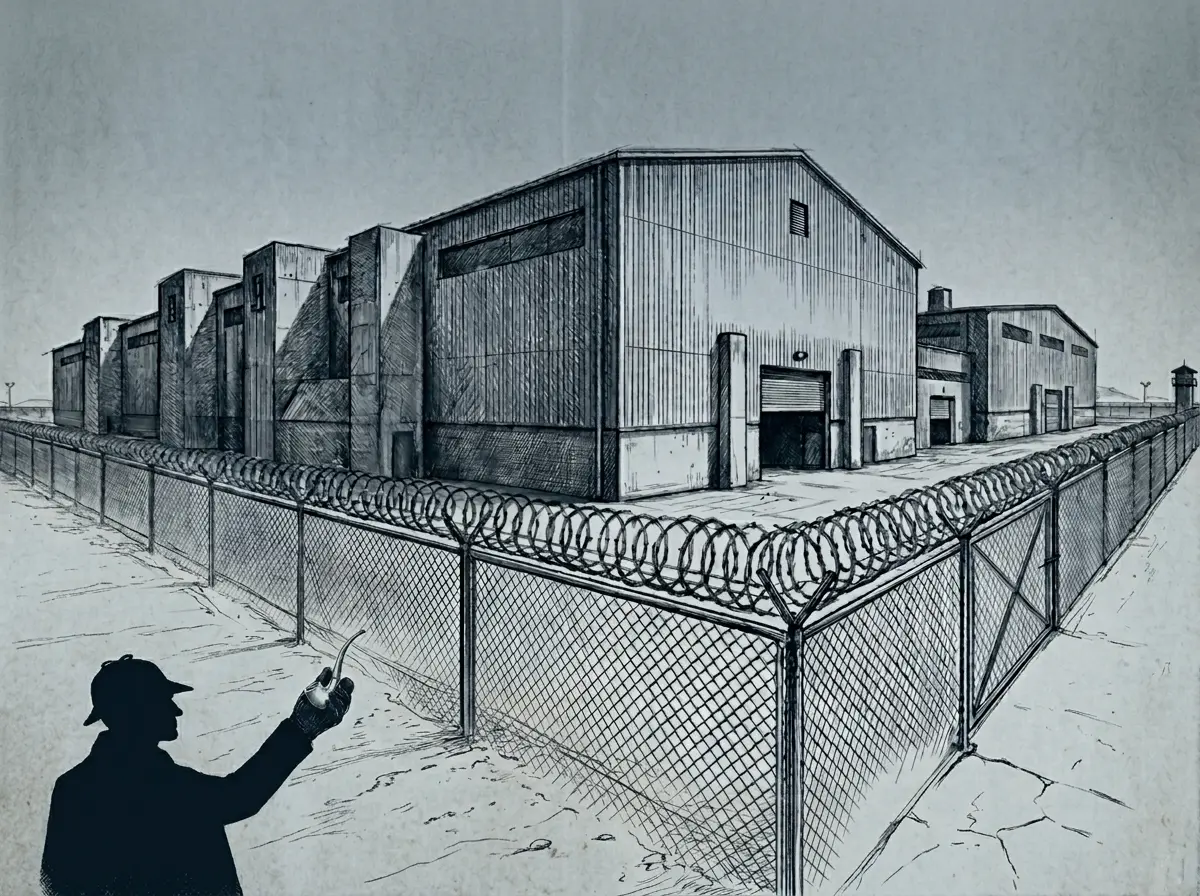
ICE has now launched what it calls the “ICE Detention Reengineering Initiative.” The plan: purchase commercial warehouses outright, retrofit them into a national network of detention facilities, and consolidate the current system of roughly 300 facilities down to 34 — organized as 8 “mega centers” holding 7,000 to 10,000 people each, and 16 regional processing centers holding 1,000 to 1,500. Total planned capacity: 92,600 people.
The purchases are already underway. As of early 2026, ICE has spent more than $690 million acquiring at least seven industrial warehouses in Maryland, Arizona, Georgia, Texas, Pennsylvania, and Michigan. A single warehouse near El Paso cost $123 million. One in Hagerstown, Maryland: over $100 million. One in Surprise, Arizona: $70 million. One in Berks County, Pennsylvania: $87 million — 520,000 square feet. The total retrofit and acquisition budget is $38.3 billion.
Before February 2025, ICE owned 10 of the 220 facilities it used. The stated plan is now to own the infrastructure entirely, with private contractors hired to operate it.
The shift from leasing to owning is the critical structural fact.
— WHY THE SHIFT MATTERS —
Leased facilities can be returned. Contracts can be terminated. Political pressure can reach the private owner. Community opposition can reach the seller, and has — at least 12 purchases have been blocked this way, and two announced deals fell through under pressure.
Owned infrastructure cannot be returned. Once the federal government holds title to 34 warehouse-scale detention facilities distributed across the national geography, the infrastructure exists independent of its current stated purpose. The legal authority that built it is Section 1231(g) of the U.S. Code, which authorizes ICE to acquire facilities for the detention of non-citizens. The physical infrastructure that results has no such limitation.
A warehouse in Berks County, Pennsylvania, retrofitted to hold 1,500 people, is — after its current occupants have been deported — a facility that holds 1,500 people. The legal designation of who qualifies for detention is a policy decision. The infrastructure is permanent.
This is not speculation. It is the nature of infrastructure. Roads built for military use carry civilian traffic. Internment camps built for one designated population have been repurposed in every historical instance where the original population was exhausted or dispersed. The facilities do not come down. The justification changes.
— THE QUESTION THIS RAISES —
The “Sequence” dispatch asks what happens when the technology reaches the rungs where the people who built this system live — when the economically displaced citizens find no legal mechanism to claim their share of the automated abundance.
This addendum adds the physical infrastructure dimension: when that displacement arrives at scale, the warehouses will already exist. Owned. Geographically distributed. Designed to hold people at capacity pending legal resolution of their status.
The acting ICE director described the goal of the new system as “Amazon Prime, but with human beings.”
Amazon’s warehouse network is not built for one product. It is built for throughput. The product changes. The infrastructure scales.
The silence won’t feel like silence. It will just feel like the way things are.
Leave a Reply