Block 8, Article 9 — Doubt Is Our Product
Your uncertainty about climate science, vaccine safety, or pesticide risk may have been manufactured by the same people who spent thirty years telling you cigarettes were safe.
Not misinformed. Not confused by complexity. Manufactured. The uncertainty you carry on a dozen settled scientific questions was produced deliberately, by professionals, at significant expense, using a playbook that was written in the 1950s, tested on tobacco, and worked by every industry that faced a scientific finding it found inconvenient ever since.
— — —
Why it works — on you, and on everyone.
Most people do not know how their own minds work under this kind of pressure.
When you encounter information that conflicts with something you already believe — something tied to your identity, your community, or your sense of how the world works — you do not evaluate it neutrally. You evaluate it defensively. You look harder for the flaws in the evidence that threatens your belief than in the evidence that confirms it. You are not lying to yourself. You genuinely feel like you are being reasonable. The bias is invisible from the inside. Researchers call it motivated reasoning. It is not a character flaw. It is how human cognition works under social pressure.
There is a second layer. On questions where accepting the scientific consensus would mean agreeing with people you distrust or disagree with politically, accepting the consensus carries a social cost. It feels like switching sides. Studies have found that on questions like climate change, the more scientifically literate the person, the more polarized their views — not less. More education, deployed in service of a motivated conclusion, produces a more sophisticated defense of the thing the person already believed.
The people who built the doubt machine understood this before the academics named it. They did not need to change your mind. They needed only to give you something to work with, to doubt.
— — —
The playbook was written in a boardroom in 1953.
In December 1953 the chief executives of the major American tobacco companies met at the Plaza Hotel in New York. The Surgeon General had not yet issued his report — that would come in 1964 — but the science was already clear inside the companies. The tobacco companies’ own researchers had established the link between cigarette smoking and lung cancer. The executives in that room knew cigarettes caused cancer. The question they brought to the Plaza Hotel was what to do about the fact that they did.
They hired Hill & Knowlton, the largest public relations firm in America. The strategy Hill & Knowlton designed was not denial. Denial could be tested against the evidence and lose. The strategy was doubt. Not “cigarettes are safe.” “The science is uncertain.” Not “the studies are wrong.” “More research is needed.” The Tobacco Industry Research Committee — funded entirely by the tobacco companies, staffed by the tobacco companies, answerable to the tobacco companies — was established to produce the impression of ongoing scientific inquiry. It did not need to find anything. It needed only to exist, to fund occasional studies, and to ensure that every news story about smoking and cancer included a quote from a scientist willing to say the question was not yet settled.
This is where the operation becomes something more than spin. The tobacco companies were not merely funding skeptics. They were building a parallel scientific infrastructure — journals, conferences, researchers holding university appointments whose work was funded and sometimes directed by the industry — specifically designed to produce official-sounding doubt. The veneer of independence was the product. When R.J. Reynolds’s ads said more doctors smoked Camels than any other cigarette — backed by a “nationwide survey” of 113,597 physicians — they did not mention how the survey was taken: doctors were handed free packs of Camels at medical conventions, then asked afterward what brand was in their pocket. The number was technically accurate. The method was the fraud. At the retail level it was an ad. At the institutional level it was the same operation — manufacture the credibility, hide the methodology, let the official-sounding conclusion do the work.
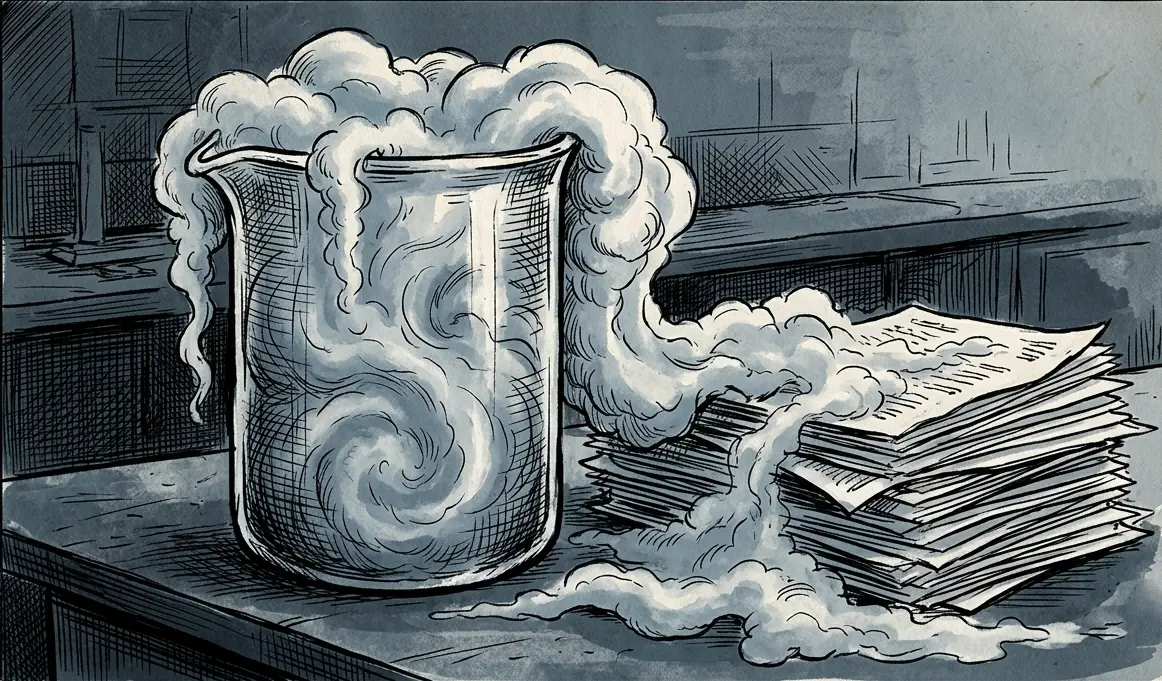
A 1969 internal memo from Brown & Williamson made the strategy explicit: “Doubt is our product since it is the best means of competing with the body of fact that exists in the mind of the general public.” Not truth. Doubt. The body of fact was not the problem. The public’s certainty about the body of fact was the problem. Manufactured uncertainty was the solution. It worked for thirty years — long enough for millions of people to smoke their way through a conclusion the companies had already reached in private.
The Tobacco Industry Research Committee was framed as independent scientific inquiry into an open question. That it was funded entirely by the companies whose product the “open question” concerned — and existed to produce doubt rather than resolve it — was not in the frame its own name was built to obscure.
— — —
The same scientists. The same firms. Different industries.
The tobacco playbook did not retire when the warning labels became mandatory and the lawsuits began. It was worked by every industry that needed it next.
Naomi Oreskes and Erik Conway documented what happened. The same PR firms. In several cases the same individual scientists — researchers who had built careers producing tobacco doubt moved to acid rain doubt, then ozone doubt, then climate doubt. Not always because they were paid in each case, though some were. Because they had developed a professional identity as contrarians, a practiced skepticism toward regulatory science, and a network of industry contacts who knew their phone numbers.
The fossil fuel industry facing climate science in the 1980s did not need to invent a new strategy. Exxon’s own scientists had confirmed the climate findings internally in 1977. The company then spent decades funding organizations specifically designed to produce public uncertainty about what its own researchers had already established internally. The same parallel scientific infrastructure the tobacco companies had pioneered — the industry-funded research bodies, the official-sounding journals, the credentialed spokespeople — reappeared under new names, in new policy domains, producing the same product.
The pharmaceutical industry facing inconvenient findings about opioid addiction. The sugar industry facing evidence linking sugar to obesity and heart disease. The agrochemical industry facing research on pesticides and bee colony collapse. The PFAS manufacturers facing findings on forever chemicals appearing in drinking water and human blood. Each worked the same strategy refined across seventy years of deployment: fund alternative research, amplify the minority scientific voice, insist the question is unsettled, and run the clock.
Running the clock is not a side effect of the strategy. It is the strategy’s second engine. Legislative deadlines expire and bills die without a vote — the session ends, the political moment passes, the next Congress arrives with different priorities. Products stay on the market and revenue continues for every month the science remains “contested.” The delay normalizes — the longer a question appears open, the more it feels like a genuinely open question, regardless of what the evidence actually shows. And the member of Congress who would rather not cast a hard vote on a question their donors have an interest in finds that an unresolved scientific debate is the most convenient thing in the world. Every actor in the room benefits from the clock running. The doubt machine doesn’t only manufacture uncertainty. It manufactures time.
— — —
The Powell apparatus is running the TIRC playbook at policy scale.
The Tobacco Industry Research Committee was one industry’s doubt operation. The Heritage Foundation, the Cato Institute, the Heartland Institute, and the dozens of state-level think tanks funded by the same donor networks are running the TIRC playbook across every policy domain simultaneously.
The product is the same: manufactured uncertainty on questions where the evidence has been settled, delivered in the language of scholarship, with footnotes, at congressional hearings, in op-ed pages, and on cable news. The member of Congress who needs to vote against climate regulation does not need to believe the science is wrong. They need only to be able to say the science is contested. The think tank produces the contest. The doubt is the alibi. Congress once had an institution whose job was to pierce it — to give members independent scientific analysis that no lobbyist could buy and no think tank could replicate. That institution is Article 8.
— — —
Uncertainty about a question the scientific community has answered has a source, and a price tag attached to producing it.
The body of fact is not the problem. Your certainty about the body of fact is the problem. That sentence was written in a tobacco company boardroom in 1969. It has been the operating premise of the apparatus ever since.
The doubt machine ran for thirty years on climate science while the carbon window that existed in 1977 was closing. Exxon’s scientists identified it. The company funded the apparatus that disputed it. The window is now closed. It is the only entry in Block 10’s ledger that cannot be recovered — not in any human timeframe, not with any policy instrument, not by any decision any future Congress could make. Everything else in Block 10 is recoverable in principle. The carbon is not. The doubt you carry on that question is not a failure of your reasoning. It is evidence that the product worked.
The institutional infrastructure that produces and distributes this doubt is documented in Article 2.
— — —
Search the UCSF Truth Tobacco Industry Documents Archive (industrydocuments.ucsf.edu/tobacco) for “doubt is our product” and read the 1969 memo in full. It is three sentences long and it is the whole playbook.
— — —
Steve Sagnotti
is a serious amateur photographer, writer, and technologist based in Oregon. With his camera he tries to capture common images not often seen, leading to common questions not often asked.
© 2026 Steve Sagnotti
— — —
Sources
1. Kunda, Ziva. “The Case for Motivated Reasoning.” Psychological Bulletin, Vol. 108, No. 3, 1990.
2. Kahan, Dan M. “Ideology, Motivated Reasoning, and Cognitive Reflection.” Judgment and Decision Making, Vol. 8, No. 4, 2013.
3. Kahan, Dan M. et al. “The Polarizing Impact of Science Literacy and Numeracy on Perceived Climate Change Risks.” Nature Climate Change, Vol. 2, 2012.
4. Brown & Williamson internal memo. 1969. UCSF Truth Tobacco Industry Documents Archive. industrydocuments.ucsf.edu/tobacco
5. Tobacco Industry Research Committee founding documents. 1953. UCSF Truth Tobacco Industry Documents Archive. industrydocuments.ucsf.edu/tobacco
6. Oreskes, Naomi and Conway, Erik M. Merchants of Doubt. Bloomsbury Press, 2010.
7. Brandt, Allan M. “Inventing Conflicts of Interest: A History of Tobacco Industry Tactics.” American Journal of Public Health, Vol. 102, No. 1, January 2012.
8. Supran, Geoffrey; Rahmstorf, Stefan; Oreskes, Naomi. “Assessing ExxonMobil’s Global Warming Projections.” Science, Vol. 379, January 2023. doi.org/10.1126/science.abk0063
9. Plaza Hotel meeting: December 14, 1953, organized by Hill & Knowlton.
10. Global Climate Coalition: founded 1989 by the National Association of Manufacturers.
11. Exxon 1977 James Black memo. insideclimatenews.org
12. R.J. Reynolds “More Doctors Smoke Camels Than Any Other Cigarette” campaign (1946–1954): Stanford Research into the Impact of Tobacco Advertising. tobacco.stanford.edu
Leave a Reply