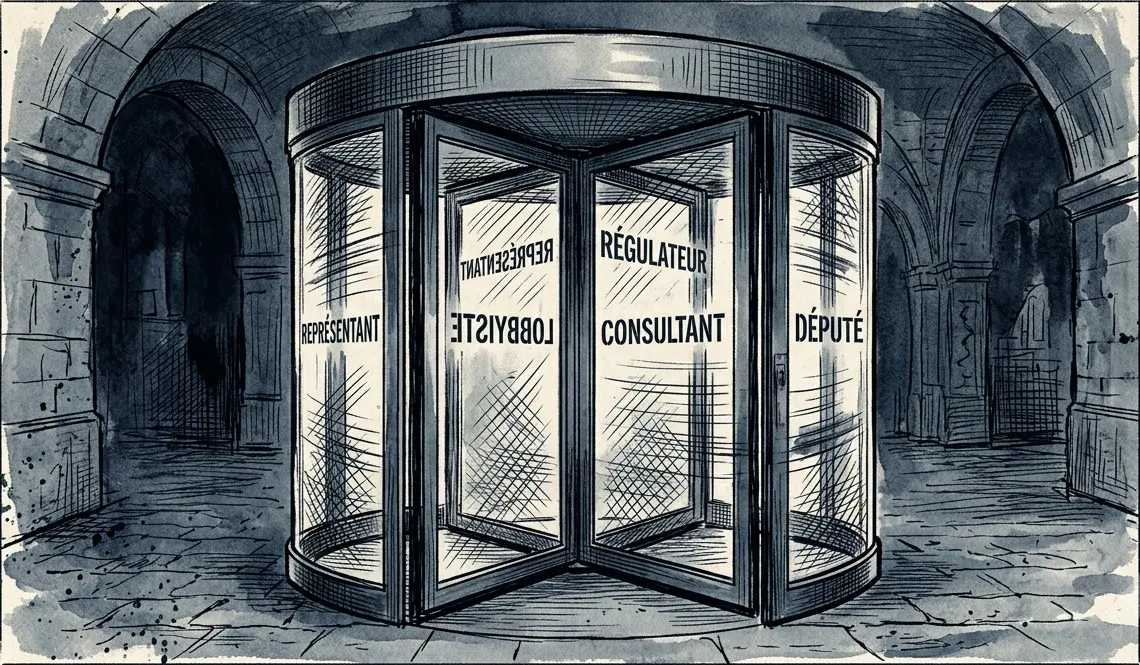
Block 8, Article 8 — The Mechanism Is Who Answers the Phone
The official who regulates an industry today is statistically likely to work for that industry tomorrow. Not eventually. Not in some distant career pivot. Within months of leaving the agency, in many documented cases. The knowledge built at public expense, the relationships forged on public time, the regulatory discretion exercised with public authority — all of it becomes the product sold on the private market the moment the cooling-off period expires. The revolving door is not a scandal. It is the architecture. And it runs in both directions.
— — —
How the pricing works
The regulator does not need to be bribed. The regulator needs only to understand their own career.
The FDA official who approves a pharmaceutical company’s drug application knows three things simultaneously: the decision is consequential, the industry is watching, and the industry hires. The regulator who applies the standard rigorously and finds against the application will find fewer calls returned when they leave. The regulator who finds a path to approval — who weights the available evidence toward the outcome the industry needs — will find a consulting engagement, a board seat, a senior vice presidency waiting. Nothing illegal is said. Nothing needs to be. The selection pressure operates automatically, the same way the call center whiteboard operates automatically. The regulator who is too aggressive prices themselves out of the market they are about to enter. The regulator who is cooperative prices themselves in.
Regulatory ethics rules are framed as preventing corruption — the explicit trading of a decision for a payment. The selection pressure that rewards cooperative regulators with post-agency careers, without any decision or payment ever being explicitly traded, was not in the frame those rules were written to cover.
The Project on Government Oversight documented 380 instances of senior Pentagon officials moving directly to defense contractors they had overseen — in a single five-year period. Not over a career. Five years. The defense contractor that cultivated the relationship with the procurement official, funded the conferences they attended, hired their former colleagues, and offered them a position upon departure did not need to corrupt the procurement process. It needed only to exist as an attractive next employer while the process was running.
The pattern is not unique to defense. FDA officials join pharmaceutical companies. SEC enforcement attorneys join securities firms. EPA scientists join the industries they regulated. CFTC commissioners join the trading firms they oversaw.
— — —
The cooling-off period is the $200 fine of regulatory capture
Before 1978, nothing restricted the move at all — an official could leave an agency and lobby it the same afternoon. The Ethics in Government Act of 1978 created the first federal cooling-off period for senior executive branch officials. Congress broadened its own restriction in the Ethics Reform Act of 1989, extending it for the first time to Members of Congress, elected officers, and covered congressional staff — those paid above a set compensation threshold, which excludes the majority of junior staff but does reach committee staff and senior personal-office employees. A separate 2007 law, the Honest Leadership and Open Government Act, extended the window to two years for the most senior officials. Each of those revisions was a specific, recorded congressional vote — not an erosion, a choice, made by the people the restriction applies to.
The law restricts direct contact with the former agency or office for one to two years, depending on seniority and role. It does not restrict employment. It does not restrict knowledge. And it exempts entirely the large majority of staff who never crossed the compensation threshold that would have covered them — the aide who spent a decade inside the committee, understanding its internal deliberation process, its enforcement priorities, and the personalities of the people still inside, but never earned enough to trigger the restriction. They can walk out the door the same day their employment ends and into the industry the next morning. No waiting room. No restriction.
And the restriction on those it does cover is narrower than it appears. It prohibits direct contact on specific matters. It does not prohibit sitting in the room while the lobbyist makes the contact. It does not prohibit briefing the people who will make the contact — explaining which arguments work, which enforcement officers respond to which framings, which internal processes can be navigated and how. The former regulator doesn’t need to make the call. The industry needs them to train the person who does. The cooling-off period is calibrated precisely not to impede that transaction. It is the cost of doing business, not a barrier to it.
— — —
The door runs both ways
The official who moves from industry to agency brings the same dynamic in reverse. They arrive with relationships, frameworks, and instincts formed inside the industry the agency is now charged with regulating. They staff the rule-making process, shape the interpretive guidance, and determine enforcement priorities. They are not corrupt. They are fluent — in the industry’s language, its concerns, its red lines. The rules that emerge from an agency staffed substantially by former industry personnel tend to reflect that fluency.
The Minerals Management Service collected royalties from offshore oil operations and oversaw their safety. By 2008 it had become so thoroughly captured by the industry it regulated — joint parties, gifts, employment relationships running in both directions — that the Interior Department’s inspector general described a culture of ethical failure. Two years later, in April 2010, the Deepwater Horizon exploded. Eleven workers died. 4.9 million barrels of oil entered the Gulf of Mexico. The MMS was abolished and reorganized. The revolving door continued under new letterhead.
The public interest language never disappears through any of this. The agency still says public interest, sound science, market integrity, safe and effective. What changes is whose interest those words are serving — the vocabulary survives capture intact because the vocabulary was never the mechanism. The mechanism is who answers the phone.
— — —
The same mechanism, a different institution
The revolving door hollows the regulatory agency by ensuring the regulator understands their future. The Powell apparatus ran the same mechanism against a different public institution — one built not to regulate industry but to serve the people industry was displacing.
The Morrill Act of 1862 was a precise transaction. The federal government granted each state 30,000 acres of public land per congressional seat, with one condition: the proceeds fund colleges teaching agriculture and the mechanic arts. The commons — public land — converted into educational infrastructure serving the people who worked the land. Sixty-nine land grant institutions. The GI Bill of 1944 extended the logic: eight million veterans, tuition paid, the highest documented return on federal investment in American history. An educated population as public good, not private transaction.
From roughly 1980 forward the Powell apparatus think tanks argued the contrary premise: a college degree is a private benefit, the individual captures the return, the individual should bear the cost. State legislators — many operating from ALEC model budgets — cut higher education appropriations and called it fiscal discipline. Universities shifted costs to tuition. Tuition required loans. Total outstanding student loan debt: $1.84 trillion, held by 42.8 million borrowers. The Morrill Act built the land grant college with public land. The ALEC budget rebuilt it as a debt instrument. The commons investment became a private tax on economic participation.
— — —
The early warning system was dismantled
The land grant college produced the research. The extension office delivered it — and watched.
The Hatch Act of 1887 created agricultural experiment stations at every land grant institution. The Smith-Lever Act of 1914 created the Cooperative Extension Service: the county agents, the field offices, the agronomists who drove out to the farm and explained what the soil test meant on that specific soil, in that specific watershed, in that year’s conditions. It was the most successful technology transfer system in American history. But the extension office was not only a translation layer. It was a monitoring infrastructure — a distributed network of observers accumulating a longitudinal record that no individual farmer, no corporate agronomist, and no satellite image produces.
The county agent who visited every farm in the watershed knew what the aquifer level was in 1987. They had the soil depth measurements from 1962. They could see the erosion rate across thirty years of specific planting decisions on specific soils. They were watching. Documenting. Tracking the pattern. The alarm they could have sounded was built on data that took decades to accumulate and cannot be reconstructed once the collection stops.
When state legislatures cut university appropriations, extension budgets contracted with them. County agent positions went unfilled. Field offices closed. The large industrial operation — Cargill, ADM, Tyson — was unaffected. It had internalized the function, employing its own agronomists and water engineers. It didn’t need the county agent because it could afford the private version. The extension office existed for the farmer who couldn’t. When it closed, that farmer lost access to applied research, soil monitoring, aquifer data, and early warning. But the commons lost something larger: the institution whose job it was to watch what was happening to the shared resources beneath every farm in the county, regardless of who owned them.
The Ogallala Aquifer is being drained. The topsoil is being spent at ten to twenty-five times its formation rate. Nobody with institutional responsibility for documenting either is left in most of the counties where it’s happening. The monitoring stopped. The pattern became invisible. The alarm cannot be sounded by someone whose position was eliminated in 1994.
This is one of four conditions that have to hold at once for an architecture like this to keep running: the public kept from seeing it, the industry’s framing arriving first and unchallenged, no independent voice left standing to document what’s disappearing, and the few people who do notice easy to wave off as alarmists. The extension office’s elimination is what the third condition looks like when it’s met by simply removing the person whose job was to watch.
This is not a coincidence of budget pressures. It is the logical extension of the same mechanism that captured the regulatory agency: remove the institution whose job is to watch, and the damage runs unseen until it is irreversible. First you stop watching. Then you eliminate the ledger — the Biden natural capital accounting framework, reversed on Day One 2025. Then you can say with a straight face that there is no evidence of a problem. The evidence was the institution. The institution is gone.
The farmer who lost the extension agent, the student who holds the loan, the worker who lost the union, the regulator who priced their decisions against their next employer — these are not four separate stories. They are one story: the systematic removal of every institutional buffer between the individual and the concentrated private interest the apparatus spent fifty years building the room to serve.
The outcomes of these mechanisms live in Block 10. The monitoring gap connects to Block 9 — the Darkened Room.
— — —
Look up how many of your state’s current agricultural extension positions are filled versus authorized. Most state land-grant universities publish this.
— — —
Steve Sagnotti
is a serious amateur photographer, writer, and technologist based in Oregon. With his camera he tries to capture common images not often seen, leading to common questions not often asked.
© 2026 Steve Sagnotti
— — —
Sources
1. POGO. Brass Parachutes: The Problem of the Pentagon Revolving Door. November 5, 2018. pogo.org
2. 18 U.S.C. § 207. law.cornell.edu
3. Ethics in Government Act of 1978, Pub.L. 95-521. Ethics Reform Act of 1989, Pub.L. 101-194. Honest Leadership and Open Government Act of 2007, Pub.L. 110-81.
4. Morrill Act of 1862. Pub.L. 37-108. archives.gov
5. GI Bill (Servicemen’s Readjustment Act of 1944). Pub.L. 78-346. archives.gov
6. Hatch Act of 1887. Pub.L. 49-541.
7. Smith-Lever Act of 1914. Pub.L. 63-95. nifa.usda.gov
8. Education Data Initiative. “Student Loan Debt Statistics 2026.” educationdata.org
9. USDA Economic Research Service. “Farming and Farm Income.” ers.usda.gov
10. Interior Department Inspector General. Report on Minerals Management Service, September 10, 2008.
11. National Commission on the BP Deepwater Horizon Oil Spill and Offshore Drilling. Final Report. January 2011. govinfo.gov
12. POGO 380-instance figure: Brass Parachutes (Nov. 5, 2018).
Leave a Reply