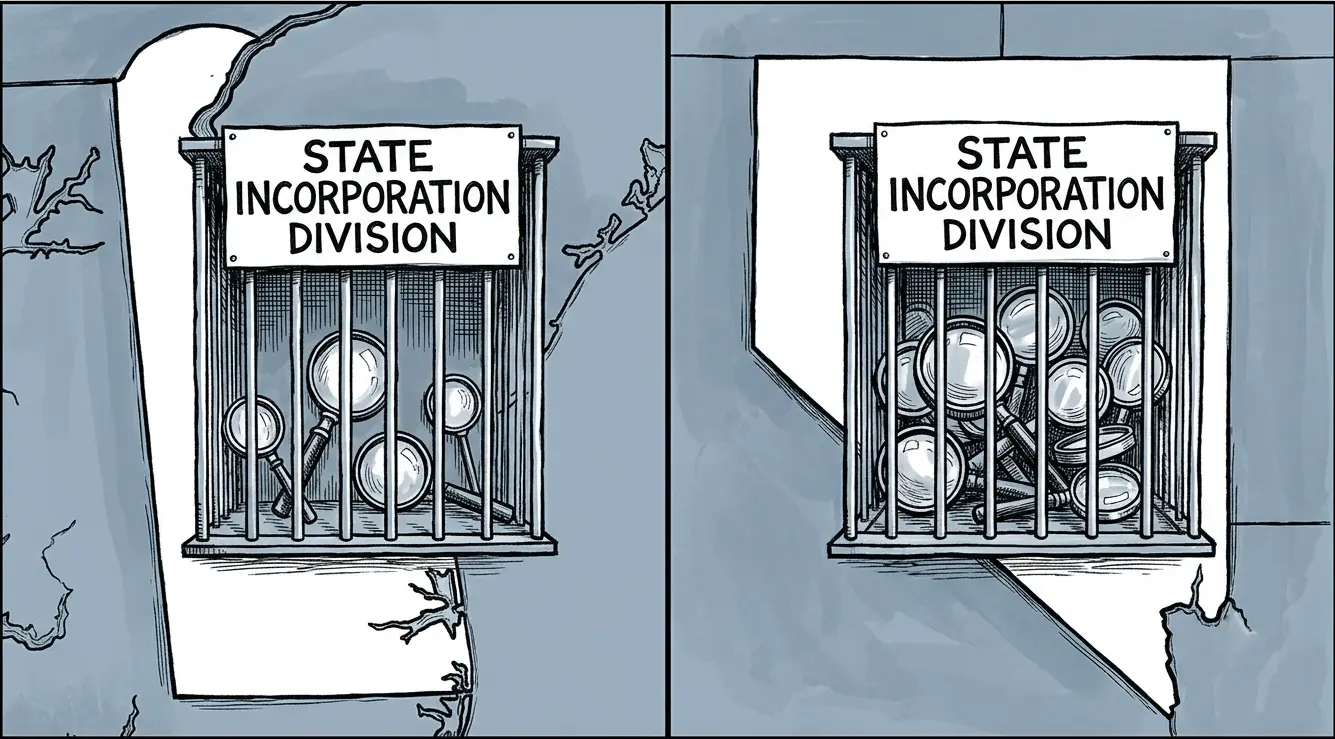
Block 8, Article 6 — Two Rooms, One Buyer’s Market
In 1899 Delaware passed a corporate law built to win a competition nobody had officially announced: which state could offer the least accountability to the people running a company. In 1983 South Dakota won a different round of the same competition, this time for families instead of corporations. Eighty-four years apart, two state legislatures wrote the same kind of victory into law, and the country barely noticed either one happen.
— — —
The corporation that shed its conditions
Before the Civil War, a corporation was a specific grant of public authority for a specific public purpose — a bridge, a canal, a bank, limited in duration, revocable if it worked against the public interest. Delaware’s General Corporation Law of 1899 was written deliberately to attract corporate registrations by stripping that logic out entirely: low fees, minimal restrictions, maximum protection for management from shareholder and public accountability. New Jersey had briefly held the lead in attracting incorporations. Delaware undercut it, and every other state that tried to compete lost the same way New Jersey did — by refusing to cut as deep.
The timing is not incidental. The same decades that saw Reconstruction’s broken promises — the 40 acres rescinded, sharecropping and convict leasing replacing slavery in fact if not in name — also saw the corporation built on top of that labor shed its remaining public conditions. The transcontinental railroad, completed in 1869, ran on 170 million acres of public land grants, federal subsidies, Chinese immigrant labor paid starvation wages, and the labor of formerly enslaved and free Black workers in the South. The corporations that built it kept the commons they were handed. The freedmen who were promised a stake in the country received nothing. The corporate form that emerged from that moment — freed from public conditions by Delaware law, granted personhood by Santa Clara seventeen years later, funded by the extraction Block 1 and Block 10 already document — is the same legal entity whose political spending Citizens United completed 141 years after Delaware wrote the law that let it stop answering to anyone.
Delaware’s corporate law was framed as attracting business through efficiency and predictability. What efficiency required — stripping the conditions that had made a corporation answerable to the public that chartered it — was not in the frame.
— — —
The race never stopped running
Delaware still hosts more than half of the Fortune 500, and its Court of Chancery remains the reason: a specialized business court with a century of precedent that gives large, investor-backed companies the legal predictability they want. But Nevada has spent the last two decades undercutting Delaware exactly the way Delaware once undercut New Jersey. Nevada corporations shield officers and directors from liability for anything short of intentional fraud or a proven breach of loyalty — Delaware’s protection is narrower and has to be opted into. Nevada charges no corporate income tax. Nevada discloses less.
The competition is not history. Since 2024, a documented wave of companies has left Delaware for Nevada — reported in industry press as “Dexit” — following a string of Delaware Chancery Court rulings that unsettled founders and boards used to predictable outcomes. Delaware still wins on prestige and case law depth. Nevada wins on how little a director has to answer for. The two states are not offering different products. They are offering the same product, priced by how much accountability the buyer wants to shed, exactly as they were in 1899 — just with a second bidder in the room now.
— — —
The same competition, run for families instead of companies
In 1983, South Dakota abolished the rule against perpetuities — the centuries-old common-law limit that forced a trust to terminate within twenty-one years of its last named beneficiary’s death. Once that limit was gone, a trust could hold assets forever. No forced distribution ever means no estate-tax event ever, indefinitely, across as many generations as the family wants.
What that trust actually delivers makes the parallel to Delaware’s corporation exact. Perpetual existence — a corporation never dies either. Sealed privacy — South Dakota trust records can be sealed from public view in perpetuity, the same shield Nevada sells corporations. Protection from creditors and divorcing spouses — the corporate veil, rebuilt for a bloodline. Tax-free compounding, because assets that are never distributed are never taxed. A corporation and a South Dakota dynasty trust are the same four advantages, purchased by whoever can afford the legal architecture to build either one.
The scale is not a rounding error. More than $360 billion in trust assets sit in South Dakota alone, a figure that roughly quadrupled in the decade before the 2021 Pandora Papers investigation exposed how the industry actually works — no residency requirement, no requirement the beneficiary ever set foot in the state, and no obligation for South Dakota to share information about the trust with any other government on earth. One trust company alone administers relationships worth more than $165 billion for over 120 billionaire and 430 centimillionaire families, 15 percent of them foreign nationals from 54 countries. The Pandora Papers found trusts connected to foreign officials accused of embezzlement, bribery, and human rights abuses, protected by the identical mechanism a domestic family uses to keep a modest fortune out of the estate tax.
— — —
The barrier was never the law
Nothing in the mechanism requires blood or marriage, and nothing in the mechanism requires billionaire status. The federal Generation-Skipping Transfer tax — the tax dynasty trusts are built to avoid — already has rules for unrelated beneficiaries: anyone more than roughly 37.5 years younger than the person setting up the trust is automatically treated the same way a grandchild would be, assigned to a “generation” by age rather than lineage. A mutual-aid society or a fraternal order could build the identical structure a wealthy family uses — a family limited liability company holding pooled assets, member interests sitting inside each member’s own individual trust rather than in their name directly, a private trust company the group itself controls sitting on top to administer it — and the tax code would treat it exactly as it treats a bloodline.
South Dakota’s own minimum trust charter is $200,000 in assets, not the millions the billionaire headlines suggest. Wealth managers cite $5 million as the point where the annual administration cost — 150 to 250 basis points, 1.5 to 2.5 percent of assets every year — actually pays for itself against decades of compounding. The gap between $200,000 and $5 million is not a legal barrier. It is the gap between knowing this mechanism exists and not knowing, and between having the capital to make the fee drag worth it and not having it. Both gaps run through the same apparatus of lawyers and information the rest of this block has already documented protecting extraction industries and campaign donors. They protect estates the identical way.
— — —
What happens if the applecart gets crowded
Congress has already tested the water, twice, in opposite directions. A 2021 reconciliation proposal would have cut the estate tax exemption from $11.7 million to $6 million, aimed specifically at slowing dynasty-trust growth. It did not pass. Four years later Congress moved the other way entirely: the 2025 One Big Beautiful Bill Act permanently raised the exemption to $15 million per individual, effective 2026, and eliminated the scheduled sunset that would have cut it back down to roughly $6–7 million. The door did not narrow. It opened wider, and stayed there. If broader use — mutual-aid societies, fraternal orders, families further down the wealth ladder than $5 million — ever did start meaningfully affecting federal revenue, the pattern this series documents everywhere else predicts what tightening would look like: not closing the mechanism outright, but grandfathering the trusts already built while narrowing the door for anyone arriving after. So far the actual test case has run the other way. The wealth already inside the structure did not just stay protected. It got a bigger room to grow in.
— — —
Two rooms, one buyer’s market
Delaware built a room for corporations in 1899. South Dakota built a parallel room for families in 1983. Nevada and a half-dozen other states have spent the years since undercutting both, each competing to offer whoever can pay the least accountability the law will still call legal. None of it required breaking a rule. That is the point this entire block has been making from the Powell Memo forward: the room does not need to be captured by force when it can simply be built, state by state, to sell exactly what its buyers are shopping for.
Closing either room requires the same thing: a state willing to compete the other direction — chartering corporations and trusts on terms that require accountability rather than sell its absence. No state currently does. Block 12’s repair argument depends on one existing.
Look up your own state’s corporate chartering statute and compare its director-liability provisions against Delaware’s and Nevada’s. Then look up whether your state has adopted South Dakota-style perpetual trust law. Both are public record. Neither took a conspiracy to write — only a legislature willing to compete for the business.
— — —
Steve Sagnotti
is a serious amateur photographer, writer, and technologist based in Oregon. With his camera he tries to capture common images not often seen, leading to common questions not often asked.
© 2026 Steve Sagnotti
— — —
Sources
1. Delaware General Corporation Law, 1899. Lawrence Mitchell, The Speculation Economy (2007); Bebchuk and Hamdani, “Vigorous Race or Leisurely Walk.”
2. Railroad land grants, 170 million acres: Paul Gates, History of Public Land Law Development (1968). Transcontinental Railroad completion 1869.
3. Santa Clara County v. Southern Pacific Railroad, 118 U.S. 394 (1886). supreme.justia.com
4. Citizens United v. FEC, 558 U.S. 310 (2010). supreme.justia.com
5. Nevada corporate liability provisions: Nev. Rev. Stat. §§ 78.138, 78.7502. leg.state.nv.us
6. “Dexit” trend 2024–2026: Tornetta v. Musk and Maffei v. Palkon (TripAdvisor).
7. South Dakota rule against perpetuities repeal, 1983: South Dakota Trust Company; Forbes, “South Dakota Turned Itself Into A Tax Haven. But Why?”, October 2021.
8. $360B+ South Dakota trust assets; Pandora Papers findings: FRONTLINE/ICIJ, “Pandora Papers,” November 2021. pbs.org
9. South Dakota Trust Company client figures: South Dakota Trust Company, “Why South Dakota.” sdtrustco.com
10. GST “skip person” generation-assignment rule: 26 U.S.C. § 2651. law.cornell.edu
11. South Dakota $200,000 minimum trust charter: SDCL § 51A-6A-19; South Dakota Division of Banking. dlr.sd.gov/banking
12. 2021 estate tax exemption reduction proposal ($11.7M→$6M); reversal via OBBBA to $15M per individual (2026).
Leave a Reply