Block 12, Article 4 — Fifteen Years Is How Long an Installed Lens Can Hold
A state legislature in Hawaii did in one bill what fifteen years of federal litigation, a constitutional amendment campaign, and two hundred and twenty-two electoral votes of interstate compact building have not managed to do: it took away a corporation’s power to spend money on an election.
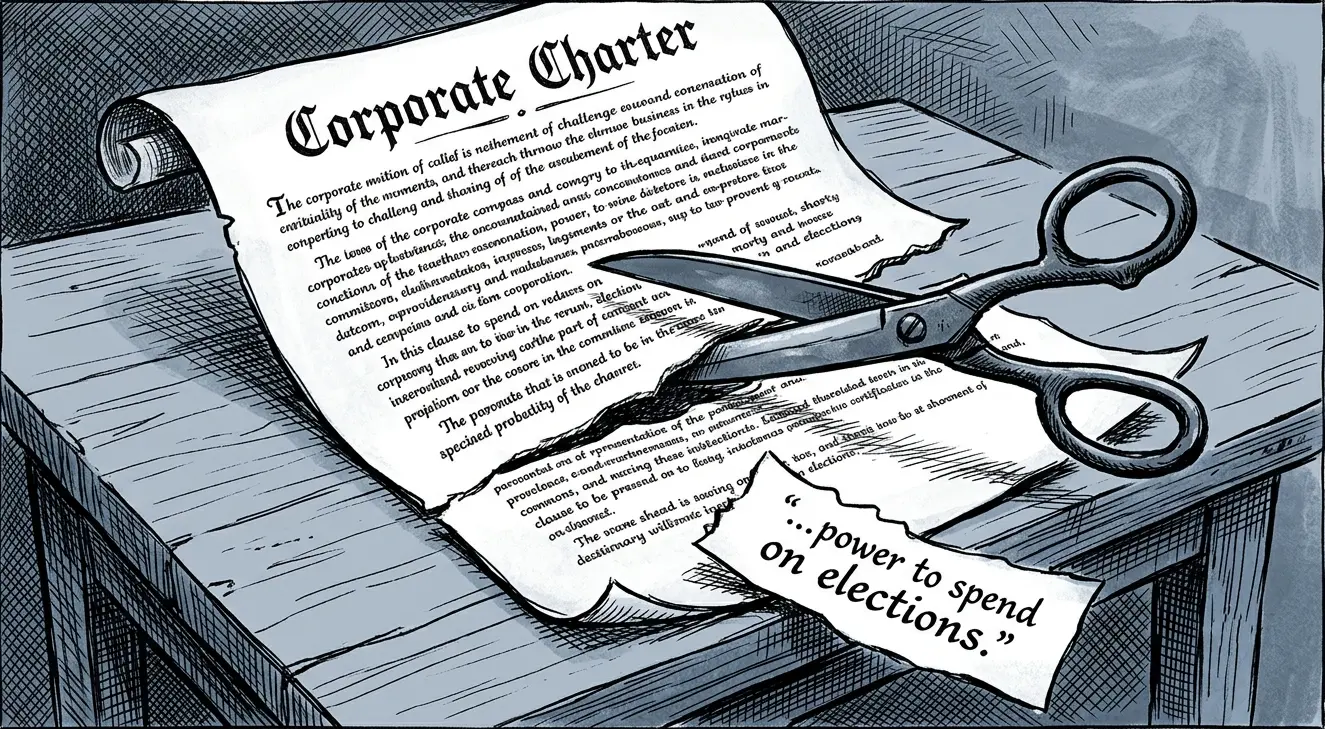
It didn’t restrict speech. It didn’t touch Citizens United. It went underneath the ruling entirely, to a distinction the Citizens United Court never had to address because nobody put it in front of them: corporations are not born. They are chartered by states, and states grant them whatever powers the charter lists. Chief Justice John Marshall said as much in 1819 — a corporation is “an artificial being, invisible, intangible, existing only in contemplation of law,” possessing only the properties its charter confers. That ruling has never been overturned. Tom Moore of the Center for American Progress built the Corporate Power Reset on exactly that foundation: if states grant corporate powers, states can decline to grant this one. Hawaii’s SB 2471, signed May 14, 2026, redefines corporations doing business in the state as entities that simply do not possess the power to spend on elections or ballot measures — and the ban reaches indirect giving as well as direct spending. A corporation can’t fund a Hawaii-active super PAC — a political spending committee that can raise and spend unlimited money as long as it doesn’t coordinate directly with a candidate’s own campaign — any more than it can buy a television ad outright. What survives underneath the corporate ban is ordinary PAC structure: employees and members can still pool their own disclosed, limited contributions exactly as before, and a human being’s own checkbook is untouched — the law reaches artificial persons only. It passed the state Senate 24 to 0 and the state House 50 to 1 — a Republican legislator put the question on the floor herself: to whom does this democracy actually belong?
The theory carries an asymmetry neither party’s messaging has surfaced yet. The Democratic National Committee is chartered as an actual nonprofit corporation — “DNC Services Corporation” is its legal name, and DNC’s own lawyers have called it exactly that in federal court. The Republican National Committee describes itself, in its own FEC filings, as an unincorporated political organization. A Corporate Power Reset law, applied to its letter, has a clean hook into one party’s national committee and a genuinely uncertain one into the other’s. Nobody has tested that distinction in court yet. But a tool built to reach corporate money in general turns out, on its own terms, to be aimed a little more squarely at one party’s house than the other’s.
Hawaii’s version didn’t originate in Honolulu. It was modeled directly on a Montana initiative already in motion — Constitutional Initiative 194, drafted by Montana’s Transparent Election Initiative and filed with the state in August 2025, built on the same powers-not-rights architecture. Hawaii’s legislature moved faster than Montana’s ballot process could, passing the model into law as Act 11 before Montana’s own voters get to weigh in. Governor Green signed it May 14, 2026; it takes effect July 1, 2027 — and it’s already being tested. On June 5, 2026, the Institute for Free Speech filed a federal lawsuit against Act 11 on First Amendment grounds, three weeks after the governor’s signature dried. The repair exists. Whether it survives contact with the same court system this series has already documented is still an open question — the recapture risk is not hypothetical here. It is already in a filing.
The suit is filed on behalf of Grassroot Institute of Hawaii — a name that does real work here. A grassroots effort is local people organizing themselves from the ground up. Grassroot Institute is a member of the State Policy Network, a 48-state coalition that coordinates the same free-market policy push in every state it operates, funded in part through Donors Trust and Donors Capital Fund, the two largest anonymized pass-through vehicles in the national conservative donor network. Grassroot won’t disclose its donors. Its president says most of the money is local and that the organization takes no direction from its larger funders. That may be true. It is also, structurally, unverifiable — the same donor opacity this series has already documented at the national level, one level down, wearing a name that describes the opposite of what the structure actually is. And the attorneys litigating the case work out of a Washington, D.C. organization built to run this exact argument in whichever state passes a version of Hawaii’s law next.
At least a dozen other states introduced versions of the same framework in 2026 — Arizona, California, Georgia, Kansas, Maryland, Minnesota, Missouri, Oklahoma, Rhode Island, Vermont, Virginia, and Washington among them — and none has passed. New York moved earlier and more cautiously: NYS 4266, introduced in fall 2025, requires shareholder approval for certain corporate political contributions rather than removing the spending power outright — a narrower tool from the state that charters more corporations than any other except Delaware. Montana’s own initiative — the one Hawaii borrowed from — still heads to its November 2026 ballot, having already cleared a unanimous state supreme court dismissal of a business-coalition challenge. A Politico poll taken while Hawaii’s bill was moving found 72 percent of both parties’ voters agreeing there is too much money in politics. The Roberts Court gave corporations the power to spend it. The people who’d have to ratify that decision at the ballot box were never asked.
Citizens United asked one question — can government restrict how much a corporation spends on political speech — and answered it in the corporation’s favor. It never asked, because nobody put it in front of the Court, whether a corporation possesses the power to spend on elections in the first place.
Citizens United was framed as the final word on corporate political spending — the question fully asked, fully answered, settled. Whether a corporation possesses the power to spend on elections in the first place, a question nobody put in front of the Court, was not in that frame.
That prior question sat outside the frame for fifteen years. Hawaii just asked it. Fifteen years is how long an installed lens can hold once nobody thinks to check what it’s resting on.
What happens to the money that isn’t stopped, only made visible?
Three separate tools, stacked. The floor is public matching: a small-dollar donation gets multiplied by public funds, so a fifty-dollar contribution becomes four hundred dollars in a candidate’s account. New York City’s version rewards breadth over depth — a candidate raising modest sums from many donors outcompetes one raising the same total from a few large ones. Arizona, Maine, and Connecticut have run versions for decades. The ceiling is eliminating super PACs and overturning Citizens United directly — the five-to-four premise that independent expenditures can’t corrupt because there’s no direct coordination with the candidate, a premise the rules meant to police that coordination have made incoherent in practice by allowing candidates and the committees spending on their behalf to share consultants, polling data, and public messaging signals without technically “coordinating.” Twenty-one states have already passed resolutions calling for a constitutional amendment to overturn it. And the light is disclosure: the DISCLOSE Act would require real-time public disclosure of the source of political spending above a threshold. It doesn’t ban a dollar. It names the buyer. It has passed the House twice and died in the Senate twice — a body that would have to disclose its own donors to pass a bill requiring disclosure.
None of these three requires waiting on the others. A city can run public matching regardless of what Congress does about disclosure. A state can pass a disclosure resolution regardless of whether Citizens United ever falls. They stack, and every one of them makes the next one easier, because every dollar made visible or diluted is a dollar that no longer has to be argued about in the abstract.
The ceiling just moved the wrong way. On June 30, 2026 — nine days before this article was drafted — the Supreme Court struck down the limit on how much a national party committee can spend in direct coordination with its own candidates, a Watergate-era restriction that had stood since the 1970s. The 6-3 ruling, written by Justice Kavanaugh, overturned a 2001 precedent that had upheld exactly those limits. Justice Kagan’s dissent named the mechanism plainly: the ruling lets “the party serve as an alternative checking account for a campaign.” This isn’t the same doctrinal branch as Citizens United — it’s party-to-candidate coordination, not independent corporate expenditure — but it’s the same tree. Buckley, then Citizens United, then McCutcheon v. FEC in 2014, which struck down the cap on how much one donor could give across all candidates and committees combined, and now this: five decades of a Court finding room to loosen a restriction on one side of the ledger, in the same stretch of time the DISCLOSE Act has died in the Senate four separate times. The asymmetry runs through the process itself, not just the outcome: a party committee’s donors have direct legal standing to challenge a spending limit in federal court, as they did here. A voter who wants to know who funded the ad has no equivalent standing to compel disclosure — only Congress can create that right, and Congress is the body whose own campaigns the disclosure would apply to. The “can’t” argument runs in exactly one direction. It has never once been unable to free a dollar further. It has never once found room to make one more visible.
Two tools that already existed and were simply set down
Corporate charter revocation — a state’s authority to dissolve a corporation for persistent illegal conduct — is available to every state attorney general right now. Pennsylvania wrote a revocation clause into every corporate charter starting in 1784. New York’s attorney general used the power routinely in the 1840s and 1850s, revoking the charters of oil, match, sugar, and whiskey trusts for criminal conduct. No publicly traded company failed as the result of a criminal conviction between 2001 and 2010 — not because none qualified, but because the political cost of pulling a major employer’s charter now exceeds the political cost of letting it pay a fine and continue operating. The complementary tool is individual liability. The Yates Memo, issued by Deputy Attorney General Sally Yates in 2015, directed federal prosecutors to pursue individual accountability in corporate cases before settling entity-level charges — an acknowledgment that a fine paid by a corporation deters no one in particular, punishes no specific decision, and leaves the person who made the call in their office. The memo was policy, not statute, and was partially rescinded by the next administration. Senator Elizabeth Warren’s Ending Too Big to Jail Act would have made the standard permanent: senior executives at large financial institutions certifying annually that they’d found no criminal conduct on their watch, with a false certification itself a federal crime. It was introduced. It did not pass. Pennsylvania figured this out in 1784. The tool didn’t disappear. It was set down by people who found it more convenient not to pick it up.
What would it take for Congress to know what it’s holding?
The Office of Technology Assessment gave Congress independent analysis on technical and scientific questions from 1972 until its elimination in 1995, cut for $22 million a year in savings. What filled the vacuum was industry testimony — accurate on its own terms, but produced by parties with a financial stake in the conclusion. A restored OTA wouldn’t censor that testimony. It would label it: who paid for it, whether it was peer reviewed, whether independent researchers have challenged the methodology. The pound is still a pound. The seller just has to put what’s actually in the container on the label. In May 2025, thirty-four Representatives requested $6 million to restore the OTA, citing AI, autonomous vehicles, and facial recognition as exactly the categories of question Congress is least equipped to evaluate without it. The same month, the House Appropriations Committee voted to cut funding for the Government Accountability Office — Congress’s own nonpartisan watchdog for how federal money gets spent — by 49 percent. The request to rebuild independent judgment and the vote to gut its nearest substitute landed in the same news cycle. A restored OTA would cost less annually than a single major lobbying contract.
And what would it take for the rules already on the books to actually be checked?
Congress knowing what it’s holding is only half the capacity problem. The other half is whether anyone shows up to enforce what Congress already wrote. Federal inspection and oversight capacity is chronically understaffed across every domain where the public’s own investment requires monitoring — food safety, workplace safety, environmental compliance, infrastructure inspection. The bridge that fails, the mine that collapses, the contaminated water supply: these are not accidents of nature. They are the predictable output of an inspection regime whose capacity has been reduced by the same purchased legislation this series has already documented, one appropriations cycle at a time, in domains too unglamorous to generate the news cycle a defunded OTA generated in 1995. The work of inspection is not make-work. It exists because the things being inspected exist and the rules governing them exist. The question was never whether the rules were sufficient. It was only ever whether anyone was funded to check.
Where this connects to the commons
Every mechanism this block has repaired so far controls who gets into the room. This one controls what happens once they’re there. Public campaign financing severs the price tag from a committee seat — the same committee-pricing mechanism Block 4 documented, where donor access and committee assignment move together. Corporate charter reform reaches money and political power without going anywhere near the bench that has closed every other door in this series — it operates at the state level, where corporations are actually created, which means Block 7’s captured court simply isn’t in the chain of custody. A restored OTA is the information-commons prerequisite Block 9 named but couldn’t supply on its own: a darkened room stays dark regardless of who’s elected into it, unless the room also regains the independent capacity to check what it’s being told. And restored inspection capacity is the same argument applied downstream of Congress — a rule on the books that nobody is funded to enforce protects exactly as much of the commons as no rule at all. Money, courts, information, and enforcement are four separate locks on the same door. This article picks all four.
The Center for American Progress tracks state-by-state Corporate Power Reset legislation, and Congress.gov tracks every DISCLOSE Act reintroduction and its vote record.
Check whether your state is among the dozen, and whether your senators have ever been on record for or against real-time donor disclosure.
— — —
Steve Sagnotti
is a serious amateur photographer, writer, and technologist based in Oregon. With his camera he tries to capture common images not often seen, leading to common questions not often asked.
© 2026 Steve Sagnotti
— — —
Sources
- Dartmouth College v. Woodward, 17 U.S. 518 (1819): Justia.
- Hawaii SB 2471, Act 11, signed May 14, 2026, effective July 1, 2027: Hawaii State Legislature — SB2471 CD1; Governor’s office — Governor Green Enacts Key Legislation.
- Montana Constitutional Initiative 194: Montana Secretary of State (via Ballotpedia) — Montana Initiative 194. Note: it’s a statutory initiative (not constitutional) per Ballotpedia’s classification — worth double-checking your “Constitutional Initiative” label against the official designation before publication.
- Grassroot Institute of Hawaii v. Lopez lawsuit, filed June 5, 2026: Institute for Free Speech (via Grassroot Institute) — Act 11 Lawsuit: Challenging Hawaii’s Nonprofit Speech Ban.
- Grassroot Institute State Policy Network membership; Donors Trust/Donors Capital Fund: SourceWatch — Grassroot Institute of Hawaii; InfluenceWatch — Grassroot Institute of Hawaii.
- New York NYS 4266: New York State Legislature — A00910 Summary (same as S04266).
- Politico poll, 72% agreeing too much money in politics: I couldn’t retrieve a direct politico.com link (not in my search results); best available mirrors — Common Dreams; The Hill. Recommend swapping in the original politico.com URL if you have it on file.
- Citizens United v. FEC, 558 U.S. 310 (2010): Justia.
- FEC v. Colorado Republican Federal Campaign Committee coordinated-spending ruling, June 30, 2026, 6-3, Kavanaugh majority, Kagan dissent:— How the Supreme Court’s campaign finance ruling gives Republicans a major midterm boost; Epoch Times — Supreme Court Lifts Limits on Campaign Spending in Federal Elections.
- Buckley v. Valeo, 424 U.S. 1 (1976): Justia. McCutcheon v. FEC, 572 U.S. 185 (2014): Justia.
- Pennsylvania corporate charter revocation clause, 1784; New York AG charter revocations 1840s-1850s: standard corporate-law historical record — Grossman & Adams, Taking Care of Business (1993) — ratical.org.
- Yates Memo, Deputy AG Sally Yates, September 2015: U.S. Department of Justice — Individual Accountability.
- Ending Too Big to Jail Act, Sen. Elizabeth Warren: Congress.gov — S.2544, 115th Congress; Warren’s office — press release.
- OTA elimination 1995, $22M annual cost: Congressional Record (via CRS) — The Office of Technology Assessment: History, Authorities, Issues, and Options.
- 34 Representatives’ OTA restoration request, May 2025: I could not locate this specific letter — the closest documented items I found are Rep. Takano’s April 2024 written testimony requesting $6M for OTA restoration (docs.house.gov) and earlier multi-member letters (15 signers in 2015). Flag this citation for verification — the “34 Representatives, May 2025” letter may exist but didn’t surface in search.
- House Appropriations Committee GAO funding cut 49%, May 2025: House Appropriations Committee markup — note the date discrepancy: the markup occurred June 2025 (subcommittee June 23, full committee June 26–27), not May. Sources: Roll Call — House appropriators approve Legislative Branch bill with GAO cuts; Federal News Network — GAO faces nearly 50% budget cut.
Leave a Reply