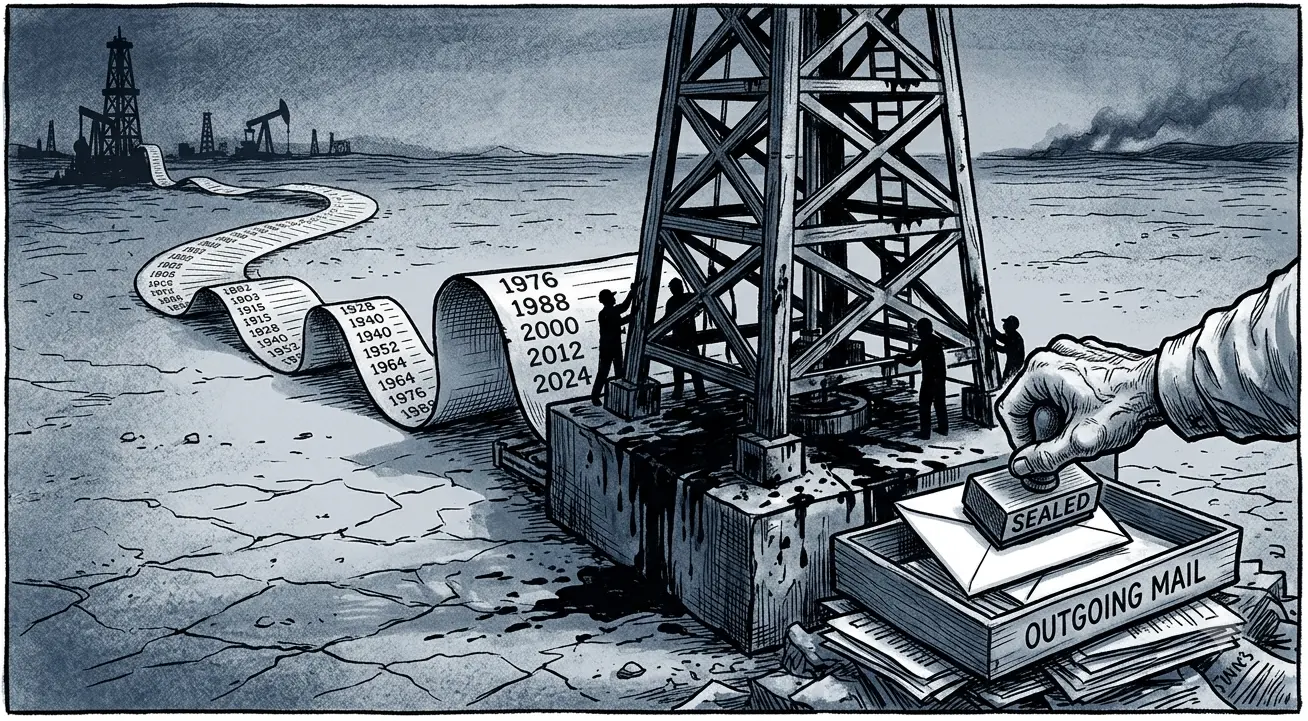
Block 12, Article 5 — What the Administration Is Already Doing, Pointed at the Public
The federal government now owns 10 percent of Intel, up to 15 percent of MP Materials, and 40 percent of the U.S. refining operation of Korea Zinc, plus a golden share in U.S. Steel — a single share carrying veto power over specific major decisions without the full ownership stake that would normally come with that kind of control — and stakes in Lithium Americas and Trilogy Metals — acquired since July 2025, without a financial emergency, without a congressional vote, by an administration that campaigns on getting government out of business. The Intel stake alone runs $8.9 billion, funded by converting unpaid CHIPS Act grants into equity instead of letting them go out the door as a subsidy. The MP Materials deal positions the Pentagon as the company’s single largest shareholder. These are not loans. They are ownership positions, taken unilaterally, in the name of national strategic interest.
They’re also passive. The Intel stake is non-voting, structured to follow the company’s board on nearly everything. The instrument exists. The architecture to make it serve a public return does not. That’s the entire distance between what the United States is doing right now and what Norway has been doing since 1990.
Norway’s Government Pension Fund Global was built on a simple premise: oil extracted from public land belongs to the public, so the revenue should compound for future generations instead of funding today’s budget. As of early 2026 the fund holds roughly $2.2 trillion — the largest sovereign wealth fund in the world, equivalent to about $390,000 for every Norwegian citizen. It returned $247 billion in 2025 alone and funds a quarter of the country’s annual government budget. Alaska runs the same logic at a smaller scale: severance taxes on extraction flow into the Permanent Fund, and every resident gets an annual dividend — $1,312 in 2023. Neither model is exotic. Both rest on one sentence: when private capital extracts value from a resource the public owns, a portion of that value belongs to the public. A unified American sovereign wealth fund — transparent governance, a public return mandate, built to hold stakes in industries extracting value from public resources — isn’t a departure from what the current administration is already doing. It’s what the administration is already doing, rationalized and extended to an actual purpose. The people who argue government should run like a business have just demonstrated that government can act like an investor. An investor expects a return. The public hasn’t been getting one.
Norway’s fund isn’t even the best evidence that governance, not scarcity, decides these outcomes. Their fisheries are. Norwegian herring stock collapsed catastrophically in the late 1960s — fourteen million tonnes down to a hundred thousand. The government imposed a total moratorium and held it against sustained industry pressure to reopen early. The herring recovered — proof that a room willing to hold a line can reverse a collapse that looks, on paper, as total as any other. Not every collapse reverses on command; Block 11 already documented the ones that don’t. But the difference between the fisheries that come back and the ones that don’t is not a reason to stop asking whether the room held the line. It’s a reason to ask it every time.
Holding a line is one test of whether a room actually governs a public asset or just administers its decline. Setting a price is another, quieter one — and this is where the same question shows up in a form nobody thinks to ask it in.
What would it take for a public asset to actually charge what it’s worth?
That question already concedes too much. It assumes the campground has to have a concessionaire in the chain at all — that the only choice left is what to charge them. A campground in a national forest, leased to a concessionaire at a below-market rate, generates revenue for the operator and a fraction of that for the public treasury, while the Forest Service still maintains the roads, the watershed, and the fire suppression that makes the campground usable in the first place. The public carries the overhead. The concessionaire keeps the margin. The fix that sounds like repair — charge market rate, route the difference to a commons fund — never asks who sets the rate in the first place. A price set by the only bidder in the room isn’t a market rate. It’s a monopoly rent with better optics, collected on the public’s behalf instead of against it, which is progress, but not the repair it looks like. New Zealand’s Department of Conservation runs its roughly three hundred public campsites directly — no concessionaire in the chain at all. A public agency sets and reviews the fee annually, benchmarked against comparable sites, and the revenue goes straight to conservation work without splitting first through a private margin. The difference isn’t the price. It’s who holds the authority to set it. Multiply either arrangement — priced-and-redistributed, or middleman-removed — across grazing leases, mining claims, timber sales, and spectrum licenses, and you get two different repairs wearing the same word. Only one of them relocates the authority. The other just redirects where the check clears.
The accounting behind all of this is not partisan arithmetic — it’s an identity. Norway collected $87.69 per barrel in oil revenue in 2013. Alaska collected $38.54. The federal government’s royalty rate, fixed in 1920 and locked back in place by the 2025 reconciliation bill, is 12.5 percent — half of what Texas charges on its own state lands, a fraction of Norway’s effective take. Broadcast spectrum went out free for sixty-five years before the FCC started auctioning it, an estimated $200 billion in value transferred with no bill ever sent. GPS infrastructure generated an estimated $1.4 trillion in downstream economic value with no licensing fee charged to the industries built on top of it. The pattern repeats in every category this series has documented, and the consequence is not abstract: when the commons stops funding the government, the government turns to taxing labor instead. The 16th Amendment passed in 1913, seven years before the frozen royalty rate, and the income tax became the substitute bill — sent to workers rather than extractors. The extractor pays the 1920 rate. The worker pays twice: once when the resource leaves the commons below market value, and again every April to cover what that undercharge left unfunded. That is the accounting identity the series has been building toward since Block 1: the profit was privatized, the loss was socialized, and the citizen got the bill on both ends.
March-in rights are the version of this argument that has already been legislated and simply never used. The Bayh-Dole Act of 1980 let universities and companies patent discoveries made with federal research money — the National Institutes of Health has invested more than $900 billion cumulatively since 1938, underlying virtually every major pharmaceutical compound on the market. Built into the same statute was the government’s explicit authority to license a federally funded patent to another manufacturer if the patent holder isn’t making the drug reasonably available. That authority has never been exercised. Not once, in forty-five years. Not for insulin, whose 1921 patent was sold to the University of Toronto for one dollar specifically to keep it universally available, and which Americans a century later were rationing at $300 to $400 a vial for a drug that costs $2 to $6 to manufacture. The Government Accountability Office has confirmed the legal authority stands. The political will has been purchased away in every session where using it was proposed, by an industry that spends more on lobbying than any other sector of the economy.
Every prior article in this block fixed who gets into the room and what happens to money once they’re there. This one closes the loop those repairs were building toward — what the room does with the asset itself, once the room can no longer be bought and the information it acts on can no longer be faked. A sovereign wealth fund and march-in rights actually exercised are not new ideas requiring new institutions. They are the existing machinery of ownership, already proven at scale by two American states and one European country, simply pointed at the public instead of away from it. A public return on public resources doesn’t just balance a ledger — it funds the next article’s argument directly. Idle land and idle labor are not separate problems from an empty treasury. They are what an empty treasury produces.
Norway’s sovereign wealth fund gets called socialism by people who have never called Alaska’s the same thing, and neither label survives contact with the fact that a Republican governor built the Alaska model in 1976 specifically to keep a public resource from disappearing into private hands without a trace. The label was never about the mechanism. It was about who the mechanism was pointed at — the installed lens working exactly as installed, presenting a public return as radical while the private extraction it replaces goes unremarked as simply how things are.
The word gets deployed against a sovereign wealth fund, and never once against the fire department. Every fire department in the country is publicly funded, publicly operated, and dispatched to a burning building regardless of the owner’s ability to pay — the textbook definition of the thing “socialism” is supposed to mean when it’s used as an insult. So is the police department. So, at a scale that dwarfs both combined, is the United States military — over $850 billion a year, entirely taxpayer-funded, entirely state-owned, the largest planned economic enterprise in the country by a wide margin. Nobody calls the Pentagon a socialist institution. The word isn’t being used to describe an economic structure. It’s being used to describe which structures get protected and which get blocked — and a fund that returns extraction revenue to the public who owns the resource is structurally closer to the fire department than critics arguing against it would find comfortable to admit.
The accusation carries particular weight when it comes from people invoking Christian authority against it, because the text doesn’t cooperate. The Epistle of James doesn’t ask the wealthy to be generous. It accuses them, directly, of a specific crime: “you have kept back by fraud the wages of the labourers who mowed your fields… the cries of the harvesters have reached the ears of the Lord.” Not a parable requiring interpretation. A charge, addressed by name to people who withhold what workers are owed. The royalty rate frozen since 1920, the committee seat priced by donor dues, the wage suppressed by an algorithm optimizing for a number that never appears on any invoice — these are the mechanisms the text is describing, twenty centuries early. The accusation that public return on public resources is un-Christian is not being made by people who’ve never read the source material. It’s being made by people counting on the people they’re saying it to not having read it either.
Norway’s Government Pension Fund Global publishes its full holdings, returns, and ethical guidelines at nbim.no.
Alaska’s Permanent Fund Corporation publishes its dividend history and fund balance at apfc.org. The question worth putting to your own representative: why does the federal government not run one?
— — —
Steve Sagnotti
is a serious amateur photographer, writer, and technologist based in Oregon. With his camera he tries to capture common images not often seen, leading to common questions not often asked.
© 2026 Steve Sagnotti
— — —
Sources
- Federal equity stakes — Intel (~10%), MP Materials (~15%), Korea Zinc U.S. refining (~40%), U.S. Steel golden share, Lithium Americas, Trilogy Metals: Treasury and Commerce Department announcements — CNBC — The Trump administration equity portfolio is growing; Korea Zinc — CNBC — Pentagon takes big stake in new Korea Zinc smelter.
- Intel $8.9B stake, CHIPS Act grant conversion: U.S. Department of Commerce (via CNBC) — same CNBC article above (confirms $5.7B CHIPS Act conversion + $3.2B secure-chips program funding for the 10% stake at $20.47/share).
- Norway Government Pension Fund Global, ~$2.2 trillion, $247B 2025 return: nbim.no — confirmed: 15.1% return, 2,362 billion kroner ($246.9B), fund value 21,268 billion kroner (~$2.2T).
- Alaska Permanent Fund dividend $1,312 (2023): apfc.org/about/history; Alaska Department of Revenue — DOR Announces 2023 PFD Amount.
- Norwegian herring stock collapse and recovery, 1960s moratorium: Norwegian Institute of Marine Research — hi.no: Norwegian spring-spawning herring.
- New Zealand Department of Conservation, ~300 public campsites, direct operation: doc.govt.nz: Stay at a campsite.
- Norway $87.69/barrel (2013), Alaska $38.54/barrel oil revenue comparison: comparative energy-policy literature — original figures from Mitchell Anderson (The Tyee), cited in Canadian Centre for Policy Alternatives — Norway and Canada: Economic and fiscal management of petroleum wealth; The Narwhal — Norway’s Oil Savings Just Hit $1 Trillion.
- 12.5% federal royalty rate, 2025 reconciliation bill: already established in Block 8 and Block 10 sourcing — no new link needed.
- Broadcast spectrum $200B value transfer; GPS $1.4T downstream value: already established in Block 10 sourcing — no new link needed.
- 16th Amendment, ratified 1913: National Archives — Milestone Documents: 16th Amendment.
- Bayh-Dole Act, Pub.L. 96-517 (1980): GAO-09-742 — gao.gov/products/gao-09-742; CRS IF12582 — congress.gov/crs-product/IF12582.
- Insulin $300-400/vial vs. $2-6 manufacturing cost; University of Toronto 1921 patent sale: KFF Health News — Why Does Insulin Cost So Much?; Yale School of Medicine — The Price of Insulin: A Q&A with Kasia Lipska; patent sale history — Snopes — Scientist Sold Insulin Patent for $1 (note: Snopes confirms the $1 sale but flags the famous “belongs to the world” quote as unverified — worth adjusting your draft if you’re using that quote as a direct attribution).
- U.S. military budget ~$850B/year: Department of Defense annual budget requests — CBO — Long-Term Implications of the 2025 Future Years Defense Program; CRS — FY2025 Budget Request: Department of Defense-Military.
- James 5:1-6, KJV: Bible Study Tools / King James Bible Online.
Leave a Reply