Block 10, Article 7 — The Commons Was Not Depleted. It Was Detonated.
Block 1 established what was here. This article closes the ledger on what cannot be restored.
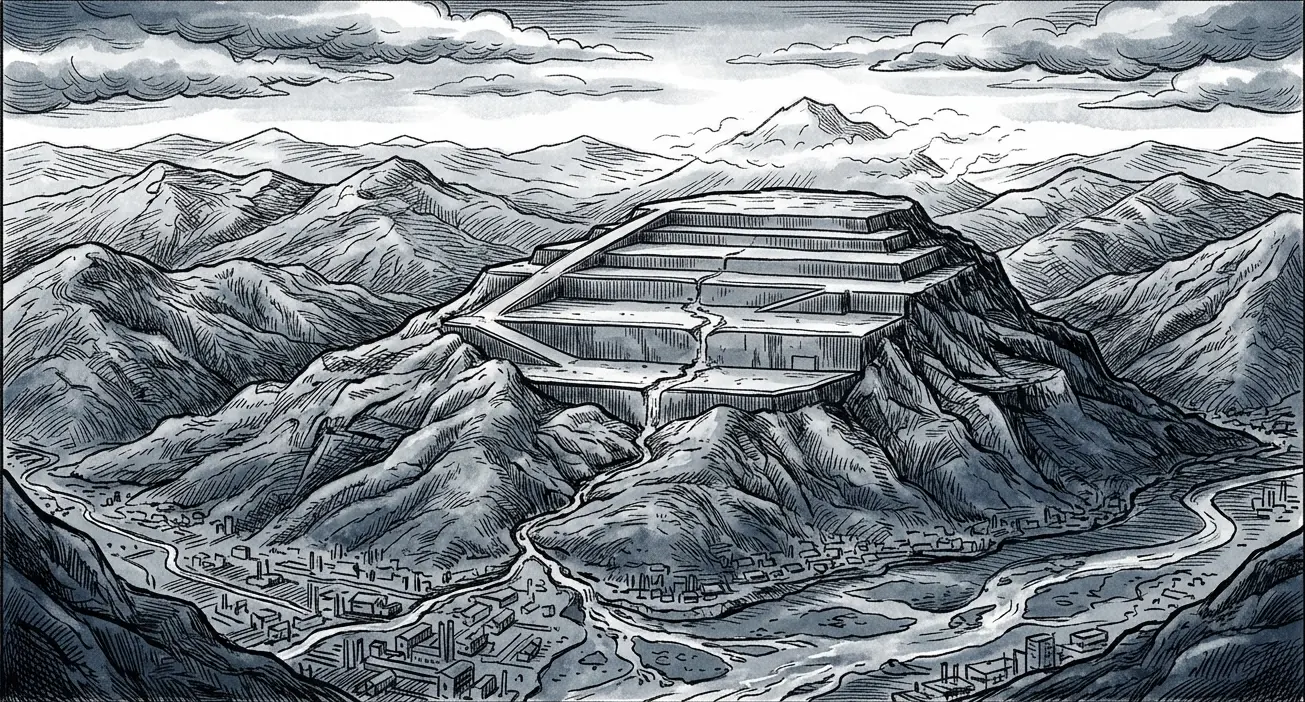
Mountaintop removal is not metaphor.
In 2024, Tennessee’s Division of Water Resources completed an audit of active surface mining permits in the state. Of 79 permits reviewed, 53 were in bond forfeiture — meaning the companies responsible for restoring the land had defaulted on their reclamation obligations. The bonds they had posted to guarantee cleanup were underfunded by $34.4 million. The mines are not being restored. The companies are gone or insolvent. The land sits compacted, drained, and producing runoff at rates the original watershed never did. Tennessee calls these zombie mines. The audit found them on 53 of 79 permits. That is not an edge case. That is the operating condition of the industry in one state, documented in public records, in 2024.
This is what the system looks like right now, before the historical accounting begins.
The word that changed
For most of the 20th century, the Clean Water Act prohibited the dumping of “fill material” into navigable waters and their tributaries. Mountaintop removal produces enormous quantities of blasted rock and earth — the overburden removed to reach the coal seam — that has to go somewhere. The practice since the 1970s was to dump it into adjacent valleys, burying the headwater streams at the base of those valleys under what the industry called valley fills.
Environmentalists argued this was illegal under the Clean Water Act. The courts agreed. In 2001, a federal district court ruled that valley fills violated the law because overburden was not “fill material” — it was waste, and dumping waste into streams was prohibited.
In 2002, the Bush administration changed the definition. By regulatory action alone — no legislation, no amendment, no vote — the Army Corps of Engineers and the EPA redefined “fill material” in the Clean Water Act to include any material placed in water, regardless of its purpose or composition. Toxic mining overburden became fill material by definition. The valley fills became legal overnight.
The redefinition was framed as a technical clarification of existing Clean Water Act authority. What the clarification authorized — the burial of thousands of miles of headwater streams under blasted rock and toxic mining waste — was not in the description of what was being decided.
A federal court’s reasoning was direct: valley fills that bury a stream’s normal flow and gradient under millions of cubic yards of waste destroy that stream segment outright — not degrade it, destroy it. Where there is no flow, there is nothing left to measure water quality against.
What the definition produced
This is what the 2002 definition of “fill material” produced. No legislation passed. A word was changed. The streams are still buried.
More than 500 mountains in central Appalachia have been leveled or permanently altered by mountaintop removal mining. More than a million acres of forest have been cleared. The EPA estimates that valley fills have buried more than 2,000 miles of Appalachian headwater streams. Every buried stream is a stream that no longer exists. The fish are gone. The riparian ecosystem is gone. The EPA’s own assessment is that forest recovery on reclaimed MTR sites takes hundreds of years. No restoration effort has ever recreated a functioning headwater stream on a mined or filled area.
The law requires that mined land be restored to its “approximate original contour.” Mountaintop removal is explicitly exempted from that standard. The reclamation that does occur consists largely of compacted, graded plateaus seeded with exotic grasses. Less than 3 percent of reclaimed MTR sites have been put to productive economic use. The communities that were promised economic development in exchange for the landscape got the compacted plateau and the grass seed.
The coal extracted by mountaintop removal supplies roughly 3 percent of national electricity generation. The jobs went to machines decades ago. The communities stayed in poverty. The streams stayed buried.
The water underground
Appalachian headwater streams are not snowmelt. The mountains don’t hold a winter snowpack the way the Rockies do. What surfaces in those valleys as streams is groundwater — the local aquifer emerging where the terrain drops below the water table. The stream and the aquifer are the same water moving through different media. A spring feeding a headwater creek in eastern Kentucky is the same water a family two miles downstream draws from a residential well.
Burying the stream with valley fill doesn’t stop the water. It stops the surface expression of the water. The groundwater continues moving — but now it percolates through thousands of tons of blasted overburden and coal processing residue before it emerges. The fill material leaches arsenic, lead, manganese, selenium, sodium, and sulfate into the water moving through it. That contaminated water recharges the regional aquifer. The regional aquifer supplies the residential wells. The EPA’s own assessment found that even after reclamation, groundwater sampled from wells near MTR sites has higher concentrations of mine-related chemicals than well water from areas without mining. The 2002 redefinition didn’t just bury the streams. It converted the regional water supply into a leachate delivery system.
The coal slurry adds a second pathway. The residue from cleaning coal — a liquid waste containing arsenic, lead, mercury, and other toxics — is impounded in surface ponds or injected directly into abandoned underground mine shafts. From there it moves where water moves: into the fractures and formations that connect to the aquifer. At least two West Virginia communities had their drinking water contaminated by injected coal slurry. The injection was legal. The contamination was documented. The remedy was bottled water.
The accounting
West Virginia and Kentucky lead the nation in cancer mortality rates. The correlation between mountaintop removal mining activity and adverse health outcomes in surrounding communities has been documented in peer-reviewed research since the mid-2000s. Researchers at West Virginia University estimated 60,000 additional cancer cases in Appalachian communities with significant MTR activity. A 2011 study by researchers at Washington State University and West Virginia University found birth defect rates in MTR counties running at 235 per 10,000 live births, against 144 per 10,000 in non-MTR Appalachian counties. Mortality researchers have estimated 1,200 excess deaths per year attributable to MTR-related pollution in affected communities.
The contamination pathway is not a hypothesis. It is the documented consequence of the 2002 redefinition: blasted overburden leaching toxic compounds into a groundwater system that feeds residential wells, across communities that had no municipal water supply and no alternative. The operator captured the coal revenue. The community absorbed the contaminated aquifer. The costs and the profits never appeared on the same balance sheet.
The communities bearing these costs did not receive the mineral royalty. The AML Fund — the Abandoned Mine Land reclamation program — collects a fee on coal production to remediate mine damage. It has collected $14.2 billion since its establishment. It has distributed $6.5 billion. It has $2.9 billion unappropriated. It is not enough to undo what the first century of coal extraction produced, and it does not touch the ongoing damage from operations still active or recently abandoned.
The flood
In July 2022, it rained in eastern Kentucky. It had rained before. The North Fork of the Kentucky River had flooded before. The previous record crest at the gauge near Whitesburg was under 15 feet. In July 2022, the river reached 22 feet. The Kentucky Geological Survey estimated it was a 600-year flood event.
Thirty-nine people died. More than 40 percent of the fatalities occurred within half a mile of Troublesome Creek or adjacent to active or reclaimed mountaintop removal mine sites. The connection is hydrological, not incidental. The 2002 redefinition buried the headwater streams that had provided both natural flood detention and the primary recharge pathway for the regional aquifer — the same water system that now surfaced in residential wells downstream, carrying whatever the valley fill had leached into it on the way through. Compacted reclaimed mine sites generate runoff at urban rates — water moves off them fast, the way it moves off parking lots and rooftops, not the way it moves through forested mountain slopes. What remained was a landscape engineered, by the accumulated decisions of a century of extraction, to move water as fast as possible toward the valley floor.
The mayor of Jenkins, a small city in Letcher County, said after the flood that he had expected recovery to take four or five years. He said in subsequent interviews that he now hoped for five. The Kentucky Lantern covered the flood and its aftermath. There is no local newspaper in Letcher County.
What remains
The streams buried under valley fills cannot be unburied. The mountains cannot be rebuilt. The forest that would have absorbed the rainfall will not return on any timeline relevant to anyone alive today. The carbon sink those forests represented is projected to become a carbon source — the best current estimates put that transition somewhere between 2025 and 2033, meaning it may already have occurred.
Block 11 names these losses alongside the Ogallala and the Atlantic cod fishery as the accounting that does not have a repair column. Two of Block 11’s three convergence pillars are recoverable, given time and a functioning room. This one is not. The mountain is not there anymore. The stream is not there anymore. The aquifer that fed the stream carries what the valley fill put into it. The flood moved through a landscape the extraction industry built, and 39 people died in it.
The commons was not depleted. It was detonated.
What the blocks that follow document is what happens when the bill from that detonation arrives simultaneously with every other deferred bill — in a room that was specifically designed not to pay any of them.
Check this yourself
| Active and former surface mines near your community | osmre.gov |
| State bond forfeiture records and reclamation status | Your state’s mining regulatory agency; Tennessee’s 2024 audit is public record https://wpln.org/post/two-thirds-of-tennessee-coal-mine-permits-are-in-bond-forfeiture |
Is there an active or former mountaintop removal mine in your watershed? OSMRE maintains a public Surface Mining database at osmre.gov. Your state’s mining agency has bond forfeiture records. If a mine permitted upstream from your community is in zombie status with an underfunded bond, that is public record and it is answerable now.
— — —
Steve Sagnotti
is a serious amateur photographer, writer, and technologist based in Oregon. With his camera he tries to capture common images not often seen, leading to common questions not often asked.
© 2026 Steve Sagnotti
— — —
Sources
Tennessee zombie mine crisis, Appalachian Voices coverage of the 2024 TDEC Primacy Report.
https://appvoices.org/2024/12/06/tennessees-zombie-mines/
2002 “fill material” redefinition, Army Corps of Engineers/EPA joint rule, 67 Fed. Reg. 31129.
https://www.federalregister.gov/documents/2002/05/09/02-11547/final-revisions-to-the-clean-water-act-regulatory-definitions-of-fill-material-and-discharge-of-fill
Bragg v. Robertson, 54 F. Supp. 2d 653 (S.D. W. Va. 1999).
https://law.justia.com/cases/federal/district-courts/FSupp2/54/653/2520193/
Bragg v. Robertson, 72 F. Supp. 2d 642 (S.D. W. Va. 1999).
https://law.justia.com/cases/federal/district-courts/FSupp2/72/642/2336213/
Scale of MTR, 2,000 miles streams buried, EPA estimate via Appalachian Voices.
https://appvoices.org/end-mountaintop-removal/mtr101/ecology/
Groundwater/well contamination after reclamation, Columbia Climate School/Earth Institute, “Mountaintop Removal: Laying Waste to Streams and Forests,” August 2011.
https://news.climate.columbia.edu/2011/08/11/mountaintop-removal-laying-waste-to-streams-and-forests/
Valley fill leachate and coal slurry injection, NIH/PMC, “Mountaintop Removal Mining: Digging Into Community Health Concerns,” PMC3226519.
https://www.ncbi.nlm.nih.gov/pmc/articles/PMC3226519/
3% of national electricity, U.S. Energy Information Administration (general coal statistics).
https://www.eia.gov/coal/annual/
Cancer cases (60,000-equivalent finding), Hendryx et al., “Self-Reported Cancer Rates in Two Rural Areas of West Virginia,” Journal of Community Health, 2011.
https://link.springer.com/article/10.1007/s10900-011-9448-5
Birth defect rates (235 vs. 144 per 10,000), Ahern et al., Environmental Research, 2011.
https://www.sciencedaily.com/releases/2011/06/110623090001.htm
1,200 excess deaths, Hendryx & Holland (2016), Environmental Science & Policy 63:1-6.
https://www.sciencedirect.com/science/article/abs/pii/S1462901116301137
AML Fund ($14.2B collected, $6.5B distributed), Office of Surface Mining Reclamation and Enforcement.
https://www.osmre.gov/programs/reclaiming-abandoned-mine-lands
July 2022 Kentucky flood (39 deaths, 22-foot crest at Whitesburg, 600-year estimate), Kentucky Lantern coverage of Kentucky Geological Survey findings.
https://kentuckylantern.com/2024/07/22/surface-coal-mining-worsened-deadly-eastern-kentucky-floods-in-july-2022-study-shows/
Peer-reviewed flood fatality/MTR study confirming 39 deaths and 22-foot Whitesburg crest.
https://www.tandfonline.com/doi/full/10.1080/17445647.2023.2214159
Mayor of Jenkins, KY, Todd DePriest, documented across Kentucky Lantern-affiliated coverage.
https://nkytribune.com/2024/08/some-kentuckians-like-many-rural-americans-are-too-poor-to-qualify-for-federal-flood-protections/
Mayor of Jenkins, KY, Todd DePriest, ReImagine Appalachia coverage.
https://reimagineappalachia.org/appalachian-flood-mitigation-roundup/
Leave a Reply