Block 9, Article 4 — The Destruction Was Complete Before Most Newsrooms Understood It
Local newspapers did not die because people stopped wanting local news. They died because the business model that paid for it was destroyed by companies that had no interest in news at all — and the destruction was complete before most newsrooms understood what had happened to them.
The first wave
For most of the twentieth century, classified advertising — jobs, cars, real estate, personal notices — was the financial backbone of the American daily newspaper. FTC testimony puts classifieds at 40 to 60 percent of total newspaper ad revenue, the single most profitable line on the page. In 2000 classifieds still accounted for roughly 40 percent of industry ad revenue. Craigslist had launched five years earlier and was already expanding city by city, offering the same listings for free.
By 2007, according to a Management Science study of the collapse, Craigslist had cost American newspapers $5 billion in classified revenue and shrunk classified ad rates by nearly 21 percent. By 2012 classifieds had fallen to roughly 18 percent of ad revenue — inside an industry that had already shrunk to half its former size. Craigslist did not set out to destroy local journalism. It set out to offer free classifieds. Nobody planned the destruction and nobody compensated the institutions that absorbed it.
The second wave
What classified revenue had been to print, digital display advertising was supposed to become online — the bridge that would carry local journalism’s business model into the internet era. It did not hold. Google and Facebook built targeting infrastructure no newspaper could match, and by the middle of the last decade were capturing the overwhelming majority of every new digital advertising dollar. The newsroom that survived the classified collapse by moving online arrived in a market two companies already owned, neither of which employed a single journalist or had any reason to fund one.
The platform era was framed as journalism’s second chance — the internet as the thing that would finally let local news reach a bigger audience for less cost. What the same platforms were simultaneously doing to the advertising revenue that audience had always paid for was not in the frame.
What came to collect the remainder
The consolidation that followed was not the cause of local journalism’s collapse. It was extraction running on an already-weakened target. Private equity firms bought distressed newspaper chains at depressed valuations, cut costs to the bone — reporters first, then editors, then photographers, then the physical building — and pulled out whatever cash flow was left before folding the paper or selling it again. What survived was not local journalism. It was the minimum product an already-gutted institution could still produce. The public interest reporting that covered the school board, the water contract, the zoning variance, the hospital closing — the reporting that would have made every mechanism this block documents visible at the local level — was gone before most readers noticed it was missing. The capture apparatus this series documents noticed immediately. It did not need a plan to benefit from an information vacuum it hadn’t caused. It only needed the vacuum to exist.
More than 3,500 local newspapers have closed since 2005. More than 213 U.S. counties now have no local news outlet at all — no reporter, no paper, no coverage of a single public meeting. Another 1,524 counties have only one remaining source. Together, roughly 50 million Americans now live with limited or no access to local news.
What runs in the gap, in real time
Here is what the gap actually looks like where it’s happening right now, not as history but as an ongoing case.
American fracking hit a production record in 2025 for the fourth consecutive year — 13.6 million barrels of crude oil per day, a record 39 trillion cubic feet of natural gas, and 107 quadrillion Btu of total energy production, according to the EIA. In Dimock, Pennsylvania, water contamination first documented in 2009 is still not fully resolved seventeen years later — a permanent pipeline is now under construction after a 2022 no-contest plea and $16.3 million settlement, but as of this writing residents still rely on bottled water while they wait. A 2025 study in Scientific Reports found 62 percent of sampled wells near New Freeport, Pennsylvania showed contamination consistent with nearby fracking operations. In Reeves County, Texas, wastewater injection volume increased sharply over the past decade; the county has spent millions repairing sinkholes and rerouting highways linked to the injection, and induced seismicity has produced a magnitude 5.0 earthquake and at least three pipeline ruptures since 2024.
National climate coverage fell 14 percent in 2025 alone, and is down 38 percent from its 2021 peak. As of this writing, only two national outlets — E&E News and the Texas Tribune — are covering the Reeves County situation at all. Neither is a local paper. Reeves County, like the more than 213 counties with no coverage at all, has no reporter positioned to cover it as a local story, because there is no local paper left to employ one.
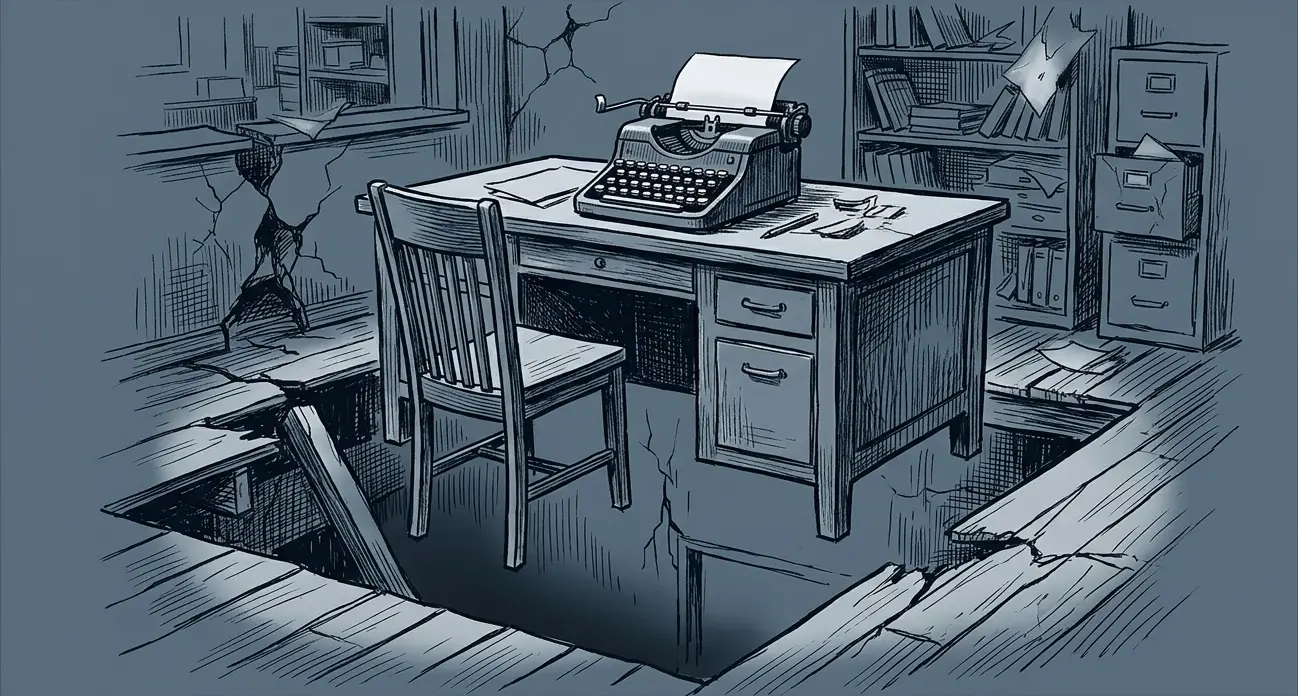
This is not a hypothetical extension of the argument. It is the argument, running today, in a county where the floor already fell out.
The counties with no coverage are not randomly distributed. Block 3 has already shown that the same map — drawn once for the census undercount, once for the gerrymandered district, once for the extraction zone — is a single map wearing three names. The news desert map belongs on top of it as a fourth layer, not a separate problem.
The founders named the precondition. The Fairness Doctrine’s elimination and the Telecom Act’s consolidation removed the broadcast half of it. Craigslist, two advertising platforms, and a wave of private equity extraction removed the print half without anyone in either boardroom intending to. Either way the effect is the same: the room where a reporter would have asked what was happening to the aquifer, the fault line, or the injection well is empty, and the extraction runs on schedule regardless.
Look up whether your own county has a functioning local news outlet at the Local News Initiative’s map (localnewsinitiative.northwestern.edu). If it doesn’t, look up what industrial activity — drilling, mining, a permitted discharge — is active in your county through your state’s environmental permitting database. Nobody is required to have connected those two searches for you.
— — —
Steve Sagnotti
is a serious amateur photographer, writer, and technologist based in Oregon. With his camera he tries to capture common images not often seen, leading to common questions not often asked.
© 2026 Steve Sagnotti
— — —
Sources
Classified ad revenue 40-60% of total, FTC testimony (E.W. Scripps).
https://www.ftc.gov/sites/default/files/documents/public_events/how-will-journalism-survive-internet-age/contreras.pdf
Classified share of ad revenue, 2000 (~40%) vs. 2012 (~18%), MinnPost, 2014.
https://www.minnpost.com/business/2014/02/how-craigslist-killed-newspapers-golden-goose/
Craigslist $5B revenue destruction, 2000-2007, 20.7% rate decline, Management Science journal study.
https://www.hbs.edu/faculty/Pages/item.aspx?num=45143
Google/Facebook digital ad capture, 73% of new/incremental digital ad dollars in 2016, eMarketer.
https://www.emarketer.com/content/google-and-facebook-s-digital-dominance-fading-as-rivals-share-grows
Google/Facebook new-dollar share fell to 48% by 2018; total digital ad spend share held around 57-60%, eMarketer via AdExchanger.
https://www.adexchanger.com/platforms/emarketer-duopoly-slips-as-amazon-and-snap-gain-ground/
Private equity newspaper acquisitions, Penny Abernathy/UNC Hussman School, “News Deserts and Ghost Newspapers,” 2020.
https://hussman.unc.edu/news/2020-report-from-unc-hussman-knight-chair-on-the-state-of-local-journalism
3,500+ closures, 213 counties with no coverage, 1,524 counties with one remaining source, 50 million Americans affected, Medill’s 2025 State of Local News Report, Oct. 2025.
https://localnewsinitiative.northwestern.edu/research/state-of-local-news/2025/
2025 fracking production record, EIA.
https://www.eia.gov/todayinenergy/detail.php?id=67684
Dimock, PA ongoing contamination, Coterra no-contest plea Nov. 29, 2022, $16.3M settlement.
https://paenvironmentdaily.blogspot.com/2022/11/ag-shapiro-coterra-energy-formerly.html
Dimock pipeline construction began March 2025, expected completion by end of 2026.
https://www.witf.org/2025/03/18/pennsylvania-american-water-company-dimock-twp-residents-will-have-drinkable-water-by-2026/
New Freeport, PA well contamination (62% of sampled wells), Stolz et al., Scientific Reports 15, Sept. 17, 2025.
https://www.nature.com/articles/s41598-025-16976-5
Reeves County, TX M5.0 earthquake near Toyah, Feb. 15, 2025, pipeline rupture, Texas Tribune.
https://www.texastribune.org/2025/02/15/texas-west-earthquake-magnitude/
Texas Railroad Commission wastewater-injection suspension, Culberson/Reeves counties, Dec. 2023.
https://www.texastribune.org/2022/11/18/texas-earthquake-fracking-railroad-commission/
Climate coverage decline 14% (2025), 38% (since 2021 peak), University of Colorado Boulder’s Media and Climate Change Observatory (MeCCO).
https://www.colorado.edu/today/2026/02/16/climate-change-media-coverage-fell-14-2025
Leave a Reply