Block 9, Article 3 — Not Prevented From Knowing. Kept Comfortable Enough Not to Need To.
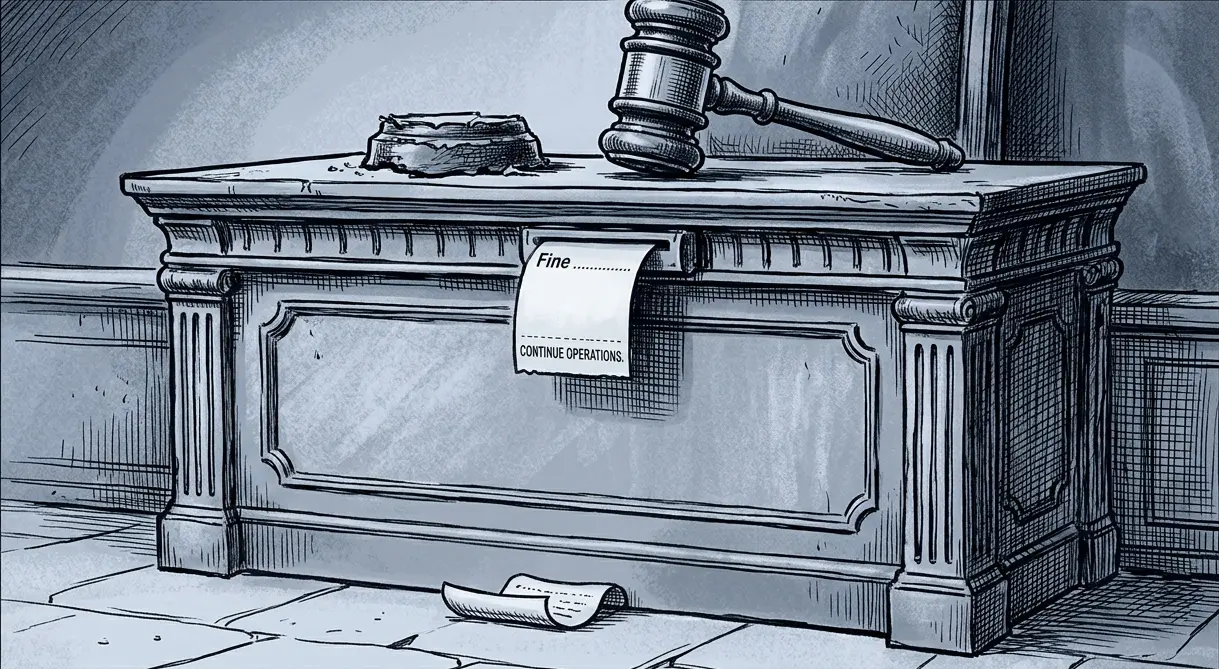
In 2019 the Federal Trade Commission fined Facebook $5 billion for privacy violations. It was the largest fine in FTC history. It was also, by any reasonable measure, a successful business transaction for Facebook.
The company had been expecting a penalty in the range of $3 to $5 billion and had already set aside a reserve. When the settlement was announced, Facebook’s stock rose. The fine required no structural changes to the company’s data practices. It extinguished the liability and ended the investigation. The $5 billion was the price of continuing to operate as before. The market understood this immediately. The regulators understood it too. The fine is the product — the mechanism by which the violation is laundered into a cost of doing business, the regulator becomes the licensing authority, and the practice continues.
The FTC settlement was framed as historic accountability — the largest privacy fine in the agency’s history. That the company had priced and budgeted for it in advance, and that its stock rose on the news, was not in the frame the word “historic” was built to convey.
This model does not run only through social media. It runs through pharmaceutical pricing enforcement, environmental penalties, financial fraud settlements, and antitrust actions across the American economy. The corporation that violates the law calculates the expected penalty as a probability-weighted cost — enforcement likelihood multiplied by expected fine, netted against the profit from the violation. When the math favors the violation, the violation is rational. When the math favors the violation every time, the regulation is not regulation. It is a fee schedule.
The warning used to run the other way. Never argue with someone who buys ink by the barrel — meaning the press held a structural advantage over the powerful because the press could outlast any single target’s patience. The observation assumed a tension between the institution and the people it covered. That tension was the point. An adversarial press worked precisely because its interests diverged from the interests of the people it scrutinized.
The Bezos acquisition of the Washington Post in 2013 did not end that tradition loudly. It ended it quietly, by eliminating the structural tension. Amazon held billions in CIA and Defense Department cloud contracts when Bezos bought the paper. The publisher who killed the Post’s approved presidential endorsement in October 2024 did not require an explicit instruction. The incentive structure issued it. More than 200,000 subscribers cancelled. The editorial board’s reasoning was never published.
The structural problem is not intent. It is architecture. The publication that covers federal contracting is owned by the federal government’s largest cloud contractor. The conflict operates through reasonable anticipation — the self-censorship that precedes any explicit instruction. Larry Ellison’s acquisition of media properties alongside Oracle’s federal data contracts follows the same logic. The people who once needed to argue with someone who bought ink by the barrel now buy the barrel. The adversarial institution became the asset.
What replaced the adversarial press is more consequential than what bought it. The Fairness Doctrine’s elimination did not suppress voices — it created an entertainment infrastructure that replaced political consciousness with political identity. The local news collapse did not silence communities — it left them with national feeds curated by platforms optimizing for engagement over accountability. The CIA Factbook’s termination did not destroy public knowledge — it moved it to subscription services accessible to those who can pay.
Each step produced not ignorance but a specific kind of knowing: loud, stimulating, identity-reinforcing, and systematically inattentive to the mechanisms running in the background. The population is not prevented from knowing. It is kept comfortable enough not to need to. Juvenal identified the mechanism two thousand years ago — bread and circuses — as the method for converting political agency into passive consumption. The delivery system is more precise now. The mechanism is the same.
The New York Times opinion podcast that covered John Cornyn’s primary defeat in Texas spent twenty minutes analyzing Cornyn’s record, his constituent service, his relationships in Washington. His fundraising — $32 million raised in a cycle, largely from the industries whose regulatory interests he served on the committees that governed them — was treated as a credential. The mechanism behind the credential was invisible. Block 8 documents where the money came from, who gave it, and what the implicit agreements were. The sophisticated analysis performing close readings of the output never looked at the input.
The YOLO caucus supplied the verification. In the spring of 2026, senators freed from electoral accountability by defeat or retirement began saying publicly what they had believed privately. The Big Beautiful Bill was described by members of the majority party as fiscal recklessness, political malpractice, and a betrayal of the constituents it claimed to serve. These observations were not new. They had been held privately for years. The silence that preceded the YOLO moment was not coercion. It was the operating condition of survival inside a system where the money that funded campaigns, staffed committees, and determined primary challengers came from the same sources the senator was supposed to oversee.
The YOLO caucus is the exception that names the rule. The rule is silence. The exception requires losing the job first.
There is a pattern that runs through this block. When the Fairness Doctrine fell, the broadcasters who benefited said nothing about what the public was losing. When the ownership caps came off, the consolidating companies said nothing about the stations that would go dark. When the local paper closed, the national press ran a brief item and moved on. When the public data disappeared, the researchers who used it filed a complaint and were ignored. Each step was met with the same calculation: this one isn’t mine. Each step made the next one easier.
By the time it was yours, the room where you would have said so was already dark.
The room built to receive the warnings was purchased, consolidated, automated, captured, and finally anesthetized.
Block 10 opens the ledger. The spectrum was public. The airwaves were public. The broadcast license carried a public interest obligation. The county reporter covered the water board meeting. The aquifer data was collected by the extension agent and filed with the state. All of it is gone — not by market forces, but by the sequence this block documents. What the public owns now is the bill for the extraction that ran while the room was dark.
Did you know your broadcast spectrum is a public resource — and that the license to use it once required the licensee to cover your community’s public business?
Look up your local radio and television stations at https://www.fcc.gov/media/radio/broadcast-radio-links. Find the ownership. Trace it back two steps.
Find your county on the news desert map at localnewsinitiative.northwestern.edu. If your county has no local coverage, find the last story filed about your county water authority, your school board, or your local zoning board. Note the date.
Then ask: if the extraction Block 10 documents was running in your county, who would have reported it?
— — —
Steve Sagnotti
is a serious amateur photographer, writer, and technologist based in Oregon. With his camera he tries to capture common images not often seen, leading to common questions not often asked.
© 2026 Steve Sagnotti
— — —
Sources
FTC v. Facebook: In the Matter of Facebook, Inc., FTC File No. 1823109 (2019)
$5B settlement. Facebook stock reaction: contemporaneous financial reporting, July 2019. The $5B fine equaled roughly 16% of Facebook’s 2018 operating expenses (Wall Street Journal).
“Ink by the barrel” idiom used without attribution to a specific speaker, consistent with its apocryphal status.
Bezos WaPo acquisition: $250M, 2013.
https://www.washingtonpost.com/business/economy/amazon-founder-jeff-bezos-will-purchase-the-washington-post-for-250-million/2013/08/06/1cc215c8-fea1-11e2-9711-3708310f6f4d_story.html
Endorsement killing, October 2024, Washington Post staff account.
https://www.washingtonpost.com/style/media/2024/10/28/post-editorial-board-resignations/
Endorsement killing, October 2024, Atlantic writers’ departure account.
https://www.cnn.com/2024/11/01/media/washington-post-writers-endorsement-atlantic/index.html
Amazon CIA/DoD contract values: $600M (2013 CIA C2S, AWS sole-source) / “tens of billions” (2020 CIA C2E, multi-vendor) / up to $10B (2022 NSA WildandStormy, AWS sole-source).
https://www.nextgov.com/modernization/2021/08/nsa-awards-secret-10-billion-contract-amazon/184390/
Bezos subscriber loss, 200,000+, NPR, Oct. 28, 2024.
https://www.npr.org/2024/10/28/nx-s1-5168416/washington-post-bezos-endorsement-president-cancellations-resignations
Bezos subscriber loss, 250,000 total, Post’s own later reporting.
https://www.washingtonpost.com/style/media/2024/10/29/washington-post-cancellations-number/
Ellison media acquisitions: Skydance–Paramount merger closed Aug. 7, 2025.
https://www.hollywoodreporter.com/business/business-news/skydance-paramount-global-merger-close-david-ellison-1236174784/
Ellison media acquisitions: Free Press/Bari Weiss acquisition.
https://www.nbcnews.com/business/business-news/paramount-cbs-news-acquires-free-press-bari-weiss-rcna220672?rand=26684
Ellison media acquisitions: Warner Bros. Discovery bid, DOJ approval June 12, 2026.
https://www.npr.org/2026/06/13/nx-s1-5856558/doj-approves-paramount-skydances-111-billion-acquisition-of-warner-bros-discovery
Juvenal, Satire X, c. 100 AD — panem et circenses. Exact Latin phrase from Satire 10.77–81.
Cornyn fundraising $32M: quarterly FEC filings for the 2025–2026 cycle show a full-cycle cumulative total in the right range to plausibly reach $32M.
YOLO caucus: Robert Siegel, E.J. Dionne Jr., and Mona Charen, “The YOLO Republicans,” The Opinions podcast, The New York Times, May 30, 2026. nytimes.com
Leave a Reply