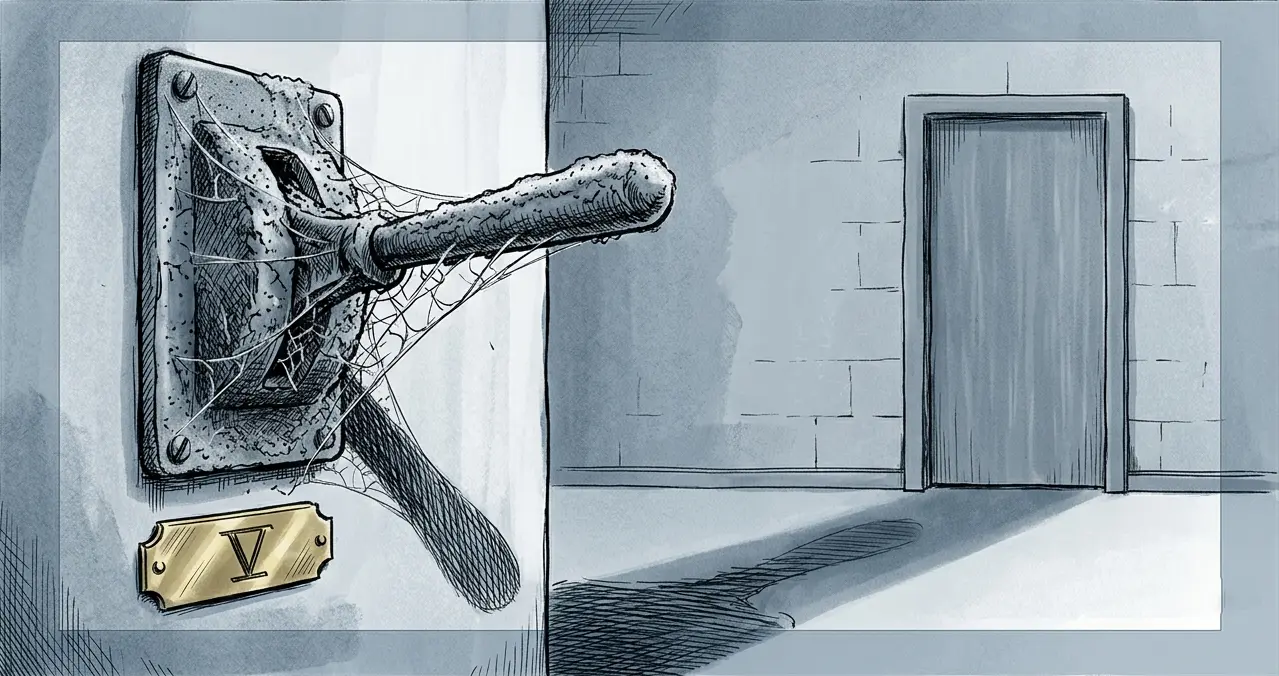
Block 12, Article 7 — The Authority Doesn’t Need to Be Exercised to Work. It Needs to Be Believed.
Every repair this block has documented so far works inside rooms that already exist — a Congress that could pass a bill, a state legislature that could charter a corporation differently, an agency that could set a different price. This article is about the rooms nobody has had to build yet, because the authority to build them has been sitting in the Constitution, unused, the entire time.
Article V of the Constitution gives the states a power Congress has never had to grant them: if two-thirds of state legislatures apply, Congress must call a convention to propose amendments. Not may. Must. The founders wrote a corrective into the document itself, for exactly the situation this series has spent eleven blocks documenting — a federal government captured by interests unwilling to reform the mechanisms that captured it.
It has never been used. Not once, in 237 years.
The nearest approach came in the early 1980s, when the balanced-budget-amendment movement reached 32 state applications, two short of the 34 required. As of early 2026, a renewed version of the same push sits somewhere between 27 and 33 states, depending on which disputed rescissions and decades-old applications get counted — a counting fight Congress has never resolved, because no one has ever forced it to. Ronald Reagan backed the strategy for a specific reason: the credible threat of a convention, not a convention itself, is what pressured Congress to propose the Seventeenth Amendment in 1912 rather than let the states convene and write it themselves. The authority does not need to be exercised to work. It needs to be believed. The installed lens here isn’t a claim that Article V doesn’t exist — nobody disputes the text. It’s the quieter assumption that it has never worked because it can’t, when the truer account is that it has never been tried by anyone organized enough to make the threat real.
This is the same shape as march-in rights, sitting unused in the Bayh-Dole Act for forty-five years, and the filibuster this series has already shown is a Senate custom, not a constitutional requirement. Each is a lever the room has never had to pull, because no one has yet organized the force to make Congress believe it would be pulled.
Naming the authority is not the same as recommending the convention. A convention run through the same state legislatures Block 4 already documented — filtered for party loyalty by a county-to-state-to-federal donor pipeline before any candidate rises far enough to matter — is not automatically a repair. It is a new room, and the apparatus that captured the bench, the map, and the money has had 237 years of practice capturing new rooms. An Article V convention could propose an amendment that expands the House, restores campaign finance limits, or ends gerrymandering by federal mandate. It could also be the vehicle for the opposite of every one of those things, if the delegates sent to it are the same delegates the pipeline already selects. The authority is real. What it produces depends entirely on who shows up holding it.
That dependency isn’t hypothetical. It has a precedent, and the precedent is American, not foreign, and not even especially old.
The Populist Party’s 1892 Omaha Platform demanded a graduated income tax, direct election of senators, and public ownership of the railroads — all three treated as fringe positions by both major parties at the time. Within roughly twenty years, two of the three had become the law of the land: the Sixteenth Amendment in 1913 gave Congress the income tax; the Seventeenth, the same year, gave voters the direct election of their senators. Neither major party ever had to formally credit the Populists. Both simply absorbed the demands, piecemeal, once holding out cost more than conceding did — while the third plank, public ownership of transportation infrastructure, never crossed the same threshold and simply died with the party that proposed it. The lesson runs in both directions: the room can absorb what threatens it and neutralize the threat that carried the idea, taking the demand while discarding the messenger. A third-party threat doesn’t need to win an election to work. It needs to make the cost of ignoring it higher than the cost of conceding to it — and even then, what gets absorbed and what gets left to die is the room’s choice, not the movement’s.
The absorption doesn’t require a national party at all, and it doesn’t require central coordination to spread. The 2018 teacher strikes are the modern instance. West Virginia’s teachers walked out February 22, 2018, over pay that ranked 48th nationally and a health insurance program raising premiums without raising wages to match — a nine-day strike, at points running past what union leadership itself had endorsed, settled with a 5 percent raise. Six weeks later, Oklahoma’s teachers walked out. Six weeks after that, Arizona’s and Colorado’s, nearly simultaneously. No single national organization planned the sequence. The NEA and AFT provided logistical and financial support once each strike began, but the state-to-state spread happened because teachers in one state watched teachers in another organize themselves — on Facebook, through livestreamed rallies — and did the same thing, faster each time, without waiting for permission from an institution built to ask for it. Four states, four different legislatures, four different governors, the same specific grievance and the same specific tactic, propagating in under three months with no central command.
Both instances point at the same fact from different directions. The Populist Party shows that an idea can win completely while the movement that carried it loses entirely — the room absorbs the demand and lets the messenger die. The teacher strikes show that a tactic can spread state to state with no institution directing it at all — the room doesn’t get to choose whether to absorb something it can’t even locate a leader to negotiate with. Article V sits between those two precedents. A convention triggered by coordinated state pressure could be absorbed the way the Populist platform was — the demand granted, the coalition that forced it dissolved and forgotten. Or it could spread the way the strikes did, faster than any single captured institution could get ahead of it. Which one happens is not a property of the mechanism. It was never a property of the mechanism. It’s a property of whether the pressure organizing it is coordinated enough to survive being offered a smaller concession than the one it asked for.
None of this matters on any timeline if the room that adopts it can’t actually build anything fast enough to matter. Block 11 named the window: 2031, on a documented schedule. A full Environmental Impact Statement currently takes three to five years and tens of millions of dollars to produce for a large project — and most of that time isn’t spent on judgment, it’s spent on document production: baseline surveys, impact modeling, cross-referencing species and water and soil data across databases that don’t talk to each other. That part is an engineering problem, solvable with tools that already exist, without touching the human review and public comment that should stay slow and deliberate. The harder problem is the complexity that isn’t bureaucratic accumulation but captured obstruction — an incumbent utility filing an objection under the National Environmental Policy Act (NEPA), the law requiring federal projects to study their environmental impact before proceeding, against a competing transmission line, indistinguishable on paper from a genuine environmental concern, because nothing in the review process is built to tell the two apart. A restored Office of Technology Assessment supplies exactly that judgment. A functioning local press reports that the utility objecting to the new line runs the extraction operation producing the damage it claims to be worried about. Germany passed infrastructure-acceleration legislation in 2023 that set hard permitting timelines without eliminating environmental review. Denmark builds offshore wind at two to three times the pace the American process allows. Neither country decided the review didn’t matter. Both decided a four-year timeline for routine infrastructure was a policy choice, not a law of nature — and that the choice has a cost, currently paid by the public rather than by whoever benefits from the delay. The window is 2031. Permitting reform isn’t a precondition for starting the repair. It’s what finishing it on time requires.
And the clock is not waiting for any of this to get sorted out. The next commons is already being taken, before the last one gets repaired.
Twenty-one billion dry tons of cobalt- and manganese-bearing nodules sit on the floor of the Pacific between Hawaii and Mexico, accreting at a rate of millimeters per million years. The UN Convention on the Law of the Sea declared the deep seabed the “common heritage of mankind” and created the International Seabed Authority to regulate its extraction on behalf of every nation. Thirty-one exploration contracts have been issued. No commercial mining has been authorized — the ISA has spent over a decade failing to finalize a mining code, partly funded by the same contractors it’s supposed to regulate. One company decided not to wait. In April 2025, the current administration invoked a 1980 law written explicitly as a placeholder before international law existed, and began licensing American companies to mine the international seabed without ISA approval at all. By May 2026, NOAA had certified an application covering 65,000 square kilometers — roughly the size of Ireland. The ISA’s own Secretary-General called the move a violation of international law. China and the EU filed formal objections. Nobody has stopped it.
The standard answer to exactly this situation is that the market will self-correct — that a resource pushed toward overexploitation generates its own price signal in time to prevent collapse, so regulation is a cost with no offsetting benefit. The claim has a specific, checkable track record, and the record runs the other way. Atlantic cod off Newfoundland collapsed in 1992 after decades of warnings the market never priced in; three decades and a total moratorium later, the stock still hasn’t recovered. The market didn’t self-correct. It extracted until there was nothing left to extract, then stopped, because stopping was no longer a choice. A regulatory body racing to keep pace with extraction it can’t yet price is not a bureaucratic inconvenience. It’s the only mechanism with any track record of preventing the cod outcome before it happens instead of just documenting it afterward.
The same sequence is running in orbit. The Outer Space Treaty of 1967 declared celestial bodies the province of all mankind — no nation could claim sovereignty over them. The 2015 Commercial Space Launch Competitiveness Act found the gap the treaty left open: the government can’t own the moon, but an American company can own whatever it extracts from it. Luxembourg passed the equivalent law in 2017, the UAE in 2019. The mining law of 1872 charged five dollars an acre and imposed no cleanup bonding requirement, leaving the liability to the Superfund — the federal program that spends taxpayer money cleaning up contaminated sites when no responsible party pays for it — a century later. The space-mining framework being written right now contains the identical omission — no bonding, no assigned cleanup cost — at a scale where, if remediation ever becomes necessary, there is no precedent for what it would even cost. The nation that never finished repairing the terrestrial commons is already writing the same undercharge into the next one, in real time, while this article is being drafted.
Every repair this article has named — the convention authority, the absorption precedent, the strike precedent, the permitting fix — exists to answer one question: can a captured room repair itself before it finishes extending the same uncorrected pattern to two new commons at once. The seabed and the sky are not future problems. They are the present tense of every mechanism this series has already documented, running exactly on schedule, while the correction is still being argued over.
The International Seabed Authority publishes every exploration contract it has issued, and every failed attempt to finalize a mining code, at isa.org.jm.
NOAA’s application record for seabed mining permits under the 1980 law is public. Ask an AI: “What is the current status of the balanced-budget-amendment Article V convention count, and which states’ applications are currently disputed?”
— — —
Steve Sagnotti
is a serious amateur photographer, writer, and technologist based in Oregon. With his camera he tries to capture common images not often seen, leading to common questions not often asked.
© 2026 Steve Sagnotti
— — —
Sources
- Article V, U.S. Constitution. Balanced-budget-amendment application count, early 1980s and current disputed count: standard constitutional-law record — Constitution Center — Report: Article V Constitutional Conventions; Congress.gov/CRS — A Balanced Budget Constitutional Amendment; Common Cause — U.S. Constitution Threatened as Article V Convention Movement Nears Success (peaked at 32 of 34 needed in late 1980s; the “current disputed count” genuinely varies by source — NTU cites 27+, others suggest the aggregate could be higher depending on how differently-worded applications are counted).
- Seventeenth Amendment, ratified 1913; Article V convention-threat pressure: National Archives — Milestone Documents: 17th Amendment; Constitution Center — Interpretation: The Seventeenth Amendment (31 of 32 needed states had petitioned by 1911-12, directly pressuring Congress to act).
- Populist Party 1892 Omaha Platform: full text — Bill of Rights Institute — Excerpts from the Populist Party Omaha Platform 1892; American Yawp Reader — The “Omaha Platform” of the People’s Party (1892).
- West Virginia, Oklahoma, Arizona, Colorado 2018 teacher strikes: contemporaneous reporting — Wikipedia (well-sourced) — 2018–2019 education workers’ strikes in the United States; New Labor Forum — The Red for Ed Movement, Two Years In.
- National Environmental Policy Act (NEPA), Pub.L. 91-190 (1970): govinfo.gov: Public Law 91-190. EIS timeline (3-5 years): CEQ — historically averaged 4.5 years (2018 CEQ data) per Trump White House Archives NEPA Modernization page and ELI: Dispelling the Myths of Permitting Reform (median 3.5 years, mean 4.5). Flag: the most recent CEQ data (2021–2024) shows a much faster median of 2.4 years — CEQ EIS Timelines Report, Jan 2025 — worth checking whether your “3-5 years” framing should be updated or explicitly framed as the historical average.
- Germany infrastructure-acceleration legislation, 2023; Denmark offshore wind permitting pace: comparative energy-policy literature — Germany’s EEG 2023 amendment — Norton Rose Fulbright: Global offshore wind: Germany; Denmark — Accelerating Offshore Wind in the Nordics.
- International Seabed Authority, UNCLOS; 31 exploration contracts: isa.org.jm/exploration-contracts (official page currently lists 22 contractors holding contracts; the “31 exploration contracts” figure — counting multiple contracts per some contractors — is confirmed via CRS: Congress.gov: Seabed Mining in Areas Beyond National Jurisdiction).
- 1980 Deep Seabed Hard Mineral Resources Act; April 2025 licensing action; NOAA 65,000 sq. km application, May 2026: NOAA — Deep Seabed Hard Minerals Mining; Federal Register — Deep Seabed Mining: Revisions to Regulations; contemporaneous reporting — TMC/GlobeNewswire: NOAA Determines TMC USA’s Consolidated Application is in Full Compliance.
- Atlantic cod collapse, 1992, non-recovery: Canadian Department of Fisheries and Oceans stock assessments (via secondary sources) — Britannica — Cod fishery collapse of 1992; Oceana Canada — The story of cod and a case for rebuilding.
- Outer Space Treaty, 1967. Commercial Space Launch Competitiveness Act, 2015. Luxembourg space-resources law, 2017; UAE, 2019: ScienceDirect — Space resource activities and the evolution of international space law; Space Generation Advisory Council — Space Resource Regulation (full citations for all four instruments).
- General Mining Law of 1872, 30 U.S.C. § 21 et seq.: epa.gov: Abandoned Mine Land and Federal Facilities. Superfund program: epa.gov/superfund.
Leave a Reply