Block 12, Article 6 — Self-Evidencing Repairs
Idle land and idle labor are not separate problems from an empty treasury. They are what an empty treasury produces.
The Works Progress Administration put roughly eight and a half million unemployed Americans to work between 1935 and 1943, building the roads, bridges, schools, and post offices that a Depression-idled workforce could construct and a Depression-starved government needed. The Civilian Conservation Corps ran alongside it, planting three billion trees and building the trail and park infrastructure still in use today. Neither program required a new theory of government. Both required a room willing to connect an idle workforce to undone work, at a scale matching the problem.
The same logic sits unused right now, in a workforce the country has been paying to warehouse rather than employ. The construction trades — HVAC, plumbing, electrical, carpentry — are short an estimated 500,000 workers, and the median tradesperson is 44 years old and aging out faster than apprenticeships replace him. It would be easy to point the prison population at that shortage and call it repair: vocational training keyed to the trades gap, RAND’s finding that completion drops reoffending 43 percent, fewer than a third of state prisons currently offering any program at all. All of that is true, and none of it answers the question the rest of this block has been asking of every other repair — who holds the authority to define what the labor is for? A program built around the trades shortage still sizes a person’s work to fill whatever gap the economy currently has. That’s the same valuation move this series has already documented in convict leasing, just with a friendlier name and a lower reoffense rate attached. The installed lens here isn’t hostile — it’s the trades-shortage framing itself, offered in good faith, that presents “what the economy needs filled” as the natural measure of a person’s labor rather than one choice among several about who gets to decide. Norway’s model is different in kind, not just in generosity: prisoners choose their own job or training track — trades, culinary work, computer repair, whatever it is — and are paid near-competitive outside wages for it, with no external shortage steering the choice. Recidivism there dropped from roughly 70 percent to roughly 20 percent within two years. The lower number isn’t produced by the training. It’s produced by who gets to decide what the training is for. Fewer than a third of American state prisons currently offer any vocational program, and where programs exist, waitlists run long and funding runs short — partly because the private prison industry’s per-diem model has a direct financial interest in rehabilitation not scaling. Every successful reentry is a lost billing day. There isn’t yet a published standard for what an American program would have to do to count as working on Norway’s terms rather than the market’s. That absence is its own kind of protection for the per-diem incentive: without a test to fail, nothing currently on offer can be shown to have failed it. A repaired room funds the scaling anyway — around what the person is choosing to become, not around what the trades shortage needs filled.
The undone work isn’t limited to the trades, and it isn’t limited to infrastructure. The Forest Service carries a documented, multi-billion-dollar backlog of fire mitigation and trail maintenance work across the national forest system — the same system this block has already shown collects below-market fees for campground concessions while carrying the maintenance cost itself. The American Society of Civil Engineers has graded the country’s infrastructure at or near failing for two decades running. And the World Economic Forum projects one of the fastest-growing labor categories through 2030 to be care work — elder care, disability support, early childhood — driven by a population that is aging faster than the workforce paid to tend it is growing. Care work is chronically underpaid for a specific, structural reason, not an accident of the market: the people who perform it have historically had the least bargaining power, and the people who need it have historically had the least political power to demand it be valued differently. A public employment option with a wage floor in care work does what the WPA and CCC did for infrastructure — absorbs a workforce the market has spent decades demonstrating it will not employ at a living wage, and delivers something the country demonstrably needs regardless of whether the market ever prices it correctly.
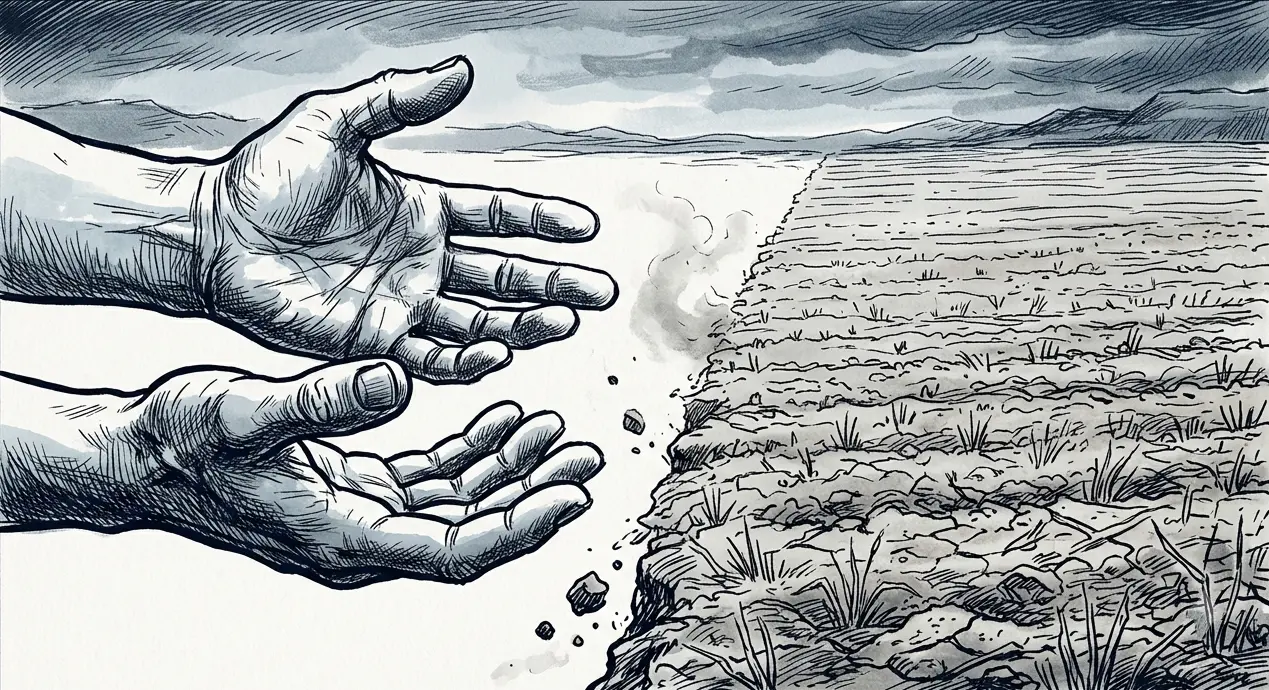
Labor is one half of what sits idle. Land is the other, and the same authority question runs underneath it.
Universal basic income has run real pilots, not just theory: Finland’s national trial in 2017–2018, Stockton’s SEED program from 2019 to 2021, both showing improved employment and health outcomes rather than the withdrawal from work critics predicted — and Alaska’s dividend has quietly been running an unconditional cash program since 1982 without anyone calling it one. The prediction that a guaranteed income makes people stop working has a specific, checkable track record, and the record doesn’t support it. It’s the same prediction that was made about the minimum wage, about unemployment insurance, and about Social Security when each was proposed — a claim about human behavior stated with total confidence and never once confirmed by the country that tried it. Land value taxation — taxing the unimproved value of land rather than the buildings on it — has its own American test case: Harrisburg, Pennsylvania adopted a split-rate version in 1975 and used it to help fund a documented turnaround from near-insolvency. Pittsburgh ran a similar system for decades before abandoning it in 2001, which is itself the data point worth having: the tool worked while it was in use and was reversed by a political decision — a reassessment-driven tax-burden shift that hit at the same moment as a rate increase, not a proven failure of the underlying tax.
None of these five repairs — the WPA/CCC model, prison labor reform, care work, UBI, land value tax — needs anyone to notice it working in order to work. That is worth stating plainly, because it’s the article’s actual argument, not a footnote to it. Block 9 documented what happens when the connection between a representative’s votes and a constituent’s conditions depends on a functioning local press to make it visible: in a news desert, the connection simply isn’t made, and the vote and the condition drift apart with nobody positioned to notice. A direct payment doesn’t have that problem. A dividend, a rebate, a paycheck for work actually done — these are self-evidencing. Nobody needs an investigative reporter to notice money arriving or not arriving in an account. Alaska’s dividend recipients don’t need a newspaper to tell them whether the check came. A land value tax rebate check either shows up or it doesn’t. The information gap Article 4 already closed on Congress’s own capacity to check power gets closed a second way here, at the individual level: the extraction-to-benefit chain becomes something a recipient can see directly, without a newspaper standing between them and the fact.
None of the five is exotic. Two are running in American states right now. One ran in Pennsylvania for over a century before a political decision, not an economic failure, ended it. One is a program cut for accounting reasons in 1995 that this block has already shown the government has the infrastructure to restore. What idle hands and idle land could build was never a question of invention. It was always a question of whether the room funding the answer was the room that benefits from the question staying open.
Deepens Article 4’s Block 9 close — a resource dividend, land value tax, or care-work wage floor doesn’t require a functioning local press to be visible; each answers the information gap at the individual level, the way Article 4’s restored oversight capacity answers it at the institutional level.
The Lincoln Institute of Land Policy’s Significant Features of the Property Tax tracker documents every U.S. jurisdiction currently running a split-rate or land value tax system, and every one that adopted and later repealed it.
datatoolkits.lincolninst.edu/subcenters/significant-features-property-tax. Ask an AI: “What does Norway’s correctional service publish about recidivism rates under its prisoner-chosen vocational training model, and how does it compare to U.S. state-by-state data?”
— — —
Steve Sagnotti
is a serious amateur photographer, writer, and technologist based in Oregon. With his camera he tries to capture common images not often seen, leading to common questions not often asked.
© 2026 Steve Sagnotti
— — —
Sources
- Works Progress Administration, 1935-1943, ~8.5 million workers: standard New Deal historical record — HISTORY.com — Works Progress Administration: WPA & New Deal.
- Civilian Conservation Corps, ~3 billion trees planted: CCC Legacy — History of the CCC (1933–1942); National Park Service — The Civilian Conservation Corps; National Parks Conservation Association — How the CCC’s Work Lives On in National Parks; HISTORY.com — Civilian Conservation Corps.
- Construction trades shortage ~500,000 workers, median tradesperson age 44: Associated Builders and Contractors workforce data — ABC: Construction industry must attract 349,000 workers in 2026. Flag: ABC’s most recent published data (early 2026) puts the median construction worker age around 42 and falling — worth checking whether “44” traces to an older ABC dataset or a different source, since current ABC reporting doesn’t match that figure.
- RAND vocational training/reoffending reduction 43%: RAND Corporation correctional education studies — Education and Vocational Training in Prisons Reduces Recidivism, Improves Job Outlook; How Effective is Correctional Education?.
- Norway prisoner-chosen training, near-competitive wages, recidivism ~70% to ~20%: Norwegian Correctional Service (via secondary sources) — Rehabilitation Lessons from Norway’s Prison System; Perspective Chapter: The Norwegian Model of Correctional Rehabilitation.
- Forest Service fire mitigation/trail maintenance backlog: USFS budget justification documents — FY2026 Congressional Budget Justification; GAO reports — GAO-13-618: Forest Service Trails; GAO-24-106495: Deferred Maintenance.
- ASCE infrastructure grade: infrastructurereportcard.org — 2025 report gave a “C” grade, up from “C-” in 2021.
- WEF care-work labor growth projections: World Economic Forum Future of Jobs Report — The Future of Jobs Report 2025.
- Finland UBI trial 2017-2018: Finland Kela — Results of the basic income experiment. Stockton SEED program 2019-2021: official site — stocktondemonstration.org. Flag: the research team was based at the University of Pennsylvania (Dr. Amy Castro) and University of Tennessee (Dr. Stacia West), not Stanford — worth correcting “Stanford SEED research team” in your draft.
- Alaska Permanent Fund dividend, running since 1982: apfc.org/about/history.
- Harrisburg, PA split-rate land value tax, adopted 1975: Lincoln Institute of Land Policy — Why So Little Georgism in America?; Significant Features of the Property Tax: Pennsylvania.
- Pittsburgh land value tax, abandoned 2001: Lincoln Institute of Land Policy — Land Value Taxation: Theory, Evidence, and Practice.
Leave a Reply