Notes from the Field — July 10, 2026
For fifty years, if a company destroyed the place where an endangered species lived, that counted as harming the species — even if not one animal was directly touched. The Supreme Court upheld that reading in 1995, in Babbitt v. Sweet Home, over the objections of timber companies who argued habitat destruction was too indirect to count.
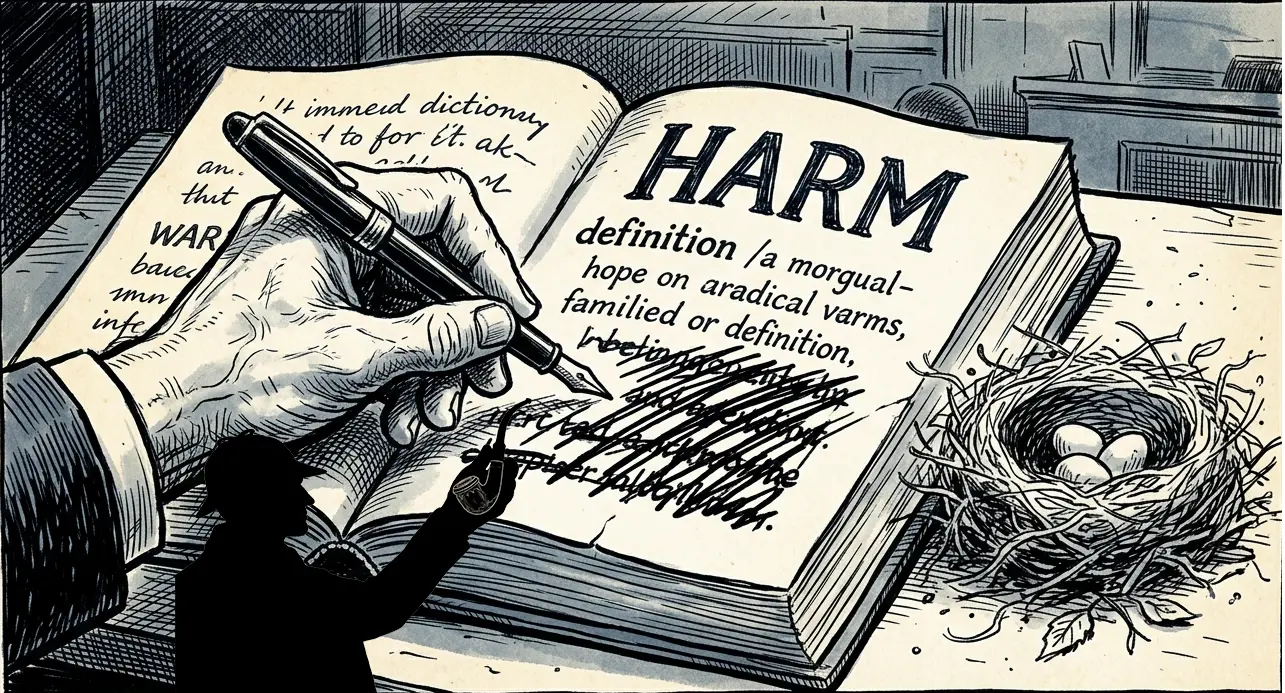
On July 10, the Interior and Commerce Departments finalized a rule erasing that reading. Destroying a nest, a den, or an entire habitat no longer counts as illegal harm under the Endangered Species Act — only killing or injuring an animal directly does. Habitat loss is, by wildlife biologists’ own account, the single largest driver of extinction. The rule doesn’t touch that fact. It just stops the law from counting it.
Interior Secretary Doug Burgum framed the change as returning to the law’s “actual text and original intent,” ending what he called “years of federal overreach.” The practical effect: oil and gas drilling, mining, logging, and development can now proceed on habitat that, until July 10, was legally off-limits — so long as the bulldozer doesn’t hit an animal on its way through.
“This is one of the most horrific attempts to harm wildlife in American history and a gift to the oil barons and foreign mining companies,” said Aaron Weiss of the Center for Western Priorities — the plainest statement of who the rule serves. Environmental groups are already suing, but they’ll be arguing in front of a Supreme Court considerably friendlier to executive authority than the one that decided Sweet Home in 1995.
Nothing here required Congress to touch the 1973 statute. It required only that an agency built to enforce a law be recomposed to redefine, on paper, what that law is allowed to see.
The gear stops turning if a court is still willing to say a word means what it meant fifty years ago.
This is The False Frame’s argument, documented in real time.
Essay 13 — The False Frame
Broken Frames — Block 9: The Darkened Room (not yet published — thebrokenframes.substack.com/s/broken-frames)
Copyright 2026 — Steve Sagnotti
Sources: AP (via WTVY), “Trump administration opens endangered species’ habitats to development, reversing 50 years of environmental law,” July 16, 2026. CNN, “Trump administration opens endangered species’ habitats to development,” July 10, 2026. Earthjustice, “Trump Administration Eliminates Habitat Protections for Vulnerable Wildlife,” July 2026. HNGN, “Trump Administration Ends 50-Year Rule Treating Habitat Destruction as Wildlife Harm,” July 11, 2026.
Leave a Reply