Block 8, Article 4 — The Same Amendment. A Consistent Set of Beneficiaries.
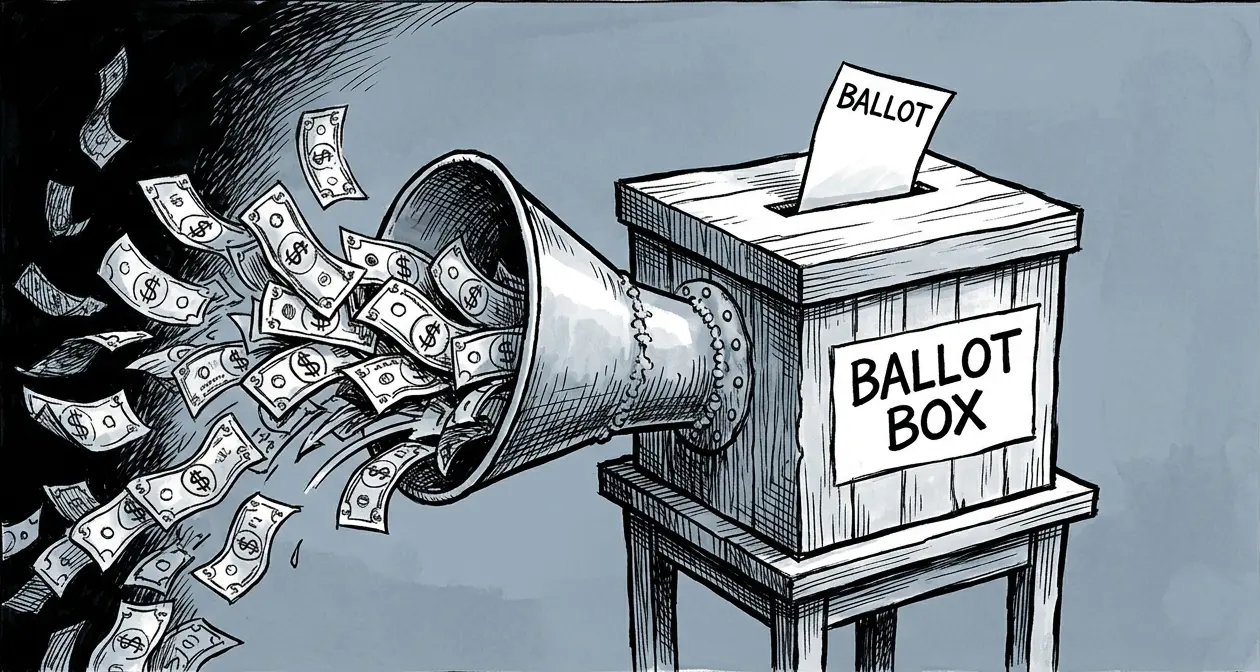
The largest political ad campaigns in American history were funded by organizations legally required to keep their donors secret.
Not hidden by clever lawyers. Not exposed by investigative reporters. Required by law to stay secret. That requirement did not arrive by accident. It was built — from tools originally designed for the opposite purpose, redirected by the same apparatus Powell set in motion, defended by the same money it was built to conceal.
— — —
The tool was a hundred years old before it was weaponized.
Section 501(c)(4) of the tax code has existed since 1913 — the same year the income tax itself was created. Congress carved it out for civic leagues and social welfare organizations: the volunteer fire department, the community garden association, the neighborhood improvement league. Organizations doing work the market wouldn’t fund and the government didn’t need to run. The protection made sense. The work was genuine.
By mid-century the vehicle carried the civil rights movement. The NAACP operated as a 501(c)(4). The ACLU. The League of Women Voters. Organizations doing work so genuinely in the public interest that the state actively tried to stop them.
In 1958 Alabama demanded the NAACP’s membership list. The state wanted names. The Supreme Court said no — unanimously. Compelled disclosure of membership in an unpopular organization violated the First Amendment right of association. The privacy protection built into 501(c)(4) status was not an accounting convenience. It was a shield against state retaliation against people doing dangerous civic work. NAACP members in Alabama in 1958 had reason to fear what happened when their names reached the wrong desk.
That unanimous decision — NAACP v. Alabama — is the legal foundation the dark money apparatus now stands on. The protection designed to keep civil rights workers alive became the protection that keeps the political spending of the industries that funded Citizens United invisible. Same statute. Same legal precedent. Opposite direction.
Section 501(c)(4) was framed as protection for civic organizations doing work the state couldn’t reach without retaliating against them. The industries and donors who would use that same anonymity to hide unlimited election spending from the public whose elections it was buying were not in the frame.
— — —
The turn happened in a single cycle.
For decades 501(c)(4) political activity existed but was modest. The IRS applied an informal standard: political activity could not be an organization’s “primary purpose.” Nobody defined primary precisely. The ambiguity was manageable because the money involved was manageable.
Citizens United did not create the legal architecture that made the flood possible. It completed a project that started thirty-four years earlier. In 1976, Buckley v. Valeo upheld contribution limits but struck down spending limits — the Court’s logic was that capping how much money a candidate or donor could spend restricted political expression protected by the First Amendment. Money, as a vehicle for speech, could not be capped. Justice Byron White dissented that unlimited spending was “a mortal danger against which effective preventive and curative steps must be taken.” The majority disagreed. Money equals speech has governed campaign finance law ever since.
Citizens United changed the scale. January 21, 2010: the Supreme Court held that corporations have First Amendment rights equivalent to individuals with respect to political speech. Spending limits on independent political expenditures are unconstitutional. Within twenty-four hours, the D.C. Circuit applied the same logic in SpeechNow.org v. FEC — corporations and individuals could now make unlimited contributions to committees that spent independently of candidates. The super PAC was born. Four years later, McCutcheon v. FEC (2014) eliminated the aggregate limit on what a single donor could give across all federal candidates combined in a two-year cycle. Thirty-eight years, four cases, one continuous project: Buckley built the foundation, Citizens United and SpeechNow built the walls, McCutcheon took the roof off entirely.
Within months of Citizens United, Karl Rove had filed Crossroads GPS as a 501(c)(4) social welfare organization. The vehicle that had carried the NAACP now carried the largest Republican outside spending operation in American history. Donors invisible. Spending unlimited. Social welfare undefined.
In 2006 dark money spending on federal elections totaled approximately $5 million. By 2012 it crossed $300 million. By 2020 it exceeded $750 million. In 2024 it crossed $1 billion for the first time — $1.9 billion in the presidential cycle alone. Two hundred times the 2006 figure in eighteen years. From 2010 to 2024, the fourteen years following Citizens United, outside groups spent more than $4 billion on federal elections in total. The law did not change that much. The money found the architecture and filled it.
The anonymity is not incidental to the design; it is the design. A corporation, a foreign government, or a billionaire with regulatory exposure across a dozen industries can route unlimited funds through a 501(c)(4) whose donors are never disclosed, into a super PAC that runs ads in competitive districts — shaping the outcome of elections that will determine who regulates them. Hawaii State Senator Karl Rhoads, lead author of the state’s corporate-spending law, made the point directly: under the current architecture, it is genuinely difficult to know whether money from Russia, Iran, or China is being routed into American elections through the same opacity built for domestic donors. The system was not designed to hide that possibility. It was designed to make no one able to check.
The IRS proposed new rules in 2013 that would have tightened the definition of political activity for 501(c)(4)s. The comment period generated over 150,000 responses, many of them orchestrated by the organizations the rules would have affected. The IRS withdrew the proposed rules in 2014. They have never been reintroduced. Congress could have written a clearer standard into statute at any point. The DISCLOSE Act — requiring donor disclosure for organizations spending on federal elections — has passed the House twice since 2010. It has died in the Senate both times on a party-line vote. The party that killed it had just discovered the vehicle was as useful for their donors as it was for the other side’s. Reversing the anonymity requires a statute the funded legislators won’t pass, or a bench revisiting Citizens United itself — the same bench Block 7 documents as this pipeline’s own construction.
— — —
27 percent. 27 percent. 45 percent.
Registered Republicans: approximately 27% of the electorate. Registered Democrats: approximately 27%. Voters registered with neither party: approximately 45% — the largest single bloc in the American electorate.
The $1 billion in “social welfare” spending in the 2024 cycle went entirely toward electing members of two private clubs that together represent 54% of voters. The 45% with no party registration received none of it. No candidate pipeline. No committee infrastructure. No 501(c)(4) operation running ads on their behalf. The organizations spending a billion dollars on “social welfare” are spending it to service the donor class of two clubs the largest share of the electorate doesn’t belong to.
The NAACP used the vehicle to protect people the state was trying to kill. The current apparatus uses it to elect members of private clubs who then service the donors who funded the clubs. The social welfare in question belongs to a very specific constituency. It is not the public.
— — —
The return is documented.
In 2009 economists Alexander, Mazza, and Sherrick published their analysis of the American Jobs Creation Act of 2004 — a tax repatriation provision that let corporations bring overseas profits home at fifteen percent instead of thirty-five. The corporations that lobbied for it spent $282 million on the campaign. The tax benefit they received: $62 billion. Return on investment: 22,000 percent.
The Strategas Lobbying Index tracks the fifty companies that spend the most on lobbying. It has outperformed the S&P 500 by approximately four percentage points annually since its inception. Not occasionally. Consistently. The market recognized the signal before the rest of us named it.
The apparatus did not build a bribery system. It built a system where the structural incentives make donor service rational, constituent service optional, and a 22,000 percent return on a $282 million investment entirely legal. Nobody goes to jail. Nobody needs to.
— — —
The 14th Amendment ran the same play.
The 14th Amendment was ratified in 1868 to protect the formerly enslaved from state deprivation of rights. By 1886 its equal protection clause was being applied to corporations. By 1896 Plessy v. Ferguson had effectively suspended it for the people it was written to protect. By 2010 it was the constitutional foundation for unlimited corporate political spending in Citizens United. By 2013 Shelby County used it to gut the Voting Rights Act — and Texas implemented a voter ID law within hours.
The same amendment. A consistent set of beneficiaries. They were not the people in the fields in 1868.
The apparatus does not need to write new law. It needs to find existing law pointing in a useful direction and redirect it. The NAACP’s shield became the donor’s cloak. The freed person’s amendment became the corporation’s charter. The social welfare organization became the good ol’ boys’ slush fund. Same instruments. Opposite results. The label stays. The mechanism turns.
The dark money funded the campaigns that confirmed the judges that eliminated the oversight that set and enforced the royalty rates on what the public owned. The causal chain is not metaphor. In 2025 the royalty rate on federal mineral leases — locked at 12.5 percent by the One Big Beautiful Bill — was the same rate set in 1920. The billion dollars in dark money spent on the 2024 cycle purchased, among other things, the legislative majority that locked it there.
Powell wrote it down in 1971. The river was already on fire. He identified accountability as the problem. Fifty years later accountability is the one thing the architecture is specifically designed to prevent.
The legal architecture behind this mechanism connects to Essay 12 of The Narrow Gate.
— — —
The dark money is disclosed in aggregate, if not by name. OpenSecrets’ dark money database tracks total spending by group and cycle, updated as filings arrive: opensecrets.org/dark-money
— — —
Steve Sagnotti
is a serious amateur photographer, writer, and technologist based in Oregon. With his camera he tries to capture common images not often seen, leading to common questions not often asked.
© 2026 Steve Sagnotti
— — —
Sources
1. NAACP v. Alabama, 357 U.S. 449 (1958).
2. Citizens United v. Federal Election Commission, 558 U.S. 310 (2010). supreme.justia.com
3. Buckley v. Valeo, 424 U.S. 1 (1976). supreme.justia.com
4. SpeechNow.org v. FEC, 599 F.3d 686 (D.C. Cir. 2010). cadc.uscourts.gov
5. McCutcheon v. FEC, 572 U.S. 185 (2014). supreme.justia.com
6. Shelby County v. Holder, 570 U.S. 529 (2013). supreme.justia.com
7. Alexander, Raquel; Mazza, Stephen; Sherrick, Susan. “Measuring Rates of Return for Lobbying Expenditures.” Journal of Law and Politics, Vol. 25, 2009.
8. Strategas Research Partners. Lobbying Index performance data.
9. American Jobs Creation Act of 2004. Pub.L. 108-357. congress.gov
10. IRS proposed 501(c)(4) rules 2013; withdrawal 2014. IRS Notice 2013-54.
11. DISCLOSE Act. H.R. 5175 (111th Congress, 2010) | H.R. 1134 (117th Congress, 2021). congress.gov — H.R. 5175 | H.R. 1134
12. Dark money totals 2006–2024. opensecrets.org/dark-money
13. Outside spending 2010–2024 ($4B+): Federal Election Commission data. fec.gov/data
14. Dark money 2024 presidential cycle ($1.9B). opensecrets.org/dark-money
15. Hawaii State Senator Karl Rhoads, on foreign-money risk (MSNBC broadcast).
16. Mayer, Jane. Dark Money. Doubleday, 2016.
17. Plessy v. Ferguson, 163 U.S. 537 (1896). supreme.justia.com
18. Santa Clara County v. Southern Pacific Railroad, 118 U.S. 394 (1886). supreme.justia.com
Leave a Reply