Block 4, Article 5 — What the Room Produces
© 2026 Steve Sagnotti.
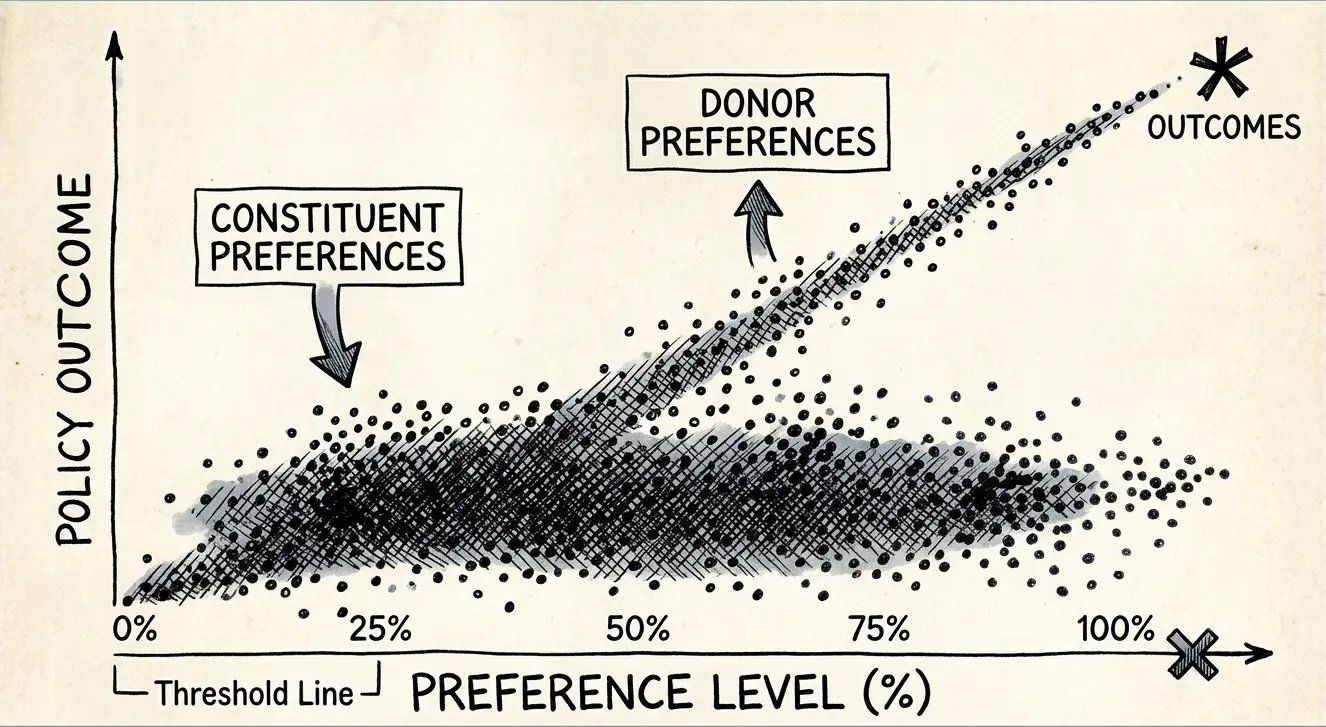
When what ordinary Americans want and what economic elites want come apart, ordinary Americans lose. Not sometimes — as a measured statistical rule. In 2014, two Princeton researchers, Martin Gilens and Benjamin Page, tested that claim against 1,779 policy outcomes over twenty years. It held. When the preferences of average citizens conflicted with the preferences of economic elites and organized interest groups, average citizens lost. Not sometimes. As a statistical matter, the preferences of the median voter have near-zero independent effect on policy outcomes. Economic elites and organized groups get what they want. Average citizens, in Gilens and Page’s measured language, have “little or no independent influence.”
They did not call it corruption. They called it measurement. The system is not failing to represent the public. It is succeeding at representing someone else.
Policy responsiveness was framed as a question of electoral accountability — vote the right people in, get the right outcomes. Gilens and Page measured something else. The previous article documented the machinery: the Rules Committee veto, the Parliamentarian’s filter, the continuing resolution baseline, the filibuster threshold. What the machinery produces can be measured. Here is the measurement.
Background checks
Ninety percent of Americans support universal background checks for gun purchases. The figure has held steady across a decade of polling from multiple independent sources — Quinnipiac, Pew, Morning Consult, Johns Hopkins. It includes 70 to 89 percent of Republicans, 70 percent of NRA members, and 89 percent of gun owners. The Johns Hopkins researcher who has tracked this number for over a decade said it plainly: if public opinion alone moved legislation, universal background checks would have been law since 2013. They are not law. They have never received a Senate floor vote. Your representative has never been required to go on record.
Drug price negotiation
Eighty-three percent of Americans support allowing Medicare to negotiate prescription drug prices directly with manufacturers — including 71 percent of Republicans. The finding held steady even after respondents were presented with the pharmaceutical industry’s counterarguments. The industry blocked the policy for decades. A narrow version passed in the 2022 Inflation Reduction Act, covering ten drugs. The form of accountability was created. The substance was preserved elsewhere — the industry spent heavily to limit the bill’s scope before it passed and has continued working to restore the exemptions it lost, one committee hearing at a time. Most Americans do not know what survived or what didn’t. Their representative has never been required to explain why.
Minimum wage
Eighty-six percent of Americans support raising the federal minimum wage — including 73 to 84 percent of Republicans. The federal minimum wage has not moved since 2009. Seventeen years. The 2021 Senate vote failed 42 to 58. Four senators voted yes when it couldn’t pass and no when it could. The constituent watching that vote could conclude their senator opposed the increase. What they could not see was the call center arithmetic that preceded the floor. Their senator was never required to explain the gap between their campaign position and their vote.
Campaign finance limits
Seventy-one percent of Americans support a constitutional amendment to limit campaign spending. Seventy-nine percent support caps on what candidates can raise and spend. Citizens United removed the legal architecture that had constrained unlimited spending. In the 2024 election cycle, billionaire donors spent over $2.6 billion — nearly 20 percent of total federal election spending. Congress has passed nothing to restore limits. Every member who would need to vote for reform has been elected under the post–Citizens United system and has benefited from the unlimited spending it permits. No floor vote has been scheduled. No representative has been required to go on record.
The unresolved crisis is worth more as a fundraising instrument than the resolved one would be. The donors who fund the perpetuation have a structural interest in the question staying open. A resolved crisis generates no counter-donation.
Third party access
Sixty-two percent of Americans tell Gallup a third major political party is needed. The figure has held at majority levels for years across both parties. The structural mechanisms preventing it are the subject of the next block. What matters here is that the largest single preference in American politics has no vehicle, no floor vote, and no representative who can be held accountable for its absence. The constituent who wants an alternative has no record to check and no vote to point to. The preference simply has nowhere to go.
What the room produces
Five issues. Five supermajorities. Five outcomes the room did not deliver.
The call center that priced the committee seat, the leadership PAC that booked the resort, the war chest invested while it waited — these are not separate phenomena from the five scoreboard items above. They are the mechanism Gilens and Page measured. The donor whose preferences dominate policy outcomes is the donor on the other end of the call. The member holding regulated-industry stock while chairing the committee that sets extraction rates is the member whose preferences Gilens and Page found predictive. The measurement and the machinery are the same system seen from two angles.
The legal definition of corruption is narrow because the people who write the legal definition of corruption are the people whose conduct the definition would otherwise constrain. Every carve-out, every $200 fine standing in for a felony penalty, every rolled-back enforcement mechanism has the same author in the background — the purchased legislation that looks like accountability from the outside and functions as permission from the inside.
The Gilens and Page finding has been replicated. The political science consensus that donor preferences dominate policy outcomes has not been translated into legislative response — because the legislature whose donor preferences dominate policy would have to authorize that response. The same gate that blocked the minimum wage would have to open to close itself.
The commons transfers — the royalty rate held at 12.5 percent since 1920, the lease mandates, the aquifer subsidies, the grazing fees unchanged for decades — do not appear on this scoreboard. They have no polling constituency demanding their floor vote. They generate no news cycle. The same room that blocked background checks also set the extraction rates. The same gate. The same outcome. For the same people, at the expense of the same public. What that cost is Block 10’s accounting to do.
The money found the room. It always finds the room.
The next article shows what the constituent’s vote looks like by the time it reaches the floor — the seven gates it has already passed through before a single hand is raised.
How much your representative raised last cycle — and from whom — is public record.
| Your representative’s call time hours — not public record; donor side is. FEC. | https://www.fec.gov |
| Your representative’s top industries by donation | https://www.opensecrets.org/members-of-congress |
| The five policy items above — your representative’s position and voting record | https://www.votesmart.org |
Sources
1. Gilens, Martin and Page, Benjamin. “Testing Theories of American Politics.” Perspectives on Politics 12, no. 3 (2014). Cambridge University Press. https://doi.org/10.1017/S1537592714001595 (paywall)
2. Gilens, Martin. Affluence and Influence (2012). Princeton University Press. WorldCat: https://search.worldcat.org/title/775271585
3. Teachout, Zephyr. Corruption in America (2014). Harvard University Press. WorldCat: https://search.worldcat.org/title/951917648
4. Lessig, Lawrence. Republic, Lost, rev. ed. (2015). Twelve. WorldCat: https://search.worldcat.org/title/930068809
5. Background checks 90% / decade of polling. Politifact, May 25, 2022. https://www.politifact.com/factchecks/2022/may/25/joe-biden/polls-consistently-show-high-support-gun-backgroun/
6. Background checks — Johns Hopkins. PBS NewsHour, September 10, 2019. https://www.pbs.org/newshour/nation/90-percent-of-americans-want-universal-background-checks-why-doesnt-congress-pass-one
7. Background checks — Trump voters 73%. Brady United / Morning Consult, November 2024. https://www.bradyunited.org/press-releases/brady-releases-new-poll-showing-massive-support-for-gun-safety-measures
8. Drug price negotiation — 83%. West Health-Gallup, January 2024. https://www.westhealth.org/press-release/new-west-health-gallup-survey-finds-widespread-support-for-medicare-drug-price-negotiation/
9. Drug price negotiation — holds after counterarguments. KFF. https://www.kff.org/medicare/poll-finding/kff-health-tracking-poll-march-2019/
10. Minimum wage — 86%. NW Labor Press / April 2024 poll. https://nwlaborpress.org/2024/04/poll-86-support-raising-minimum-wage/
11. Minimum wage frozen since 2009. U.S. Department of Labor. https://www.dol.gov/agencies/whd/minimum-wage/history
12. 2021 Senate vote and four senators. NW Labor Press, ibid.
13. Campaign finance — 71% constitutional amendment. American Promise. https://americanpromise.net/blog/2023/02/16/new-poll-finds-71-of-americans-support-constitutional-amendment/
14.Campaign finance — 79% spending caps. Gallup. https://news.gallup.com/poll/700499/new-high-identify-political-independents.aspx
15. Billionaire spending 2024 — $2.6 billion. Roosevelt Institute, February 2026. https://rooseveltinstitute.org/publications/billionaire-political-spending/
16.Third party 62%. Gallup, October 2025. https://news.gallup.com/poll/696521/americans-need-third-party-offer-soft-support.aspx
Block 4, Article 5. © 2026 Steve Sagnotti.
Leave a Reply