Notes from the Field — Dispatch, June 22, 2026
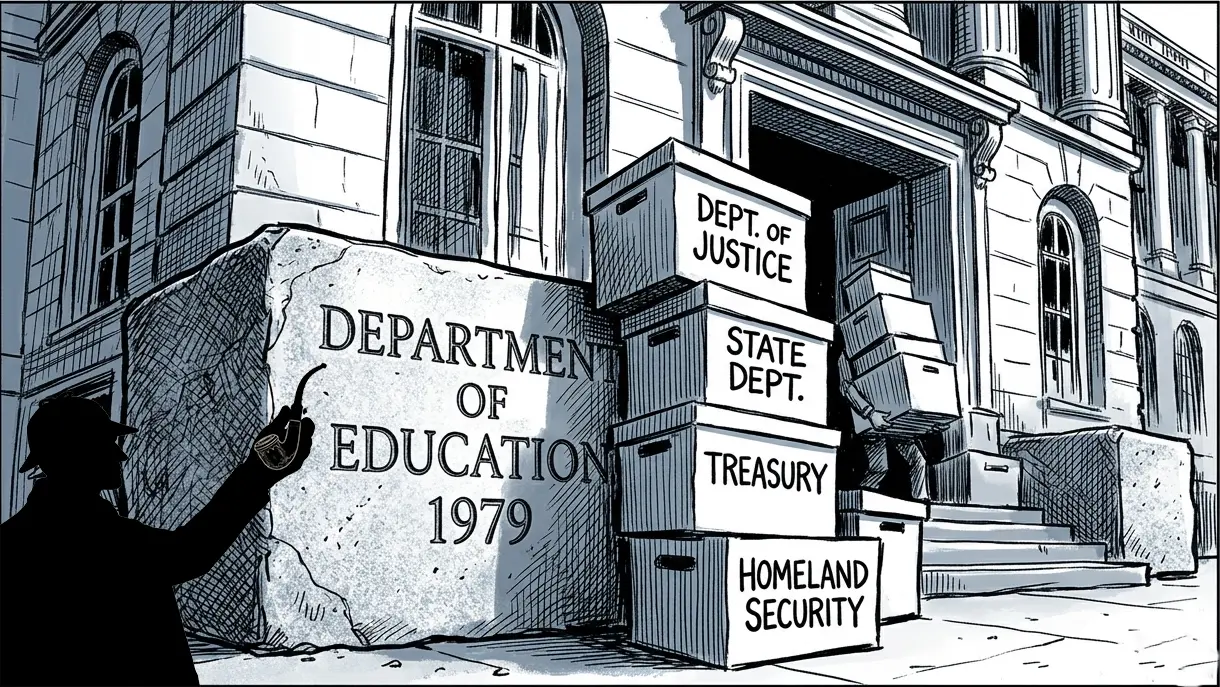
The U.S. Department of Education cannot be closed. Congress created it by statute in 1979, and only Congress can end it — a fact the current administration has never disputed, because it hasn’t needed to. On June 16, the department announced it was handing its two largest remaining functions to other agencies: special education oversight to Health and Human Services, civil rights enforcement to the Justice Department. It was the eleventh such transfer in just over a year. Between them, the moves cover elementary and secondary programs (Labor), federal student aid (Treasury), Indian education (Interior), and now special education and civil rights — six cabinet departments in total now administering pieces of an agency Congress has neither closed nor voted to shrink.
The tool making this possible is a decades-old provision called the Economy Act, which lets one federal agency pay another to perform services on its behalf. It was written for routine interagency logistics — grant administration, shared personnel, that kind of thing — and both parties have used it that way for years; a 2022 agreement under the prior administration used it to move grant work to the Department of Labor. What’s different this time is scale and intent: department officials have said openly that these transfers are meant to demonstrate the agency is “redundant,” building the political case for a closure Congress still hasn’t voted on. Catherine Lhamon, who ran the Office for Civil Rights under two previous administrations, called moving it to Justice “a terrible idea” — not because Justice is incompetent, but because it has, in her words, no institutional expertise in school civil rights work and no reason to develop one now.
Congress has noticed and done nothing binding about it. Lawmakers from both parties wrote language into the fiscal 2026 budget explanation warning that fragmenting education programs across agencies would “create inefficiencies,” raise costs, and delay funding reaching schools. That language was advisory. Republican lawmakers blocked a Democratic amendment that would have explicitly prohibited the interagency agreements. The fiscal 2027 bill currently moving through the House doesn’t mention them at all. The result is a formal, bipartisan acknowledgment that the mechanism is a problem, sitting beside a formal refusal to use the one tool that would stop it.
Coverage of the announcement mostly asked whether the new arrangement would serve students as well as the old one — a reasonable question, and an unanswerable one this early. The question the coverage asked less often is the structural one: what does it mean that an agency can be functionally dissolved through a contracting mechanism designed for grant paperwork, using a legal authority nobody originally built for this purpose, while the body with sole constitutional power to authorize the dissolution watches from the sidelines? As of January 2025, disability discrimination made up nearly half of the department’s 12,000 unresolved civil rights cases. Those cases don’t disappear. They just change custodians, one interagency agreement at a time, until the agency that was supposed to answer for them isn’t the agency anymore.
The department remains open. The sign is still on the building. Almost nothing behind the door answers to it.
—
Essay 3 — The People in the Room
Copyright 2026 — Steve Sagnotti
Sources:
NPR, “Special Ed, Civil Rights Are Largely Leaving Education Department,” June 16, 2026.
The Washington Post News Service, “Special Ed and Civil Rights Offices to Shift Out of Education Department,” June 16, 2026.
The 74, “Special Ed and Civil Rights Oversight Moving Out of Education Department,” June 16, 2026.
Education Week, “Education Department Moves Special Ed. and Civil Rights to Other Agencies,” June 16, 2026.
The College Investor, “Education Department Moves Special Ed to HHS and Civil Rights to DOJ,” June 18, 2026.
Deutsche Welle, “Education Department Shifts Civil Rights and Special Ed,” June 22, 2026.
Leave a Reply