Block 4, Article 4 — Before the Vote, the Rules
© 2026 Steve Sagnotti.
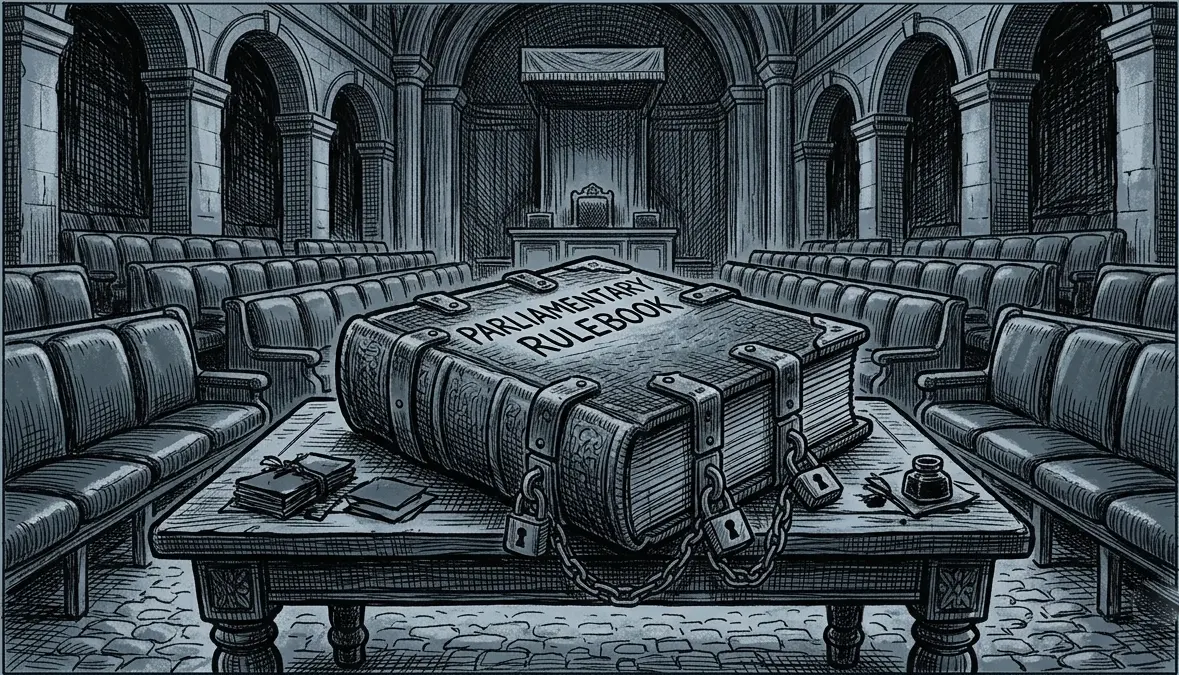
Before your representative casts a vote, the rules determining what they’re allowed to vote on have already been written. Not by you. Not by them.
You voted for a person. The person arrived in a room already arranged. Not arranged by accident, not arranged by tradition, and not arranged by the voters who sent them. Arranged by the same system we’ve been tracing through this block — the dues, the call center, the whiteboard, the optimization. The room was ready before they walked in. The question this article answers is what the arrangement cost you.
How a procedural tool became a political weapon
The Rules Committee was established on the second day of the First Congress, April 2, 1789. Its original mandate was straightforward: prepare standing rules and orders for the new body. For its first century, that is what it did — set decorum, define the role of the Speaker, establish the order of business. Its members complained that little attention was paid to their reports. It was parliamentary housekeeping. Not a weapon. A framework.
That changed in the 1880s. As the House grew, the Rules Committee became a standing body with real power over floor scheduling. By 1903 Speaker Joseph Cannon had turned it into an instrument of personal control so total that his opponents called him Czar Cannon. He used it to block progressive legislation, punish members who defied him, and concentrate power in the speakership to a degree the founders had not designed. In 1910 a bipartisan coalition stripped him of the chairmanship. His opponents said he had stood between the people and too many things they wanted and ought to have.
The revolt was supposed to democratize the floor. It transferred the weapon instead. Power moved from the Speaker to the committee itself — and then in 1975 back to the Speaker, who now nominates all majority members. The gate survived every reform intact.
What changed between Cannon’s era and the present is not the mechanism. It is who the Speaker owes. Cannon owed his caucus. The modern Speaker owes the call center. The dues structure that prices committee seats runs through the Speaker’s office. The Rules Committee chair who owes $1.8 million in donor-funded dues to the party campaign committee was put there by a Speaker who owes the same system. The same weapon. Different patrons.
One more thing the 1910 revolt did not survive: nineteen years later, the rural and extractive-state bloc that lost the Rules Committee fight answered with the apportionment freeze. The Permanent Apportionment Act of 1929 capped the House at 435 seats, locking in representation ratios that urbanization had been eroding. The democratic assertion of 1910 was answered by the structural counter-move of 1929. Block 2 documents that freeze. This block documents what happened to the gate.
The rules come before the laws
Most people understand that Congress passes laws. What most people don’t know is that before any bill becomes law, the majority party decides which bills get to try. Those decisions are made through the rules — internal operating procedures adopted at the start of each Congress, written by the party that controls the chamber, governing everything that follows for the next two years. The rules are not law. You never voted on them. You almost certainly don’t know they exist.
These rules were framed as procedural neutrality — a technical operating system, not a political instrument. The bills that never reach a vote suggest otherwise.
The mechanism is the Rules Committee. It determines whether a bill comes to the floor, when it comes, under what conditions, and whether amendments are permitted. A bill that never receives a rule never receives a vote. It doesn’t fail — failure would require a vote. It simply does not happen. The member who introduced it can tell their constituents they tried. What they will not tell them is that the Rules Committee chair decided it wasn’t coming to the floor. That decision doesn’t appear in any newspaper. It isn’t in any vote record. It leaves no mark the constituent can find unless they already know to look.
There is a theoretical escape valve. Two hundred and eighteen signatures on a discharge petition force a bill to the floor over the Rules Committee’s objection. In practice it almost never happens. Signing a discharge petition against your own party’s leadership is a career-defining act — the committee reassignment, the primary challenge, the campaign funding withdrawal documented in the last article make the escape valve functionally unavailable. The door exists. The price of opening it is designed to be prohibitive. The rules that govern the escape from the rules were written by the same people the escape is designed to circumvent.
The Rules Committee chair who owes $1.8 million in donor-funded dues to the party campaign committee is not going to bring to the floor the bill those donors oppose. The constituent’s representative introduced the bill. That is as far as it goes.
The gavel has a price
In January 2023 Kevin McCarthy took fifteen rounds of voting over four days to be elected Speaker of the House. The last time that happened was 1859. Most people watching read it as chaos — the People’s House unable to organize itself, paralyzed by a faction of twenty members.
What they were actually watching was a pricing negotiation.
The concessions McCarthy made were not about policy. They were about machinery. Three Freedom Caucus members installed on the Rules Committee — the committee that decides which bills reach the floor. The threshold for a motion to vacate the Speaker lowered to a single member, meaning one person could force a no-confidence vote at any time. More Freedom Caucus seats on the steering committee, which governs committee assignments, which governs the dues structure, which governs who can fund primary challenges against whom. The negotiation was entirely internal. The constituent was not a party to it. The constituent’s policy preferences were not on the table. What was on the table was who controls the rules before the laws can begin.
Nine months later Matt Gaetz used the single-member motion to vacate to remove McCarthy from the speakership. The concession McCarthy made to get the gavel was the instrument used to take it back. McCarthy understood this when he agreed to it. He agreed anyway because the gavel was worth more than the security. The title of former Speaker of the House does not expire when the gavel does. It is worth millions in the consulting circuit on the other side of the door — independent of any government salary or pension. The credential is permanent. The speakership was the investment.
The institution that is supposed to represent the constituent was being run as a private negotiation over private organizational leverage, in public, on C-SPAN. Most people watching didn’t understand what they were seeing. They thought it was chaos. It was a transaction.
The unelected gatekeeper
The Senate has its own version. The Senate Parliamentarian is a staff position — not elected, not confirmed by anyone, appointed by the Senate Majority Leader and serving at leadership’s pleasure. The job is to rule on whether legislation complies with the Senate’s own internal rules, most consequentially on what can be included in budget reconciliation bills. Reconciliation allows the Senate to pass budget-related legislation with a simple 51-vote majority, bypassing the 60-vote filibuster threshold. The Byrd Rule — an internal Senate rule, not a law — prohibits including provisions that aren’t directly budget-related. The Parliamentarian rules on what passes and what does not. What fails dies there.
In 2021 the Senate Parliamentarian ruled that a $15 federal minimum wage increase could not be included in the reconciliation bill. Not budget-related enough. The minimum wage increase that had been a central campaign promise of multiple elected senators — supported by polling majorities in most states — died on a staff ruling. The constituent who voted for the senator who campaigned on it never heard the name Elizabeth MacDonough.
What the constituent was never told: multiple mechanisms existed to reach a different outcome — waiving the Byrd Rule, overruling the Parliamentarian from the chair, or simply replacing her, as Senate Majority Leader Trent Lott did in 2001. None were used. The White House said they respected the process. What went unannounced was the political arithmetic underneath: two Democratic senators had already signaled they would not support the bill regardless. The overrule was framed as deference to institutional procedure. It was the politically safe exit from a vote that wasn’t there. The constituent never saw any of that. They saw the policy die and were told the rules did not permit it. The rules permitted exactly what the people in power decided the rules permitted. They decided the minimum wage was not among those things.
The frozen baseline
Congress hasn’t passed a complete federal budget on time since 1996. Nearly thirty years. What looks like chronic dysfunction is now the operating condition — and the operating condition has a name. When Congress fails to pass full appropriations, the government runs on a continuing resolution. A CR funds agencies at roughly the previous year’s spending levels and keeps operations running while negotiations continue. It looks like a neutral holding pattern.
It is not.
Built into every CR is a prohibition on new spending initiatives. You can continue what exists; you cannot start what does not. A program zeroed out in a previous budget cannot be restarted under a CR. A new initiative a member campaigned on cannot be funded under a CR. There is no inflation adjustment — programs funded at last year’s levels lose real purchasing power every quarter the CR runs, quietly, without a vote. The longer the government operates on continuing resolutions — and since 2012, CRs have funded nearly half of every fiscal year — the more the policy agenda is frozen at whatever the baseline was when the last real budget passed, and the more that baseline quietly erodes.
The baseline is not neutral. It reflects the priorities of every Congress that preceded this one, including the Congresses that were themselves shaped by the capture apparatus this block has been documenting. The oil and gas royalty rate that has not been raised since 1920 is in the baseline. The below-market timber stumpage rates are in the baseline. The agricultural subsidies flowing to the operations drawing down the Ogallala Aquifer are in the baseline. The CR that funds the government for another three months funds all of it, automatically, without a vote, because it was already there. The constituent who voted for the representative who campaigned on changing these things watches the CR pass and does not know the CR just funded everything they voted against for another quarter.
The CR is also a hostage mechanism. The threat of a government shutdown gives any faction willing to make the threat the ability to extract concessions on unrelated matters. In the fall of 2025 the government shut down for 43 days — the longest in history — before a CR reopened it. The constituent watching the shutdown clock was watching a hostage negotiation conducted entirely within the private machinery of the institution they thought they controlled. The constituent was not consulted on the terms.
The call center paid for the committee seat. The committee seat wrote the rules. The rules froze the baseline. The baseline funds the extraction rates, the royalty schedules, the lease terms the donors needed protected. The constituent who thought they voted for change funded the mechanism that prevented it. Their tax dollars ran the primary. Their primary produced the representative. Their representative went to the call center. The call center produced the committee. The committee froze the baseline. The baseline is still running.
These are internal legislative decisions. Federal courts have consistently declined to adjudicate internal legislative procedure — Rules Committee scheduling, Parliamentarian rulings, the Byrd Rule’s application are treated as matters for the chamber to police itself. The bench that would have to agree to review them is the bench Block 7 documents.
The gate is the same
The issues are different. The donors are different. The industries are different. The gate is the same. The Rules Committee chair who owes $1.8 million in donor-funded dues to the party campaign committee is not making five separate decisions. They are making one decision — expressed five different ways — about whose preferences the room serves.
Notice what the gate also produces beyond the blocked bill. When a bill dies in the Rules Committee there is no vote. No vote means no record. No record means the constituent cannot find out how their representative would have voted — because their representative was never required to vote. The donor who needed the bill killed gets the outcome without the exposure. The gate that prevents the vote also prevents the accountability a losing vote would create.
The visible issues — background checks, drug pricing, the minimum wage — absorb the outrage. The commons transfers happen in the same room, through the same gates, at the same time, without polling data and without a news cycle. The royalty rate held at 12.5 percent since 1920, the grazing fee unchanged for decades, the aquifer drawdown funded by agricultural subsidies in states whose senators chair the Agriculture Committee — none of these generate a march. The outrage goes to the visible issues. The value transfers in the dark. The same gate that blocked the minimum wage also blocked royalty rate reform. The same committee chair whose donors opposed drug price negotiation also sets federal lease terms. The same mechanism. The same room. The same outcome — for the same people, at the expense of the same public.The next article measures what that room produces.
The rules governing what your representative is allowed to vote on are public.
| House Rules Committee — what it controls and how it operates | https://rules.house.gov |
| Senate Byrd Rule — what qualifies for reconciliation. 2 U.S.C. § 644 | https://uscode.house.gov/view.xhtml?req=granuleid:USC-prelim-title2-section644&num=0&edition=prelim |
Ask an AI: “What does the House Rules Committee actually control, and can its decisions be overridden?”
Sources
1. Rules Committee history — established April 2, 1789. U.S. House, History, Art & Archives. https://history.house.gov/Institution/Origins-Development/Rules-Committee/
2. National Archives — Records of Committee on Rules. https://www.archives.gov/legislative/guide/house/chapter-18-rules.html
3. Cannon revolt 1910. Bill of Rights Institute. https://billofrightsinstitute.org/essays/joseph-cannon-and-the-revolt-of-1910
4. 1975 Speaker nomination authority. Rules Committee history. https://history.house.gov/Institution/Origins-Development/Rules-Committee/
5. Issue One. “The Price of Power” / “The Price of Power Revisited,” February 2023. https://issueone.org/articles/the-price-of-power-revisited/
6. McCarthy speaker vote January 2023. Congressional Record, 118th Congress. https://www.congress.gov/congressional-record/118th-congress/house-proceedings
7. Gaetz motion to vacate October 3, 2023. Congressional Record.
8. McCarthy post-Congress consulting. South Slope News, October 2025.
9. Byrd Rule. 2 U.S.C. § 644. https://uscode.house.gov/view.xhtml?req=granuleid:USC-prelim-title2-section644&num=0&edition=prelim
10. Byrd Rule waiver requires 60 votes. CRS R48640. https://crsreports.congress.gov/product/pdf/R/R48640
11. Lott fired Parliamentarian 2001. Arnold & Porter, January 2025. https://www.arnoldporter.com/en/perspectives/advisories/2025/01/the-nuclear-option-and-the-parliamentarian
12. Pew Research — Congress struggles to pass spending bills on time, October 2025. https://www.pewresearch.org/short-reads/2025/10/01/congress-has-long-struggled-to-pass-spending-bills-on-time/
13. Peter G. Peterson Foundation — continuing resolutions, November 2025. https://www.pgpf.org/blog/2025/11/continuing-resolutions-are-stopgap-measures
14. Antideficiency Act. 31 U.S.C. § 1341. https://uscode.house.gov/view.xhtml?req=granuleid:USC-prelim-title31-section1341&num=0&edition=prelim
Block 4, Article 4. © 2026 Steve Sagnotti.
Leave a Reply