Block 5, Article 4
© 2026 Steve Sagnotti.
Ranked choice voting does one thing: it lets voters rank their preferences. First choice, second choice, third. If no candidate wins a majority of first-choice votes, the last-place candidate is eliminated and those voters’ second choices are counted. The process continues until one candidate holds a majority.
The consequence is simple and the two parties understand it precisely: a voter can support a third candidate without handing the election to their least-preferred option. The spoiler problem disappears. The binary loses its enforcement mechanism. Voters can say what they actually want. That is exactly what the duopoly is organized to prevent.
Two states ran the experiment
Maine adopted ranked choice voting in 2016 after a citizen initiative — bypassing the legislature entirely. The Maine Republican Party attempted to repeal it through the legislature. When that failed, they funded a people’s veto referendum. That failed too. Maine has used ranked choice voting in every subsequent federal election. The outcomes have been accepted, the results have been orderly, and the voters who participated have reported higher satisfaction with the process than the binary it replaced.
Alaska adopted ranked choice voting alongside a top-four nonpartisan primary in 2020 — also by citizen initiative, also bypassing the legislature. Anyone could vote in the primary; the top four finishers advanced; the general election was decided by ranked choice. In 2022 the system produced a special election in which a Democrat won a seat that had been Republican for fifty years. The Alaska Republican Party began funding a repeal initiative before the result was certified.
The repeal passed in November 2024 by 4,000 votes — 1.6 percentage points — after a campaign funded substantially by the Republican Governors Association, the Republican State Leadership Committee, and aligned dark money groups. None of them are Alaskan.
The binary is the asset. Both parties hold it.
Maine’s repeal effort was Republican-funded. The Democratic Party’s record on ranked choice voting is not the record of a party that wants it. In states where the reform might cost a Democratic incumbent a safe seat, the Democratic legislative apparatus has not been its champion. Where the choice is between the reform and the seat, the seat wins.
Neither party will surrender the binary voluntarily. The question of whether there should be only two choices is the one question on which Washington is not divided.
The frame and the excluded question
The campaign against Alaska’s ranked choice system argued it was confusing, expensive, and produced uncertain outcomes. Those arguments were deployed against every jurisdiction where RCV was adopted — and in every jurisdiction where it was tested, they were wrong. The arguments were not about the reform’s effects on voters. They were about the reform’s effects on the parties making them.
The repeal was framed as Alaskan voters defending their preferred voting system. What the frame excluded was the question that never got asked in the public debate: why are organizations headquartered in Washington spending millions of dollars to determine how Alaska counts its votes?
That excluded question is the tell — and it appears every time national money arrives to kill a state reform. Ranked choice voting in Alaska. Mail-in voting expansion in multiple states. Environmental ballot initiatives in Colorado, Arizona, and California. Minimum wage increases in red states. The reform varies. The pattern does not. A threatening idea demonstrates it can work in one state. National money arrives before it can spread to others. The argument deployed is always local and procedural — confusing, premature, risky, uncertain. The question of whose structural interests the money is actually protecting is never in the frame.
What the room was protecting
The Alaska RCV repeal was not funded by Alaskan voters defending their preferred voting system. It was funded by the organizations that benefit from the room Alaska’s senators occupy and the committees they sit on. RCV would have opened that room to broader competition. The repeal kept it closed.
The door locked against a third party — the ballot access wall, the debate threshold, the primary structure that routes everything back into the binary — is also the door through which any serious challenge to extraction economics would have to pass. RCV was the tool that cut it: not by persuading the room to open, but by allowing voters to build a coalition outside the binary and change what the room is optimizing for. That is precisely what 4,000 votes and national money prevented.
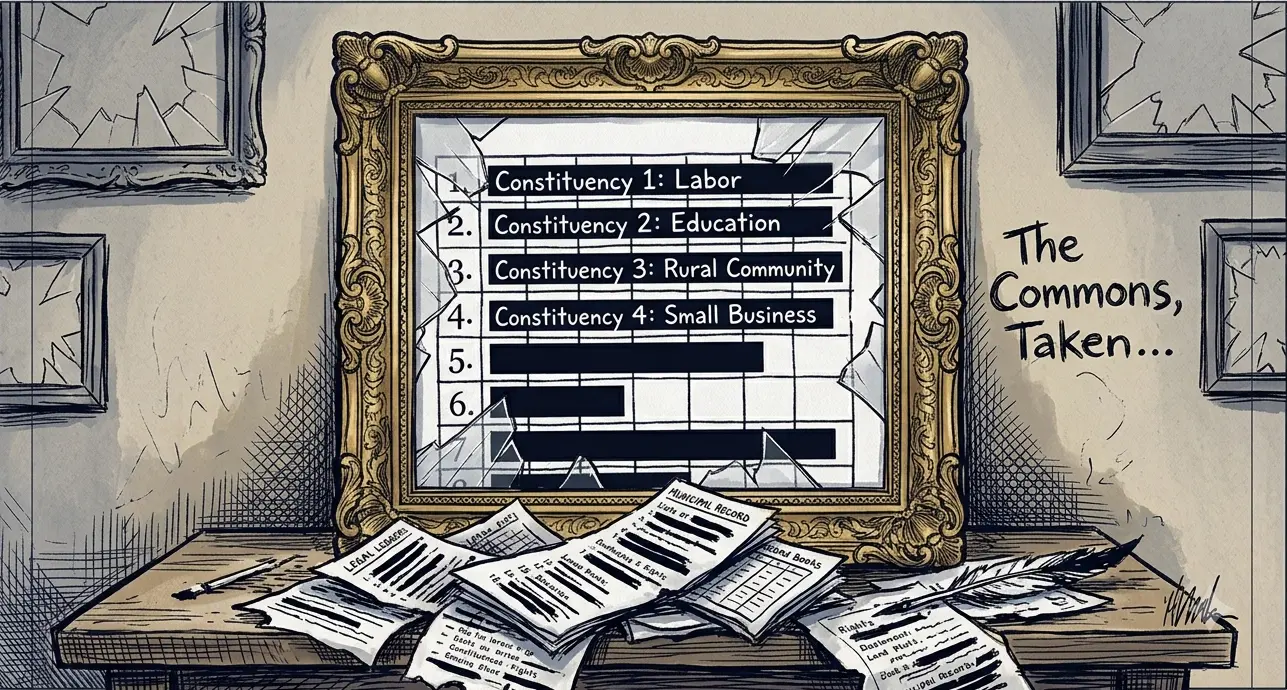
It was not the fishermen and the farmers and the miners and the factory workers all at once. It was the fishery first, then the topsoil, then the aquifer, then the union, then the local paper, then the pension, then the entry-level job. And then the reform that might have cut the knot — 4,000 votes, national money, the same calculation running in reverse. By the time it was Alaska’s ranked choice system, there was no coalition left to defend it. Each step was met with the same calculation: this one isn’t mine. Each step made the next one easier.
The locked door and the extracted commons are not two problems. They are the same problem, viewed from two sides of the same wall.
Your representative took an oath to provide for the general welfare. The records below are public. You can check them yourself.
The Public Record
| How your representative voted on ranked choice voting legislation | https://www.congress.gov/search?q=%22ranked+choice%22 |
| Who funded the Alaska Proposition 2 repeal campaign | https://aws.state.ak.us/ApocReports/CampaignDisclosure/ |
| Outside money in your state’s electoral reform battles | https://www.opensecrets.org/outsidespending |
| Which national organizations opposed RCV and where they spent | https://www.fec.gov/data/independent-expenditures/ |
| RCV adoption and rollback tracking nationally | https://www.fairvote.org/rcv |
Sources
1. Maine RCV adoption 2016, citizen initiative. Maine Secretary of State. https://www.maine.gov/sos/cec/elec/results/index.html
2. Maine Republican repeal attempt / people’s veto 2018. Ballotpedia. https://ballotpedia.org/Maine_Ranked_Choice_Voting,_People%27s_Veto_(2018)
3. Alaska RCV adoption 2020, citizen initiative. Alaska Division of Elections. https://elections.alaska.gov/RCV.php
4. Alaska 2022 special election — Democrat wins Republican seat. Alaska Division of Elections. https://elections.alaska.gov/results/22SSPRIMARY/
5. Alaska 2024 repeal — Proposition 2, 1.6 percentage points, RGA / RSLC funding. Alaska APOC. https://aws.state.ak.us/ApocReports/CampaignDisclosure/
6. Out-of-state money in state ballot initiative campaigns. OpenSecrets. https://www.opensecrets.org/outsidespending
7. FairVote RCV tracking. https://www.fairvote.org/rcv
Block 5, Article 4. © 2026 Steve Sagnotti.
Leave a Reply