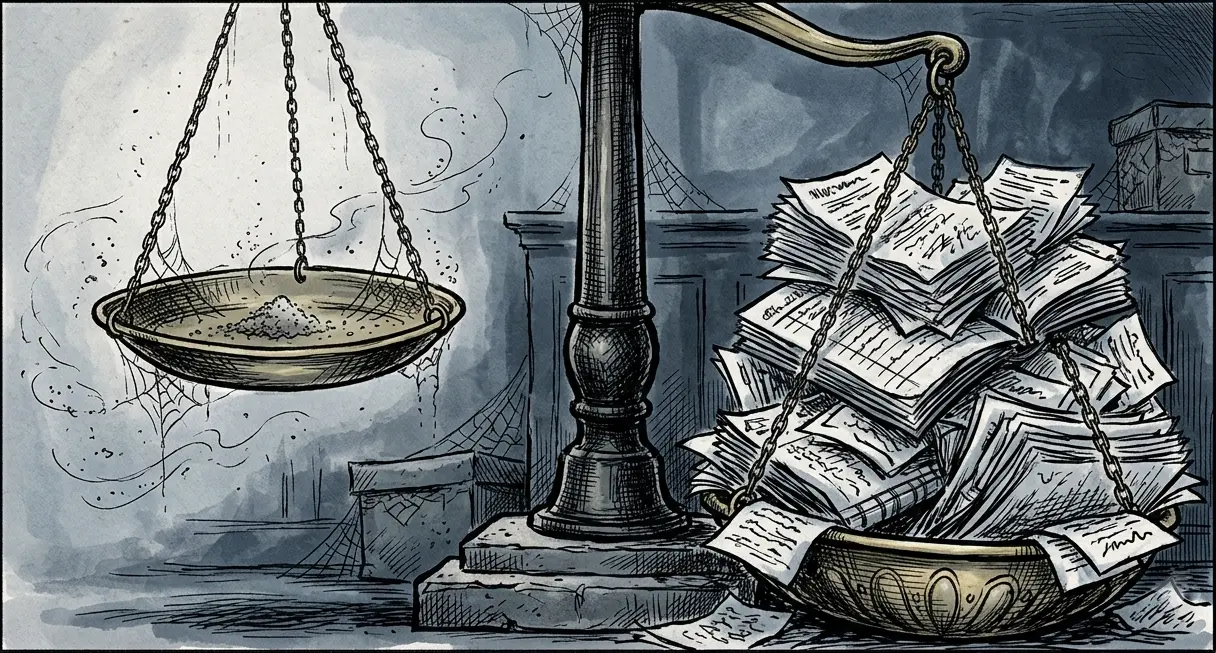
Block 8, Article 10 — Eliminated to Save Less Than Two Congressional Offices
Congress once had its own independent scientific body — and eliminated it to save less than the cost of two congressional offices.
In 1972 Representative Chuck Mosher stood on the House floor and said out loud what every member already knew: “Let us face it, Mr. Chairman, we in the Congress are constantly outmanned and outgunned by the expertise of the executive agencies. We desperately need a stronger source of professional advice and information, more immediately and entirely responsible to us and responsive to the demands of our own committees.” Congress agreed. It built the Office of Technology Assessment. Twenty-three years later it eliminated it. The problem Mosher named in 1972 is worse now than it was then.
— — —
What they built and why.
The OTA was envisioned as an early warning system — an institution whose job was to see what technology was doing before the damage was irreversible, and to tell Congress what it was looking at in plain language that didn’t come from the industry being regulated. It was the first new legislative branch agency in fifty years. Its model was copied by parliaments around the world. Other democracies kept theirs. The United States eliminated its.
For twenty-three years it worked. Energy policy. Environmental risk. Defense procurement. Biotechnology. Telecommunications. Pharmaceutical safety. The questions where a member without a technical background was entirely dependent on whoever happened to be in the room with them — and the people in the room were the industries being regulated. The OTA’s analysts had one obligation: accuracy. Not accuracy convenient for a client. Not accuracy calibrated to a conclusion the industry submitting testimony needed the record to show. The pound on the scale. The weight in the measure. An institution that told Congress what it was actually holding.
Its annual budget was $22 million. Less than the operating cost of two congressional offices.
— — —
What they eliminated and what filled the vacuum.
In January 1995 the new Republican majority eliminated the OTA as part of a package of congressional budget cuts. The savings: $22 million annually.
The Powell Memo had named the problem precisely. Independent expertise — on campuses, in regulatory agencies, in the courts, in the media — was the institutional home of the argument against concentrated corporate power. Powell’s remedy was equally precise: fund the counter-institutions, endow the academic chairs, build the legal pipeline, place people inside the agencies. Not to win the next argument. To remove the institutions that produced the arguments. The OTA was exactly the kind of institution Powell had identified as the enemy: independent, nonpartisan, answerable to accuracy rather than to a client, sitting inside the legislative branch where it could not be captured by the standard means. The political moment that arrived in 1995 had been twenty-four years in preparation.
Congress was left with the lobbyist’s white paper, the think tank’s report, and no institutional mechanism to test either against the evidence.
Eliminating the OTA was framed as a $22 million budget savings inside a much larger deficit-reduction package. The specific capacity being removed — the only body in the legislative branch answerable to accuracy rather than to a client — was not in the frame the savings figure was built to justify.
The information asymmetry that followed is not incidental to the legislative failures of the three decades since. It is present in the architecture of each one. The financial instruments that produced the 2008 collapse were instruments the relevant committees could not evaluate independently — and the people who could were working for the firms issuing them. The pharmaceutical pricing structures that consume a fifth of the American economy passed through committees dependent on industry testimony for their technical understanding of the market. The opioid crisis was a regulatory failure of exactly the kind the OTA existed to prevent — a technology with documented adverse impacts deployed at massive scale before Congress understood what it was approving.
The doubt machine Article 7 documented needed an empty room to work in. Congress obligingly built one.
— — —
DOGE is the OTA elimination at scale.
In 1995 Congress eliminated its own ability to independently verify what the industries before its committees were telling it. In 2025 the executive branch ran the same move across the entire regulatory state simultaneously — with the legal foundation already prepared and waiting.
Loper Bright removed judicial deference to agency expertise. DOGE removed the expertise itself. The agencies targeted were the ones constraining the companies whose personnel staffed DOGE. The CFPB, which regulated consumer financial products. The EPA, which regulated environmental externalities. The NLRB, which enforced labor rights. The FTC, which enforced competition law. Each gutted of staff and institutional memory, its remaining authority challenged in courts that no longer defer to it.
Schedule Policy/Career converted up to 50,000 civil service positions to at-will status — removing the protection that makes it possible for a federal employee to push back on an unlawful directive without losing their job. The whistleblower mechanism moved from the Office of Special Counsel — an external, independent body — to the general counsel offices of the agencies being reported on. The accused now investigates the accusation.
The vacuum is the same as 1995. The people filling it have the same professional interest in filling it a particular way.
— — —
The tool that could rebuild the room.
Congress eliminated the OTA because it lacked the political will to defend it — not because the function became unnecessary. That function is more necessary now than it was then. The AI systems reshaping the labor market, the pharmaceutical pricing structures consuming a fifth of the economy, the climate decisions that will define the next fifty years — Congress is making all of them in the same information vacuum it has operated in since January 1995.
AI built on public research — DARPA, NSF, NIH, the public universities that trained every researcher who built the models — could perform continuous independent technical analysis across every domain Congress is asked to decide. Not the industry’s AI. Not the think tank’s AI. A publicly-owned analytical capacity answerable only to accuracy — the OTA rebuilt with tools that didn’t exist in 1995, available to every member, on every question, continuously. The Sanders bill proposes public ownership of the AI the public funded. That ownership is not only an equity claim. It is the early warning system Congress eliminated in 1995, rebuilt at a scale no human analytical body could match.
The apparatus spent fifty years ensuring Congress would not have independent analytical capacity when it needed it most. The technology to rebuild it now exists. The question is whether the same apparatus that eliminated the OTA will be permitted to capture the tool that could replace it.
The royalty rate the public charged for oil and gas extracted from federal land had not been updated since 1920 when the OTA was eliminated in 1995. It has not been updated since. Congress has had no independent capacity to calculate what that rate costs the public treasury — or what updating it would return. The industries paying the 1920 rate have. The empty room is not a neutral condition. It is a condition with a price, and someone else is collecting it.
— — —
What the reader can do with this.
The verification questions that close this block are not rhetorical. They are a methodology.
Look up your representative — the overlap is not a coincidence. It is the pricing structure made visible.
| Donors & holdings | Find their top ten donors for the last cycle, their committee assignments, and their stock holdings in their public financial disclosure, at opensecrets.org. Note the overlap. |
| DISCLOSE Act record | Find their voting record on the DISCLOSE Act. |
| Town hall access | Find whether they have held an in-person town hall in the last twelve months with open public access and unscreened questions. |
| OTA restoration | Find their position on restoring independent congressional technical capacity. |
Then ask them the question their oath requires them to answer:
You swore to support and defend the Constitution of the United States and to well and faithfully discharge the duties of your office. Article I, Section 8 charges Congress to provide for the general welfare of the United States. Please explain how eliminating the institution whose job was to tell you what you were actually voting on advances the general welfare of your constituents rather than the specific welfare of the industries that funded your campaign.
They cannot be required to answer. The oath does not enforce itself. The apparatus documented across these ten articles was built precisely to ensure it never has to. But the question is on the record. The mechanism is visible. The room is no longer dark for anyone who has read this far.
Block 9 — The Darkened Room — documents how the public information infrastructure that might have made any of this visible was systematically dismantled by the same apparatus. Block 10 — The Commons Outcome — shows the balance sheet.
— — —
Steve Sagnotti
is a serious amateur photographer, writer, and technologist based in Oregon. With his camera he tries to capture common images not often seen, leading to common questions not often asked.
© 2026 Steve Sagnotti
— — —
Sources
1. Mosher, Chuck. House floor debate on Technology Assessment Act. Congressional Record, 1972.
2. Technology Assessment Act of 1972. Pub.L. 92-484. govinfo.gov
3. OTA terminated January 1995. Annual budget $22 million.
4. OTA legacy archive: Princeton University. ota.fas.org
5. Loper Bright Enterprises v. Raimondo, 603 U.S. ___ (2024). supremecourt.gov
6. ProPublica. “The DOGE 100.” June 10, 2025. propublica.org
7. Federal News Network. “Big, Beautiful Bill gives new feds a choice.” June 11, 2025.
8. Schedule Policy/Career Executive Order: issued January 20, 2025; implementation order June 3, 2026.
9. 5 U.S.C. § 3331. Congressional Oath of Office. law.cornell.edu
10. U.S. Constitution. Article I, Section 8. constitution.congress.gov
11. OpenSecrets.org donor and committee assignment database. opensecrets.org
12. U.S. House Financial Disclosures. efts.house.gov
13. Sanders, Bernie. “The Public Should Own Half of the Big A.I. Companies.” New York Times Opinion. June 1, 2026.
14. CFPB dismantlement: NTEU v. Vought litigation, D.C. Circuit.
15. Schedule Policy/Career 50,000 figure: OPM final rule, February 2026.
Leave a Reply