Block 12, Article 8 — Not a Check. An Inheritance, Kept This Time.
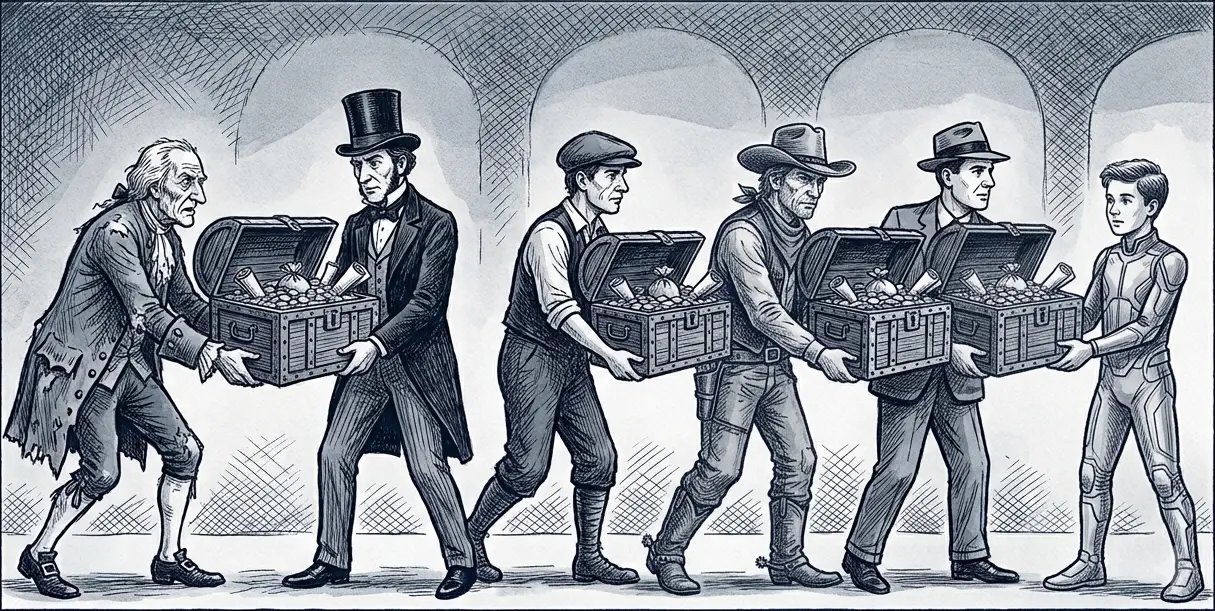
This series opened by describing what was here — an aquifer that took the Pleistocene to fill, a cod stock that fed a coastline for five centuries, forests that took a millennium to grow, a body of public knowledge built by generations of publicly funded research. Every mechanism this series has documented since is the story of that inheritance being taken, at rates set by the people doing the taking, faster than any of it could replace itself. The question this article exists to answer is not what a repaired room administers. It’s what a repaired room hands forward — not a check, not a program, but the thing itself, restored enough that the next generation can actually stand in it, drink it, fish it, walk into it, and use what took centuries to build without paying a stranger for the privilege of touching what should already have been theirs.
Water that isn’t gone
The Ogallala Aquifer took the end of the last ice age to fill and is being drawn down in decades. A repaired room doesn’t produce a subsidy for the farms drawing it dry. It produces an aquifer that still has water in it when the people being born today are raising their own children — recharge rates that exceed extraction, drilling limits enforced before the wells run dry rather than after, the difference between an heirloom and a countdown. The alternative this series has already documented in full: communities drilling deeper every year, chasing a water table that keeps dropping, until deeper isn’t possible anymore and the answer is simply gone.
A fishery that wasn’t allowed to hit one percent
The Atlantic cod stock collapsed to roughly one percent of its historical population before Canada imposed a moratorium that lasted three decades — five hundred years of a coastal culture ended inside a single generation because a resource that renews itself, if left alone, was not left alone. A repaired room produces a fishery that never has to be shut down for thirty years to partially recover, because the extraction rate was never allowed to outrun the replacement rate in the first place. What gets handed forward is not a bailout for fishing communities after the collapse. It’s a coastline where the collapse never had to happen.
A forest you can actually walk into
This series has already documented what happens when public forests are logged at a public loss and then, when the logging stops, simply abandoned — roads nobody maintains, campgrounds run by a concessionaire whose reservation system holds a quarter of the sites empty and paid-for while the family that drove there finds no vacancy. A repaired room doesn’t produce a forest managed for someone else’s convenience. It produces a forest a family can actually reach, actually use, actually camp in without a private company standing between the public and the land the public already owns. The trees the CCC planted are still standing ninety years later. The question is whether the public still has a road that reaches them.
Knowledge that comes back to the people who paid for it
The public funded the basic research behind nearly every major pharmaceutical breakthrough of the last half-century, through the National Institutes of Health, and then watched the resulting patents get sold back to the same public at prices the public’s own investment never justified. A repaired room doesn’t produce a rebate program. It produces a body of publicly funded knowledge that stays at least partially public — march-in rights actually used when a publicly funded invention is priced out of reach of the public that paid to invent it, not left dormant for forty-five years while the industry that benefits from the dormancy quietly ensures it’s never tested.
What this inheritance actually requires
None of these four things — water, fish, forest, knowledge — is a policy in the ordinary sense. Each is closer to a trust: something held for people who don’t yet exist, by people who could extract it faster than they could ever be caught, and mostly chose not to only because a room existed that made the extraction cost something. That is a different, harder standard than “the program works.” A program can work for a decade and still fail the only test that matters for an inheritance, which is whether it’s still there in fifty years, under a different government, after everyone who built it has left the room.
Restoration like this gets framed, when it gets discussed at all, as a cost — a subsidy for farmers, a burden on the general fund, a program competing with other programs for a finite budget. What isn’t in that frame is the ledger’s other half: the extraction that emptied the aquifer, collapsed the fishery, and clear-cut the forest was never counted as a cost when it happened. Only the repair gets billed. The drawdown got called growth.
That is exactly the question the strongest published disagreement with this series’ whole approach doesn’t answer. Brink Lindsey and Steven Teles — a libertarian and a liberal, writing together in The Captured Economy — reach a diagnosis structurally similar to this series’ own: regulatory capture across finance, intellectual property, licensing, and zoning enriches incumbents at everyone else’s expense. Their prescription is sustained public-interest vigilance at the obscure hearings where captured rules currently get written unopposed. It is a serious argument, and it deserves to be tested against the actual stakes just named — not “does this reform survive,” but “is a five-century fishery, a Pleistocene aquifer, still here for the great-grandchildren of the people reading this.”
The next article runs that test.
The Ogallala’s current recharge-versus-extraction data is public via USGS; NOAA publishes cod stock assessments annually; the National Park Service’s own historical record documents CCC-built infrastructure still standing.
Ask an AI: “What would it take for the Ogallala Aquifer’s extraction rate to fall below its natural recharge rate, and has any U.S. state actually achieved that for a comparable aquifer?”
— — —
Steve Sagnotti
is a serious amateur photographer, writer, and technologist based in Oregon. With his camera he tries to capture common images not often seen, leading to common questions not often asked.
© 2026 Steve Sagnotti
— — —
Sources
1. Ogallala Aquifer recharge/extraction data: usgs.gov: High Plains Aquifer Groundwater Levels Continue to Decline.
2. Atlantic cod stock collapse to ~1% of historical levels, 1992 moratorium: Canadian Department of Fisheries and Oceans (via secondary sourcing) — Britannica — Cod fishery collapse of 1992; Wikipedia — Collapse of the Atlantic northwest cod fishery.
3. CCC infrastructure — ~3 billion trees planted, 1933-1942, 711 new state parks built, 800 more improved: CCC Legacy — History of the CCC (1933–1942) (confirms exact figures: 3 billion trees, 711 new state parks, 800 improved); HISTORY.com — 6 Projects the Civilian Conservation Corps Accomplished; National Park Service — The Civilian Conservation Corps.
4. NIH cumulative research investment; march-in rights, Bayh-Dole Act: already established in Block 10 sourcing — no new link needed.
5. Lindsey, Brink and Steven M. Teles. The Captured Economy: How the Powerful Enrich Themselves, Slow Down Growth, and Increase Inequality. Oxford University Press, 2017: confirmed accurate — publisher record — Oxford University Press (232 pp., ISBN 978-0-19-062776-8, published November 10, 2017).
Leave a Reply