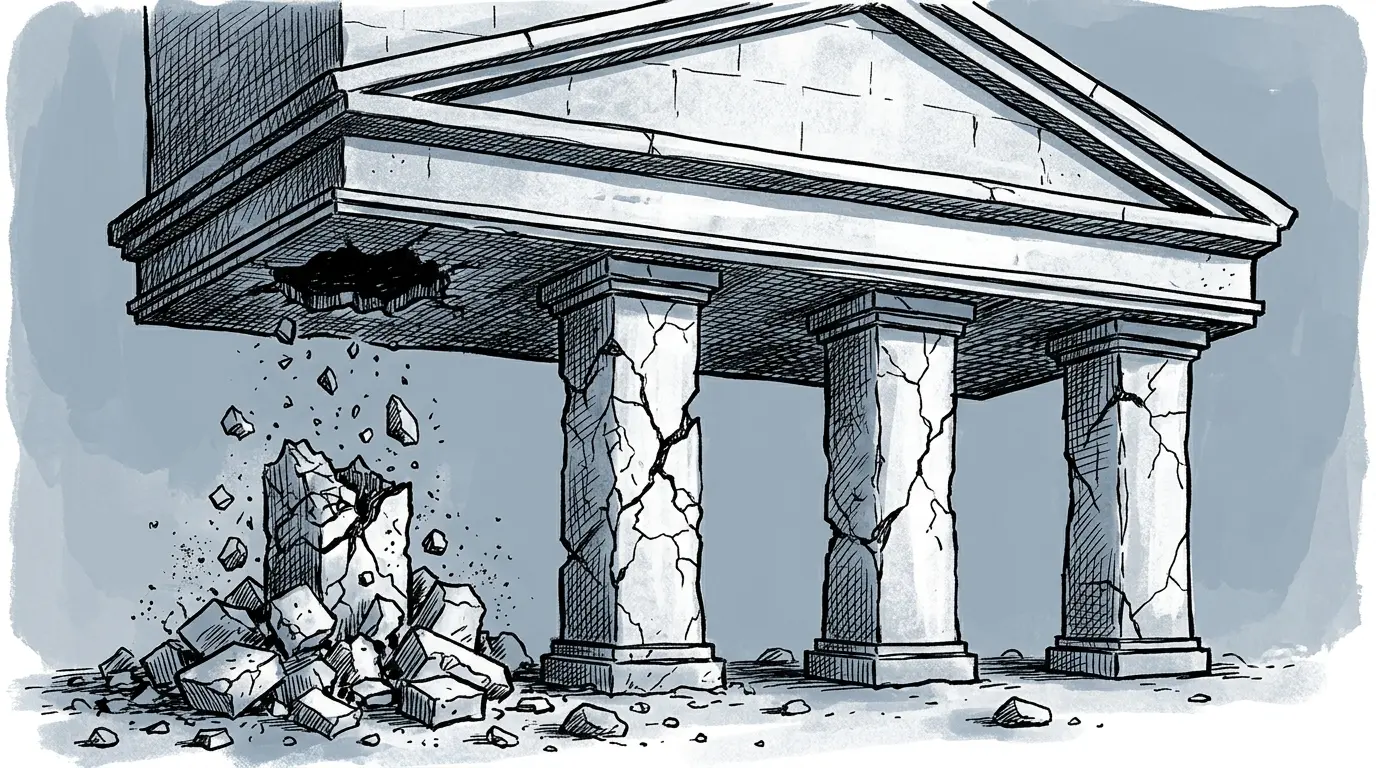
Block 11, Article 3 — The Knot Cannot Be Untied One Strand at a Time
The debt can be paid down. A functioning room could write the tax code differently, raise revenue, service the obligations, and stabilize the trajectory. The workforce disruption is recoverable — the same people being displaced by automation are the people who could build the infrastructure a sovereign wealth fund would finance, the public works a repaired room could authorize. These are political problems. Political problems have political solutions.
The third pillar is different.
The aquifer that took six million years to fill.
The Ogallala Aquifer took six million years to fill. In the southern plains — the Texas Panhandle, western Kansas, eastern Colorado, the Oklahoma panhandle — it is being drawn down at rates between one and three feet per year. Nature replenishes it at roughly half an inch. Agriculture accounts for approximately 94 percent of what is extracted, but the aquifer is also the drinking water, the cooking water, the industrial supply, and the waste treatment source for the 1.9 million people living within its boundary — 82 percent of everyone whose address sits above it. In Kansas, the aquifer supplies 70 to 80 percent of all water used in the state each day: irrigation, yes, but also every city, every school, every hospital, every factory, every tap. When the southern portions can no longer support pumping, it is not only the farms that end. It is the towns.
The aquifer supports 20 percent of the nation’s wheat, corn, cotton, and cattle production — one fifth of the total annual U.S. agricultural harvest. Forty percent of the nation’s beef supply comes from this region. If it goes, more than $20 billion worth of food and fiber vanishes from world markets, grocery prices move nationally, and forty percent of the nation’s beef supply reorganizes from scratch. There is no surface water alternative available at the scale required.
The crops being grown are themselves part of the problem. Corn — water-intensive, aquifer-dependent, grown across millions of High Plains acres — is not primarily food. Approximately 40 percent of U.S. corn production goes to feeding livestock and roughly another 40 percent supplies the ethanol industry. The aquifer is being spent to produce animal feed and fuel. The communities above it will need drinking water long after the feedlots are gone.
The law rewards whoever pumps fastest. A farmer who conserves loses that water to the neighbor who keeps pumping. The aquifer depletes regardless.
Forty years of voluntary conservation programs have not slowed the decline. Some farmers have adopted drip irrigation, which can save 30 to 60 percent compared to conventional sprinkler systems. But efficiency gains in a prior appropriation system do not reduce total extraction — they enable more acres to be irrigated, thirstier crops to be grown, the savings consumed by expansion. Cotton acreage has increased substantially in Texas and Kansas over the last four years — one of the thirstiest crops, expanding in the driest part of the aquifer. The Kansas Geological Survey recorded water table drops of more than a foot in 2024 alone.
The people closest to the ground know what is happening. Kansas passed a law in 2023 requiring groundwater districts to produce conservation plans — it cleared the legislature 116 to 6. The plans were due in 2026. They are not pumping limits. They are plans. The law that makes conservation individually irrational remains intact. The Farm Bill that subsidizes production regardless of water use is written in the same room that has known about the decline for forty years and left the requirements voluntary.
Within 50 years the entire Ogallala is projected to be 70 percent gone. In the Texas Panhandle and western Kansas the timeline is measured in decades, not centuries. The aquifer that took six million years to fill will be functionally depleted in those regions within the working lifetime of a child born today. No federal royalty was ever charged for the water. No replacement cost was ever assessed. The extraction was free. When it ends, the communities built around it will still be there. The water will not.
Depletion is not the only clock running underneath the Ogallala. Block 10 documents a second, faster one: the same aquifer sits directly above the Permian Basin’s fracking wastewater injection zones, and may not stay clean long enough for the depletion timeline to be the thing that ends it first.
The fishery that fed a civilization.
The Atlantic cod fishery sustained New England for four centuries. By 1992, thirty years of documented overharvest had ended it — Northern cod populations fell to one percent of historic levels. Canada imposed a moratorium. More than thirty years have now passed. In June 2024, Canada announced the end of the moratorium, calling it a historic milestone. The total allowable catch was set at less than ten percent of the 1992 quota, which itself was a fraction of peak levels. Scientists say the stock remains stagnant and unhealthy.
The fishery did not disappear. It was replaced. Fishers shifted to crab, shrimp, and other shellfish. Consumers shifted to Alaskan pollock, tilapia, farmed salmon. The market adapted. The adaptation cost more and traveled farther — Alaskan pollock and farmed salmon cross continents where cod crossed a harbor. The supply chain is longer, more energy-intensive, and more vulnerable to the same disruptions that now threaten the Ogallala. That is what unrecoverable looks like in practice. Not zero — permanently degraded and replaced by something worse at higher cost. The Georges Bank, which fed a civilization for three centuries, reorganized around different species and did not return to what it was. The fishing communities that built their lives on the assumption of a renewable resource inherited the empty water. The resource did not come back.
The senators who sat on the committees setting catch limits received contributions from the industry exceeding those limits. The pattern is identical to the one documented across every block of this series. The room was occupied. The resource was exhausted. The public paid the residual.
The soil that took millennia to form.
The Corn Belt has lost 57.6 billion metric tons of topsoil over 160 years of industrial agriculture. More than a third of its farmland has completely lost its A-horizon — the biologically active layer that took millennia to form at roughly one inch per five hundred years. Iowa farmers today work 6.8 fewer inches of topsoil than their great-grandparents did. The annual erosion rate runs ten to twenty-five times faster than the formation rate. No technology recreates A-horizon topsoil on any agricultural timescale.
The response to falling yields from eroded soil is to apply more chemical fertilizer. This does not work. A third of the Midwest is currently losing 50 percent of its fertilizer to runoff — the plants on depleted soil are stunted, smaller, and cannot take up the nitrogen regardless of how much is applied. The PNAS study that documented the topsoil loss found yields had declined six percent from erosion alone, producing nearly three billion dollars in annual economic losses. Overfertilization of low-yielding eroded areas in the Midwest costs an additional half billion dollars a year. The farmer pays twice: once when the soil washes away, once when the fertilizer follows it.
The fertilizer that washes off eroded fields does not disappear. It travels down the Mississippi River, accumulates at the Gulf of Mexico, feeds algae blooms that die and consume oxygen, and produces a dead zone that in 2024 was measured at approximately 6,705 square miles — an area roughly the size of New Jersey, more than 3.5 times larger than the reduction target a federal task force set in 1997. That task force has been working to shrink the dead zone for nearly thirty years. The five-year average has not reached the interim target. The Trump administration is now scaling back the federal agencies that monitor it.
The topsoil leaves the field. The fertilizer applied to compensate also leaves the field. Both arrive in the Gulf. The commons is depleted at the top of the Mississippi and destroyed at the bottom simultaneously.
The war that changed the price of the fix.
The fertilizer the Corn Belt applies to compensate for depleted topsoil is not domestically self-sufficient. Natural gas is the primary feedstock — 70 to 80 percent of production cost — for nitrogen fertilizers including urea and anhydrous ammonia. The Persian Gulf region supplies approximately 30 to 35 percent of global urea exports and 20 to 30 percent of global ammonia exports. Up to 30 percent of all globally traded fertilizer passes through the Strait of Hormuz.
On February 28, 2026, the United States and Israel launched strikes on Iran. The Strait closed to normal shipping. Within days, crude oil surged above $110 per barrel. Urea prices jumped approximately 50 percent. Ammonia prices jumped approximately 20 percent. In Illinois, anhydrous ammonia went from $828 per ton before the conflict to $1,123 per ton by April — more than $20 per acre in additional cost arriving at spring planting. American farmers are the world’s largest importers of urea. Even where the U.S. does not import directly from the Gulf, fertilizer is a globally integrated market. The price moved everywhere.
The war whose cost Article 2 documented — $11.3 billion in the first six days, $40 to $50 billion true cost including base repairs, a $1.5 trillion defense budget request — closed the chokepoint through which a third of global fertilizer supply moves. The Corn Belt farmer paying $1,123 a ton for anhydrous ammonia to compensate for soil his great-grandparents depleted is paying the compounded price of decisions made across 160 years. The bill just got larger because of a war partly financed by borrowed money on the trajectory Article 2 documented. The UN World Food Programme estimates that if the conflict continues beyond June 2026 with oil prices above $100 per barrel, the number of people facing acute hunger globally could increase by 45 million.
What the market confessed.
State Farm stopped writing new homeowners insurance policies in California in 2023. Allstate, AIG, and Chubb followed. The January 2025 Los Angeles wildfires produced $1.08 billion in catastrophe losses for Allstate in a single month. In 2025 the California Department of Insurance approved an emergency 17 percent rate increase for State Farm; further increases are pending.
California is the leading edge, not the exception. Arizona homeowners insurance premiums rose 94 percent between 2021 and 2025 — the largest increase in the country. Idaho premiums rose 88 percent; total homeowner policies statewide fell nine percent in a single year as insurers nonrenewed en masse. Washington and Colorado premiums rose above 80 percent. Oregon premiums rose more than 27 percent. The pattern is the same across the forested western states: insurers are pricing the wildfire risk and exiting where it exceeds profitable coverage thresholds. The person with the five-acre property in the ponderosa pines east of the Cascades faces a specific trap — the lender requires insurance to hold the mortgage, the insurance is unaffordable or unavailable, and the property becomes unmortgageable and therefore unsellable. The market is not failing. It is functioning. It is pricing what the political system declined to price for a century.
The private insurance market has no mechanism for distributing that cost across the system that produced it. It can only price it onto the individual homeowner or exit. It is exiting.
When the private market exits, the public becomes the insurer of last resort. California’s FAIR Plan has seen its exposure grow from $153 billion in 2020 to over $458 billion by late 2023 — a tripling in three years. Texas and Oregon FAIR Plan enrollment is growing on the same trajectory. The National Flood Insurance Program carries the same function federally: private insurers won’t write flood coverage in high-risk areas, so the federal government does, at rates chronically below actuarial cost, accumulating a debt that stood at approximately $20 billion before the 2017 hurricane season and has grown since. Every one of these public backstops draws on the same treasury the debt spiral documented in Article 2 is already draining.
State Farm didn’t make a political argument. It did the math. The externalized cost of a century of carbon emissions lands somewhere. It is landing on the public balance sheet — and on the homeowner in Idaho who cannot sell a property the market has decided is in a fire zone.
The knot.
These are not separate ledgers. The aquifer depletion feeds the fertilizer demand. The fertilizer demand flows to the Gulf dead zone. The war that closed the Strait of Hormuz raised the price of the fertilizer that compensates for the topsoil that is already gone. The insurance market exit pushes the climate cost onto state FAIR Plans and federal flood programs that draw on the same treasury the debt spiral is draining. Every thread runs to the same public balance sheet.
The narrow frame — each crisis managed separately, in its own committee, by members whose campaigns were funded by the industries that benefit from the separation — is not an analytical choice. It is a structural requirement of the extraction apparatus. The knot cannot be untied one strand at a time.
That is not a coincidence. That is the design.
The ledger that was closed.
In April 2022, President Biden signed Executive Order 14072, creating a framework for natural capital accounting — a system to measure the value of ecosystem services, track depletion, and put the cost of extraction on the federal books. For the first time, the government would begin counting what it was spending.
It was reversed on Day One of the new administration in January 2025.
Reversing natural capital accounting was framed as removing a regulatory burden. That the order did nothing but measure — that reversing it stopped no extraction and only guaranteed the damage would stay off the books — was not in that frame.
The measurement system that would have made the aquifer depletion visible, quantified the topsoil loss, tracked the fishery collapse, and documented the climate risk the insurance market is now pricing — terminated before it produced its first report. The damage continues to compound off-book. The insurance market exits make it briefly visible. The news cycle moves on. The depletion continues.
The room that cannot measure what it has spent cannot begin to repair it. Article 4 shows what that room looks like from the inside.
The record is public. Look it up:
| USGS, Groundwater Depletion in the United States | usgs.gov/special-topics/water-science-school |
| PNAS, Extent of soil loss across the U.S. Corn Belt | pnas.org/doi/10.1073/pnas.1922375118 |
| NOAA, Gulf of Mexico hypoxic zone annual forecast | oceanservice.noaa.gov/hazards/hypoxia |
| farmdoc daily, Fertilizer Cost Increases from Iran Conflict | farmdocdaily.illinois.edu |
| California FAIR Plan exposure data | insurance.ca.gov |
Ask an AI assistant: “What is the connection between Corn Belt topsoil loss, fertilizer runoff, and the Gulf of Mexico dead zone — and how has the Iran war affected fertilizer prices for American farmers?”
— — —
Steve Sagnotti
is a serious amateur photographer, writer, and technologist based in Oregon. With his camera he tries to capture common images not often seen, leading to common questions not often asked.
© 2026 Steve Sagnotti
— — —
Sources
- Ogallala 94% agricultural / 82% of people for drinking water: USDA Climate Hubs Ogallala Overview (2024) — Impacts to the Ogallala Aquifer: An Overview of Selected Papers; Dennehy et al. 2002 — The High Plains Aquifer, USA: Groundwater development and sustainability.
- 20% of nation’s wheat, corn, cotton, cattle; 40% of beef: Texas & Southwestern Cattle Raisers Association — Ogallala Aquifer questions and answers; USDA-funded Ogallala Aquifer Program — USDA Expands Investment in Water Conservation and Improvement in Nation’s Largest Aquifer.
- 40% corn to livestock, ~40% to ethanol: USDA ERS data — Corn-based ethanol production in the United States has plateaued in recent years; Feed Grains Database.
- Drip irrigation 30–60% savings; efficiency rebound; cotton acreage increase in TX and KS: industry and USDA reporting — The efficiency of drip irrigation unpacked; As the Ogallala Aquifer Dwindles, West Texas Farmers Face a Future Without Irrigated Crops; Irrigation Efficiency – Ogallala Aquifer Program.
- Kansas 116-6 vote 2023: Kansas House passed the groundwater management district accountability bill 116-6 (companion Senate vote 34-6) — New laws increase accountability for Kansas water districts, set aside conservation funding (Kansas Reflector); With the Ogallala Aquifer drying up, Kansas ponders limits to irrigation (KMUW); With the Ogallala Aquifer drying up, Kansas ponders limits to irrigation (KCUR); A key Kansas water source is in trouble. Gov. Kelly wants to preserve it in new proposal (The Beacon).
- 70% depletion in 50 years; topsoil loss 57.6 billion metric tons; Iowa 6.8 inches topsoil loss: USDA NRCS — Impacts to the Ogallala Aquifer: How Changes in Long-term Weather Patterns…Affect the Aquifer; Midwestern US has Lost 57.6 Billion Metric Tons of Soil Due to Agricultural Practices (UMass Amherst); Soil Erosion 101 (NRDC, citing NRCS).
- 6% yield decline / $3 billion annual loss: PNAS 2021 Corn Belt study (Thaler, Larsen, Yu; 6±2% yield reduction, $2.8±0.9B annual loss) — The extent of soil loss across the US Corn Belt.
- Gulf dead zone 2024 size: measured at 6,705 square miles in 2024 (12th-largest on record) — NOAA/NCCOS, August 2024 — Above Average Summer 2024 ‘Dead Zone’ Measured in Gulf of Mexico.
- Cod collapse to 1% in 1992: Wikipedia — Cod; Collapse of the Atlantic northwest cod fishery; Britannica — Cod fishery collapse of 1992. (I could not verify a source called “ScienceInsights” — flag that citation for replacement or removal.)
- 2024 moratorium end, catch under 10% of 1992 quota: the 1992 pre-moratorium quota was 185,000 metric tons (Canadian Geographic, citing DFO historical data) — The cod delusion; the 2024 reopening quota was 18,000 metric tons (Britannica — Cod fishery collapse of 1992; The Globe and Mail — Ottawa ends decades-long ban on Newfoundland’s Northern cod fishing; SeafoodSource — Canada doubles quota one year after reopening Northern cod fishery). 18,000/185,000 ≈ 9.7%.
- Arizona 94% / Idaho 88% premium increases: Newsweek (May 8, 2026), citing insurance industry data — Map Shows Where America’s Home Insurance Crisis Is Hitting Hardest.
- Oregon premiums up 27%: Consumer Federation of America data, reported by Oregon Capital Chronicle and OPB (January 2026) — Oregon bill would require home insurers to consider wildfire prevention efforts. (I could not separately verify an OPB version of this story — flag for confirmation or removal.)
- FAIR Plan $153B to $458B: California FAIR Plan exposure data, 2020–2023 — California homeowners insurance: Current state of the market and implications of the Los Angeles wildfires (Milliman). Note: Milliman’s figures run September 2020–September 2024, not 2023 — worth double-checking your intended date range.
- NFIP $20B+ pre-2017: National Flood Insurance Program debt figures — Reauthorizing the National Flood Insurance Program (AAF, citing GAO: $24.6B as of March 2017).
- EO 14072 reversal: revoked as item (x) in EO 14154, “Unleashing American Energy,” signed January 20, 2025 — Unleashing American Energy – The White House; Federal Register: Unleashing American Energy.
- Urea up 50%, ammonia up 20%: Oxford Economics/Alpine Macro via CNBC (March 2026) — Fertilizer prices surge amid Iran war, sparking food security warnings; farmdoc daily — Nitrogen Prices Remain in Focus After Iran Conflict.
- 30% of global fertilizer through Hormuz: up to 30% of globally traded fertilizer products transit the Strait of Hormuz — The Iran war’s impacts on global fertilizer markets and food production (IFPRI, citing 2024 data); the Persian Gulf region provides 30-35% of global urea exports and 20-30% of ammonia exports — Understanding How the Strait of Hormuz Conflict Is Disrupting Global Fertilizer Supply Chains.
- 45 million additional people facing acute hunger: UN World Food Programme estimate — WFP projects food insecurity could reach record levels as a result of Middle East escalation.
Leave a Reply