Block 9, Article 1 — A Republic, if You Can Keep It
Philadelphia, September 17, 1787. The Constitutional Convention has ended. Benjamin Franklin makes his way to the home of Elizabeth Powel, one of the city’s most prominent political hostesses, where the delegates have gathered. She asks him what they’ve built. He answers in five words.
A republic, if you can keep it.
Not a celebration. A condition. A republic is not self-maintaining. It is not preserved by the act of founding it. It requires, continuously and actively, a citizenry capable of seeing what is being done in its name and holding to account the people doing it. Franklin had just spent four months in a room with men of property and influence designing a system of government. He understood what those men were capable of when the public was not watching. The warning was not abstract civic sentiment. It was the observation of someone who had just seen the room.
Jefferson, in Paris that summer rather than Philadelphia, supplied the mechanism of loss: a nation that expects to be ignorant and free expects what never was and never will be. Together the two sentences define the founding condition. Self-government requires an informed citizenry. The infrastructure built to meet that condition — a free press, public information, independent expertise, accessible government data — was not decoration. It was the operating requirement.
They were not alone in saying so. James Madison, writing in 1822 — thirty-five years after the convention, the republic still finding its footing — put it with the precision of a man who had watched governments fail: “A popular Government without popular information, or the means of acquiring it, is but a Prologue to a Farce or a Tragedy, or perhaps both. Knowledge will forever govern ignorance: And a people who mean to be their own Governors, must arm themselves with the power which knowledge gives.” Those words are now inscribed at the entrance to the Library of Congress James Madison Memorial Building. The institution that houses the republic’s knowledge carries the warning on its wall.
Franklin said it. Jefferson said it. Madison had it inscribed in stone. They kept saying it. Nobody kept it.
Washington, D.C., January 17, 1961. Dwight Eisenhower delivers his farewell address three days before handing power to John F. Kennedy. He is a five-star general, Supreme Allied Commander of the liberation of Europe, a two-term president. He is not given to alarm. What he says next has been partially remembered and mostly ignored.
He warns about the military-industrial complex. Everyone remembers that part. Two paragraphs later he says something more precise:
“The prospect of domination of the nation’s scholars by Federal employment, project allocations, and the power of money is ever present and is gravely to be regarded. Yet, in holding scientific research and discovery in respect, as we should, we must also be alert to the equal and opposite danger that public policy could itself become the captive of a scientific-technological elite.”
Read it again. A president leaving power is warning that concentrated private money can capture the institutions that produce knowledge and shape public understanding. He is describing, twelve years before Lewis Powell wrote his memo, the precise mechanism the Powell apparatus would execute. He is not describing a hypothetical. He is describing what he watched from the inside for eight years.
What the warning required, to mean anything at all, was the infrastructure to act on it. A citizenry that can see what is being done in its name needs somewhere to look. It needs reporters at the county water board meeting. It needs a local paper covering the school board vote. It needs broadcast licensees who are required, as a condition of using a public resource, to present the public’s own business to it without fear or favor.
That infrastructure existed. It was built deliberately, over decades, on the principle that self-government is not self-executing — that it requires an information commons the way an engine requires air.
The information commons was not a separate project from the physical commons. It was the precondition. You cannot organize to protect an aquifer you don’t know is being drained. You cannot vote against a royalty structure whose existence has never been reported. The founders understood this. The infrastructure they named was not decoration. It was the mechanism by which a citizenry could see what was being done to everything else it owned.
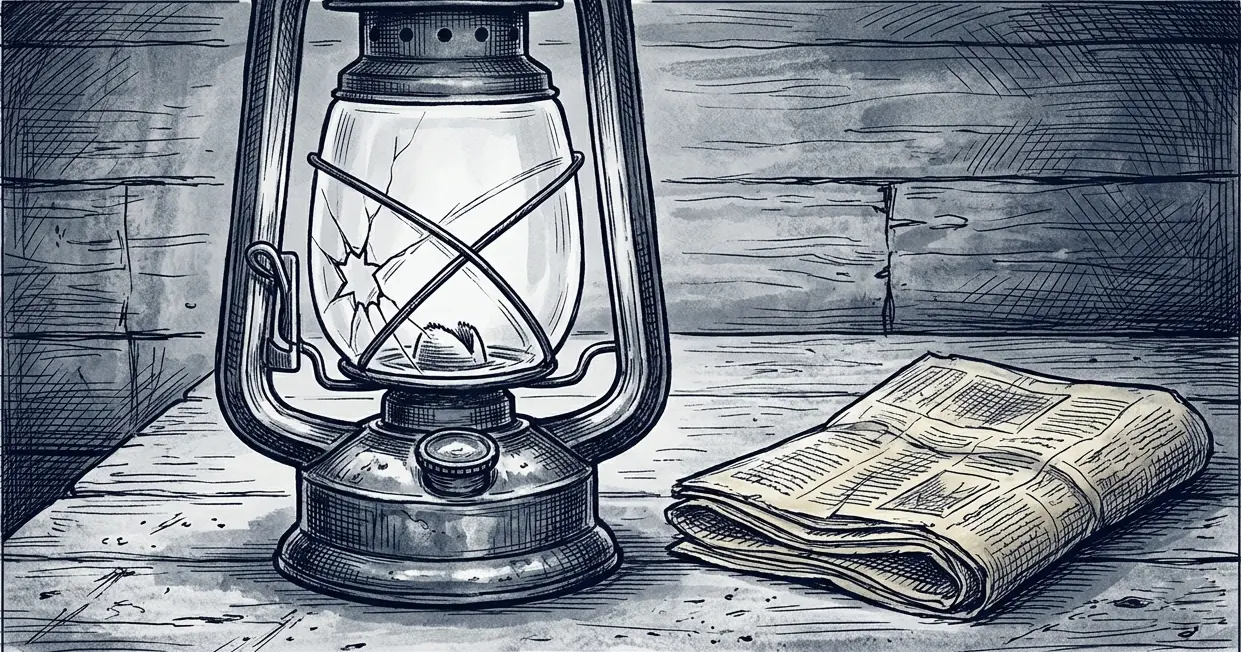
Then the room went dark.
Not all at once. Not with an announcement. The Fairness Doctrine went first, in 1987. Then the ownership limits. Then the business model. Then the local paper. Then the county reporter. The next articles document each step. Every mechanism in Blocks 2 through 8 — the map, the door, the bench, the pipeline — depends on someone being able to see it operating. When the room that would have shown it goes dark, the mechanisms don’t stop. They just stop being visible to the people they govern.
The most recent step came on February 4, 2026. CIA Director John Ratcliffe — sworn in thirteen months earlier, appointed by President Trump, the 25th director in the agency’s history — discontinued the World Factbook. Sixty-four years of freely accessible public reference data on every nation on earth. Used by students, journalists, researchers, and citizens worldwide. Gone with no congressional vote, no public debate, no explanation given. Ratcliffe cited the agency’s core missions. The public’s reference to the world was not among them. Twenty-four directors across twelve administrations, Democratic and Republican, had maintained it as a public resource. The twenty-fifth ended it in year one.
No authority was required beyond administrative discretion. The Factbook was not a congressionally mandated publication. It was a public resource that a director could create and a director could end. The same logic that eliminated the Fairness Doctrine in 1987. The same administrative discretion that has been applied, systematically, to every institution that helped the public see what was being done in its name.
The Factbook’s discontinuation was framed as an internal reallocation of the agency’s resources toward its core missions. Sixty-four years of free public access to reference data used by researchers, students, and journalists worldwide — and what disappears from public reach when it ends — was not in the frame.
The founders named the condition. Eisenhower named the threat. The twenty-fifth director removed one more piece of the public record.
A republic, if you can keep it.
Look up whether the CIA World Factbook survives in any archived form
The Internet Archive’s Wayback Machine holds snapshots of the CIA’s own version going back years. Then check whether any other federal open-data resource has been discontinued since January 2025 without a congressional vote. The information commons doesn’t announce its own closures. You have to go looking.
— — —
Steve Sagnotti
is a serious amateur photographer, writer, and technologist based in Oregon. With his camera he tries to capture common images not often seen, leading to common questions not often asked.
© 2026 Steve Sagnotti
— — —
Sources
1. Franklin: James McHenry diary, September 18, 1787. Max Farrand, ed., The Records of the Federal Convention of 1787 (Yale University Press, 1911). Manuscript Division, Library of Congress.
2. Jefferson: Thomas Jefferson to Charles Yancey, January 6, 1816. Library of Congress. https://founders.archives.gov/documents/Jefferson/03-09-02-0209
3. Madison: Letter to W.T. Barry, August 4, 1822. The Writings of James Madison, ed. Gaillard Hunt (1910), Vol. 9, p. 103. https://press-pubs.uchicago.edu/founders/documents/v1ch18s35.html
4. Eisenhower: Farewell Address, January 17, 1961. Eisenhower Presidential Library. eisenhowerlibrary.gov
5. Ratcliffe confirmation: CIA, January 23, 2025. cia.gov
6. CIA World Factbook discontinuation: AP, February 4, 2026. CNN, February 5, 2026. cnn.com
Leave a Reply