Block 7, Article 2 — Same Amendment. Different Outcomes. Consistent Beneficiaries.
Steve Sagnotti · thebrokenframes.substack.com
In 1868 Congress ratified the Fourteenth Amendment. Section 1 established the citizenship and constitutional rights of formerly enslaved people. The language was direct: all persons born or naturalized in the United States are citizens. No state shall deprive any person of life, liberty, or property without due process of law, nor deny any person the equal protection of the laws.
Person. Due process. Equal protection.
The amendment was written for human beings who had been treated as property. Within twenty years it was being used primarily by corporations.
The headnote that became precedent
Santa Clara County v. Southern Pacific Railroad reached the Supreme Court in 1886 on a tax dispute between California and a railroad company. Before oral argument the Chief Justice stated from the bench that the Court did not wish to hear argument on whether the equal protection clause of the Fourteenth Amendment applied to corporations — all the justices, he said, were already of the opinion that it did.
That statement was not in the Court’s written opinion. It was not a majority ruling. It was not a holding of any kind. It was a prefatory remark, recorded only in a headnote written by the court reporter — a man named Bancroft Davis, who had previously worked as a railroad executive.
That headnote was subsequently cited in later cases as though it were a judicial decision. It became the legal foundation for corporate personhood under the Fourteenth Amendment. Not a Supreme Court holding. Not a vote. A former railroad executive’s summary of a remark made before argument began, elevated to precedent by repetition. It was challengeable from the start — headnotes have no binding authority, and the opinion itself never addressed corporate personhood at all. The doctrine that holds prior decisions in place — stare decisis — kept it there. The same doctrine that would later abandon forty years of agency deference in Loper Bright and forty-nine years of reproductive rights in Dobbs. Stare decisis, it turns out, is sturdier in some directions than others.
Between 1868 and 1912 the Supreme Court heard 28 cases involving the rights of Black Americans under the Fourteenth Amendment and 312 cases involving the rights of corporations. The people the amendment was written to protect lost most of their cases. The corporations that appropriated its language won most of theirs.
The logic that kept running
The Fourteenth Amendment gave personhood to formerly enslaved people. A court reporter’s headnote gave corporations a claim to it. The next step was to give that claimed personhood rights.
The Lochner era — named for Lochner v. New York (1905), where the Court struck down a state law limiting bakers’ work hours — ran on a simple-sounding idea: a worker and an employer are two free parties who agree to terms, and the Constitution protects their right to make that deal without government interference. In practice it meant that if a company offered sixteen-hour shifts or none at all, the law called that a contract freely entered into, not an offer the worker had no power to refuse. Courts used that logic to strike down minimum wage laws, child labor restrictions, workplace safety regulations, and labor organizing protections. The corporation’s right to contract freely with workers on any terms was constitutionally protected. The worker’s right not to be worked to exhaustion or injury was not. The same amendment written to establish human liberty for people who had been property was now protecting corporate liberty against the people whose labor built the corporations’ wealth.
Franklin Roosevelt threatened to pack the Court in 1937. The Court pivoted. West Coast Hotel v. Parrish upheld a state minimum wage law. The Lochner era ended. For forty years the constitutional protection of corporate power against labor retreated.
Then the Powell Memo commissioned the intellectual and judicial infrastructure to rebuild it.
Buckley v. Valeo (1976): money spent on political campaigns is speech protected by the First Amendment. First National Bank of Boston v. Bellotti (1978): corporations have First Amendment rights to spend on ballot initiatives. Citizens United v. FEC (2010): corporations may spend unlimited amounts on independent political expenditures. The majority opinion: the government may not suppress political speech based on the speaker’s corporate identity.
A headnote — not a ruling, not an opinion, not a vote — handed corporations the Fourteenth Amendment. The First Amendment gave that appropriated personhood free speech. Citizens United gave that speech unlimited money. The three steps together produced a legal entity with the political rights of a person, the financial resources of a treasury, the liability protection of a legal fiction, and no obligation to die, retire, or limit its political activity to one vote.
The logic began with a headnote in 1886. It took 124 years to complete.
The inversion
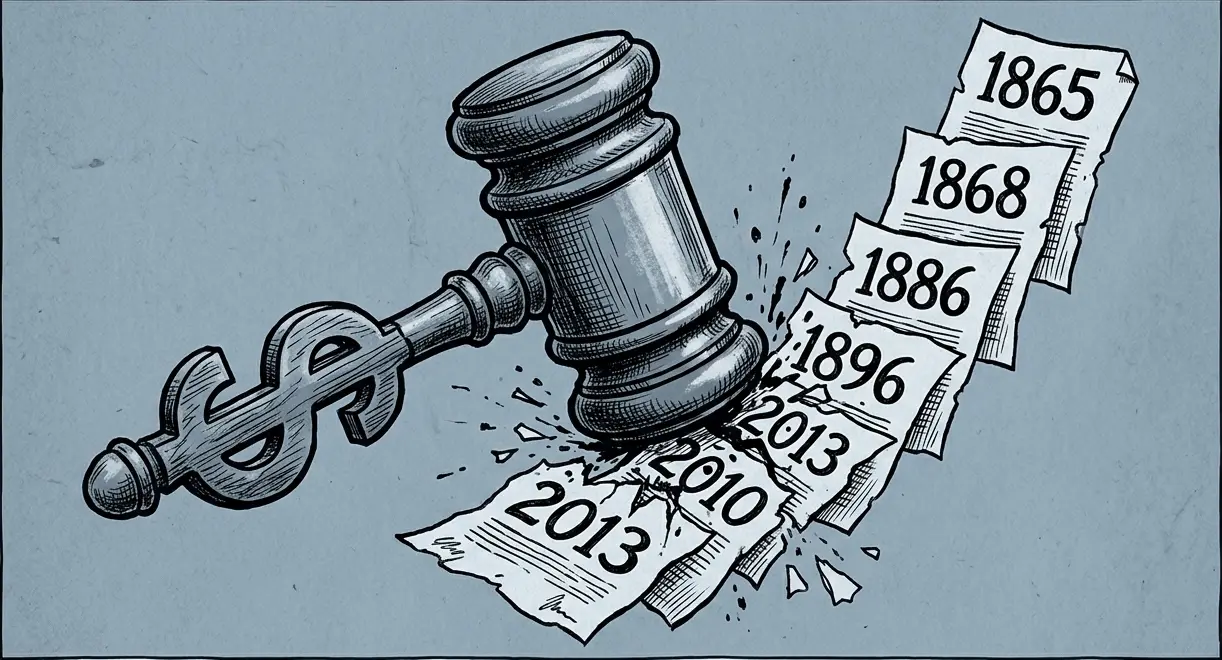
Here is the sequence in dates.
1868: the Fourteenth Amendment ratified to protect Black Americans.
1886: the amendment extended to corporations via a headnote written by a railroad executive.
1896: Plessy v. Ferguson. Separate but equal. The equal protection guarantee the amendment had established for Black Americans effectively nullified. The same bench that had granted corporations equal protection denied it to the people the amendment was written for.
2010: Citizens United. Corporations gain unlimited political spending rights under the First and Fourteenth Amendments.
2013: Shelby County v. Holder. The Voting Rights Act preclearance requirement gutted. Black voters lose the federal protection that had been enforcing the Fifteenth Amendment for forty-eight years.
Three years apart. Same bench. Corporations gained unrestricted political spending rights in 2010. Black voters lost preclearance protection in 2013. The bench that did both was built by the same Federalist Society pipeline Article 1 documented.
The formerly enslaved person denied forty acres in 1865. The corporation chartered in Delaware in 1899 with no conditions and no expiration. The Supreme Court decision in 2010 giving that corporation unlimited political speech. The Supreme Court decision in 2013 removing the voting protection from the descendants of the person denied the forty acres.
Same amendment. Different outcomes. Consistent beneficiaries.
Citizens United was framed as a First Amendment protection for political speech. The 14th Amendment’s original purpose — protecting people who had been treated as property — was not in the frame.
What the inversion purchased
The extraction economy did not build the pipeline and fill the bench out of civic-mindedness. It built it because the legal architecture the bench would produce was worth building it for.
A headnote gave corporations the Fourteenth Amendment’s personhood. Citizens United completed that personhood with unlimited political spending. The money went into the campaigns, the committees, the party infrastructure that set royalty rates, wrote lease terms, and determined how aggressively federal agencies enforced the rules that governed what was taken from the public’s land at what price.
The bench that granted corporations unlimited political spending is the same bench that later eliminated the agency deference that let the EPA and Interior defend their own regulatory interpretations. The political spending bought the legislators who appointed the pipeline’s nominees. The nominees eliminated the agencies’ ability to protect the commons without a judicial fight before judges the pipeline had already selected. The public whose royalties and land were at stake had no comparable channel — no coordinated spending vehicle, no equivalent access to the legislators or the bench that decided the outcome. A vote was the only tool available, and it reached none of the decisions that mattered.
The corporate spending rights the inversion created are the same rights that make Block 8’s money pipeline constitutionally protected today. Reversing the inversion requires either a constitutional amendment or a bench willing to reconsider a headnote it has treated as a holding for 138 years. Both paths run through the argument this block is making.
The inversion is not a metaphor. It is the mechanism.
The next article names what that mechanism has closed — each door, in sequence, since 2010.
The record is documented. Read it.
| Santa Clara County v. Southern Pacific Railroad (1886) — the headnote case | supreme.justia.com/cases/federal/us/118/394 |
| Citizens United v. FEC (2010) — full opinion | supreme.justia.com/cases/federal/us/558/310 |
| Shelby County v. Holder (2013) — full opinion | supreme.justia.com/cases/federal/us/570/529 |
— — —
Steve Sagnotti
is a serious amateur photographer, writer, and technologist based in Oregon. With his camera he tries to capture common images not often seen, leading to common questions not often asked.
© 2026 Steve Sagnotti
— — —
Sources
1. 14th Amendment text and ratification 1868: U.S. Constitution, Amendment XIV. National Archives, archives.gov/founding-docs/amendments-11-27
2. Santa Clara County v. Southern Pacific Railroad, 118 U.S. 394 (1886). https://supreme.justia.com/cases/federal/us/118/394/ Headnote author Bancroft Davis, railroad background: Howard Jay Graham, “The Conspiracy Theory of the Fourteenth Amendment,” Yale Law Journal, 1938.
3. 28 vs. 312 cases figure: Adam Winkler, We the Corporations: How American Businesses Won Their Civil Rights (2018) — between 1868 and 1912 the Supreme Court heard 28 Fourteenth Amendment cases on the rights of African Americans and 312 on the rights of business corporations. Graham (1938) retained as supporting secondary source.
4. Lochner v. New York, 198 U.S. 45 (1905). https://supreme.justia.com/cases/federal/us/198/45/
5. West Coast Hotel v. Parrish, 300 U.S. 379 (1937). https://supreme.justia.com/cases/federal/us/300/379/
6. Buckley v. Valeo, 424 U.S. 1 (1976). https://supreme.justia.com/cases/federal/us/424/1/
7. First National Bank of Boston v. Bellotti, 435 U.S. 765 (1978). https://supreme.justia.com/cases/federal/us/435/765/
8. Citizens United v. FEC, 558 U.S. 310 (2010). https://supreme.justia.com/cases/federal/us/558/310/
9. Plessy v. Ferguson, 163 U.S. 537 (1896). https://supreme.justia.com/cases/federal/us/163/537/
10. Shelby County v. Holder, 570 U.S. 529 (2013). https://supreme.justia.com/cases/federal/us/570/529/
11. Dobbs v. Jackson Women’s Health Organization, 597 U.S. ___ (2022). https://www.oyez.org/cases/2021/19-1392
12. Loper Bright Enterprises v. Raimondo, 603 U.S. ___ (2024). https://www.supremecourt.gov/opinions/23pdf/22-451_7m58.pdf
Leave a Reply