Block 4, Article 6
© 2026 Steve Sagnotti.
Fewer than four percent of bills introduced in Congress become law.
That number sounds like dysfunction. It is not. It is the output of a functional filter system — one built gate by gate, by different Congresses, at different moments, each piece individually defensible, together constituting architecture no single designer planned and no single reform can dismantle.
Your vote is step one. There are six more.
The gates
Gate one is the committee. A bill introduced in the House or Senate is referred to the committee with jurisdiction. The committee chair decides whether it gets a hearing. Most bills never get one. In a typical Congress, roughly 10,000 bills are introduced. The chair’s calendar has room for a fraction of them. The chair sits on that committee because they paid the dues. The dues were set by the leadership that the donor infrastructure produced. The bill that challenges those industries does not get scheduled. It is not defeated. It is not there.
Gate two is the Rules Committee in the House. If a bill survives committee and moves toward the floor, the Rules Committee determines the terms of debate — how long, which amendments are permitted, whether the minority can offer alternatives. The Rules Committee chair serves at the Speaker’s pleasure. The Speaker was elevated by the same dues infrastructure. The terms of debate are set before debate begins.
Gate three is the floor calendar. In the Senate, the Majority Leader controls what reaches the floor. A bill that cleared committee and could pass with a majority vote can sit in the Leader’s queue indefinitely. It is not blocked. It is simply never scheduled.
Gate four is the filibuster. Sixty votes to proceed. Not to pass — to proceed to debate. The minority that controls the filibuster threshold is, in this era, the minority whose electoral geography most heavily overlaps with the states where the extraction apparatus is most firmly embedded. The sixty-vote requirement is not in the Constitution. It is a Senate rule, written by senators, adjusted by senators, serving the senators who benefit from it.
Gate five is the Byrd Rule. In the Senate’s budget reconciliation process — the one track that bypasses the sixty-vote threshold — the Senate Parliamentarian rules on whether provisions are sufficiently budget-related to proceed. The Parliamentarian serves at the pleasure of leadership. A provision that clears the filibuster track on a fifty-one-vote path can be ruled out of order by a single unelected official whose appointment is controlled by the leadership the donor infrastructure produced.
Gate six is the conference committee. When House and Senate pass different versions of the same bill, a conference committee reconciles them. Conference committee members are appointed by leadership. The compromise that emerges from conference can differ substantially from either version the chambers passed. What went in as a reform can come out as its inverse.
Gate seven is the President’s desk. And if the bill reaches it — having survived the committee chair, the Rules Committee, the floor calendar, the filibuster, the Parliamentarian, and the conference committee — the President can veto it. The override requires two-thirds of both chambers.
Each gate was built for a reason. The committee system manages workload. The Rules Committee provides order on the floor. The filibuster protects the minority from simple-majority tyranny. The Byrd Rule protects the reconciliation process. The conference reconciles bicameral differences. The veto gives the executive a check on the legislature. Taken individually, each one is a feature of deliberative democracy.
The system was framed as deliberative democracy. The sequence it produces is not.
Taken together, the gates are a sequence. The constituent’s vote at step one propagates through six subsequent filters before it can affect anything the donor class cares about. The dues structure determines who sits on the Rules Committee. The call center funds the dues structure. The donor on the call funds the call center. The Parliamentarian serves at the pleasure of the leadership the donors funded. The continuing resolution freezes the baseline the donors have spent fifty years constructing. The filibuster protects the Senate minority — currently the minority that controls the states where the extraction apparatus is most firmly embedded. Each gate was built separately, by different Congresses, at different moments, for ostensibly different reasons. Together they ensure the constituent’s vote rarely survives the first filter. The bill that dies in the Rules Committee was never reported as dying anywhere. It simply was not there when the constituent looked for it.
This is not conspiracy. It is architecture. No single person designed the seven gates. Each was built by people responding to the incentives of their moment, using the tools their predecessors left them, in service of interests that funded their campaigns and would fund their opponents if they chose differently. The architecture accumulated. The constituent never saw it being built.
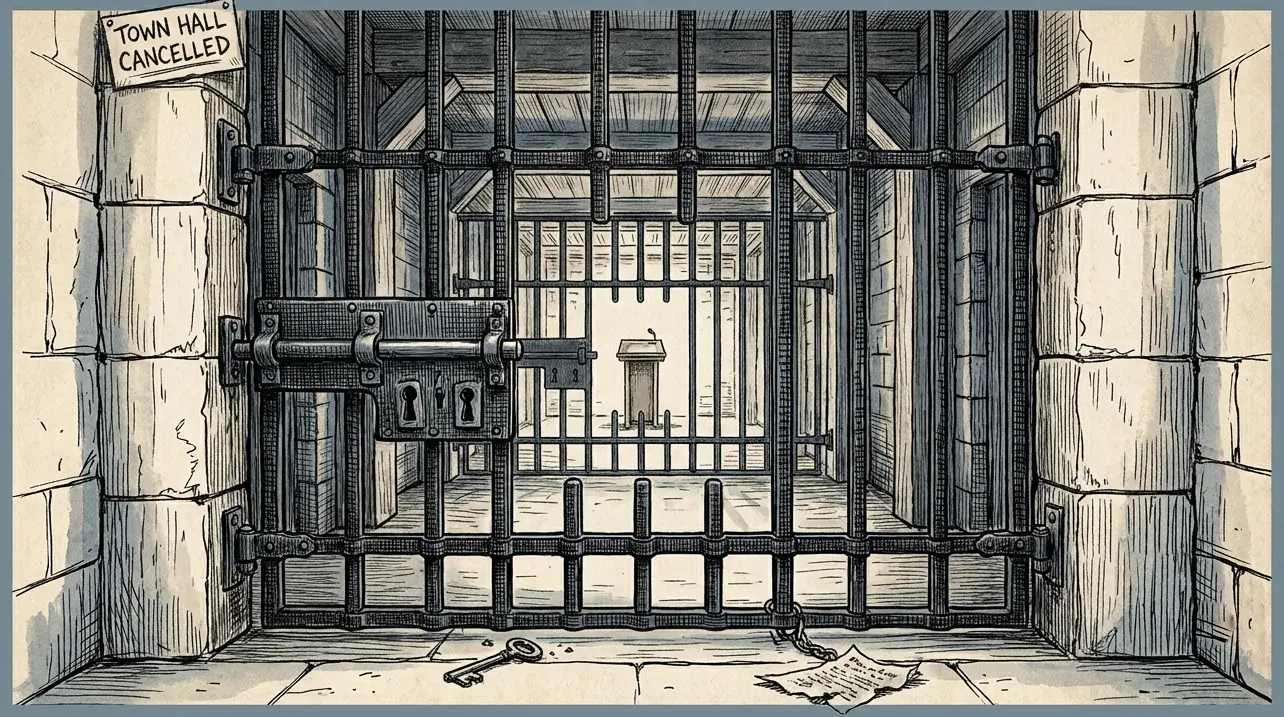
The disappeared town hall
While the architecture was accumulating, something else was disappearing.
In 2015, members of the House majority held 222 in-person town hall events in a comparable two-month window. In early 2017, after Republicans took the House majority and the Affordable Care Act repeal produced packed gymnasiums and viral confrontations, 292 Republican lawmakers scheduled just 88 town hall events in the same period. The National Republican Congressional Committee advised its members against holding in-person town halls. The guidance was not a secret. Uncontrolled constituent contact created political risk. The tele-town hall — a one-way broadcast to constituents who could submit questions through a filter — was offered as the alternative.
The pattern held and accelerated. During the August 2025 recess, as DOGE-era federal cuts produced the same constituent fury, the NRCC chair advised Republicans in a closed-door meeting that there were more efficient ways to reach constituents than open forums. Speaker Mike Johnson encouraged members to use telephone town halls and small groups instead, calling participants at in-person events “professional protesters” without evidence. Of 219 House Republicans, roughly 37 hosted any kind of town hall during the recess. Approximately 16 hosted at least one in-person event.
The replacement format is the tele-town hall — a phone call, moderated by staff, with pre-screened questions and no capacity for follow-up. The constituent dials in. They may or may not be selected to ask a question. The question is answered on terms the member controls. The exchange the town hall was designed to produce — a representative accountable, in public, to the people they represent — does not occur. The telephone town hall is not a more efficient version of the town hall. It is its opposite dressed in its name.
The gymnasium is where a constituent might have asked why their water rates keep rising while the aquifer is being pumped for free by agricultural operations that pay nothing for the right. It is where a rancher might have asked why the grazing fee on public land has not moved in forty years while their neighbor’s private lease costs seventeen times as much. The town hall is not only a political accountability mechanism. It is the forum where the connection between a member’s votes and a constituent’s lived conditions might have been made visible. When that forum disappears, so does that connection.
The member who eliminated the town hall and raised $900,000 from energy industry donors in the same cycle voted to lock the federal oil and gas royalty rate at 12.5 percent — a rate set in 1920 when a gallon of gasoline cost twenty cents. That rate has not moved. The gasoline costs four dollars now. The member did not need to be instructed. The architecture instructed them.
The fix that isn’t one
The standard response to this accounting is: vote them out. The architecture has an answer to that too. The map that determines which districts are competitive was drawn by the party in power after the last census. In most states, competitive districts are a legislative choice, not a geographic inevitability. The member who holds a safe seat does not need to hold a town hall. They need to hold the donor relationship. The call center is how that relationship is maintained. The safe district is why the call center can replace the gymnasium.
Reforming the call center alone — public campaign financing, stricter limits, transparency requirements — would change the fundraising pressure without touching the map. Reforming the map alone would create more competitive districts without changing the money infrastructure that determines who runs in them. Neither reform reaches the seven gates at the legislative level. All three would have to move together for the underlying dynamic to shift. None of them can be moved in the room that each of them protects. Block 12 is where that simultaneous-move argument gets made.
The question your member can answer
Your representative took an oath to support and defend the Constitution and to provide for the general welfare. The oath is public. Their schedule is mostly public. Their donor list is entirely public. Their voting record is entirely public.
Did they hold an in-person town hall this term? Who are their top five donors by industry? How did they vote on the last royalty rate legislation to reach the floor?
The architecture is designed to make these connections invisible. The connections are not invisible. They are documented, searchable, and available to any constituent willing to look.
| Did my representative hold in-person town halls this term? | https://townhallproject.com |
| Who are my representative’s top donors by industry? | https://www.opensecrets.org |
| Full donor contribution records | https://www.fec.gov |
| How did my representative vote? | https://www.congress.gov |
| What committees does my representative sit on — and what industries fund those seats? | https://www.opensecrets.org/members-of-congress |
Sources
1. House Rules Committee jurisdiction. https://rules.house.gov/about
2. Senate filibuster Rule XXII. https://www.senate.gov/about/powers-procedures/filibusters-cloture.htm
3. Byrd Rule. 2 U.S.C. § 644. https://uscode.house.gov/view.xhtml?req=granuleid:USC-prelim-title2-section644&num=0&edition=prelim
4. Conference committee procedures. Riddick’s Senate Procedure. https://www.govinfo.gov/content/pkg/GPO-RIDDICK-1992/pdf/GPO-RIDDICK-1992.pdf
5. Bills introduced vs. enacted. GovTrack.us. https://www.govtrack.us/congress/bills/statistics
6. Town Hall Project. https://townhallproject.com
7. 2015 vs. 2017 town hall comparison — 222 events vs. 88 events, 292 Republicans. Legistorm data cited in Vice News, February 2017 (paywall).
8. NRCC guidance against in-person events, 2017. Politico, February 2017 (paywall).
9. NRCC Chair Hudson closed-door advice / Speaker Johnson “professional protesters.” NBC News, March 5, 2025. https://www.nbcnews.com/politics/congress/republicans-town-halls-constituents-rcna193824
10. 37 of 219 House Republicans holding any town hall August 2025 recess, ~16 in-person. NPR, August 15, 2025. https://www.npr.org/2025/08/15/nx-s1-5482963/republican-congress-town-hall-obbb-medicaid-tax-cuts-immigration-trump
11. 12.5% royalty vote. Rep. Huffman press page — E&E News/Politico reprint, May 6, 2025. https://huffman.house.gov/media-center/in-the-news/republicans-mum-as-dems-target-natural-resources-reconciliation-bill-westerman-stock-purchases —
12. [S-19] Issue One. “The Price of Power” / “The Price of Power Revisited,” February 2023. https://issueone.org/articles/the-price-of-power-revisited/
Block 4, Article 6. © 2026 Steve Sagnotti.
Leave a Reply