Block 12, Article 9 — The Test a Repair Has to Survive
This is the diagnosis this whole series has been building, and a diagnosis is not a doom. A doctor doesn’t deliver a prognosis by pronouncing a verdict — diagnosis, prognosis, treatment plan, then the choice handed to the patient. The condition documented across eleven mechanism blocks is diagnosable. The prognosis without intervention is knowable: the debt spiral Block 11 named, compounding on a schedule; the aquifers and fisheries and topsoil that don’t recover on any human timescale once they’re gone; the loop running to exhaustion with no brake. But the prognosis is a conditional, not a prophecy. The brake exists — this block has spent eight articles describing it, in mechanisms already tested by American states and foreign governments, not invented from theory, and the previous article showed what those mechanisms actually build. The coronary event is not fate. It’s the documented consequence of continuing a pattern that a repaired room could simply stop continuing. The patient who changes the diet doesn’t have the heart attack. The choice belongs to the patient. The series’ job was only ever to make sure the patient understood exactly what was being chosen.
But a treatment plan isn’t finished the moment it’s written. It has to survive the patient’s own relapse risk — and this series has already shown, twice over, that a written guarantee is not the same thing as a durable one. This block opened by naming the enforcement asymmetry running under every mechanism this series has documented: guarantees protecting extraction get reaffirmed permanently, guarantees protecting people get treated as provisional. There is a second test, one level down, that applies specifically to the repairs this block has proposed rather than to the guarantees the rest of the series found already broken. Call it the recapture test: once a repair is made, does reversing it cost the reverser something real, or does it merely depend on the room continuing to behave?
The previous article closed on the strongest published disagreement with this series’ whole approach: Lindsey and Teles’s The Captured Economy, which prescribes sustained public-interest vigilance at the hearings where capture currently goes unopposed, rather than the structural mechanisms this block has documented. Run the recapture test against their own prescription first, because it fails without even requiring public attention to lapse. Vigilance depends on access to the room, and access is exactly what this series has already shown getting narrowed the moment it becomes effective. Town halls did not stop being useful to the people who once held them; they became invitation-only, or telephone-format, the moment open attendance produced constituents the room didn’t want to face. Nothing prevents the same narrowing from reaching the obscure hearings Lindsey and Teles are counting on. They are not wrong about the diagnosis. They are proposing a method that depends on a door staying open that this series has already documented being closed, repeatedly, the instant it mattered.
Run the same test honestly against what this block actually built, and the answer splits.
Norway’s and Alaska’s sovereign wealth funds pass decisively — three and a half decades of dispersed, direct-deposit constituency makes reversal a cost no government has been willing to pay, under governments of every ideological stripe. Independent redistricting commissions, created by ballot initiative in California and Virginia, pass for the same structural reason: voters built them directly, bypassing the legislature that would otherwise be the only body capable of undoing them. Ranked choice voting passes too — Alaska’s voters have refused to repeal it twice, and Maine’s have used it in every federal election since 2018, which means the two places it has actually been tried are the two places it has survived every attempt to kill it. That success produced the sharpest version of the recapture test in this block: when the states won’t finish the job, the room reaches for a tool that doesn’t need a single voter in either one. The Make Elections Great Again Act (H.R. 7300), introduced by House Administration Committee Chairman Bryan Steil on January 30, 2026, would ban ranked choice voting nationwide under the Elections Clause — the constitutional provision giving Congress power to override how states run federal elections — not because voters rejected it, but because they wouldn’t. A repair a state’s own electorate defends twice is durable against that state. It is not automatically durable against a different room deciding the state shouldn’t have gotten to choose at all.
Alaska’s dividend, examined earlier in this block, passes for a third reason again — everyone can see exactly what it is and where it comes from, which makes it politically expensive to touch regardless of who’s proposing the touch.
Some of this block’s own repairs fail the same test, and naming that honestly is worth more than pretending otherwise. Pittsburgh’s land value tax survived from 1913 to 2001, then was ended not because it stopped working but because a reassessment and a rate increase landed in the same year and produced a political backlash the underlying tax had nothing to do with — a repair that ran successfully for almost ninety years and still failed the durability test in the end, because nothing about it had made reversing it cost the reverser anything beyond an unpopular news cycle. The Office of Technology Assessment is the starkest case: it existed, it worked, and it was defunded in a single 1995 appropriations rider with no public debate at all, because nothing about its existence had built a constituency that would notice it was gone before it was already gone.
Some repairs in this block haven’t been tested long enough to know. Hawaii’s Corporate Power Reset law is three weeks into a federal lawsuit as this article is being drafted — Article 4 already showed what that lawsuit’s own argument reveals about who is contesting it and why. Whether the law survives contact with the courts, and whether the dozen other states considering the same framework watch it survive or watch it fall, is genuinely still open. March-in rights have never been exercised even once in forty-five years, which means there is no data point yet on whether using them even a single time creates the kind of precedent that becomes hard to reverse, or whether the industry that has kept them dormant this long simply absorbs the one use and goes back to preventing the next.
The test doesn’t produce a uniform verdict, and it isn’t supposed to. What it produces is a map of where the actual work is: not in proposing the repair, which this block has now done many times, but in building the specific kind of constituency — dispersed, direct, visible, voter-created — that makes a repair durable rather than merely correct. A repair that is correct but reversible is a favor. A repair built the way Norway’s fund or California’s commission were built is a fact the next government has to reckon with, not a policy the next government can simply defund on a Tuesday.
They didn’t break the frame that was supposed to protect the excluded. They used it — for the entities it was never written to serve, against the people it was written to protect. The Fourteenth Amendment is where this happened most literally, twice, four decades apart, to the same family line’s descendants. Four images show the mechanism front to back.
A formerly enslaved man in January 1865, receiving a deed to forty acres of coastal South Carolina under federal military authority — a specific, material, documented promise of a stake in a country his labor had built. Eight months later, by presidential order, it was taken back.
A corporation chartered in Delaware in 1899, under a law written specifically to attract registrations by imposing as few conditions as possible — no expiration, no public-interest obligation, no accountability to the communities whose labor and commons it would go on to extract. The same public authority that couldn’t keep its promise to forty thousand Black families built, in the same generation, a legal instrument of permanent private accumulation with full constitutional protection.
A Supreme Court ruling on January 21, 2010, holding that corporations may spend unlimited money to influence elections, grounded in the same Fourteenth Amendment written for the descendants of the man who lost his forty acres — decided by a bench built over forty years by the industries that stood to benefit from the ruling.
A second Supreme Court ruling on June 25, 2013, striking down the Voting Rights Act’s preclearance requirement. Texas implemented a voter ID law within hours. The same amendments written to protect the right to vote of that same man’s descendants were held insufficient to require states to prove their voting laws weren’t discriminatory before enforcing them. Same bench. Three years apart. Corporations gained ground both times. People lost it both times. Same constitutional text. Consistent beneficiaries.
That is the mechanism this entire series has documented, run at every scale from a Philadelphia summer in 1787 to a Hawaii legislature this spring. It is what a repaired room would have to change first, and it is the one change every other repair in this block depends on.
Every member of Congress swears an oath on a book that contains a verse offering no middle ground: no one can serve two masters, and the master a person serves is the one whose interests get protected when the two conflict. The verse isn’t an accusation. It’s a description of what divided loyalty produces, and it was written that way on purpose. The oath is on file. The votes are on the record. The verse names the binary; it doesn’t require the reader to do anything but apply the math that’s already sitting in front of them. This series has spent twelve blocks doing exactly that math, in public, using the public’s own records, so that no one would have to take anyone’s word for the conclusion.
The same book has a second verse for the specific failure this series documents, and it is less often quoted by the people most fond of quoting the first one. Ezekiel’s charge against the shepherds of Israel is not a parable about generosity. It is a direct accusation, addressed to the people entrusted with tending something that was not theirs: “Woe be to the shepherds of Israel that do feed themselves! should not the shepherds feed the flocks?… The diseased have ye not strengthened, neither have ye healed that which was sick, neither have ye bound up that which was broken, neither have ye brought again that which was driven away, neither have ye sought that which was lost; but with force and with cruelty have ye ruled them. And they were scattered, because there is no shepherd.” The scattering is not a separate misfortune that happened to the flock alongside the shepherds’ neglect. The text is explicit about the order: they were scattered because there was no shepherd. The deterioration is not incidental to the failure of stewardship. It is the direct, named consequence of it.
That order matters here because the deterioration this series has documented is not a steady state. It is accelerating, and the series’ own dates show the acceleration without needing a single new source to prove it. The 1920s produced two foundational moves — the royalty rate set in 1920, the House frozen in 1929 — in a single decade. The next major removal took until 1995, when the Office of Technology Assessment was defunded in a single unread rider. Then the pace changed. Citizens United in 2010 and Shelby County v. Holder in 2013 — two in four years. Then 2025 and 2026 alone: the royalty rate reaffirmed, Temporary Protected Status ruled unreviewable, the Federal Trade Commission’s independence stripped outright — three in two years, not a decade. The gap between one erosion and the next has been shrinking for a century. A shepherd who feeds himself once is a failure. A shepherd whose self-feeding accelerates, decade over decade, without anyone ever being made to answer for the pattern, is not a broken system correcting itself slowly. It is a system with no shepherd in it at all, exactly as the text describes, still calling itself one.
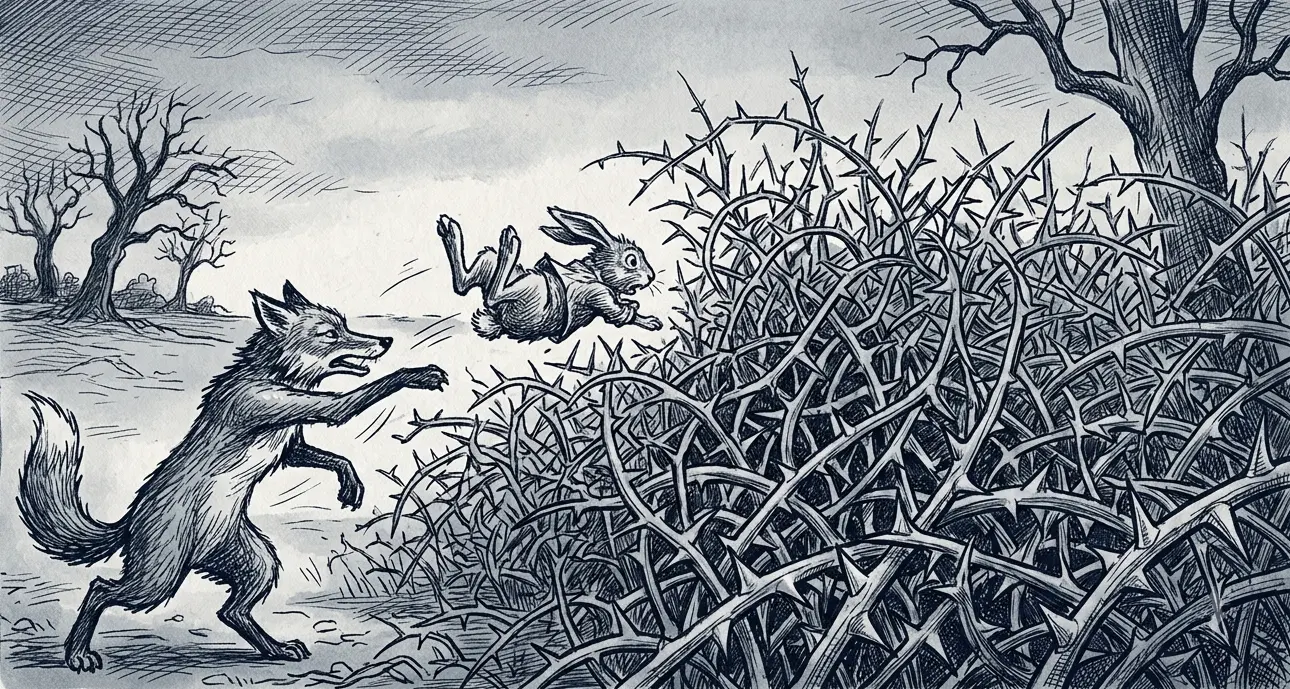
There is an old story about a rabbit caught by a fox, who begs for any punishment — roasting, hanging, drowning — except the one thing he actually fears: being thrown into the briar patch. The fox, wanting to hurt him the worst way possible, throws him straight into it. The rabbit was born and raised in the briar patch. He escapes laughing. The trick was never in what he wanted. It was in convincing the fox that giving it to him was the fox’s own idea.
Alaska has been running this trick for nearly fifty years without ever naming it. The Permanent Fund dividend is a direct, unconditional cash payment, indistinguishable in mechanism from any UBI proposal this block has documented elsewhere as politically radioactive. Alaska didn’t adopt it as redistribution. It adopted it, and in 2008 a Republican governor expanded it, as a dividend — a return on an asset residents already own, paid because the resource belongs to them, not because the state is generous. Framed as redistribution, the identical mechanism draws the fiercest opposition of anything in this series. Framed as a dividend on an owned asset, it has survived and grown for nearly fifty years in one of the most conservative states in the country. Nothing about the mechanism changed. What changed was who got to think it was their idea. Every repair named in this block will meet the same test the fox met: not whether the fix is correct, but whether it can be described in the room’s own language, truthfully, as the thing the room was already entitled to.
The profit was privatized. The loss was socialized. The citizen got the bill on both ends and cast no vote on any of it. That has been true in every block of this series, at every scale, from the beaver pelt to the AI training set. It does not have to keep being true. Norway decided otherwise in 1990. Alaska decided otherwise in 1976, under a Republican governor who wanted a resource turned into “money wells pumping money for infinity” rather than watching it disappear into private hands without a trace. Hawaii decided otherwise this spring, by a vote of 24 to 0 and 50 to 1. None of these rooms did anything more complicated than choose to point an existing tool at the public instead of away from it. The sovereign wealth fund gets called socialism by people who have never once applied the label to Alaska’s. The label was never about the mechanism. It’s always been about who the mechanism was aimed at — and that, unlike geological time or a depleted aquifer, is a choice a room can still make differently tomorrow.
There is an old story about a king whose trial was rigged. Two grapes in a cup, one white, one red. Draw white and go free. Draw red and die. Against all statistical odds, the accused drew red, time after time. The court had made both grapes the same color.
One man, brought before the cup, reached in, took a grape — and ate it.
The court erupted. He had destroyed the evidence. He smiled and gestured at the cup. Whatever grape remained, he said, proved what he had drawn. The remaining grape was red. He went free.
The frame had assumed he would play by its rules. He didn’t. He stepped outside it. The proof was what was left.
The proof of what this series has documented is not in the arguments that were permitted inside the frame. It is in what remains in the cup: a commons drawn down across a century of extraction. A national debt compounding across decades while public resources were leased at below-market rates and the revenue that wasn’t collected was never counted. Private wealth that grew in precise proportion to the public cost that was deferred, distributed, and handed forward to people who had no vote in the transaction. The argument inside the frame said all of this was necessary, inevitable, the only practical path. The remaining grape says otherwise.
The full record this series has drawn on — royalty rates, campaign finance filings, congressional votes, Supreme Court opinions — is public, government-collected, and available to anyone willing to look.
Pick one mechanism from any block in this series and ask your own representative, on the record, where they stand on repairing it. The answer is either already public or conspicuously not. Both tell you something.
— — —
Steve Sagnotti
is a serious amateur photographer, writer, and technologist based in Oregon. With his camera he tries to capture common images not often seen, leading to common questions not often asked.
© 2026 Steve Sagnotti
— — —
Sources
- Lindsey, Brink and Steven M. Teles. The Captured Economy. Oxford University Press, 2017: confirmed — Oxford University Press.
- Norway Government Pension Fund Global; Alaska Permanent Fund: NBIM — Annual Report 2025 (fund value 21,268 billion kroner, ~$2.2T; 15.1% return, $246.9B profit in 2025); APFC — apfc.org/about/history.
- California and Virginia independent redistricting commissions: Ballotpedia — California Citizens Redistricting Commission (created via Prop 11, 2008, and Prop 20, 2010); Ballotpedia — Redistricting in Virginia after the 2020 census (commission created via 2020 constitutional amendment, Question 1).
- Pittsburgh land value tax, 1913-2001: Lincoln Institute of Land Policy — Land Value Taxation: Theory, Evidence, and Practice (Pittsburgh’s graded tax ran 1913/1914 to repeal in 2001, triggered by a botched reassessment rather than a judgment on the tax’s merits).
- Office of Technology Assessment, defunded 1995: Congress.gov/CRS — The Office of Technology Assessment: History, Authorities, Issues, and Options (defunded via the FY1996 Legislative Branch Appropriations Act; statute authorizing OTA was never repealed, only funding was cut).
- Hawaii Corporate Power Reset lawsuit: Institute for Free Speech — Act 11 Lawsuit: Challenging Hawaii’s Nonprofit Speech Ban (Grassroot Institute of Hawaii v. Lopez, filed June 5, 2026, naming AG Anne Lopez and DCCA director Nadine Ando).Make Elections Great Again Act, H.R. 7300, introduced by Rep. Bryan Steil (R-WI), January 30, 2026, committee hearing February 10, 2026, no floor vote as of this session: confirmed on all points — Congress.gov — H.R.7300 text (sponsor: Steil; introduced Jan. 30, 2026); FGA — FGA Applauds Introduction of the Make Elections Great Again Act; NACo — MEGA Act moves in House; NACo raises county concerns (confirms Feb. 10 hearing); GovTrack — H.R. 7300 (still in committee, no floor vote).
- Bayh-Dole Act march-in rights, unused 45 years: GAO-09-742 — gao.gov/products/gao-09-742; CRS IF12582 — congress.gov/crs-product/IF12582.
- Forty acres and a mule, January 1865, Special Field Order No. 15, revoked by presidential order: confirmed — issued Jan. 16, 1865 by Sherman, revoked by President Andrew Johnson in fall 1865 — Georgia Historical Society — Marker Monday: History of Emancipation; New Georgia Encyclopedia — Sherman’s Field Order No. 15.
- Delaware General Corporation Law, 1899. Citizens United v. FEC, 558 U.S. 310 (2010), decided January 21, 2010. Shelby County v. Holder, 570 U.S. 529 (2013), decided June 25, 2013: dates check out against standard case-law records (Citizens United decided Jan. 21, 2010; Shelby County decided June 25, 2013) — no new links needed beyond what’s already in the sources register.
- 5 U.S.C. § 3331, Congressional Oath of Office: uscode.house.gov: 5 U.S.C. 3331. Matthew 6:24: King James Bible Online — “No man can serve two masters… Ye cannot serve God and mammon.”
- Ezekiel 34:2-5, KJV. Verified against multiple translations (NIV, NKJV, USCCB/NABRE): confirmed consistent across KJV, NIV, and NKJV — BibleRef.com: Ezekiel 34:2 (side-by-side comparison); YouVersion: Ezekiel 34:2-5 Compare All Versions. I did not independently check USCCB/NABRE wording — recommend confirming that specific translation directly at usccb.org if precision matters for your citation.
- Accelerating-deterioration dates: all sourced elsewhere in this series per Block 12 Article 1 sourcing — no new links needed.
- Alaska Permanent Fund dividend, 1976 founding under Gov. Jay Hammond (R), 2008 expansion: confirmed — Hammond was a Republican governor (1974–1982); the “2008 expansion” refers to Gov. Sarah Palin’s one-time $1,200 special payment via SB 4002 — apfc.org/about/history; apfc.org: Historical Timeline; Alaska Legislature — The Alaska Permanent Fund and the Permanent Fund Protection Act. Note: if your draft calls this a “PFD formula expansion,” it’s technically a separate one-time supplemental payment from the General Fund, not a change to the PFD formula itself — worth checking your phrasing matches that distinction.
Leave a Reply