Block 2, Article 1
© 2026 Steve Sagnotti.
The founders were explicit about this. James Madison wrote Federalist No. 58 specifically to address the fear that the House of Representatives would stop growing with the population. He titled it “Objection That The Number of Members Will Not Be Augmented as the Progress of Population Demands Considered” and argued that the constitutional design made perpetual growth inevitable. The “unequivocal objects” of the census and reapportionment mechanism, he wrote, were “to readjust, from time to time, the apportionment of representatives to the number of inhabitants… and to augment the number of representatives.” George Washington’s only recorded intervention in the Constitutional Convention debates was to push for smaller districts — one representative per 30,000 constituents. The founders projected 400 representatives by 1838, more than 600 by 1887. The House was designed to grow forever.
It stopped.
The frontier closes, the majority arrives
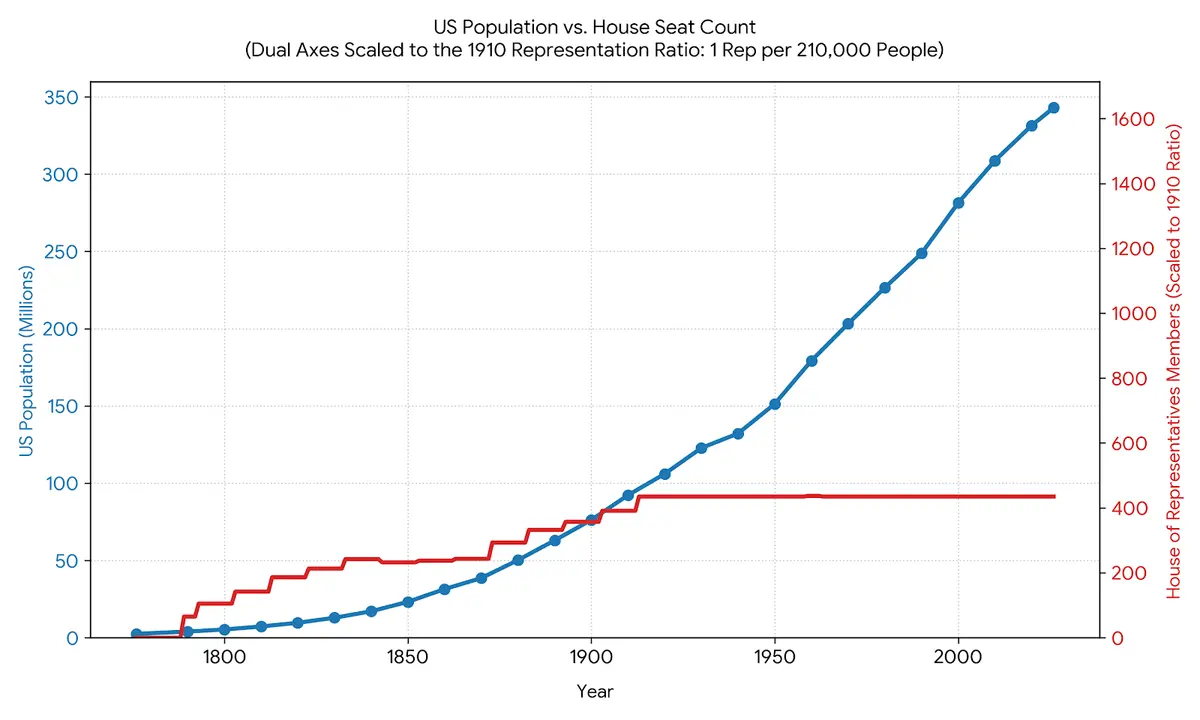
For three centuries, westward expansion defined American political identity. New territories became states. States sent new representatives. The room grew with the country. From 1790 through 1911, the House grew after every single census — thirteen reapportionments, thirteen expansions, 65 seats to 435 over 130 years. Every time the country grew, the room grew with it.
Then the map filled in. Oklahoma achieved statehood in 1907. New Mexico and Arizona followed in January and February of 1912 — the last two contiguous states, completing the lower 48. The continental frontier was formally closed in law and geography just eight years before the census that changed everything.
The 1920 census was the first in American history to show that more than half the United States population lived in cities. What that meant for Congress was arithmetic: a constitutionally required reapportionment would transfer seats from rural states to urban ones. Rural incumbents faced losing power not through any election — not because voters had chosen otherwise — but because Americans had moved. Urban members faced a different but equally unwelcome prospect: more colleagues meant less individual influence. A larger House means smaller districts, less money per race, and a thinner slice of committee power for every member already holding it. The primary motive was rural retention. The secondary motive was something every member in every safe district understood: a smaller room is an easier room to control — and an easier room to buy. Every new seat is a new relationship the donor class has to purchase. Freeze the room at 435 and the price of capture stays fixed while the country grows around it.
So they simply did not reapportion. The House failed to act on the 1920 census — the first and only time Congress defied the constitutional reapportionment requirement while the House was still designed to grow. The 1929 Act ended that design. After 1929, there was nothing left to defy. The seats just move between states. The total stays fixed. The 1910 seat distribution stayed in effect until 1933 — a full decade of congressional sessions, running on numbers the Constitution required Congress to update.
It was not chaos or dysfunction that produced this outcome. It was the ordinary logic of people in a room who shared a common interest in the result.
The freeze and what it produced
In 1929, Congress acted — not to reapportion, but to ensure no reapportionment could threaten incumbency again. The Permanent Apportionment Act froze the House at 435 members, the number it happened to be after the 1910 census. No constitutional amendment. No referendum. No public debate on record. The people whose representation was being permanently restructured were not asked.
Madison had promised this was impossible. The people in the room decided otherwise.
The arithmetic consequence has been compounding ever since. Wyoming today has 587,000 people and one House representative. Montana has 1.1 million people and one House representative. Both states have the same voice in the people’s chamber. A Montana voter’s House vote is worth roughly half of a Wyoming voter’s — not because of anything either state did, but because the math froze in 1929 and the fractions fell differently. The national average has moved from 30,000 constituents per representative at the founding to 747,000 today — the highest ratio in American history, and by far the highest of any industrialized democracy. That is a 25-fold dilution. It is not drift. It is arithmetic.
In the immediate aftermath, a handful of rural-state members tried to restore the old logic — introducing bills in the early 1930s to raise the cap just enough that no state would lose a seat. Those bills were buried in committee before the decade was out. The Depression shifted every agenda. And then, for roughly sixty years, the question of whether the House should grow with the country essentially disappeared from Congress. Not defeated. Not debated and voted down. Simply not raised. The 1929 statute was treated as if it were written into the Constitution itself, despite being an ordinary federal law that a simple majority could repeal any Tuesday.
The objection you hear most often is physical: where would they all sit? The Capitol Building itself answers this. The current House Chamber — opened in 1857, built specifically because a growing Congress needed more room — seats 448 members. There are 435. The chamber was built for more representatives than currently use it. Every time before 1929 that Congress outgrew its room, they built a bigger one. After 1929, they decided the room was fine.
Congress framed the freeze in 1929 as a question of practical capacity — how many members a chamber could hold, how large a deliberative body could function. Whether the chamber’s composition still represented the country was never raised as the question it actually was.
What came with the freeze
The founders never intended 747,000 constituents per representative. They also never intended what came next.
The same generation that watched the frontier close also understood that a proportional House would have every reason to revisit the legal architecture built for a world of inexhaustible abundance. The below-market royalty rates on federal minerals, set in 1920. The grazing fees frozen at 1966 levels. The spectrum licenses given free to broadcasters for six decades. These arrangements required a room too diluted to challenge them. The freeze delivered that room. It has been delivering it ever since.
The room that votes to keep itself frozen is the same room that draws its own district lines without restraint. What that power built is Block 3.
The United States Congress has a lower ratio of representatives to constituents than any other major democracy in the world.
The founders wrote a guarantee. The room they were guaranteeing ignored it.
Sources
1. Madison, James. Federalist No. 58. February 20, 1788. Avalon Project, Yale Law School. https://avalon.law.yale.edu/18th_century/fed58.asp
2. U.S. House — Permanent Apportionment Act of 1929. https://history.house.gov/Historical-Highlights/1901-1950/The-Permanent-Apportionment-Act-of-1929/
3. U.S. House — 1911 Reapportionment. https://history.house.gov/Historical-Highlights/1901-1950/Reapportionment-Act-of-1911/
4. American Academy of Arts & Sciences. “The Case for Enlarging the House.” https://www.amacad.org/ourcommonpurpose/report
5. 1920 census first majority-urban. U.S. Census Bureau. https://www.census.gov/history/www/through_the_decades/index_of_questions/1920_1.html
6. Wyoming 587,000 / Montana 1.1 million. U.S. Census Bureau, 2020. https://data.census.gov/table/DECENNIALPL2020.P1
7. 747,000 constituents per representative. Pew Research Center, May 2018. https://www.pewresearch.org/short-reads/2018/05/31/u-s-population-keeps-growing-but-house-is-same-size-as-in-taft-era/
8. Member-dilution motive. Bloomberg, May 2021 (paywall) — “Lost N.Y. House Seat Stirs Echoes of Racist 1929 Congress Debate.”
9. House Chamber 448 seats. Architect of the Capitol. https://www.aoc.gov/explore-capitol-campus/buildings-grounds/capitol-building/house-wing/chamber
10. 1930s “Stop the Loss” bills. American Redistricting Project, October 2025. https://thearp.org/documents/capping-the-house/
Block 2, Article 1. © 2026 Steve Sagnotti.
Leave a Reply