Block 1, Article 5
© 2026 Steve Sagnotti.
Congress resolved the problem of a resource that doesn’t respect property lines back in 1872 — in favor of whoever got there first. The rule is still on the books.
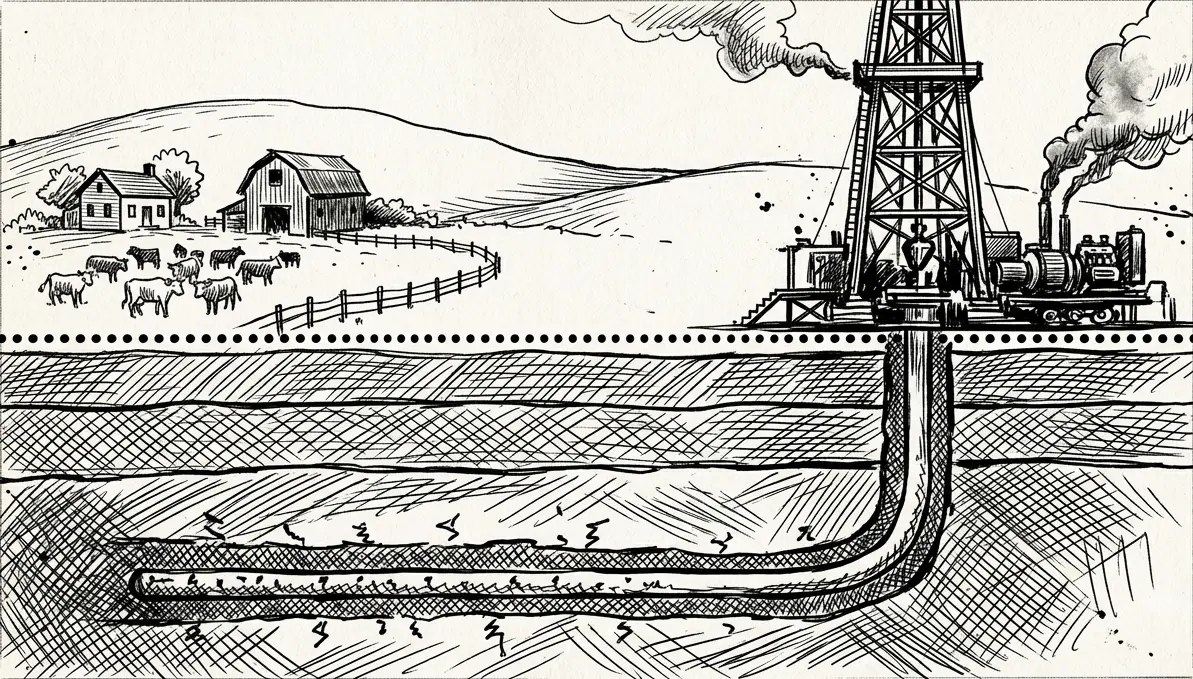
In Dimock, Pennsylvania, a resident turned on the kitchen tap in 2008 and the water caught fire. He called Cabot Oil & Gas, which had drilled and fracked 62 wells in the nine-square-mile area around this town of 1,500 people. He was told to flee in case his house exploded. The Pennsylvania Department of Environmental Protection investigation that followed found contamination in 19 homes on Carter Road alone. Residents drove long distances to buy bottled water. Some fetched it from an artesian well miles away. A water buffalo — a portable tank — was parked on the road. The EPA opened an investigation, sampled roughly 60 households, reported no immediate danger, and closed the investigation.
The company, now called Coterra Energy, denied responsibility for fourteen years and then, in November 2022, pleaded no contest to criminal environmental charges. The settlement included $16.29 million toward a public water system for Dimock’s 1,200 residents — the first one the town has ever had. Construction of that system is ongoing. Coterra is still drilling.
What the family in Dimock did not know when they moved there, and what most Americans do not know about land they have owned for generations, is that the ground beneath their feet may not belong to them. The deed says one thing. The law says another.
The vein runs where it runs
Congress wrote the General Mining Law of 1872 to solve a specific problem. Gold and silver veins do not follow property lines. A vein that apexes — surfaces — on one claim may run laterally beneath a dozen neighboring claims. In the early decades of western mining this produced constant litigation and occasional violence. Congress resolved it with a doctrine called the apex law: whoever holds the claim where a vein surfaces — its apex — owns the right to follow that vein wherever it runs beneath the earth, including under a neighbor’s claim. The right travels with the apex, not with whoever happens to reach a given stretch of ore first. And if two claims turn out to be working what later proves to be the same vein, the claim holding the apex takes precedence over the entire vein — even the portions a neighboring claim had already been mining as if it were their own.
F. Augustus Heinze — a mining engineer who understood the law as well as the geology — proved what this meant in practice. He acquired tiny triangular slivers of surface land near Anaconda Copper’s claims in Butte, Montana. Some were less than 400 square feet — the footprint of a 20-by-20-foot room. Under apex law, those slivers’ surface contact with a vein gave Heinze the right to follow it wherever it ran — including deep into shafts Anaconda had spent millions to build. Courts built three-dimensional models of Butte’s vein systems to determine where each vein first broke the surface. While the litigation ran, Heinze’s crews drilled crosscuts from his claims directly into Anaconda’s tunnels and extracted ore from shafts the other company had constructed. The legal right was the entry point. The physical extraction followed. The tunnels kept moving while the courts argued overhead. Anaconda eventually bought Heinze out — not because he lost, but because the litigation was cheaper to end than to win.
The geological fiction at the heart of the apex law — that a vein is a discrete structure traceable from a single surface emergence to wherever it runs in the earth — was not scientifically supportable even in 1872. But the legal right is real, and it is still in effect.
The land is yours. What’s under it isn’t.
In 1916, Congress passed the Stock Raising Homestead Act. Homesteaders in the arid West received 640-acre allotments — twice the standard — because the land required more acreage to be viable for grazing. The federal government retained the mineral rights. The homesteader got the surface. The minerals stayed federal.
Over the following decades, roughly 70 million acres passed into private surface ownership under the SRHA while the mineral estate remained federal. The federal government then leased that estate — under the 1872 Mining Law, open to any valid claimant — to operators the surface owner had no role in selecting. The surface owner had no right of first refusal. They were not offered the mineral estate when it was leased. They were not consulted when the lease was awarded. In 1993 — seventy-seven years after the SRHA passed — Congress amended the law to require that the surface owner be notified before an operator enters their land. The surface owner may request a convenient time. The surface owner may not prevent entry.
The mineral estate is dominant. That is the legal term, and it means what it says. The most exposed party in this arrangement is not the original homesteader, who at least knew what they were signing. It is the buyer two or three transactions later — who purchased what looked like a ranch or a farm or a rural home site, whose title insurance excluded mineral rights in language buried in the exceptions schedule, and who discovered the gap only when a land crew showed up to begin survey work.
Congress framed the 1872 law as an orderly system for resolving competing claims on public land. The zero-royalty rate, the no-cleanup obligation, and the right to follow a vein beneath a neighbor’s claim were not in the public description of the law’s purpose.
The choice Congress made for coal — and the lease that never had to work
In 1920 Congress created a leasing system for energy minerals — royalties, competitive bidding, revenue sharing with states. The minimum bid was set at two dollars an acre and stayed there for thirty-five years. More than a third of federal leases have sold at exactly the floor price with exactly one bid — a process the law calls competitive. A company can then hold a lease for years without producing anything, paying only a nominal annual rental fee, encumbering public land and foreclosing other uses while the public collects almost nothing. The lease sits on the corporate balance sheet as an appreciating asset — an option on a publicly owned resource held at public expense, gaining value as commodity prices rise, sellable or developable whenever the market reaches the number the company was waiting for. The original holder can also sell the lease to a third party at the appreciated market value before a single barrel is pumped, capturing the gain between the $2 acquisition price and the current value of the option, royalty-free, while the public that owns the underlying resource collects nothing on the transfer.
A private landowner leasing mineral rights routinely prohibits assignment, requires development within a set timeframe, and mandates forfeiture for non-performance — standard protections any owner applies to a valuable asset. Federal mineral leases include none of these protections consistently. The lessee can assign. The timeline is extensible. Forfeiture is rare. The difference between the two arrangements is who wrote the lease and in whose interest.
Congress had watched the railroad land grants and the homestead giveaways and decided that for energy minerals, the public ought to collect something from the extraction. The royalty rate it set was 12.5 percent — as established in Article 4. It did not extend the same logic to hardrock minerals — gold, silver, copper, uranium. Those remained governed by the 1872 Mining Law. Five dollars an acre for the claim. Zero royalty on what comes out. Cleanup costs go to the Superfund. The Superfund’s documented remediation need exceeds seventy-five billion dollars. Its annual appropriation is less than one billion.
Congress knew how to build a royalty system. It built one for coal and oil in 1920 — and then framed the question of what the public was owed for hardrock mineral wealth as one the law had already answered in 1872. The answer was zero. It has not been revised in 153 years. The question has not returned to the floor.
What the tradition knew
The theological tradition the nation most loudly claims is specific about what inheritance requires. Genesis 2:15 does not say own the earth. It says tend it and keep it. The charge is stewardship, not title. The tradition didn’t hand it over to be liquidated. It handed it over to be maintained, improved, and passed forward to those who come after. This is not a loose cultural allusion. It is the foundational text of the tradition, read aloud at the sessions the nation opens with prayer, sworn upon at inaugurations, embossed on the currency.
The commons this block documents was the inheritance. The fossil water, the mineral wealth deposited over geological time, the fisheries and forests and soil — these were not created by the industries that extracted them. They were created by geological time, biological process, and the management systems of the people who were here before the 1872 law was written. The Hebrew prophets who gave the tradition its moral core were not abstract about what violated the obligation. Isaiah named the specific sin: joining field to field until you are placed alone in the midst of the earth. The prophets were describing a particular operation: people with legal and political leverage taking the commons, and leaving everyone else with nothing. The tradition knew this operation. It named it.
The legal architecture documented in this article — the zero-royalty claim, the split estate, the speculative lease, the choice Congress made for coal and withheld from hardrock — is the foundation every subsequent mechanism block was built to protect. The mechanism blocks that follow do not explain why extraction ran at below-market rates. They explain why the architecture that set those rates was never corrected.
The nation that received this inheritance also received the obligation that came with it. The charge was not to maximize the extraction rate. The question the tradition raises is not whether the nation knew what it was receiving. It is whether it understood what receiving it required.
Check This Yourself
| Active hardrock mining claims filed under the 1872 Mining Law | https://reports.blm.gov/reports/legacy/lrassist |
| Whether your land carries a mineral reservation | https://www.blm.gov/programs/lands-and-realty/title-and-records/master-title-plats |
Does the land you own — or land your family has owned — carry a mineral reservation? Check your deed’s chain of title back to the original patent. BLM master title plats are public record at your local BLM field office. If the land was homesteaded under the Stock Raising Homestead Act of 1916, the federal government retained the mineral rights. The answer is public record and costs nothing to find.
Sources
1. Pennsylvania DEP contamination / Dimock. Allegheny Front. https://www.alleghenyfront.org/pa-attorney-general-charges-cabot-oil-and-gas-with-environmental-crimes-in-dimock/ — DeSmog. https://www.desmog.com/2022/11/30/fracking-company-pleads-no-contest-in-iconic-water-contamination-case-in-dimock/
2. Heinze / Butte apex law. The Verdigris Project. https://www.verdigrisproject.org/2021/11/butte-americas-story-episode-280-the-apex-law/
3. SRHA / split estate. Earthworks. https://earthworks.org/issues/stock-raising-homestead-act/ — BLM. https://www.blm.gov/programs/energy-and-minerals/oil-and-gas/leasing/split-estate
4. Competitive bidding / 37% single minimum bid. GAO-21-138. https://www.gao.gov/products/gao-21-138
5. Federal lease assignment / diligence. 43 CFR Part 3100. https://www.ecfr.gov/current/title-43/chapter-II/subchapter-C/part-3100
6. Superfund remediation gap. EPA CERCLA. https://www.epa.gov/superfund — CBO, “The Total Costs of Cleaning Up Nonfederal Superfund Sites,” January 1994: https://www.cbo.gov/sites/default/files/cbofiles/ftpdocs/48xx/doc4845/entirereport.pdf — $75B figure from CBO 1994 base-case scenario (lifetime cost projection). Annual appropriation < $1B (recent).
7. Genesis 2:15; Isaiah 5:8. Hebrew Bible. No URL required.
Block 1, Article 5. © 2026 Steve Sagnotti.
Leave a Reply