Block 1, Article 3
© 2026 Steve Sagnotti.
The physical commons documented in the first two articles — the land, the water, the forests, the soil — was the foundation. The country kept building on top of it. Not through private enterprise alone, but through deliberate public investment in knowledge, infrastructure, and science. The commons expanded into new forms across two centuries. The logic that transferred the physical commons to private hands ran alongside that expansion the entire time.
The institution that converted land into knowledge
In 1862 — the same year as the Homestead Act — Congress passed the Morrill Act. Where the Homestead Act converted public land into private farms, the Morrill Act converted public land into public universities. Each state received federal land — eventually 17.4 million acres in total — to fund colleges that would teach agriculture, engineering, and the mechanical arts to the working population. Not the elite. The farmer. The mechanic. The person who needed applied science, not classical letters.
The land grant universities that followed — Michigan State, Cornell, Texas A&M, the University of California, Iowa State, and sixty-five others — were the most successful knowledge commons in American history. They produced the agricultural science that made the Corn Belt productive, the engineering that built the infrastructure, the hard science that eventually became the foundation for everything that followed. The Hatch Act of 1887 created agricultural experiment stations at every land grant institution. The Smith-Lever Act of 1914 created the Cooperative Extension Service — the county agents who drove out to the farm, read the soil test, watched the aquifer level, and tracked the patterns that compound over decades into catastrophe or productivity. It was not only a knowledge transfer system. It was a monitoring infrastructure — a distributed network of observers whose institutional job was to watch what was happening to the shared resources that no individual farmer could see alone.
The commons the Morrill Act built with land kept expanding through the next century through public investment that never stopped: the GI Bill sent eight million veterans through higher education on the public’s account. Economists still identify it as the highest documented return on any federal investment in American history. An educated population as public good, not private transaction.
What the knowledge commons produced
The land grant college was the seed. What grew from it was not only agricultural science.
The Defense Advanced Research Projects Agency — DARPA — funded the network that became the internet beginning in 1969. The protocols that make it work, TCP/IP, were developed at Stanford under DARPA contract. The National Science Foundation funded the backbone infrastructure through the early 1990s. When the network was privatized in 1995, the protocols, the architecture, and the network effects built on fifty years of public investment transferred to private hands without a royalty collected on the public’s behalf. The private sector did not build the internet. It inherited it. The government that should have collected a return on that inheritance on behalf of the public that funded it did not. The mechanism to do so was never built.
The Global Positioning System was built by the Department of Defense at an initial cost of approximately $12 billion. It was a military navigation tool opened to civilian use in 2000. RTI International estimates GPS generated $1.4 trillion in economic value in the United States between 1984 and 2017 alone — with ninety percent of that value accruing after smartphones made it a mass consumer technology. The industries built on GPS generate hundreds of billions in annual revenue. The government collects no royalty on that foundation on the public’s behalf. The constellation was a public investment. The return was entirely private.
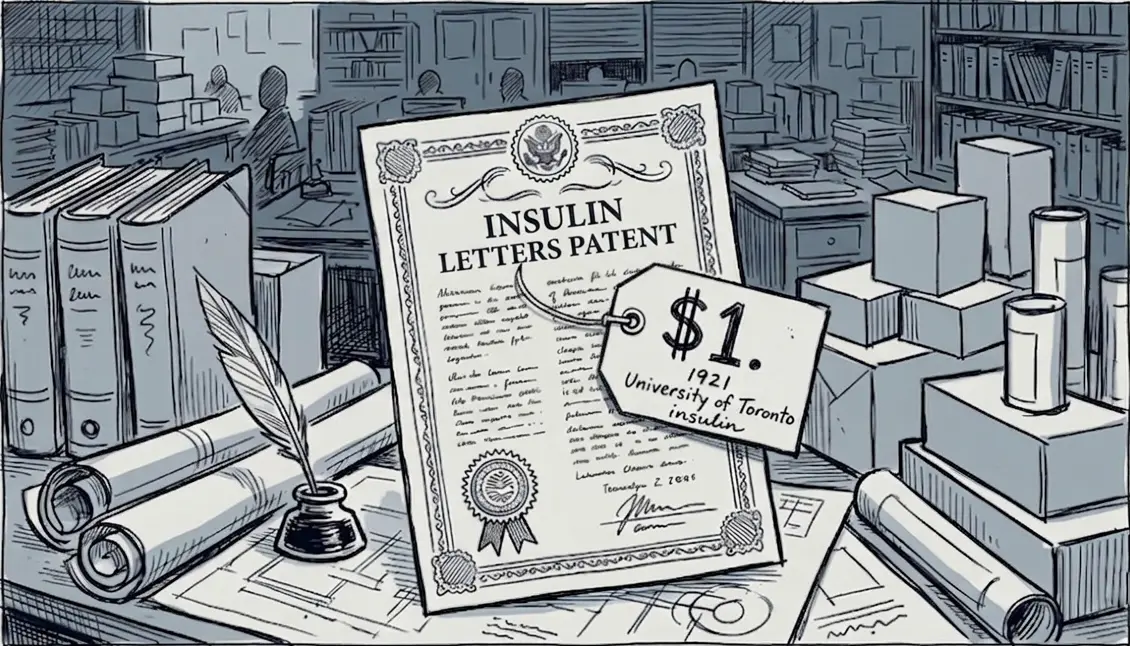
The federal government has invested more than $900 billion cumulatively in the National Institutes of Health since 1938. That investment produced the foundational science underlying virtually every major pharmaceutical compound on the market. The Bayh-Dole Act of 1980 gave universities and private companies the right to patent those discoveries and charge what the market would bear. The public paid for the basic research. It paid again at the pharmacy. Built into Bayh-Dole were march-in rights — the explicit statutory authority for the federal government to license a federally funded patent to competing manufacturers when the patent holder is not making the invention available on reasonable terms. March-in rights have never been exercised once in forty-five years. Not for insulin, rationed by Americans at $300 to $400 per vial for a drug that costs $2 to $6 to manufacture, whose patent was sold to the University of Toronto in 1921 for one dollar so it would be available to everyone who needed it. The royalty mechanism existed. It was built into the law. It has never been used.
The commons expanded into intelligence itself
The AI industry’s current valuation is measured in trillions. It was built on a foundation assembled with public money over fifty years — the DARPA-funded research, the public university laboratories, the publicly funded internet infrastructure, and the accumulated written output of human civilization scraped, ingested, and productized without payment to the people who produced it.
Common Crawl, the nonprofit that organized the public internet into training datasets used by every major AI model, received $250,000 each from Anthropic and OpenAI in 2023 — for datasets worth billions in commercial value. The Books3 dataset used to train multiple AI models contained over 196,000 books whose authors were never contacted, never paid, and in most cases never notified. OpenAI acknowledged to the House of Lords that it would be impossible to train today’s leading AI models without using copyrighted materials. The material was used regardless.
The human genome is the same argument at the most fundamental scale. The Human Genome Project was publicly funded — a thirteen-year, $3 billion international collaboration completed in 2003 — and the sequence was deliberately placed in the public domain to prevent private patenting of the human genetic code. The downstream application of genomic knowledge — the diagnostic tools, the drug targets, the personalized medicine built on the public sequence — has flowed predominantly into private hands through the same Bayh-Dole mechanism that governs the rest of the NIH portfolio. The most universal inheritance in the history of biology — the genetic sequence shared by every human being — was built into a commons deliberately and has been converted into private commercial infrastructure in the decades since.
The inversion of the original bargain
The public funded the internet, the GPS constellation, the pharmaceutical knowledge base, and the AI training foundation. No royalty was collected on its behalf for any of it. The industries that inherited those foundations — and the trillions in annual revenue they generate — now fund the political apparatus that determines whether a royalty mechanism will ever be built. The people who paid for the foundation are taxed on their labor to fund the government that manages it, while the people who took the foundation shape the government’s decisions about what it is owed.
The original bargain — the public owns the commons, the commons funds the government, the government serves the public — was inverted. What replaced it is the arrangement this series documents.
What the through-line is
Morrill Act. DARPA. GPS. NIH. The internet. The human genome. These are not technology stories or education stories or pharmaceutical stories. They are the same story as the land grant and the railroad grant and the Mining Law — the public commons, built through collective investment, transferred to private hands at terms the public never set, in rooms the public never entered, by people with a specific interest in the outcome.
The commons kept expanding. The transfer logic kept pace with it. Block 10 documents the balance sheet. The mechanism blocks in between show how the room that managed the transfer was protected so the accounting would never arrive.
Sources
1. Morrill Act of 1862. Pub.L. 37-108. 17.4 million acres. https://www.congress.gov/bill/37th-congress/senate-bill/130 — National Archives Milestone Documents confirms 17,400,000 acres.
2. Hatch Act of 1887. Pub.L. 49-541. https://www.congress.gov/bill/49th-congress/senate-bill/372
3. Smith-Lever Act of 1914. Pub.L. 63-95. https://www.congress.gov/bill/63rd-congress/senate-bill/2884
4. GI Bill (Servicemen’s Readjustment Act of 1944). Pub.L. 78-346. 8 million veterans. https://www.congress.gov/bill/78th-congress/senate-bill/1767
5. DARPA / ARPANET 1969. DARPA official history. https://www.darpa.mil/about/history/darpa-and-the-internet
6. Internet privatization 1995. NSF backbone transfer history. https://www.nsf.gov/news/news_summ.jsp?cntn_id=103050
7. GPS — $12 billion initial cost, $1.4 trillion economic value 1984–2017. RTI International, 2019. https://www.rti.org/publication/economic-benefits-global-positioning-system-gps/fulltext.pdf
8. NIH cumulative investment $900 billion+. NIH Office of Budget. https://officeofbudget.od.nih.gov/approp_hist.html
9. Bayh-Dole Act. Pub.L. 96-517 (1980). 35 U.S.C. § 203 (march-in rights). https://www.congress.gov/bill/96th-congress/senate-bill/414 — March-in rights never exercised: GAO-09-742. https://www.gao.gov/products/gao-09-742
10. Insulin — $300–$400/vial, $2–$6 manufacturing cost. University of Toronto patent sale 1921: historical record.
11. Common Crawl $250,000 donations from Anthropic and OpenAI 2023. ⚠ Primary source required — verify against primary reporting.
12. Books3 dataset — 196,000 books. ⚠ Primary source required — verify against primary reporting.
13. OpenAI House of Lords testimony on copyrighted materials. House of Lords Communications and Digital Committee, 2023. https://committees.parliament.uk/work/6986/large-language-models/publications/
14. Human Genome Project — $3 billion, 13 years, completed 2003, public domain release. National Human Genome Research Institute. https://www.genome.gov/human-genome-project
Block 1, Article 3. © 2026 Steve Sagnotti.
Leave a Reply