Block 2, Article 4
© 2026 Steve Sagnotti.
The previous three articles documented two frozen rooms — how they were built, how the locks were installed, why neither can fix itself. The question this article answers is simpler: what were they protecting?
The room that already knew
The people who froze the House in 1929 were not operating in ignorance. The conservation argument had been made, published, and institutionalized for thirty years before they voted.
By the 1890s the evidence of depletion was already visible. Wild turkey populations had fallen from approximately 10 million to 200,000. Elk from 10 million to 100,000. Theodore Roosevelt and Gifford Pinchot spent the first decade of the 20th century building a federal conservation apparatus — the Forest Service, the national parks, the Antiquities Act — explicitly premised on the recognition that the old abundance frame was wrong.
Pinchot named it directly in 1910, in The Fight for Conservation: “As a people, we have been in the habit of declaring certain of our resources to be inexhaustible. To no other resource more frequently than coal has this stupidly false adjective been applied.” He was not speaking only of coal. The same chapter named soil waste, forest denudation, and water loss as compounding crises in progress.
The members of Congress who voted to freeze the House nineteen years later had lived through all of it. The finite nature of the commons was not a secret. The freeze did not happen because the political class still believed the continent was inexhaustible. It happened because a reapportioned, urban-majority House would eventually revisit the legal architecture that protected below-market extraction rates — and the people in the room in 1929 knew it.
The freeze was not ignorance. It was a decision made by people who already knew what Pinchot had said and chose to protect the arrangement anyway.
What a frozen room will not do
The record of what the frozen room protects is not theoretical. It is current and specific.
In March 2025, Representative Bruce Westerman of Arkansas — Chair of the House Natural Resources Committee — made his first stock purchases since entering Congress in 2015. He bought approximately $1.6 million in oil and gas company shares: BP, ConocoPhillips, ExxonMobil, Shell.
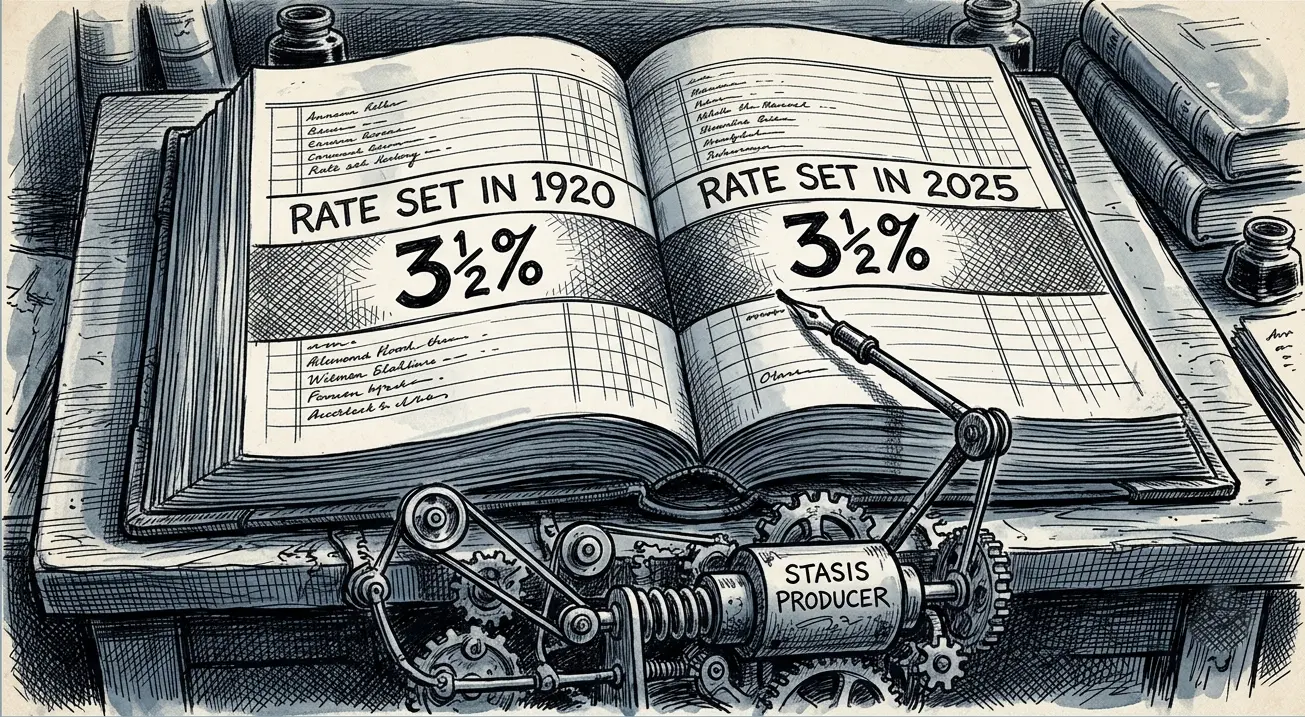
Two months later, his committee advanced the reconciliation package that became the One Big Beautiful Bill Act, signed July 4, 2025. The bill cut coal royalty rates from 12.5 percent to 7 percent through 2034. It rolled back oil and gas royalty rates from 16.67 percent back to 12.5 percent — the rate set in 1920. It mandated quarterly lease sales on federal lands. It rescinded old-growth forest protection funding.
Wyoming produces the majority of the nation’s federal coal and receives approximately half of federal coal royalty payments. The royalty rate cut will cost Wyoming an estimated $50 million annually. State lawmakers said they were blindsided. One noted: “If in fact this Big Beautiful Bill is going to cost us $50 million, I know that was not the intent.”
It was the intent. The room that voted for it is composed of 435 members serving an average of 747,000 constituents each, drawn into districts by legislatures that had no compactness requirements to follow, funded by industries whose rates the committee chairs are simultaneously trading. The mining royalty has stood at zero since 1872. The grazing fee is frozen at 1966 levels. The oil royalty just went back to 1920. The room will not revisit these arrangements. Not cannot. Will not.
Westerman disclosed the trades under the STOCK Act. The fine for late disclosure: $200. Less than a good dinner out. The trade: $1.6 million.
The federal deficit in 2025 was $1.8 trillion. The Congressional Budget Office projects the national debt will reach $56 trillion by 2036. When that debt is invoked as the reason nothing can be funded — no infrastructure, no social programs, no investment in what the public needs — the answer is not complicated. The deficit is framed as a spending problem: programs to cut, benefits to trim, entitlements to means-test. The revenue the government never charged for the public’s own resources doesn’t show up in that frame. The 1872 Mining Law charges zero royalty on federal hardrock minerals. The oil and gas royalty just went back to 12.5 percent, half of what Texas charges on its own state lands and less than what Alaska charges on North Slope production. Texas and Alaska are the two largest oil-producing states in the country. Both charge more than the federal government for extracting resources from land they own. The comparison is not ideological. It is accounting. The grazing fee is $1.69 per animal unit month against a market rate of over $23. The spectrum given to broadcasters at no charge for sixty-five years was worth an estimated $200 billion. Charge market rates on the public’s resources and the revenue exists. The room will not do it. The room that created the deficit by protecting the giveaways is the same room that points at the deficit to justify not fixing them.
The nail
The chain from 1929 to 2025 is not a series of coincidences. It is a single mechanism running forward.
Benjamin Franklin published the verse in Poor Richard’s Almanack in 1758: For want of a nail the shoe was lost. For want of a shoe the horse was lost. For want of a horse the rider was lost. For want of a rider the battle was lost. For want of a battle the kingdom was lost. And all for the want of a horseshoe nail.
The compactness requirements dropped in the same 1929 act that froze the House — barely noticed, never debated separately, never restored — compounded into ninety-five years of engineered maps. The maps compounded into locked committees. The locked committees compounded into royalty rates that have not been revised in over a century. The royalty rates compounded into the depletion documented in Block 10. The aquifer dropping a foot a year compounded into the communities already drilling deeper and finding less.
Each link looked manageable at the time. The compactness requirements were procedural housekeeping. Congress set the 1920 royalty rate at what seemed like a reasonable number. The first congressional hearing on reapportionment went nowhere, and then the next one, and then the question stopped being asked for sixty years.
The shoe was not lost when the nail fell out. The shoe was lost after the horse had traveled some distance on a shoe working itself loose. By the time anyone noticed, the sequence was already running. Pinchot had named it in 1910. The people in the room had read him. They froze the room nineteen years later.
That is what the frozen rooms produced: not dysfunction. A result. Specific, compounding, and — for the people the room was built to serve — entirely predictable.
The Frozen Room — Verification
These questions can be answered with public records. The links are live.
| The royalty rate the federal government charges for coal, oil, and gas extracted from public land | https://www.blm.gov/programs/energy-and-minerals | Why is the federal rate lower than what Texas and Alaska charge on their own state land? |
| Your representative’s stock holdings and recent trades | https://disclosures.house.gov | Did they hold energy industry positions when they voted on the One Big Beautiful Bill royalty provisions? |
| The size of your congressional district versus the founding standard | https://www.census.gov/topics/public-sector/congressional-apportionment.html | Do they support the Wyoming Rule — expanding the House so no district exceeds the population of the smallest state? |
Sources
1. Gifford Pinchot. The Fight for Conservation. 1910. Chapter I. https://www.gutenberg.org/files/11238/11238-h/11238-h.htm — Verified primary source.
2. Wildlife population figures — wild turkey 10M → 200K; elk 10M → 100K by 1890. PERC, June 2019. https://www.perc.org/2019/06/06/the-north-american-model-of-wildlife-conservation/
3. Westerman stock purchases — $1.6M in BP, ConocoPhillips, ExxonMobil, Shell, March 2025. Arkansas Times, May 9, 2025 (paywall). HuffPost/Public Domain, May 12, 2025. https://publicdomain.media/p/bruce-westerman-stocks
4. One Big Beautiful Bill Act. H.R. 1, P.L. 119-21. Signed July 4, 2025. BLM press release July 22, 2025: https://www.blm.gov/press-release/interior-department-announces-actions-implement-one-big-beautiful-bill
5. Wyoming $50M annual coal royalty revenue loss. Wyoming Public Media, August 15, 2025. https://www.wyomingpublicmedia.org
6. STOCK Act $200 fine. 5 U.S.C. app. § 101 et seq. https://www.congress.gov/bill/112th-congress/senate-bill/2038
7. Federal deficit FY2025 — $1.8 trillion. CBO Monthly Budget Review: Summary for Fiscal Year 2025, November 2025. https://www.cbo.gov/publication/61307
8. CBO national debt — $56 trillion by 2036. CBO, “The Budget and Economic Outlook: 2026 to 2036,” February 11, 2026. https://www.cbo.gov/publication/62105
9. Texas oil royalty rate on state land — 25%. Texas GLO Oil & Gas Royalty Reporting Manual. https://rrac.glo.texas.gov/assets/forms/instructions/oil-and-gas-reporting-manual.pdf
10. Alaska North Slope royalty rate — 16.67% (Beaufort Sea / North Slope North Sub-Region). Alaska DNR, Division of Oil & Gas, 2025 Areawide Lease Sale Notice. https://aws.state.ak.us/OnlinePublicNotices/Notices/View.aspx?id=221056
11. General Mining Law of 1872 — zero royalty on hardrock minerals. 30 U.S.C. § 21 et seq. https://uscode.house.gov/view.xhtml?path=/prelim@title30/chapter2&edition=prelim
12. BLM Grazing Fee 2026 — $1.69/AUM. https://www.blm.gov/press-release/blm-usda-forest-service-announce-2026-grazing-fees — USDA NASS private rate $23+: https://www.nass.usda.gov/Statistics_by_Subject/index.php?sector=ECONOMICS
13. Spectrum $200B estimate. CTIA / Broadband Breakfast, February 8, 2024. https://broadbandbreakfast.com/potential-200-billion-loss-for-u-s-economy-without-global-spectrum-harmonization-report/ — Note: figure represents projected economic cost of spectrum misalignment, not historical valuation of broadcaster licenses.
14. Franklin, Benjamin. Poor Richard’s Almanack, 1758. Historical record.
Block 2, Article 4. © 2026 Steve Sagnotti.
Leave a Reply